
Deck builders design and build outdoor living spaces: new decks, rebuilds of old ones, stairs, railings, pergolas, built-in seating and lighting. Homeowners invest in decks to enjoy their homes and add value, and a builder known for safe, beautiful work can stay busy through referrals. This guide explains how to start a deck building business, from licensing and startup costs to pricing and finding customers.
Decks look simple, but they’re structures that carry people high off the ground. Deck collapses often happen where the deck attaches to the house, so building to code, with proper ledger attachment, flashing, footings and guards, is essential. Nearly every jurisdiction requires a permit and inspections for decks.
A deck building business at a glance
Table of Contents
| Topic | What to expect |
|---|---|
| Startup cost | Moderate: truck and trailer, carpentry tools, insurance, licensing and design software |
| Key rules | Contractor licensing, permits and inspections, building codes, fall protection, lead-safe rules on older homes |
| Revenue model | Priced per project, often estimated per square foot, plus upgrades |
| How you earn | New decks, rebuilds, railings, stairs, pergolas and repairs |
| Best for | Skilled carpenters who enjoy design, structure and working with homeowners |
Who deck building suits
It suits experienced carpenters who understand structure, enjoy design and can manage projects from permit to final inspection. Good communication matters, since homeowners rely on you to explain materials, costs and what’s required by code.
Services to offer
- New decks in pressure-treated wood, cedar, hardwood or composite.
- Deck rebuilds and replacements, including inspecting and replacing failing structures.
- Railings, stairs and gates.
- Pergolas, built-in benches, planters and privacy screens.
- Deck lighting, coordinated with a licensed electrician where wiring is needed.
- Repairs, board replacement and safety inspections.
Licensing, permits and inspections
Check contractor licensing with your state and city: many states license general or specialty contractors, some require registration for home improvement work, and others license above a project value. Most cities require a business license, and many projects need a building permit and inspections. Carry general liability and commercial auto insurance, get workers’ compensation once you hire (some states require it even for small crews), and put scope, price, schedule, payment terms and change-order rules in a written contract. Many states require specific contract terms and a right to cancel for home improvement contracts signed at a customer’s home, under state law and the FTC’s Cooling-Off Rule.
Decks nearly always need a building permit, with inspections typically of footings before concrete, framing and the final deck. Pull permits in the homeowner’s or your name as local rules require, and never skip inspections.
Building codes and DCA 6
Most jurisdictions use the International Residential Code (IRC), published by the International Code Council, which includes deck requirements, sometimes with local amendments. The American Wood Council’s DCA 6, Prescriptive Residential Wood Deck Construction Guide, explains how to build common decks to code, including footing sizes, beam and joist spans, ledger attachment, lateral load connections, guards and stairs. Many building departments accept it for permit plans.
The ledger: where decks fail
The ledger board that attaches a deck to the house is where many collapses start. Attach ledgers with code-compliant fasteners (such as through-bolts or approved structural screws) into the house’s rim joist, never just nails, and never to brick veneer or siding alone. Install proper flashing to keep water out of the house framing and ledger, since rot causes failures. Where a ledger can’t be attached safely, build a freestanding deck.
Footings, guards and stairs
Set footings below the local frost line and size them for the loads. Under the IRC, decks more than 30 inches above grade generally need guards at least 36 inches high (higher in some places), with openings small enough to stop a child from slipping through. Stairs need consistent risers and treads, graspable handrails and lighting. Check your local code for the exact requirements.
Safety on the job
Construction work six feet or more above a lower level requires fall protection under OSHA rules, such as guardrails, safety nets or personal fall arrest systems, and ladders and scaffolds must be used safely. On homes built before 1978, disturbing painted surfaces (such as removing an old painted deck attached to the house) can trigger the EPA’s lead-safe Renovation, Repair and Painting (RRP) rules, which require a certified firm and lead-safe practices.
Materials
Pressure-treated lumber is the most common framing material, with ground-contact rated lumber where required, and corrosion-resistant fasteners and connectors rated for treated wood. For decking, homeowners choose between treated wood, cedar, tropical hardwoods and composite or PVC boards, which cost more but need less maintenance. Follow manufacturers’ installation instructions to keep warranties valid.
Design and pricing
Use deck design software to show homeowners 3D designs and material options. Price by project, estimated from square footage, height, complexity, materials, stairs, railings and extras, plus permits and removal of old decks. Collect deposits, with progress payments tied to milestones. Use our pricing calculator.
Rebuilds and deck inspections
Many older decks were built before modern codes and are now unsafe, with nailed ledgers, rotted posts, corroded fasteners or loose railings. Offering deck safety inspections is a good way to win rebuild work: check the ledger and flashing, posts and footings, joists and beams, fasteners and connectors, guards and stairs. Give homeowners a written report with photos and recommendations, and explain clearly when repairs are enough and when a rebuild is safer.
When you rebuild, check whether the old footings and framing can be reused under current codes, or whether everything needs replacing. Removing an old deck can uncover hidden rot in the house’s rim joist, so include contingency terms in your contract.
Maintenance plans
Wood decks need cleaning and sealing every few years, and composite decks need occasional cleaning. Offering annual maintenance and inspection plans brings repeat income in quieter months and keeps you in touch with customers who’ll call you for their next project or refer friends.
Working with subcontractors
Many deck projects include work outside carpentry: electrical wiring for lighting and outlets, gas lines for fire features and grills, and concrete or stone patios below the deck. Use licensed subcontractors for electrical and gas work, check their insurance, and include their work and permits in your schedule and contract, so the homeowner has one clear plan.
Startup costs for a deck building business
| Item | What to budget for |
|---|---|
| Truck and trailer | Work truck and materials trailer |
| Carpentry tools | Saws, drills, impact drivers, levels, post hole tools |
| Design software | For layouts and 3D drawings |
| Insurance | General liability, commercial auto, workers’ compensation |
| Licensing and RRP | Contractor license, and RRP certification if working on older homes |
| Marketing | Website, photos and reviews |
Use our startup cost calculator for your total.
A worked example: a deck builder with a small crew
These are illustrative assumptions for a deck builder with a two-person crew, not predictions.
| Assumption | Monthly | |
|---|---|---|
| New decks and rebuilds | 3 projects averaging $14,000 | $42,000 |
| Repairs, railings and small projects | $4,000 | |
| Revenue | $46,000 | |
| Lumber, decking and hardware | $(18,400) | |
| Crew wages and payroll costs | 2 workers | $(10,200) |
| Permits and inspection fees | $(900) | |
| Truck, trailer and fuel | $(1,200) | |
| Insurance and licensing | $(1,100) | |
| Marketing and design software | $(1,000) | |
| Profit before owner pay and taxes | $13,200 |
That leaves about $13,200 a month before the owner’s pay and taxes, on about $46,000 of revenue in peak season. Composite decks and add-ons such as lighting and pergolas raise average job value.
Winning work
- Homeowners through your website, Google Business Profile and photos.
- Referrals from neighbors who see your decks.
- Home builders and remodelers who subcontract decks.
- Home inspectors and real estate agents who spot failing decks.
- NADRA membership and manufacturer installer programs.
Common mistakes to avoid when starting a deck building business
- Nailing ledgers instead of using approved fasteners.
- Skipping flashing.
- Building without permits or inspections.
- Shallow footings above the frost line.
- Guards that are too low or have wide gaps.
Your first 90 days as a deck building business owner
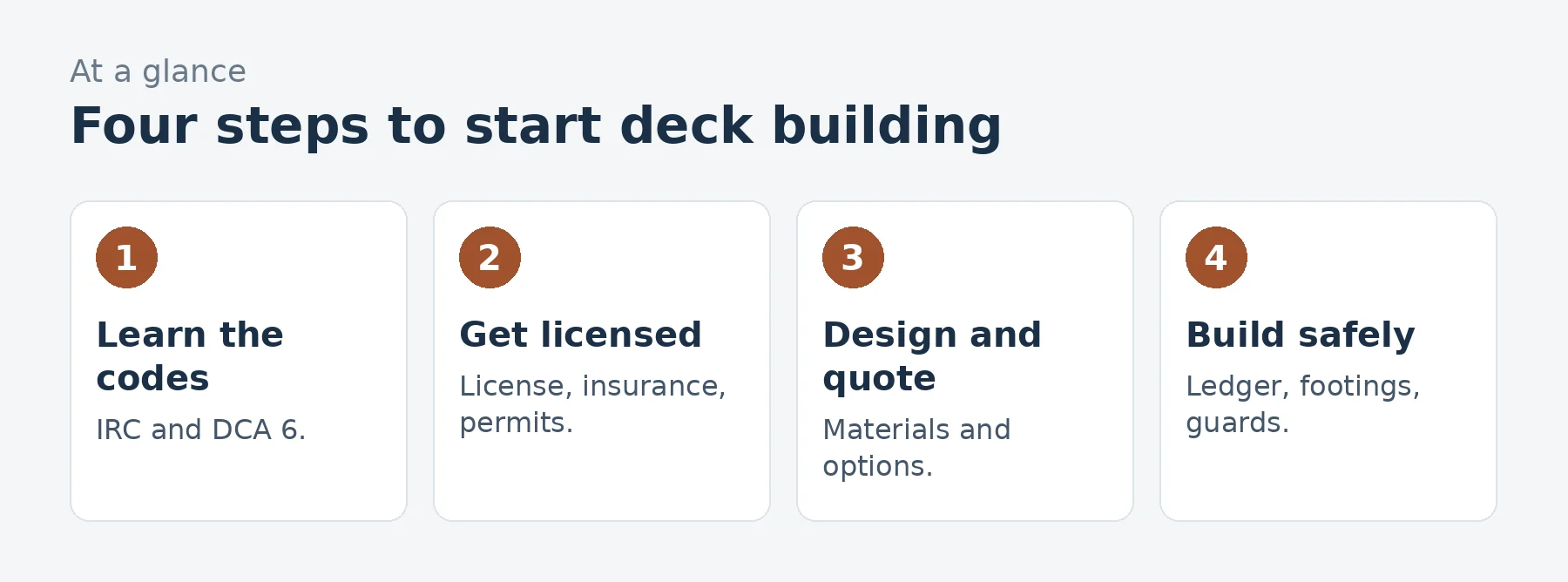
- Days 1-30: study the IRC and DCA 6, get licensed, insured and RRP-certified if needed.
- Days 31-60: set up suppliers and design software, build a portfolio and start quoting.
- Days 61-90: complete first projects, pass inspections, and collect reviews and referrals.
Frequently asked questions about starting a deck building business
Do decks need a permit?
Almost always; most jurisdictions require permits and inspections for decks.
What is DCA 6?
The American Wood Council’s prescriptive guide to building common residential wood decks to code.
Why do decks collapse?
Often because of poor ledger attachment, missing flashing and rot, or inadequate footings and connections.
How high must deck railings be?
Under the IRC, guards are generally at least 36 inches high for decks more than 30 inches above grade; check local codes.
Is composite decking better?
It needs less maintenance but costs more; many homeowners choose it for durability.
Do I need lead-safe certification?
Yes, for work disturbing painted surfaces on pre-1978 homes under the EPA’s RRP rule.
How do deck builders price?
Usually per project, estimated from size, height, materials and extras.
What is NADRA?
The North American Deck and Railing Association, the industry group for deck builders.
Should I offer deck inspections?
Yes; inspections help homeowners stay safe and often lead to repair and rebuild work.
Can deck builders install lighting?
Low-voltage lighting is often simple, but line-voltage wiring should be done by a licensed electrician.
Keep learning
- Fencing and decks industry data
- How to start a fence installation business
- How to start a hardscaping business
- Pricing calculator
Sources
- American Wood Council, DCA 6: Prescriptive residential wood deck construction guide
- International Code Council (ICC), International Residential Code
- North American Deck and Railing Association (NADRA)
- OSHA, Fall protection
- EPA, Lead Renovation, Repair and Painting (RRP) program
- US Small Business Administration, Apply for licenses and permits
Last reviewed November 7, 2026. Startup costs are estimates; check local prices, licensing and tax rules before you commit money.

