
A youth sports league organizes teams, schedules, coaches, referees and fields so children can play: soccer, basketball, baseball and softball, flag football, volleyball, lacrosse and more. Leagues may be recreational (everyone plays, community focus) or competitive (travel teams and tournaments), and many are run as nonprofits by parents and community leaders.
Safety comes first. Leagues must protect children from abuse with background checks and SafeSport practices, follow state concussion laws and plan for emergencies, while managing fields, insurance and volunteers. Advanton’s sports and recreation data shows a median pay of $35,380 for recreation workers (May 2024), across about 327,700 jobs with employment projected to grow about 4%; owners earn the profit after staff, facilities and insurance. This guide covers structure, safety rules, fields, insurance, volunteers, fees, a worked budget example and a 90-day plan.
A youth sports league at a glance
Table of Contents
| Topic | What to expect |
|---|---|
| Startup cost | Moderate: insurance, field or gym permits, equipment, uniforms, registration software, background checks and referee fees |
| Structure | Often a nonprofit (501(c)(3)); some leagues and clubs are for-profit businesses |
| Key safety rules | Background checks, SafeSport requirements for many organizations, mandatory abuse reporting and state concussion laws |
| How it is funded | Registration fees, sponsorships, fundraising, concessions and grants, with scholarships for families in need |
| Best for | Organized community builders who love the sport and put children’s safety first |
Who a youth league suits
It suits organized people who love the sport and their community, and who can coordinate many volunteers, parents and schedules. Communication and fairness matter as much as sports knowledge.
Nonprofit or for-profit
Most community recreational leagues operate as nonprofits, often seeking 501(c)(3) status, which allows tax-deductible donations and access to grants, and is governed by a volunteer board. Competitive clubs and training-based programs are sometimes for-profit businesses. Choose a structure early, since it affects funding, governance and insurance.
Affiliating with a national organization
Many leagues affiliate with a national organization or governing body for their sport, which can provide rules, coach education, background check systems, insurance programs and tournament pathways. Affiliation often brings SafeSport requirements and standard policies.
Protecting children
Working with young athletes brings serious responsibilities. The federal SafeSport Authorization Act requires many amateur sports organizations to report suspected child abuse, train adults who work with minors and limit one-on-one interactions; organizations affiliated with national governing bodies follow U.S. Center for SafeSport policies. State laws also make many adults mandatory reporters of suspected abuse. Run background checks on every coach, staff member and volunteer, follow two-adult rules and give parents clear policies.
Concussion and health safety
Every state has a youth sports concussion law, typically requiring education for coaches, parents and athletes, removal from play when a concussion is suspected and written clearance from a health care provider before returning. The CDC’s free HEADS UP training and NFHS courses on concussion, heat illness and sudden cardiac arrest are widely used. Keep an emergency action plan, first aid supplies and, ideally, an AED at practices and games.
Fields and facilities
Leagues usually rent fields and gyms from cities, parks departments and school districts through facility use permits, which often require insurance certificates, schedules and rules on lights, parking and cleanup. Apply early, since popular fields book quickly.
Insurance and volunteers
Carry general liability insurance, accident coverage for players, directors and officers coverage for nonprofit boards and coverage required by facility permits. The federal Volunteer Protection Act limits certain liability for volunteers of nonprofits acting in good faith, but it does not protect the organization itself or cover gross negligence, so insurance remains essential.
Startup costs to plan for
| Item | What to budget for |
|---|---|
| Insurance | Liability, accident, directors and officers |
| Facilities | Field and gym permits |
| Equipment and uniforms | Balls, goals or bases, jerseys |
| Safety | Background checks, training, first aid kits, AED |
| Registration system | Online registration, waivers, payments |
| Referees and officials | Per-game fees |
Use our startup cost calculator for your total.
Registration fees
Set fees to cover fields, referees, uniforms, insurance and administration, with a scholarship fund so cost does not keep children from playing. Offer sibling discounts and payment plans, and publish what fees include. Use our pricing calculator to set fees from your budget.
A worked budget example: one season
These are illustrative assumptions for one season of a recreational league with 320 players, not predictions.
| Assumption | Monthly | |
|---|---|---|
| Registration fees | 320 players at $140 | $44,800 |
| Sponsorships and fundraising | $6,000 | |
| Revenue | $50,800 | |
| Scholarships | Fee waivers for families in need | $(3,500) |
| Field and gym permits | $(9,000) | |
| Referees | $(8,500) | |
| Uniforms and equipment | $(9,600) | |
| Insurance | Liability and accident coverage | $(4,200) |
| Registration software, background checks and training | $(3,000) | |
| Trophies, events and supplies | $(2,500) | |
| Profit before owner pay and taxes | $10,500 |
That leaves about $10,500 for the season before any paid staff, on about $50,800 of revenue. Nonprofit leagues reinvest surplus into fields, equipment and scholarships; for-profit leagues and clubs pay staff and owners from it.
Loading the calculator…
Recruiting and training coaches
Most recreational coaches are parent volunteers. Screen them with background checks, require safety training (SafeSport where applicable, concussion and emergency training), give them practice plans and a coaching guide and pair new coaches with experienced ones. Good coaching keeps kids coming back.
Running the season
- Open registration with clear dates, fees and policies.
- Form teams fairly by age and skill level.
- Schedule practices and games around field permits.
- Train coaches and referees before the season.
- Communicate weekly with families.
- Hold an end-of-season celebration and survey families.
Sponsors and fundraising
Local businesses sponsor teams and leagues for community visibility on jerseys, banners and websites. Fundraisers, concessions and grants for youth activity programs help keep fees affordable.
Board and governance
Nonprofit leagues are governed by a board responsible for finances, policies and safety. Adopt bylaws, conflict of interest and safety policies, keep financial records transparent and rotate responsibilities so the league does not depend on one person.
Referees and officials
Recruit referees through local referee associations or train young officials, pay them fairly and protect them from abuse by coaches and spectators. Referee shortages are common, and leagues that respect officials keep them.
Parent and spectator conduct
Publish a code of conduct for parents, coaches and spectators, explain it at registration and enforce it consistently. Positive sideline behavior protects children’s experience and keeps volunteers and referees involved.
Recreational and competitive tracks
Many leagues offer a recreational program where every child plays plus competitive or travel teams for advanced players. Competitive teams need tryout policies, higher fees, travel planning and additional coach qualifications.
Registration and data privacy
Registration systems collect children’s names, birthdates, medical information and parent contacts. Choose secure software, limit who can see medical details and share only what coaches need, such as allergies and emergency contacts.
Common mistakes to avoid
- Skipping background checks for volunteers.
- Allowing one-on-one adult and child situations.
- No concussion protocol or return-to-play clearance.
- Applying for fields too late.
- Fees that exclude families without scholarships.
Your first 90 days
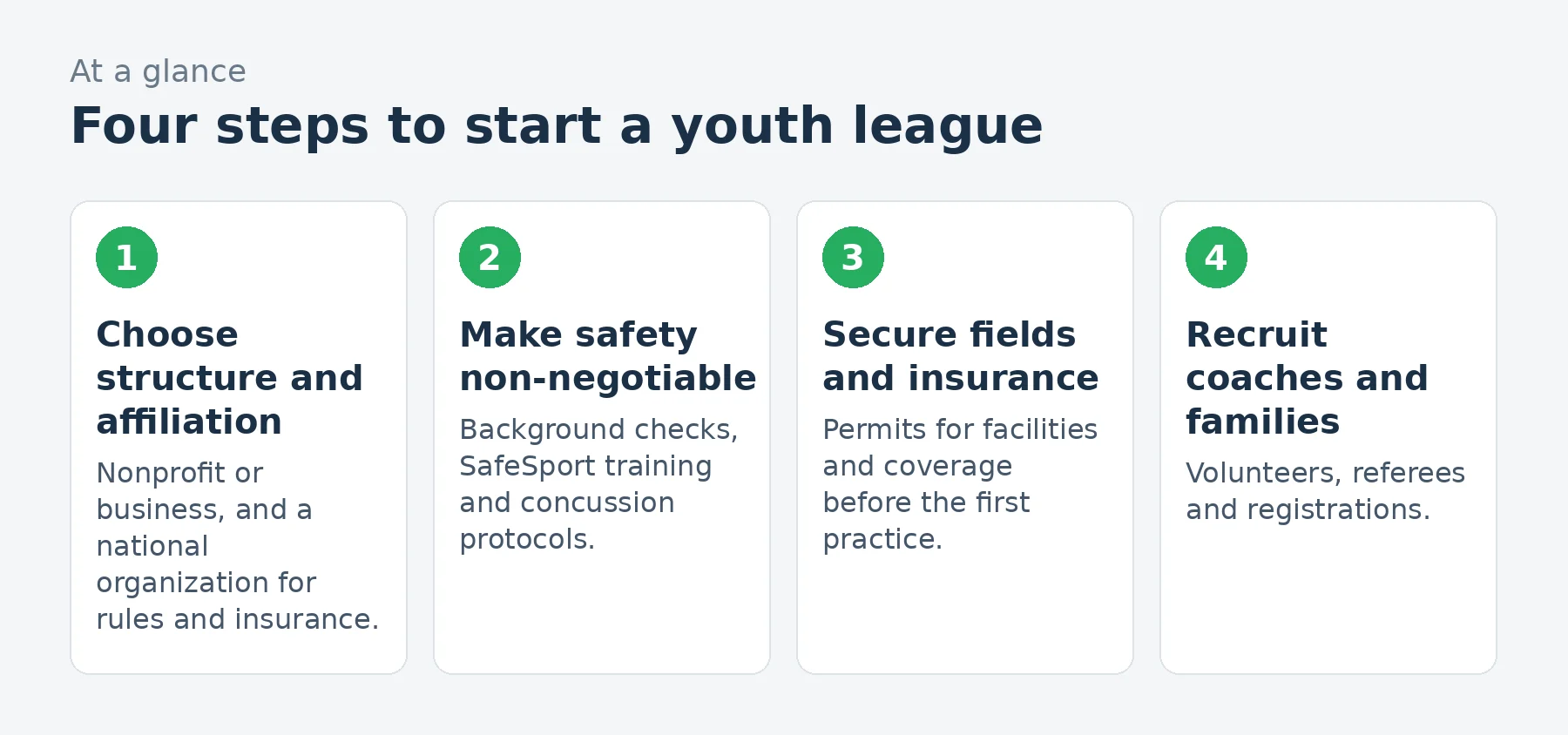
- Days 1-30: choose the sport, structure and affiliation, form a board and set safety policies.
- Days 31-60: secure insurance and field permits, set fees and open online registration.
- Days 61-90: recruit and screen coaches, train them in safety and run a preseason event for families.
Frequently asked questions
Do youth sports leagues need background checks?
Yes. Background checks for coaches, staff and volunteers are essential and often required by affiliations and insurers.
What is SafeSport?
Policies under the federal SafeSport Authorization Act requiring many amateur sports organizations to report abuse, train adults and limit one-on-one interactions with minors.
What do concussion laws require?
Generally education, removal from play when a concussion is suspected and written clearance before returning.
Should a youth league be a nonprofit?
Many community leagues are nonprofits, which helps with donations and grants; competitive clubs are sometimes for-profit.
Does the Volunteer Protection Act protect my league?
It limits certain liability for individual volunteers of nonprofits, but not the organization, so insurance is still needed.
How do leagues get fields?
Through facility use permits from cities, parks and school districts, usually with insurance certificates.
How much should youth league registration cost?
Enough to cover fields, referees, uniforms and insurance, with scholarships available; publish what fees include.
Do youth league coaches need training?
Yes. Safety training on abuse prevention, concussions and emergencies, plus basic coaching education, is strongly recommended and often required.
Can a youth league be run by volunteers only?
Many are, with a volunteer board and parent coaches; larger leagues often add paid administrators.
What insurance does a youth league need?
General liability, accident coverage for players, directors and officers coverage for nonprofit boards and coverage required by facility permits.
How do leagues handle concussions?
Remove any player with a suspected concussion from play and require written clearance from a health care provider before returning, as state laws require.
Keep learning
- Sports and recreation industry data
- How to start a sports coaching business
- How to start a batting cage or training facility
- Pricing calculator
Sources
- U.S. Center for SafeSport, Protecting athletes and the SafeSport Authorization Act
- CDC, State laws on youth sports concussions
- CDC, HEADS UP concussion training for youth sports
- NFHS Learn, Free coaching courses (concussion, heat illness, sudden cardiac arrest)
- Volunteer Protection Act of 1997 (42 U.S.C. 14501 and following)
- IRS, Applying for 501(c)(3) tax-exempt status
Last reviewed November 3, 2026. Startup costs are estimates; check local prices, licensing and tax rules before you commit money.

