
An independent financial advisor practice helps individuals and families plan their finances and manage investments: retirement planning, investment management, tax-aware strategies, education saving, insurance reviews and estate coordination. Many advisors launch their own registered investment adviser (RIA) firm after years at a bank, brokerage or larger firm.
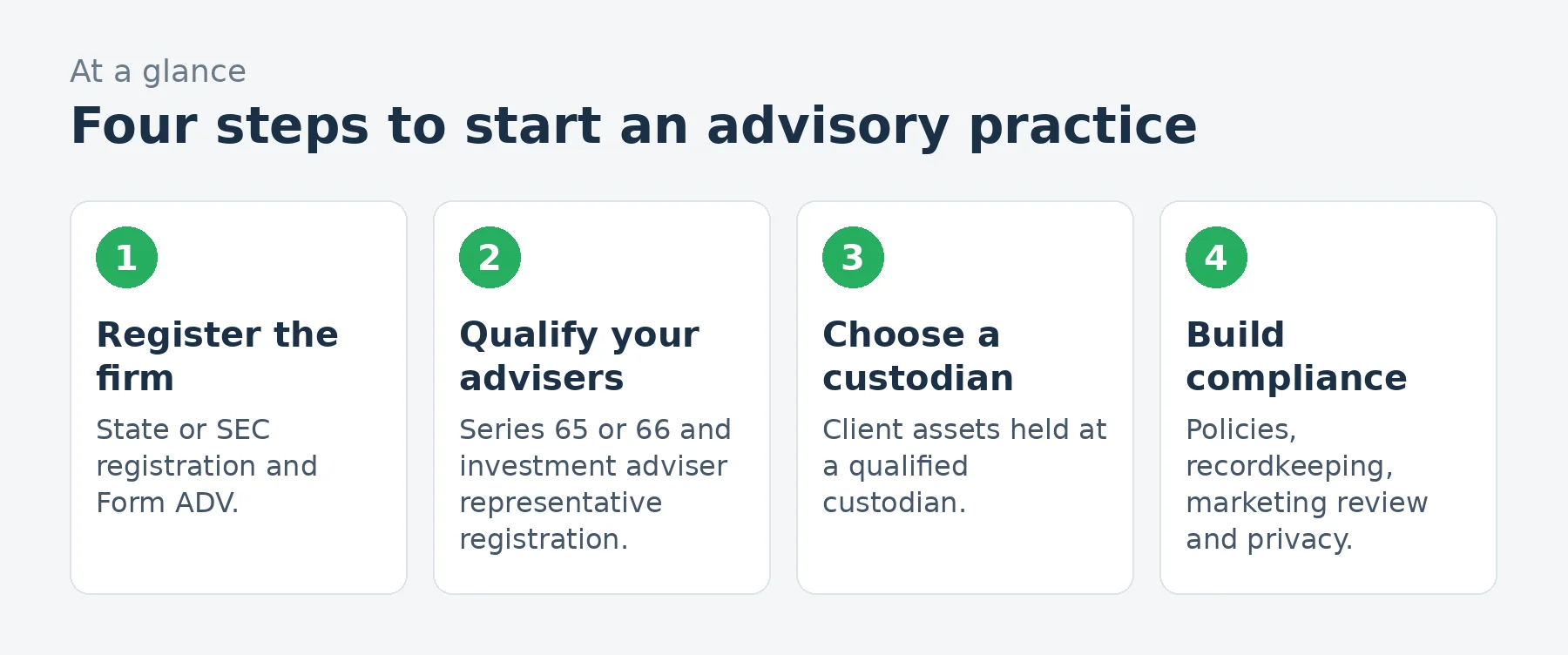
Giving investment advice for pay is regulated. Most new firms register with their state securities regulator, while larger firms (generally those managing $100 million or more) register with the SEC. Advisers file Form ADV, pass qualification exams such as the Series 65 and act as fiduciaries to clients. The Bureau of Labor Statistics reports a median pay of $102,140 for personal financial advisors (May 2024), with employment projected to grow about 10%. This guide covers registration, exams, compliance, fee models, technology, a worked example and a 90-day plan.
A financial advisor practice at a glance
Table of Contents
| Topic | What to expect |
|---|---|
| Startup cost | Moderate: registration and compliance setup, custodian relationships, planning and portfolio software, insurance and marketing |
| Registration | State registration for most new firms; SEC registration generally at $100 million or more in assets under management |
| Exams and credentials | Series 65 (or Series 66 with Series 7) for advisers; the CFP certification for planners is optional but widely respected |
| Key duties | Fiduciary duty, Form ADV disclosures, custody rules, the SEC Marketing Rule and privacy protections |
| Best for | Experienced advisors with client relationships who want independence and fiduciary practice |
Who an advisory practice suits
It suits experienced advisors who enjoy long-term relationships, can explain complex topics simply and are committed to acting in clients’ best interests. Most independent founders bring existing clients or networks; starting from zero takes patience.
State or SEC registration
Investment advisers generally register with the SEC once they manage at least about $100 million in regulatory assets (with some exceptions), and with their state securities regulator below that level. Registration uses Form ADV: Part 1 describes the business, and Part 2 (the brochure) explains services, fees, conflicts and disciplinary history to clients in plain language. Many firms also deliver a client relationship summary (Form CRS) where required.
Exams and representatives
Individuals giving advice for the firm usually register as investment adviser representatives, typically after passing the Series 65 exam (or the Series 66 together with the Series 7). Some professional designations, including the CFP certification, can qualify for exam waivers in many states. Selling insurance products requires separate insurance licenses.
The CFP certification
The CFP (Certified Financial Planner) certification from CFP Board requires education, an exam, experience and ethics commitments, including a fiduciary duty when providing financial advice. It is widely recognized by clients and strengthens a planning-focused practice.
Fiduciary duty and conflicts
Registered investment advisers owe clients a fiduciary duty of care and loyalty: advice must be in the client’s best interest, and conflicts of interest must be eliminated or fully disclosed. Fee arrangements, product recommendations and any compensation from third parties all need careful disclosure.
Custody and client assets
Most independent advisers keep client assets at a qualified custodian (a large brokerage or bank custodian), with the adviser authorized to trade and deduct fees. Custody rules add requirements when advisers have access to client funds; using a third-party custodian simplifies operations and builds trust.
Marketing rules
The SEC’s Marketing Rule governs adviser advertising, including testimonials, endorsements, performance presentations and third-party ratings, with disclosure and substantiation requirements; states have similar rules for state-registered advisers. Review every website page, social post and presentation for compliance, and keep records.
A compliance program
- Written policies and procedures, reviewed annually.
- A chief compliance officer, often the founder at first, sometimes with a consultant.
- A code of ethics, including personal trading rules.
- Books and records, including communications archiving.
- Privacy and cybersecurity protections for client information.
- Annual Form ADV updates and state or SEC exams readiness.
Fee models
Advisers charge asset-based fees (a percentage of assets managed), flat or subscription fees for planning, hourly fees or combinations. Asset-based fees are common for investment management; flat fees suit younger clients with fewer assets. Disclose fees clearly in Form ADV. Use our pricing calculator to model revenue.
Startup costs to plan for
| Item | What to budget for |
|---|---|
| Registration | State or SEC filings, representative registration, exam fees |
| Compliance | Policies, consultant, archiving |
| Custodian setup | Account opening and integration |
| Software | Planning, portfolio management, CRM, rebalancing |
| Insurance | E&O and cyber liability |
| Marketing | Compliant website, content, events |
Use our startup cost calculator for your total.
Technology
A typical independent stack includes a custodian’s platform, financial planning software, portfolio management and rebalancing tools, a CRM, document management and communications archiving. Many custodians and technology providers offer bundles for new RIAs.
A worked example: a small firm
These are illustrative assumptions for a small firm with $40 million in client assets, not predictions.
| Assumption | Monthly | |
|---|---|---|
| Advisory fees | $40 million in assets at about 0.95% a year, billed quarterly, averaged monthly | $31,670 |
| Planning fees | Flat-fee financial plans | $2,000 |
| Revenue | $33,670 | |
| Associate advisor and operations staff | With payroll costs | $(11,000) |
| Software | Planning, portfolio management, CRM and archiving | $(1,500) |
| Compliance consultant and filings | Averaged monthly | $(700) |
| E&O and cyber insurance | $(500) | |
| Office and technology | $(2,500) | |
| Marketing | $(1,200) | |
| Profit before owner pay and taxes | $16,270 |
That leaves about $16,270 a month before the owner’s pay and taxes, on about $33,670 of revenue. Advisory revenue depends on asset levels, so market declines reduce income, and growing assets takes years of trust-building.
Loading the calculator…
Finding clients
- Existing relationships if you are leaving a firm, subject to your agreements and the law on soliciting former clients.
- Referrals from clients, accountants and estate attorneys.
- Niches: physicians, business owners, teachers, retirees or specific communities.
- Educational content and workshops, reviewed for compliance.
- Local presence and professional associations.
Leaving a firm
If you are leaving an employer or broker-dealer, review your employment agreement, any non-solicitation terms and whether your former firm participates in industry protocols that govern what you may take. Get legal advice before transitioning clients.
Cybersecurity and privacy
Advisers hold sensitive financial data and are frequent targets of fraud. The SEC’s amended Regulation S-P requires covered firms to maintain incident response programs and notify affected clients of certain breaches, with compliance dates phased in for smaller firms. Use strong authentication, verify money movement requests by phone and train staff on fraud.
Insurance and annuity products
Recommending insurance or annuities for commissions requires insurance licenses and creates conflicts that must be disclosed. Many fee-only advisers avoid commissions entirely; others offer insurance through licensed partners. Decide your model early and disclose it clearly.
Succession planning
Clients want to know who will help them if something happens to you. A written succession plan, often with another advisory firm, protects clients and the value of your practice, and some custodians and regulators expect it.
Choosing your clients
Define who you serve best, such as young professionals, pre-retirees, business owners or a specific profession, and design services and fees around them. A clear client profile shapes marketing, technology and which minimums, if any, make sense.
Common mistakes to avoid
- Giving investment advice before registration is effective.
- Unclear or undisclosed conflicts of interest.
- Marketing with testimonials or performance claims that break the rules.
- Weak cybersecurity for client data.
- Underestimating how long it takes to grow assets.
Your first 90 days
- Days 1-30: form the firm, pass required exams and prepare Form ADV and policies.
- Days 31-60: file registration, choose a custodian and technology and buy insurance.
- Days 61-90: once registered, transition or welcome first clients and launch compliant marketing.
Frequently asked questions
Do I register with the SEC or my state?
Most new advisers register with their state; firms generally register with the SEC at about $100 million in assets under management.
What exam do financial advisers need?
Typically the Series 65, or the Series 66 with the Series 7; some designations can qualify for waivers.
Do I need the CFP certification?
Not legally, but it is widely respected and signals planning expertise and a fiduciary commitment.
What is Form ADV?
The registration form for investment advisers; Part 2 is the plain-language brochure given to clients.
How do financial advisers charge?
Asset-based fees, flat or subscription fees, hourly fees or combinations, disclosed in Form ADV.
Can I use client testimonials?
Only in compliance with the SEC Marketing Rule or state rules, with required disclosures.
What is a fee-only advisor?
An advisor paid only by clients, not by commissions from products, which reduces conflicts of interest.
How long does RIA registration take?
State and SEC reviews take time, often weeks to months; do not give advice until registration is effective.
Can I start an RIA alone?
Yes, many solo advisers run their own firms, often with compliance consultants and outsourced operations support.
Do I need a compliance consultant?
Not required, but many new RIAs use one to prepare Form ADV, policies and annual reviews, especially in the first years.
What custodian should a new RIA use?
Compare large custodians on platform, fees, minimums, service and technology integrations for new firms.
Keep learning
- Financial planning industry data
- How to start a virtual CFO service
- How to start an independent insurance agency
- Pricing calculator
Sources
- SEC, Investment adviser registration and Form ADV
- NASAA, Investment adviser registration with the states
- FINRA, Series 65 and qualification exams
- CFP Board, CFP certification requirements
- SEC, Investment Adviser Marketing Rule
- US Bureau of Labor Statistics, Personal financial advisors
Last reviewed November 3, 2026. Startup costs are estimates; check local prices, licensing and tax rules before you commit money.

