
A credit repair business helps people review their credit reports, dispute inaccurate or unverifiable information with credit bureaus and creditors, and build better credit habits. Many people find errors on their reports or need guidance after financial setbacks, and they want help navigating the process.
Credit repair is one of the most tightly regulated small businesses, because of past fraud in the industry. The federal Credit Repair Organizations Act (CROA) prohibits charging fees before services are fully performed, requires written contracts and disclosures and gives customers three days to cancel; the Telemarketing Sales Rule adds restrictions for telemarketed services; and many states require registration and bonds. Importantly, no one can legally remove accurate, timely negative information. Advanton’s credit counseling data shows a median pay of $50,480 for credit counselors. This guide covers the rules, honest services, pricing, a worked example and a 90-day plan.
A credit repair business at a glance
Table of Contents
| Topic | What to expect |
|---|---|
| Startup cost | Low: compliance and legal review, state registration and bonds where required, software, insurance and a website |
| Key federal rules | No fees until services are fully performed, written contracts, required disclosures and a three-day right to cancel (CROA) |
| State rules | Many states regulate credit services organizations with registration, bonds and their own disclosure rules |
| What you can do | Help dispute inaccurate, incomplete or unverifiable items and educate clients; not remove accurate information |
| Best for | Honest, detail-oriented people who want to help clients and will follow strict rules |
Who credit repair suits
It suits organized, patient and honest people who enjoy helping clients improve their finances, are comfortable with paperwork and follow rules carefully. A reputation for honesty is essential in an industry known for scams.
What credit repair can and cannot do
Under the Fair Credit Reporting Act, consumers can dispute inaccurate or incomplete information with credit bureaus and the businesses that reported it, which must investigate. Credit repair businesses help organize and send these disputes, often more efficiently. But accurate, timely negative information generally stays on reports for set periods, and no one can legally remove it just for a fee. Consumers can do all of this themselves for free, and CROA requires you to tell them so.
The Credit Repair Organizations Act
- No advance fees: you may not charge or receive payment for services until they are fully performed.
- Written contract: with the services, total cost, time frame and any guarantees.
- Required disclosure: a specific statement of consumers’ rights, given before the contract is signed.
- Three-day cancellation: customers may cancel within three business days without charge.
- No false claims: you may not make untrue or misleading statements, or advise consumers to make false statements to creditors or bureaus, or to create a new credit identity.
Violations can bring lawsuits, regulatory action and personal liability.
The Telemarketing Sales Rule
If you sell credit repair services by telephone, the FTC’s Telemarketing Sales Rule generally prohibits collecting fees until the promised results have been achieved and documented, which includes giving the consumer a credit report showing the results, at least six months after the results were achieved. This makes telephone sales models especially restrictive.
State laws
Many states have credit services organization laws requiring registration, a surety bond, specific contract terms and disclosures, and some restrict fees further. State rules can apply based on where clients live, so check the laws for every state you serve, ideally with an attorney experienced in consumer finance.
Honest services to offer
- Reviewing credit reports from all three bureaus with the client.
- Disputing inaccurate, incomplete or unverifiable items.
- Goodwill letters and communication with creditors where appropriate.
- Credit education: payment history, utilization, credit mix and new credit.
- Budgeting and debt planning, and referral to nonprofit credit counseling when needed.
Marketing within the rules
Never promise to remove accurate negative items, guarantee specific score increases or suggest creating a new credit identity. Describe what you do accurately, include required disclosures and avoid testimonials that imply typical results you cannot support. Honest marketing is both a legal requirement and a competitive advantage.
Startup costs to plan for
| Item | What to budget for |
|---|---|
| Legal review | Contracts and disclosures reviewed by an attorney |
| State registration and bonds | Where required for your clients’ states |
| Software | Credit repair management and dispute tracking |
| Insurance | E&O coverage |
| Website | Clear services, disclosures and education |
| Working capital | Expenses before fees can be collected |
Use our startup cost calculator for your total.
Pricing
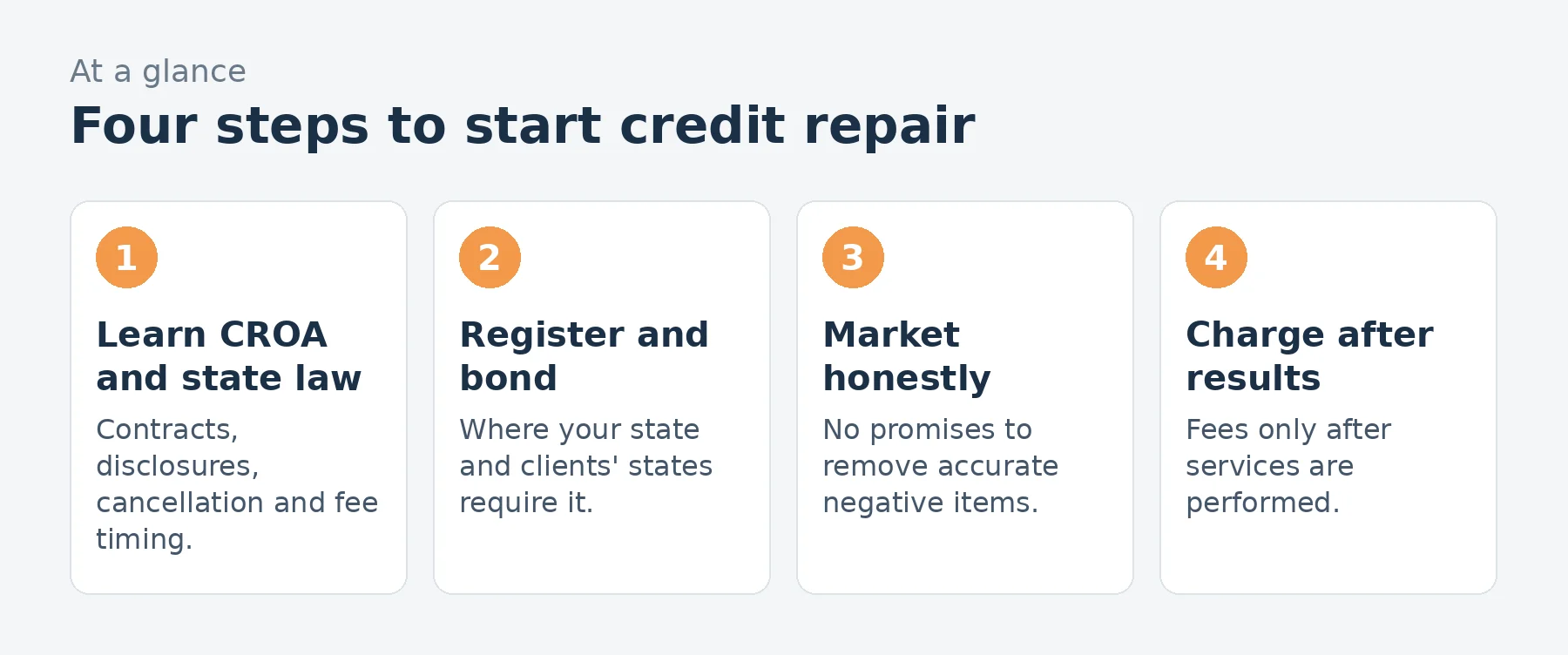
Because CROA bans advance fees, credit repair businesses typically bill after each month’s services are completed, or per item successfully addressed, as allowed by federal and state law. Avoid setup fees collected before work is done. Set fair, transparent prices and explain them in the contract. Use our pricing calculator.
A worked example: a solo business
These are illustrative assumptions for an established solo business, not predictions; fees are charged only after services are performed each month.
| Assumption | Monthly | |
|---|---|---|
| Monthly service fees | 70 active clients billed after each month’s disputes are completed, $89 average | $6,230 |
| Credit education consultations | $600 | |
| Revenue | $6,830 | |
| Credit repair software and report access | $(450) | |
| Assistant | Part-time, with payroll costs | $(1,300) |
| Compliance, bond and legal | Averaged monthly | $(250) |
| Insurance | E&O | $(100) |
| Marketing | $(700) | |
| Profit before owner pay and taxes | $4,030 |
That leaves about $4,030 a month before the owner’s pay and taxes, on about $6,830 of revenue. Because fees can only be collected after work is done, cash flow lags behind effort, especially when starting.
Loading the calculator…
A client process
- Give the CROA disclosure and explain consumers’ rights.
- Sign a written contract; honor the three-day cancellation period.
- Review credit reports together and identify questionable items.
- Send disputes with documentation, and track responses.
- Report results and bill only for completed services.
- Coach the client on building positive credit.
Protecting client data
Clients share Social Security numbers, account details and reports. Use secure systems, limit access and follow privacy laws. Credit report access services have their own terms and requirements for permissible use.
Finding clients
- Mortgage brokers and real estate agents whose clients need better credit to qualify.
- Auto dealers and lenders, within rules on referral payments.
- Financial educators and community organizations.
- Content that teaches credit basics.
- Referrals from satisfied clients.
Helping identity theft victims
Identity theft victims have specific rights to block fraudulent information and place fraud alerts and security freezes, which are free. Helping victims file reports and disputes is valuable, but remind them of free federal resources such as IdentityTheft.gov.
Business credit services
Some credit businesses help small companies build business credit profiles and understand financing readiness. Business credit services are not consumer credit repair, but honest marketing and accurate claims still matter.
A typical monthly cycle
Each month, review new bureau responses, update the client on results, send follow-up disputes where appropriate and coach the client on positive habits. Bill only after the month’s work is complete, and send a clear summary with each invoice.
Building trust in a skeptical market
Many consumers have heard of credit repair scams. Transparent pricing, clear explanations of what you can and cannot do, educational content, a physical address and real reviews help you stand apart from bad actors.
Common mistakes to avoid
- Charging any fee before services are fully performed.
- Promising to remove accurate negative information.
- Skipping state registration and bonds.
- Encouraging false disputes.
- Telemarketing without understanding TSR fee restrictions.
Your first 90 days
- Days 1-30: study CROA, the TSR and your state’s laws, and have an attorney review contracts and disclosures.
- Days 31-60: register and bond where required, set up software and write honest marketing.
- Days 61-90: build referral partnerships with mortgage and real estate professionals and take first clients.
Frequently asked questions
Is credit repair legal?
Yes, when it follows the Credit Repair Organizations Act, the Telemarketing Sales Rule and state laws.
Can credit repair companies charge upfront fees?
No. CROA prohibits charging fees until services are fully performed.
Can you remove accurate negative items from a credit report?
No. Accurate, timely negative information generally remains for set periods; only inaccurate, incomplete or unverifiable items can be disputed.
Do I need a license for credit repair?
Many states require registration and a bond for credit services organizations; check every state you serve.
What must a credit repair contract include?
Services, total cost, time frame, guarantees and the three-day cancellation right, plus the required CROA disclosure beforehand.
Can consumers repair credit themselves?
Yes, they can dispute errors for free, and CROA requires credit repair businesses to tell them so.
How long does credit repair take?
It varies; bureaus usually respond to disputes within about 30 to 45 days, and results depend on whether items are actually inaccurate.
Can I offer credit repair in every state?
Only where you meet each state’s requirements; some states have strict registration, bond and fee rules.
Do credit repair businesses need insurance?
E&O insurance is recommended, and many states require a surety bond for credit services organizations.
Keep learning
- Credit counseling industry data
- How to start a debt counseling service
- How to start a mortgage brokerage business
- Pricing calculator
Sources
- FTC, Credit Repair Organizations Act
- FTC, Credit repair: how to help yourself (consumer guidance on credit repair rules)
- FTC, Complying with the Telemarketing Sales Rule (advance fees for credit repair and debt relief)
- CFPB, Disputing errors on credit reports
- US Bureau of Labor Statistics, Financial clerks and credit counselors (credit counselors)
Last reviewed November 3, 2026. Startup costs are estimates; check local prices, licensing and tax rules before you commit money.

