
Many households struggle with credit card debt, budgets and credit reports. Credit counselors and financial coaches help them build budgets, understand options and, through debt management plans, repay creditors with lower interest. This field is heavily regulated because of past abuses in debt relief and credit repair. Credit counselors earned a median of $50,480 in May 2024, and the Bureau of Labor Statistics counted about 31,800 of them, with 3% projected growth. Below is the key industry data on credit counseling and financial coaching, with costs, business models and a first-year projection.
Businesses range from financial coaching practices to nonprofit credit counseling agencies offering debt management plans and approved providers of bankruptcy counseling and education courses.
The workforce
| Occupation | Jobs (2024) | Median pay (May 2024) | Projected growth, 2024 to 2034 |
|---|---|---|---|
| Credit counselors | 31,800 | $50,480 | +3% |
Source: U.S. Bureau of Labor Statistics, Occupational Outlook Handbook and Occupational Employment and Wage Statistics.
Business models compared
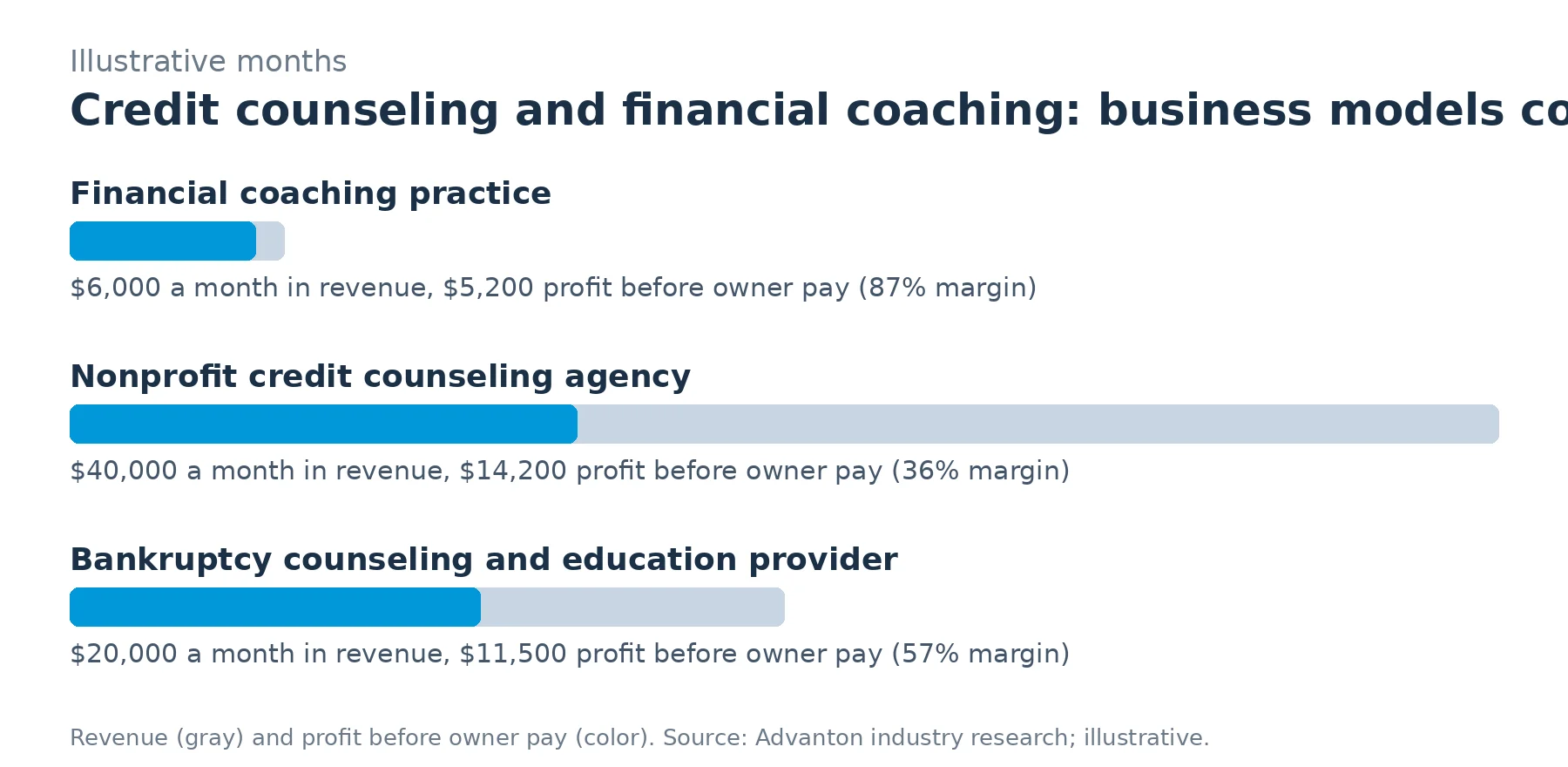
The figures below are illustrative months from our research, not industry averages. They show how revenue and costs typically fit together; your market, prices and costs will differ.
| Business model | Startup costs | Example monthly revenue | Costs | Profit before owner pay | Margin |
|---|---|---|---|---|---|
| Financial coaching practice | Low: training, website, scheduling, insurance | $6,000 | $800 | $5,200 | 87% |
| Nonprofit credit counseling agency | Moderate: licensing, counselors, compliance systems, creditor relationships | $40,000 | $25,800 | $14,200 | 36% |
| Bankruptcy counseling and education provider | Moderate: U.S. Trustee approval, online platform, counselors | $20,000 | $8,500 | $11,500 | 57% |
Fixed and variable costs
For projections, the most useful split is between variable costs, which rise and fall with sales (materials, supplies, hourly labor, fees), and fixed costs, which you pay every month regardless (rent, salaried staff, insurance, loan payments).
| Business model | Variable costs (% of revenue) | Fixed costs per month | What it means |
|---|---|---|---|
| Financial coaching practice | 3.0% | $620 | Mostly fixed: needs steady volume to cover overhead |
| Nonprofit credit counseling agency | 39.5% | $10,000 | Balanced: margins improve as volume grows |
| Bankruptcy counseling and education provider | 28.0% | $2,900 | Mostly fixed: needs steady volume to cover overhead |
What the numbers say
Coaching has very low overhead, with income tied to client numbers and fees.
Agencies depend on counselor staffing and compliance, funded by fees and creditor contributions.
Bankruptcy education scales online once approved.
The three models in brief
Financial coaching practice. Budgeting and money coaching without managing debt payments. See financial planning data.
Nonprofit credit counseling agency. Counseling and debt management plans. See nonprofits data.
Bankruptcy counseling and education provider. Required pre-filing and post-filing courses. See online courses and coaching data.
Cost structure: bankruptcy counseling and education provider
Each cost as a share of the example month’s revenue ($20,000):
| Cost | Monthly amount | Share of revenue | Type |
|---|---|---|---|
| Counselor pay | $5,000 | 25.0% | Variable |
| Attorney outreach | $1,000 | 5.0% | Fixed |
| Platform and hosting | $800 | 4.0% | Fixed |
| Compliance | $800 | 4.0% | Fixed |
| Payment fees | $600 | 3.0% | Variable |
| Insurance | $300 | 1.5% | Fixed |
| Profit before owner pay | $11,500 | 57% |
A first-year projection: bankruptcy counseling and education provider
New businesses rarely start at full speed. This projection assumes revenue ramps from 35% of the example month in month 1 to 100% by month 12, variable costs move with revenue, and fixed costs stay the same every month. It’s a planning illustration, not a forecast.
| Month | Revenue | Variable costs | Fixed costs | Profit | Cumulative |
|---|---|---|---|---|---|
| 1 | $7,000 | $1,960 | $2,900 | $2,140 | $2,140 |
| 2 | $9,000 | $2,520 | $2,900 | $3,580 | $5,720 |
| 3 | $11,000 | $3,080 | $2,900 | $5,020 | $10,740 |
| 4 | $12,400 | $3,472 | $2,900 | $6,028 | $16,768 |
| 5 | $14,000 | $3,920 | $2,900 | $7,180 | $23,948 |
| 6 | $15,200 | $4,256 | $2,900 | $8,044 | $31,992 |
| 7 | $16,400 | $4,592 | $2,900 | $8,908 | $40,900 |
| 8 | $17,400 | $4,872 | $2,900 | $9,628 | $50,528 |
| 9 | $18,200 | $5,096 | $2,900 | $10,204 | $60,732 |
| 10 | $19,000 | $5,320 | $2,900 | $10,780 | $71,512 |
| 11 | $19,600 | $5,488 | $2,900 | $11,212 | $82,724 |
| 12 | $20,000 | $5,600 | $2,900 | $11,500 | $94,224 |
Year one: revenue $179,200, profit before owner pay $94,224. The first profitable month is month 1. Cumulative results stay positive from the start, before any startup costs.
Counselor pay moves with client volume and fixed costs are moderate, so this agency illustration is profitable from month 1. The real early costs are state licensing, bonds, audits and the time it takes to build creditor relationships and referral partners before a single plan starts.
How credit counseling businesses earn
- Coaching fees for budgeting and money habits.
- Debt management plan fees within state limits.
- Creditor contributions to nonprofit agencies.
- Bankruptcy counseling and education fees.
- Workshops for employers and community groups.
Debt management plans
A debt management plan consolidates a client’s unsecured debt payments into one monthly payment, often with reduced interest negotiated with creditors. Agencies offering plans usually need state licenses, bonds and audits.
Avoid debt relief and credit repair traps
Debt settlement and credit repair have strict rules: no advance fees for telemarketed debt relief, and no charging for credit repair before the work is done. Many problems in this industry come from ignoring these rules.
A startup checklist for credit counseling and financial coaching
- Decide your model: coaching, counseling or education.
- Check state licensing for debt management plans.
- Apply for U.S. Trustee approval if offering bankruptcy courses.
- Write compliant contracts and disclosures.
- Protect client data.
Counselor training
Counselors need training in budgeting, credit, housing and consumer law. Many earn certifications that build credibility and quality, and ongoing training keeps them current as rules change.
Where the opportunities are
- Employer financial wellness programs.
- Housing and homebuyer counseling.
- Student loan guidance.
- Online bankruptcy education.
- Community workshops.
Key terms
| Term | Meaning |
|---|---|
| DMP | Debt management plan |
| Credit repair | Services claiming to improve credit reports, regulated by federal law |
| Advance fee | Charging before services are delivered |
| U.S. Trustee Program | Agency that approves bankruptcy counseling providers |
Honest guidance
Clients are often stressed and vulnerable. Explain options honestly, including bankruptcy, and never pressure them into plans that don’t fit.
Key numbers to track
Track clients served, plan completion rates, fees collected, compliance audits and client outcomes.
Common mistakes
- Charging illegal advance fees.
- Operating without required licenses.
- Overpromising credit score results.
- Weak data security.
- Pressuring clients.
Marketing a credit counseling business
Employer partnerships, credit unions, housing agencies, bankruptcy attorneys and community workshops bring clients. See financial planning data.
Data security
Clients share sensitive financial data; encryption, access controls, secure payment systems and staff training are essential, and breaches can end an agency.
Nonprofit status
Many credit counseling agencies are nonprofits and must follow tax-exempt rules, including reasonable fees and education as a core purpose.
Employer programs
Companies offer financial wellness programs that bring steady clients, workshops and long-term contracts.
Online services
Phone and video counseling expand reach to rural clients and busy workers who can’t visit an office.
Housing counseling
Pre-purchase, foreclosure prevention and rental counseling help families with housing decisions. Agencies approved by HUD can access grants and referrals, though approval requires meeting program standards.
The first session
A first session reviews income, expenses, debts and goals, then explains every option, from budgeting changes to debt management plans and, when appropriate, referral to a bankruptcy attorney. Clients should leave with a clear written action plan.
Creditor relationships
Debt management plans depend on creditors agreeing to reduced interest and waived fees. Strong relationships, accurate payment processing and reliable reporting keep creditors participating.
Outcomes
Track savings, debts repaid, plan completions and credit improvement to show impact to clients, funders and partners.
Test these numbers with your own plan
Open this industry in our free Business Idea Reality Check to start from any model above, change prices, costs, startup budget and your own pay, and see your break-even month, the cash you’d need, three scenarios and how new businesses in this sector survive in your state.
- Start with the closest model and its cost structure.
- Replace every price and cost with local quotes.
- Estimate your ramp: how fast customers will realistically come in year one.
- Map cash month by month with the free Cash & Payroll Planner.
- Build the full plan in the free Business Planner.
About this data
Workforce figures come from the U.S. Bureau of Labor Statistics (Occupational Outlook Handbook and Occupational Employment and Wage Statistics, May 2024 wages and the 2024 to 2034 projections, unless noted). Market figures cite their sources above. Business model figures are illustrative months built from typical prices and costs to show how revenue, fixed costs and variable costs fit together; they are not industry averages or guarantees. We review these profiles when new government data is released, at least once a year, and the same figures power the Business Idea Reality Check.
Licensing and rules
Many states license or register credit counseling agencies that offer debt management plans, often requiring bonds, audits and nonprofit status; providers of pre-bankruptcy counseling and debtor education must be approved by the U.S. Trustee Program; the FTC’s Telemarketing Sales Rule bans charging advance fees for debt relief services sold by phone; the Credit Repair Organizations Act prohibits charging for credit repair before services are performed and requires specific disclosures and contracts; nonprofit agencies must follow tax-exempt rules; customer financial data must be protected. Requirements change; confirm with your state and local agencies before you start.
Frequently asked questions about credit counseling and financial coaching
Do credit counselors need a license?
Agencies offering debt management plans often need state licenses; coaching may not.
What do credit counselors earn?
BLS reported a median of $50,480 in May 2024.
Can I charge upfront for credit repair?
No; federal law prohibits charging before credit repair services are performed.
Who approves bankruptcy counseling providers?
The U.S. Trustee Program.
What is a debt management plan?
A plan consolidating debt payments, often with lower negotiated interest.
Is credit counseling a good business?
It can be, especially with employer and community partnerships and strict compliance.
How long do debt management plans last?
Often several years, depending on the debt and payment amount.
Can financial coaches manage client payments?
Handling debt payments usually triggers licensing; many coaches avoid it.
How can I test these numbers?
Open credit counseling and financial coaching in the Business Idea Reality Check and enter your own numbers.
Keep learning
Sources
Last reviewed November 2, 2026. Startup costs are estimates; check local prices, licensing and tax rules before you commit money.
In India
This business type isn’t common in India. Credit counseling isn’t an established business type.
Looking for a business to start in India? Browse industries that fit well, such as interior design, coaching classes, cloud kitchens, salons and beauty parlours, AC service, and the India-only industries like tiffin services and mehendi artists.