
A blogging business publishes useful articles on a website and earns from display ads, affiliate commissions, sponsorships, digital products and services. Successful blogs focus on a niche and answer readers’ questions better than anyone else, building search traffic, email subscribers and trust over time.
Search has become more competitive as search engines emphasize helpful, reliable, people-first content and fight low-quality content made mainly to rank. Blogs that share real experience and expertise, and build direct relationships through email, are best positioned. The Bureau of Labor Statistics reports a median pay of $72,270 for writers and authors (May 2024), with about 135,400 jobs and employment projected to grow about 4% over the decade. Independent creators’ income varies enormously, from nothing to substantial businesses. This guide covers niche, content quality, search rules, monetization, disclosures, a worked example and a 90-day plan.
A blogging business at a glance
Table of Contents
| Topic | What to expect |
|---|---|
| Startup cost | Low: a domain, hosting or a website platform, a theme, an email tool and your time |
| Key rules | FTC disclosure of affiliate links and sponsorships, rel="sponsored" on paid links and a privacy policy |
| Search quality | Helpful, experience-based content; Google’s spam policies target scaled low-value content and site reputation abuse |
| Revenue streams | Display ads, affiliate commissions, sponsorships, digital products and services |
| Best for | Patient writers with expertise or experience in a topic readers search for |
Who blogging suits
It suits people who enjoy writing, research and teaching, have real experience in a topic and are patient: blogs often take many months to gain search traffic. A blog can also support another business by attracting clients.
Choosing a niche
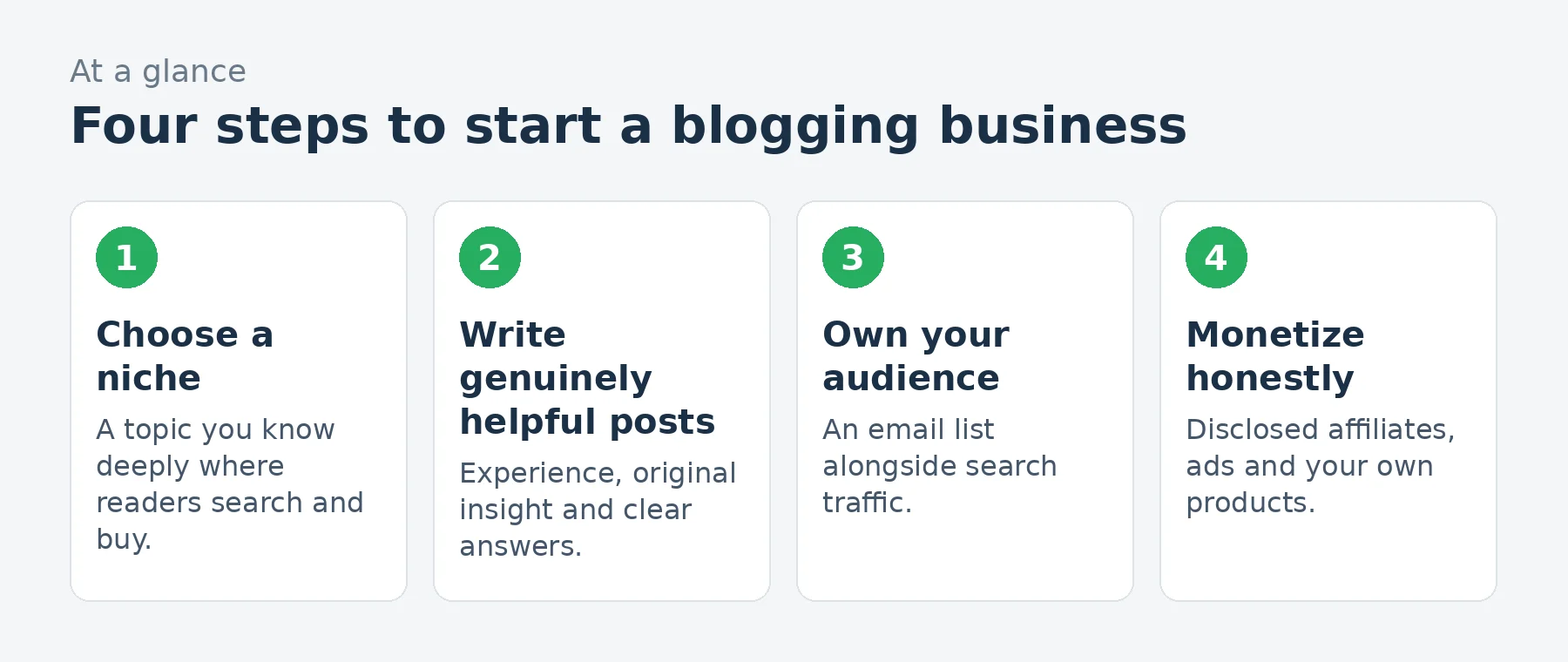
Pick a topic where you have experience or expertise, where people search for answers and where products or services are bought: home improvement, personal finance, travel planning, pets, cooking, software, small business or hobbies. Narrow niches are easier to rank in and more trusted by readers.
Writing helpful content
Google’s guidance asks whether content is created for people, demonstrates first-hand experience and expertise, fully answers the reader’s question and leaves them satisfied. Show your experience with original photos, tests, examples and data; cite sources; update posts when information changes; and organize content so readers find answers quickly.
Search rules to respect
Google’s spam policies target practices such as scaled content abuse (mass-producing low-value pages, however they are made), site reputation abuse, link schemes and keyword stuffing. AI tools can help research and editing, but publishing large volumes of unedited, generic content is risky. Focus on fewer, better posts.
Monetization options
- Display ads through ad networks, many of which set traffic minimums.
- Affiliate programs: commissions on products you recommend.
- Sponsored posts and partnerships, clearly labeled.
- Digital products: guides, templates, courses and printables.
- Services: consulting, coaching or freelance work for readers.
- Paid newsletters or memberships for loyal readers.
Disclosures and links
Sponsorships, affiliate links, free products and paid partnerships must be clearly disclosed under the FTC’s Endorsement Guides: disclosures should be easy to notice, in plain language (such as "sponsored" or "I earn a commission"), and placed where audiences will see them, not buried in a link or at the end.
For search engines, mark paid and affiliate links with rel="sponsored" (or nofollow), as Google recommends, so you do not violate link scheme policies.
Privacy, images and legal pages
Publish a privacy policy describing data collection, including analytics, ads and email; some states’ privacy laws and ad networks require additional notices and consent tools. Use only images you took, licensed or that are properly free to use with attribution as required. Add terms of use and a clear about page describing who writes the blog and why readers should trust it.
Startup costs to plan for
| Item | What to budget for |
|---|---|
| Domain and hosting | Or a website platform subscription |
| Theme and plugins | Fast, accessible design |
| Email marketing | Newsletter tool |
| Images | Camera, stock licenses |
| SEO tools | Keyword and site audit tools |
| Legal pages | Privacy policy and disclosures |
Use our startup cost calculator for your total.
Building traffic
- Research what your audience searches for and the intent behind it.
- Write complete, well-organized answers with original experience.
- Link related posts together into topic clusters.
- Promote posts on social platforms and communities where your readers are.
- Earn links naturally through useful resources and relationships.
A worked example: an established niche blog
These are illustrative assumptions for an established niche blog with about 80,000 monthly visits, not predictions.
| Assumption | Monthly | |
|---|---|---|
| Display advertising | $1,600 | |
| Affiliate commissions | Product recommendations with disclosures | $1,800 |
| Digital products | Guides and templates | $1,100 |
| Sponsored content | 1 disclosed sponsorship | $500 |
| Revenue | $5,000 | |
| Hosting, email and software | $(150) | |
| Freelance editor and images | $(400) | |
| SEO tools | $(100) | |
| Profit before owner pay and taxes | $4,350 |
That leaves about $4,350 a month before the blogger’s pay and taxes, on about $5,000 of revenue. Search traffic can change with algorithm updates, so email subscribers and your own products protect the business.
Loading the calculator…
Email: owning your audience
Offer readers a useful free resource in exchange for their email, send regular newsletters with helpful content and recommend products and your own offers. Email subscribers are not affected by algorithm changes and often convert far better than search visitors. Follow CAN-SPAM rules for every email.
Site speed and experience
Fast, mobile-friendly pages with limited intrusive ads keep readers engaged. Balance ad income against user experience, since too many ads can drive readers away.
Updating and pruning content
Older posts lose accuracy and rankings over time. Review your top posts regularly, update facts, prices, screenshots and recommendations, combine thin posts into stronger ones and remove pages that no longer serve readers.
Building authority
Readers and search engines trust sites with clear expertise: an author page with credentials and experience, citations of reliable sources, transparent methods for reviews and recommendations and a consistent focus on the niche. Guest posts and interviews on respected sites build reputation and links naturally.
Turning a blog into a business asset
Profitable blogs with steady traffic, diverse income and clean records can sometimes be sold through marketplaces for online businesses. Documentation, original content and an email list increase value.
Multiple formats
Repurpose posts into short videos, social posts, email lessons or downloadable guides. Different formats reach readers in different places and bring them back to your site and email list.
Choosing a platform
Choose a fast, reliable platform you can control, with good search features and easy publishing. Self-hosted platforms give the most control; hosted builders are simpler. Whatever you choose, own your domain so you can move later.
Affiliate programs
Join affiliate programs for products you genuinely use and recommend, read each program’s rules (some ban certain promotional methods or require specific disclosures) and compare commission rates and cookie windows. Honest reviews with real testing convert better and protect your reputation.
Common mistakes to avoid
- Generic content without experience or original insight.
- Mass-publishing unedited AI content.
- Hidden affiliate links or missing disclosures.
- Relying only on search traffic.
- Using images without permission.
Your first 90 days
- Days 1-30: choose a niche, set up a fast site, legal pages and an email tool, and plan 30 topics.
- Days 31-60: publish two quality posts a week and create a free email resource.
- Days 61-90: add affiliate links with disclosures, promote posts and plan a first digital product.
Frequently asked questions
Is blogging still profitable?
It can be for blogs with real expertise and a clear niche, especially with email lists and their own products.
Do I need to disclose affiliate links?
Yes. FTC rules require clear disclosure, and Google recommends marking paid links rel="sponsored".
Can I use AI to write blog posts?
AI can assist, but mass-producing low-value content risks Google’s spam policies; helpful, experience-based content performs best.
How long does it take a blog to make money?
Often many months, because search traffic and trust take time to build.
Do I need a privacy policy?
Yes, especially if you use analytics, ads or email; some laws and ad networks require additional notices.
What is the best way to monetize a blog?
Many blogs combine affiliates, ads and their own digital products or services.
How many posts does a new blog need?
Quality matters more than count, but many niche blogs publish dozens of strong posts before traffic grows meaningfully.
Do I need to be an expert to blog?
Experience and honesty matter most; share what you have actually done, tested or learned.
What should a blog privacy policy include?
What data you collect, how you use analytics, ads and email, cookies, third parties and how readers can contact you or opt out.
How do blogs earn from display ads?
Ad networks place ads and share revenue based on traffic and audience; many networks require minimum monthly traffic.
Should my blog have an email list from day one?
Yes. Email subscribers are the most reliable audience you can build, independent of search algorithms.
Can a blog support my other business?
Yes. Many service businesses use blogs to attract clients through helpful content in their field.
Keep learning
- Content creation industry data
- How to start a newsletter business
- How to start a content marketing agency
- Local SEO Check
Sources
- Google Search Central, Creating helpful, reliable, people-first content
- Google Search Central, Spam policies for Google web search
- Google Search Central, Qualify your outbound links (rel="sponsored")
- FTC, Endorsement Guides: what people are asking
- US Copyright Office, Fair use index and copyright basics
- US Bureau of Labor Statistics, Writers and authors
Last reviewed November 3, 2026. Startup costs are estimates; check local prices, licensing and tax rules before you commit money.

