
A Shopify store builder helps brands launch and grow online stores on Shopify: setting up stores, customizing themes, adding products and apps, migrating from other platforms, improving conversion and supporting stores over time. Shopify makes selling online accessible, but many merchants want an expert to set it up properly and make it sell.
Shopify runs a free Partner Program for developers and agencies, with tools for building client stores and referral programs. The best Shopify specialists sell outcomes: more sales, fewer abandoned carts and smoother operations. The Bureau of Labor Statistics reports a median pay of $95,380 for web developers and digital designers (May 2024), with about 214,900 jobs and employment projected to grow about 7% over the decade. Business owners earn the profit after contractors, tools and overhead. This guide covers services, the partner program, standards, pricing, a worked example and a 90-day plan.
A Shopify store builder business at a glance
Table of Contents
| Topic | What to expect |
|---|---|
| Startup cost | Low: a computer, a Shopify Partner account, theme and app licenses, a portfolio and insurance |
| Partner program | Shopify’s free Partner Program offers development stores and partner tools, plus referral programs |
| Services | Store setup, theme customization, Liquid development, apps, migrations and conversion optimization |
| How you charge | Fixed-price store builds, development hourly rates and monthly growth or support retainers |
| Best for | E-commerce-minded designers and developers who care about sales results |
Who this business suits
It suits designers and developers who understand online selling: product presentation, checkout, shipping, marketing and analytics. Many successful Shopify experts have run their own stores.
Services to offer
- Store setup: theme, navigation, products, collections, payments, shipping and taxes settings.
- Theme customization and Liquid development for unique designs and features.
- App setup and integrations: reviews, subscriptions, email, inventory and fulfillment.
- Migrations from other platforms, preserving products, customers and search traffic with redirects.
- Conversion rate optimization: product pages, speed, trust signals and checkout flow.
- Ongoing support and growth retainers.
The Shopify Partner Program
Shopify’s Partner Program is free to join and lets you create development stores for client projects, transfer stores to clients and access partner tools and education. Shopify also runs referral and revenue share programs for partners; check current terms on the partner site. Being a partner supports credibility, but clients still choose you for results.
Store basics that clients overlook
- Clear shipping, return and refund policies.
- Correct tax settings for where the store sells, with the merchant’s accountant.
- Privacy policy and cookie settings for marketing tools.
- Accessible themes and alt text for product images.
- Accurate product information, sizing and claims.
Accessibility and privacy
Accessibility is both good practice and a legal risk area. The Web Content Accessibility Guidelines (WCAG) are the widely used standard; the Justice Department’s 2024 rule requires state and local government websites to meet WCAG 2.1 Level AA, and businesses open to the public have faced lawsuits over inaccessible websites under the ADA. Build accessible sites by default: semantic headings, text alternatives for images, keyboard navigation, sufficient color contrast and accessible forms.
Websites that collect personal information need a privacy policy and good security. Several states have consumer privacy laws, some uses of tracking and cookies require notices or consent, and the FTC expects businesses to protect personal information they collect. Advise clients and connect them with legal help for policies; do not write legal documents yourself unless qualified.
Startup costs to plan for
| Item | What to budget for |
|---|---|
| Partner account | Free to join |
| Themes and apps | Licenses for tools you use often |
| Portfolio | Example stores and case studies |
| Contracts | Build projects, retainers, ownership |
| Insurance | Professional liability |
| Marketing | E-commerce communities and partnerships |
Use our startup cost calculator for your total.
Pricing
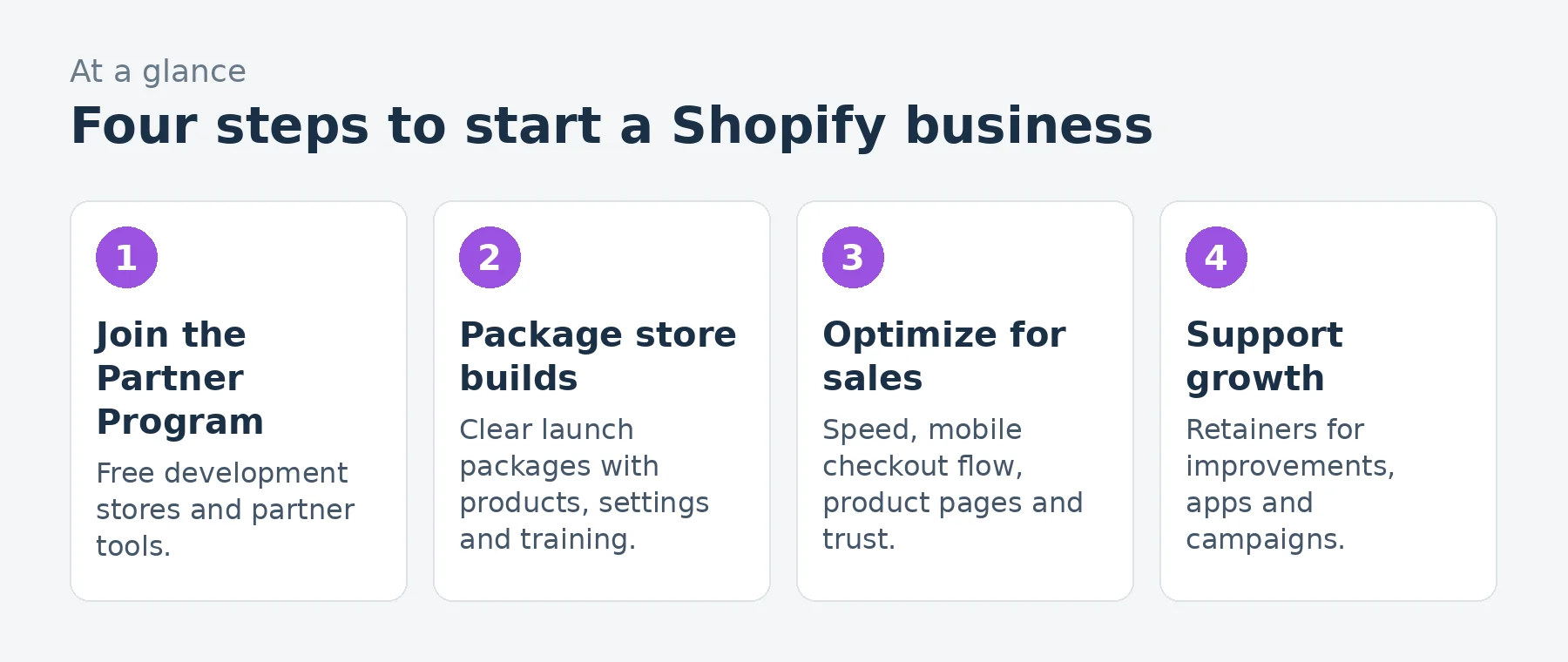
Offer fixed-price launch packages by store size (number of products, pages and integrations), hourly or fixed prices for custom development and migrations, and monthly retainers for ongoing improvements. Make sure prices cover product data entry, which takes more time than many expect. Use our pricing calculator.
A worked example: a solo specialist
These are illustrative assumptions for a solo specialist, not predictions.
| Assumption | Monthly | |
|---|---|---|
| Store builds | 2 stores at $4,000 | $8,000 |
| Migrations and custom development | $3,000 | |
| Monthly retainers | 6 stores at $600 | $3,600 |
| Revenue | $14,600 | |
| Theme and app licenses | $(400) | |
| Contractors | Product photography, copywriting, development help | $(2,000) |
| Software and tools | $(200) | |
| Marketing, insurance and accounting | $(600) | |
| Profit before owner pay and taxes | $11,400 |
That leaves about $11,400 a month before the owner’s pay and taxes, on about $14,600 of revenue. Retainers with growing stores provide steady work and often lead to larger projects.
Loading the calculator…
A store launch process
- Discovery: products, audience, competitors and goals.
- Choose and customize a theme.
- Set up products, collections, navigation and policies.
- Configure payments, shipping, taxes and notifications.
- Install and configure essential apps.
- Test orders on mobile and desktop, then launch.
- Train the client and hand over the store.
Conversion optimization
Small improvements can raise sales significantly: clear product photos and descriptions, reviews, shipping information near the add-to-cart button, faster pages, simpler navigation and email capture. Test changes and measure results.
Ownership and handoff
Build stores in development stores and transfer ownership to the client, so they own the store, domain and data. Give clients staff accounts for your agency rather than using their owner login.
Finding clients
- Brands outgrowing basic setups or other platforms.
- Marketing agencies needing Shopify developers.
- E-commerce communities and founder groups.
- Product photographers and fulfillment companies as referral partners.
- Case studies showing sales growth after launch or redesign.
Choosing a niche
Specializing in an industry (apparel, beauty, food and beverage, home goods) or a service (migrations, subscriptions, speed) helps you build templates, apps knowledge and case studies that win similar clients.
Product data and photography
Products sell on photos and descriptions. Help clients organize product data (titles, variants, sizes, SKUs and descriptions), and partner with product photographers for consistent images. Product setup is time-consuming, so price it clearly.
Subscriptions and repeat purchases
Subscription apps let stores sell recurring deliveries of consumables such as coffee, supplements and pet food. Setting up subscriptions, customer portals and email flows is a valuable specialty for brands with repeat products.
B2B and wholesale
Some brands sell wholesale to retailers alongside retail customers. Wholesale price lists, minimum orders and separate customer groups require planning in the store setup, and experience with these makes you valuable to growing brands.
Analytics and tracking
Set up analytics and conversion tracking for sales, add-to-cart and checkout steps, plus marketing pixels with proper consent. Clear analytics show where stores lose customers and guide improvements.
Learning the ecosystem
Much of a Shopify specialist’s value is knowing which themes and apps work well together, which slow stores down and which solve common problems. Keep notes on tested apps, follow Shopify’s partner updates and test new features in development stores.
Selling internationally
Brands that sell abroad need currency, language, shipping, duties and tax settings planned carefully. Experience with international setups is valuable for growing brands, though tax questions should go to the merchant’s accountant.
Common mistakes to avoid
- Building stores in your own account instead of transferring ownership.
- Installing too many apps that slow the store.
- Skipping policy and tax setup.
- Migrations without redirects.
- Underpricing product setup work.
Your first 90 days
- Days 1-30: join the Partner Program, build two demo stores and define launch packages.
- Days 31-60: land first clients through your network and agencies, and document results.
- Days 61-90: add retainers, publish case studies and choose a niche.
Frequently asked questions
Do I need to be a Shopify Partner?
It is not required, but the free Partner Program provides development stores, tools and referral programs.
How much should I charge to build a Shopify store?
It depends on products, design and integrations. Offer fixed packages and quote custom work separately.
Do I need to know Liquid?
Basic Liquid, Shopify’s template language, helps with theme customization; many builds need little code.
Who owns the store I build?
The client should. Build in a development store and transfer ownership.
Can I migrate a store from another platform?
Yes. Migrations should preserve products, customers and orders, and set up redirects to protect search traffic.
Do Shopify stores need privacy policies?
Yes, stores that collect customer information should have privacy and other policies, ideally reviewed by legal advisors.
How long does it take to build a Shopify store?
Simple stores can launch in a few weeks; larger stores with many products and integrations take longer.
Should I offer marketing too?
Many Shopify specialists add email marketing or partner with marketing agencies, since stores need traffic after launch.
Can I build Shopify stores without coding?
Many stores can be built with themes and apps alone, but Liquid and front-end skills let you customize more.
What apps do most Shopify stores need?
It varies, but reviews, email marketing, analytics and shipping or fulfillment apps are common; keep the list lean to protect speed.
Keep learning
- Web design and development industry data
- How to start a web design business
- How to start a dropshipping business
- Pricing calculator
Sources
- Shopify, Partner Program
- US Bureau of Labor Statistics, Web developers and digital designers
- W3C, Web Content Accessibility Guidelines (WCAG) overview
- ADA.gov, Guidance on web accessibility and the ADA
- FTC, Protecting personal information: a guide for business
Last reviewed November 3, 2026. Startup costs are estimates; check local prices, licensing and tax rules before you commit money.

