
A web design business builds websites for businesses and organizations: designing pages, writing or editing content, setting up hosting and domains, optimizing for search and mobile, and keeping sites updated after launch. Every business needs a website, and many need a better one.
Easy site builders mean clients can make basic sites themselves, so successful web designers sell results: more calls, bookings and sales, and a site that is fast, accessible and easy to manage. Recurring maintenance plans turn one-time projects into steady income. The Bureau of Labor Statistics reports a median pay of $95,380 for web developers and digital designers (May 2024), with about 214,900 jobs and employment projected to grow about 7% over the decade. Business owners earn the profit after contractors, tools and overhead. This guide covers niche, platforms, pricing, accessibility, contracts, process, a worked example and a 90-day plan.
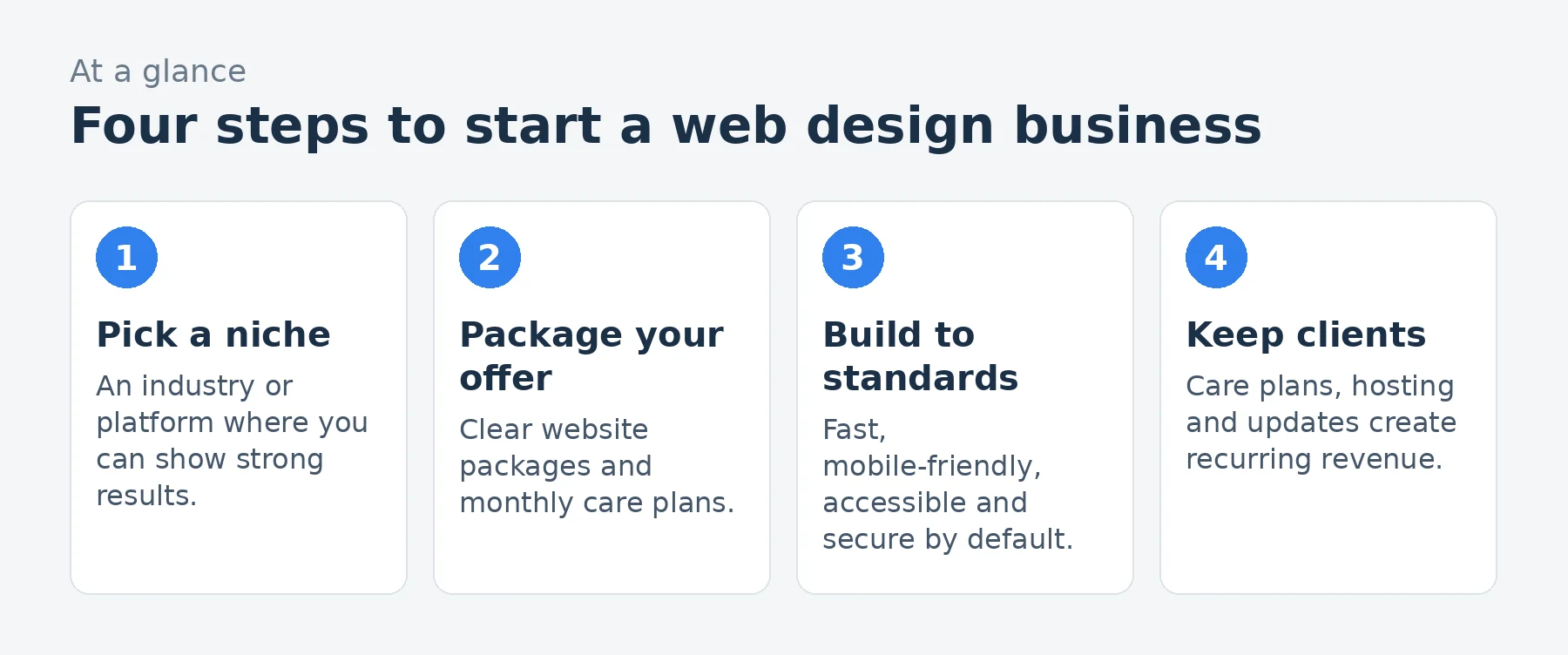
A web design business at a glance
Table of Contents
| Topic | What to expect |
|---|---|
| Startup cost | Low: a computer, design and development tools, a portfolio site, contracts and insurance |
| Key standards | Accessible design following WCAG, privacy policies and security for sites that collect data |
| How you charge | Project fees for new sites, monthly care plans, hosting and hourly changes |
| Best niches | One industry (such as restaurants, contractors or therapists) or one platform |
| Best for | Designers who can also communicate, write and manage projects |
Who web design suits
It suits people with design sense and technical comfort who also enjoy talking to clients, writing and solving business problems. Project management skills matter as much as design: deadlines, content collection and approvals decide whether projects finish on time.
Choosing a niche and platform
- Industry niches: restaurants, contractors, therapists, law firms, nonprofits or real estate.
- Platform specialties: WordPress, Webflow, Shopify, Squarespace or custom development.
- Service specialties: conversion-focused redesigns, accessibility remediation or speed optimization.
A niche lets you reuse layouts and content structures, speak your clients’ language and charge more for proven results.
What to include in a website package
- Discovery: goals, audience and competitors.
- Sitemap, wireframes and design.
- Content: copywriting or editing, photos and calls to action.
- Development, mobile optimization and speed.
- Basic SEO: titles, descriptions, structure and local business details.
- Accessibility checks, forms, analytics and launch support.
Accessibility
Accessibility is both good practice and a legal risk area. The Web Content Accessibility Guidelines (WCAG) are the widely used standard; the Justice Department’s 2024 rule requires state and local government websites to meet WCAG 2.1 Level AA, and businesses open to the public have faced lawsuits over inaccessible websites under the ADA. Build accessible sites by default: semantic headings, text alternatives for images, keyboard navigation, sufficient color contrast and accessible forms.
Privacy and security
Websites that collect personal information need a privacy policy and good security. Several states have consumer privacy laws, some uses of tracking and cookies require notices or consent, and the FTC expects businesses to protect personal information they collect. Advise clients and connect them with legal help for policies; do not write legal documents yourself unless qualified.
For security, use reputable hosting, keep software updated, enforce strong passwords and two-factor authentication and set up automatic backups.
Pricing websites and care plans
Price projects by scope (pages, features, content and integrations), not hours alone. Offer two or three packages with clear deliverables, and quote larger custom builds separately. Care plans typically include hosting, updates, backups, security monitoring and a set amount of edits each month. Use our pricing calculator.
Contracts and ownership
Contracts should cover scope, timeline, the client’s responsibilities (content, feedback deadlines), payment schedule (often a deposit, a milestone payment and a final payment before launch), revision limits, change requests, ownership of the finished site after payment, licensed assets and the care plan terms. Register domains in the client’s name.
Startup costs to plan for
| Item | What to budget for |
|---|---|
| Computer and software | Design tools, code editor, browsers for testing |
| Themes, plugins and licenses | Tools you use across client sites |
| Portfolio website | Your own site with case studies |
| Contracts | Project agreement and care plan terms |
| Insurance | Professional liability, cyber coverage |
| Marketing | Networking, referrals, content |
Use our startup cost calculator for your total.
A project process that works
- Discovery call and proposal.
- Contract, deposit and content checklist.
- Sitemap and wireframes, then design approval.
- Build, with content added and tested on mobile.
- Accessibility, speed and SEO checks.
- Client review, revisions and launch.
- Training and the start of the care plan.
Collect content early: missing content is the most common reason projects stall.
A worked example: a solo designer
These are illustrative assumptions for an established solo designer with contractors, not predictions.
| Assumption | Monthly | |
|---|---|---|
| New website projects | 2 sites at $4,500 | $9,000 |
| Monthly care plans | 25 clients at $120 | $3,000 |
| Hourly changes and add-ons | $1,200 | |
| Revenue | $13,200 | |
| Contractors | Copywriting, illustration, development help | $(2,200) |
| Software, themes and plugins | $(350) | |
| Hosting costs for care plan clients | $(500) | |
| Marketing | $(400) | |
| Insurance and accounting | Professional liability | $(300) |
| Profit before owner pay and taxes | $9,450 |
That leaves about $9,450 a month before the owner’s pay and taxes, on about $13,200 of revenue. Care plans are the stability engine: each new site can add a monthly client for years.
Loading the calculator…
Finding clients
- Your network and local businesses with outdated websites.
- Referral partners: marketing agencies, photographers, accountants and business coaches.
- Niche communities and associations.
- Case studies showing more calls, bookings or sales.
- Free website reviews with three specific improvements.
Selling outcomes
Clients care about results: more leads, easier booking, fewer phone calls asking for hours, better search visibility. Ask about goals in discovery, design for them and report on them after launch with analytics.
Templates and efficiency
Build reusable layouts, component libraries and checklists for your niche. Efficiency lets you deliver faster at the same price, which improves profit without lowering quality.
Hosting choices
Many designers resell or manage hosting as part of care plans, which adds recurring revenue and control over performance and security. Choose reputable managed hosting with backups and support, and make sure clients can move their site if they leave, with domains and accounts in their names.
Writing website copy
Words often matter more than design. Clear headlines, specific services, local details, proof such as reviews and strong calls to action drive results. Offer copywriting or partner with a copywriter, because client-supplied text is often the weakest part of a site.
Sites for local businesses
Local businesses need fast mobile sites with tap-to-call buttons, hours, service areas, booking or quote forms, reviews and consistent business details that match their Google Business Profile. Building these well for one industry is a strong niche.
Offboarding clients
When a client leaves, hand over cleanly: transfer access, provide a site backup and documentation and confirm domains and accounts are in their names. Professional offboarding protects your reputation and often brings referrals later.
A portfolio that sells
Show complete case studies, not just screenshots: the client’s problem, what you built and the results, such as more calls or bookings. Include sites from your niche, and keep your own website fast, accessible and well written, since prospects judge you by it.
Common mistakes to avoid
- Starting work without a deposit or content plan.
- Unlimited revisions.
- Ignoring accessibility.
- Registering client domains in your own name.
- No care plan offer, leaving recurring revenue on the table.
Your first 90 days
- Days 1-30: choose a niche and platform, build your portfolio site and write contracts and packages.
- Days 31-60: build two or three sites, possibly at introductory prices, and document results.
- Days 61-90: launch care plans, ask for referrals and reach out to 30 businesses in your niche.
Frequently asked questions
How much should I charge for a website?
It depends on scope, features and content. Price by packages and value rather than hours alone, and offer care plans after launch.
Do websites need to be ADA compliant?
Businesses open to the public have faced ADA lawsuits over inaccessible sites, and WCAG is the standard most use. Build accessible sites by default.
Which platform should I use?
Choose one you can master and that fits your clients, such as WordPress, Webflow or Shopify.
What is a website care plan?
A monthly service covering hosting, updates, backups, security and small edits.
Do I need to know how to code?
Not always, with modern builders, but HTML and CSS skills help you deliver better, faster sites.
Who should own the client’s domain?
The client. Register domains in their name and give them access.
How long does it take to build a website?
Small business sites often take a few weeks, depending mostly on how quickly content and feedback arrive.
Should I offer hosting?
Many designers include managed hosting in care plans for recurring revenue, keeping domains in the client’s name.
Do web designers need insurance?
Professional liability insurance protects you if a client claims your work caused a loss; cyber coverage helps if you manage hosting.
Keep learning
- Web design and development industry data
- How to start a WordPress development business
- How to start an SEO agency
- Free website builder
Sources
- US Bureau of Labor Statistics, Web developers and digital designers
- W3C, Web Content Accessibility Guidelines (WCAG) overview
- ADA.gov, Fact sheet: 2024 rule on web and mobile app accessibility for state and local governments
- ADA.gov, Guidance on web accessibility and the ADA
- FTC, Protecting personal information: a guide for business
Last reviewed November 3, 2026. Startup costs are estimates; check local prices, licensing and tax rules before you commit money.

