
An embroidery business stitches logos, names and designs onto polos, hats, jackets, bags, towels and uniforms. Businesses, schools, sports teams, clubs and medical offices order embroidered apparel because it looks professional and lasts.
Commercial embroidery machines can run with little supervision once set up, which makes the business scalable. The skills are in digitizing (turning artwork into stitch files), hooping and production efficiency, and in pricing correctly. This guide covers machines, digitizing, supplies, pricing, permissions, customers, a worked example and a 90-day plan.
An embroidery business at a glance
Table of Contents
| Topic | What to expect |
|---|---|
| Startup cost | Moderate: a commercial single-head or multi-head machine, digitizing software or services, hoops, thread, stabilizers and blanks |
| Licenses | Business license and sales tax permit; resale certificate for blanks |
| How you charge | By stitch count and quantity, plus a one-time digitizing fee for each new design |
| Key rule | Embroider logos only with the owner’s permission |
| Best for | Detail-oriented people who enjoy machines, production and serving business customers |
Who embroidery suits
It suits patient, detail-oriented people who enjoy machines and precision, and who like building long-term relationships with business customers. The Bureau of Labor Statistics reports a median pay of $56,260 for craft and fine artists, a reference point for design skills.
Choosing machines
- Single-head commercial machines with multiple needles (colors) suit startups and small orders.
- Multi-head machines stitch several garments at once for larger orders.
- Features to compare: number of needles, embroidery field size, cap frames, speed, service and training.
- Avoid relying on home sewing-embroidery machines for commercial volume; they are slow and limited.
Digitizing designs
Embroidery machines need a stitch file created from the artwork, called digitizing. Good digitizing controls stitch types, density, underlay and sequence so designs look clean and do not pucker. Learn digitizing software, or outsource to a professional digitizing service, especially for complex logos, and charge customers a one-time digitizing fee for new designs.
Supplies and production
Stock quality embroidery thread in common colors, stabilizers (backing) suited to different fabrics, needles and a range of hoops and cap frames. Efficient hooping, color sequencing and batching orders by thread color save time. Test each new design on a sample before running an order.
Logo permissions
Logos and team marks are protected by trademark and copyright. Only embroider a logo when the customer owns it or has permission, put that confirmation in your order terms and decline requests for brand or team logos without a license.
Startup costs to plan for
| Item | What to budget for |
|---|---|
| Machine | Commercial multi-needle machine, cap frames, hoops |
| Software | Digitizing and lettering software |
| Supplies | Thread, stabilizers, needles, scissors |
| Blanks | Polos, hats, jackets from wholesale suppliers |
| Space | A clean, well-lit area with power and storage |
| Training | Machine and digitizing training |
Use our startup cost calculator for your total.
Pricing embroidery
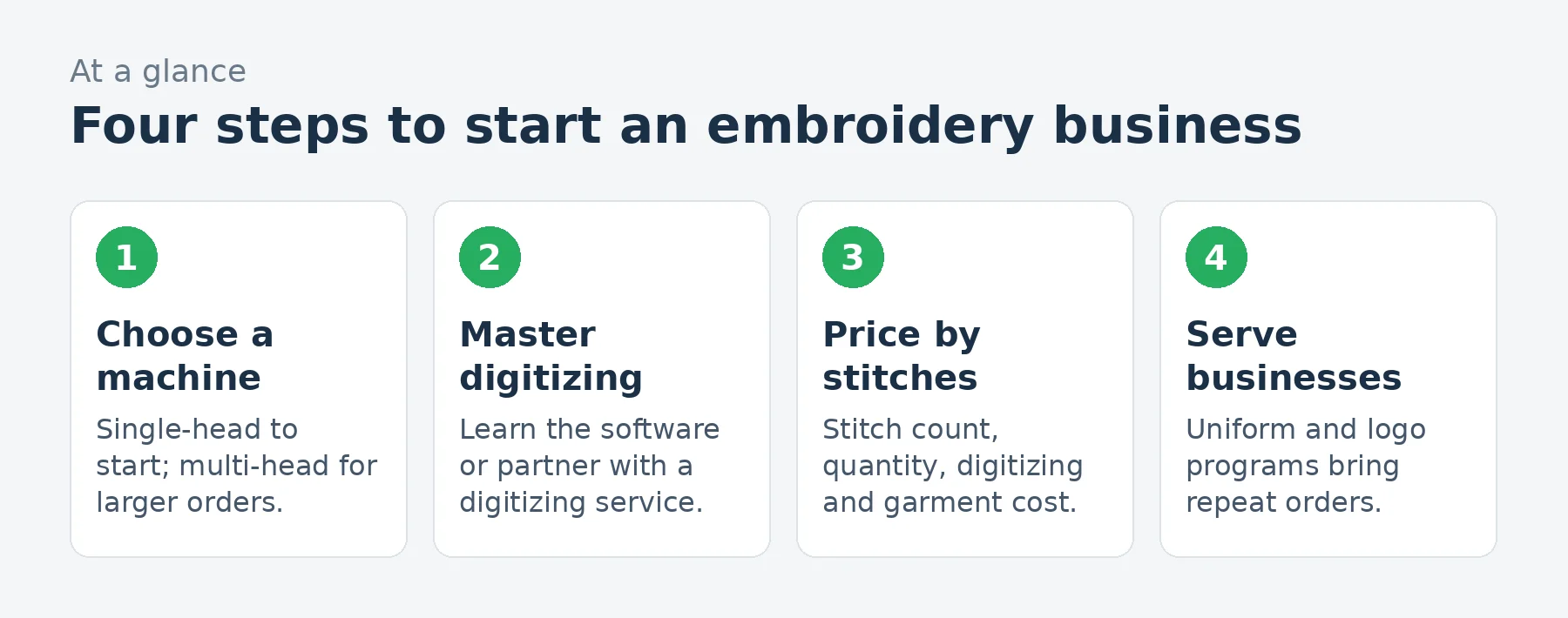
Most shops price by stitch count (designs with more stitches take longer) and quantity (larger orders cost less per piece), plus a one-time digitizing fee and the garment price if you supply it. Charge extra for additional locations, names and specialty items such as caps and bags. Use our pricing calculator.
A worked example: one multi-needle machine
These are illustrative assumptions for a home-based shop with one multi-needle machine, not predictions.
| Assumption | Monthly | |
|---|---|---|
| Business and uniform orders | 600 pieces at $9 embroidery charge | $5,400 |
| Garments supplied and resold | 450 garments marked up over cost | $3,600 |
| Digitizing fees | 12 new logos at $50 | $600 |
| Revenue | $9,600 | |
| Garment costs | 450 garments at $5.50 | $(2,475) |
| Thread, stabilizers and needles | $(350) | |
| Machine payment and maintenance | $(650) | |
| Part-time help | Hooping and finishing | $(900) |
| Software, marketing and fees | $(350) | |
| Profit before owner pay and taxes | $4,875 |
That leaves about $4,875 a month before the owner’s pay and taxes, on about $9,600 of revenue. Adding a second machine or more heads multiplies capacity, since one person can often run several machines.
Finding customers
- Local businesses: staff polos, hats and jackets.
- Medical, dental and veterinary offices: scrubs and lab coats with names.
- Schools, teams and clubs: spirit wear and uniforms.
- Contractors and trades: workwear with logos.
- Gifts: monogrammed towels, bags and baby items.
Uniform programs with repeat orders for new hires are especially valuable.
Hats and specialty items
Caps are among the most popular embroidered items and need cap frames and good technique. Bags, towels, blankets and patches open more markets. Test each new item type and adjust stabilizers and settings before taking large orders.
Uniform programs
Businesses with many employees need consistent uniforms over time. Offer uniform programs: approved garments and logo placement, an online ordering page for employees or managers and stocked inventory for new hires. These programs create predictable repeat revenue.
Managing thread and colors
Keep a thread chart that matches common brand colors, record the thread colors used for each customer’s logo and store thread properly to avoid fading and brittleness. Consistent color across reorders matters to businesses.
Machine care
Clean and oil your machine as the manufacturer recommends, replace needles regularly and keep spare parts on hand. Downtime during a big order is costly, so follow a maintenance schedule and keep a technician’s contact handy.
Adding a second machine
When your machine runs most of the day, a second machine or a multi-head machine increases capacity without doubling labor, since one operator can often run several machines. Add capacity when you have steady repeat business.
Patches and appliqué
Embroidered patches and appliqué designs are popular for jackets, hats, uniforms and teams. They can be made in batches and applied later, which helps with complex or large designs.
Combining with printing
Many shops offer both embroidery and printing, so customers can order polos and hats with embroidery and T-shirts with prints in one place. Partnering with a local printer or adding DTF transfers broadens what you can sell.
Hooping and placement
Correct hooping and placement make the difference between professional and amateur results. Use the right hoop size and stabilizer for each fabric, keep garments taut but not stretched and use placement guides for consistent logo positions across an order.
Names and personalization
Adding names to uniforms, jackets and gifts is a steady add-on. Price each name per piece, use clear lettering fonts and double-check spellings from a written list.
Scheduling production
Plan the machine schedule by deadline, batch orders with the same thread colors and prepare garments and hoops while the machine runs. Efficient scheduling lets one person produce far more each day.
Insurance and customer garments
Customers sometimes supply their own garments, which can be damaged in embroidery. State your policy for customer-supplied items in your terms, test on scrap fabric where possible and carry general liability insurance.
Pricing quotes quickly
Businesses often request quotes for several garments and locations at once. A simple price grid by stitch range and quantity, plus garment prices from your supplier, lets you quote within minutes. Fast, clear quotes win orders.
Common mistakes to avoid
- Using poor digitizing that ruins garments.
- Underpricing high-stitch designs.
- Embroidering logos without permission.
- Skipping test stitch-outs.
- Buying a machine without support and training.
Your first 90 days
- Days 1-30: research machines, buy one with training and practice on test garments.
- Days 31-60: learn digitizing or find a digitizing partner, set prices and open blank supplier accounts.
- Days 61-90: contact 30 local businesses, offices and teams, and deliver first orders on time.
Frequently asked questions
What machine do I need to start embroidery?
A commercial multi-needle single-head machine suits most startups; multi-head machines handle larger orders.
What is digitizing?
Turning artwork into a stitch file that controls how the machine embroiders the design.
How is embroidery priced?
By stitch count and quantity, plus a digitizing fee for new designs and the garment cost.
Can I embroider any logo?
Only with the owner’s permission. Logos are protected by trademark and copyright.
Can I run an embroidery business from home?
Many do, if zoning allows. Machines need power, space and good lighting.
How long does embroidery take per piece?
It depends on stitch count and machine speed; simple left-chest logos can take minutes, larger designs longer.
Do I need to buy digitizing software?
Not necessarily. Many shops outsource digitizing at first and learn the software later.
What sells best in embroidery?
Business polos, caps, jackets and workwear with logos, along with personalized gifts.
Should I embroider customer-supplied garments?
Many shops do, with clear terms about responsibility for damage, since some fabrics are difficult to embroider.
How do I find embroidery customers?
Visit local businesses, offices, schools and contractors with samples, and offer uniform programs and fast turnaround.
How do I price digitizing?
Many shops charge a one-time digitizing fee per new design based on size and complexity, then reuse the file for reorders.
Is embroidery profitable?
It can be, especially with repeat business accounts and efficient production, because machines run while you prepare the next order.
Can I embroider leather or thick items?
Yes, with the right needles, stabilizers, hoops and machine settings. Test first, since mistakes on expensive items are costly.
Keep learning
- Fashion and apparel industry data
- How to start a custom t-shirt printing business
- How to start a clothing brand
- Pricing calculator
Sources
- USPTO, Trademark basics
- US Copyright Office, Copyright basics
- FTC, Threading your way through the labeling requirements (textile products)
- US Bureau of Labor Statistics, Craft and fine artists
Last reviewed November 2, 2026. Startup costs are estimates; check local prices, licensing and tax rules before you commit money.

