
A small egg farm raises laying hens and sells eggs directly to customers, at farmers markets, to restaurants and to local grocers. Many small producers focus on pasture-raised or free-range eggs, which command higher prices than conventional eggs and attract loyal customers.
Eggs are a perishable, regulated food, and bird health is a constant concern: highly pathogenic avian influenza has repeatedly forced the loss of flocks in recent years, making biosecurity essential. The Bureau of Labor Statistics reports a median pay of $87,980 for farmers, ranchers and other agricultural managers (May 2024), though most small farm owners earn far less in their early years, and employment in the occupation is projected to decline slightly. This guide covers flock size, housing, regulations, biosecurity, selling, a worked example and a 90-day plan.
An egg farm at a glance
Table of Contents
| Topic | What to expect |
|---|---|
| Startup cost | Moderate: hens or chicks, coops or mobile housing, fencing, feeders, waterers, egg washing and refrigeration |
| Licenses | State egg licensing and grading rules for most sales; the FDA Egg Safety Rule applies to farms with 3,000 or more laying hens |
| Key risks | Avian influenza, predators, feed costs and egg price swings |
| How you sell | Farm stands, farmers markets, CSAs, restaurants and local grocers |
| Best for | Patient, hands-on people who will care for animals every day of the year |
Who egg farming suits
It suits people who will care for animals every day, in every season, and who enjoy selling directly to customers. Hens need daily feeding, watering, collection and protection from predators and disease.
Choosing your scale and model
- Small flocks (a few dozen to a few hundred hens): direct sales from the farm and at markets; simpler rules in many states.
- Mid-size pasture flocks (hundreds to a few thousand): mobile coops rotated on pasture, sold to markets, restaurants and grocers.
- 3,000 hens and up: the FDA Egg Safety Rule applies, with Salmonella prevention plans, testing, refrigeration and registration.
Pasture-raised, free-range and organic claims each have specific meanings; use them accurately.
Housing, feed and care
Hens need predator-proof housing with nest boxes, roosts, ventilation and protection from weather, plus outdoor space for free-range or pasture systems (often with electric netting). Feed is the largest ongoing cost. Hens lay best in their first year or two, then production declines, so plan for replacing flocks and for what you will do with older hens.
Egg safety rules
The FDA Egg Safety Rule applies to producers with 3,000 or more laying hens, requiring measures such as Salmonella Enteritidis prevention plans, testing, refrigeration and recordkeeping, along with registration. Smaller producers are not covered by that rule but are subject to state egg laws, which often address licensing, grading and candling, cleaning, refrigeration and labeling. Egg cartons for shell eggs generally need safe handling instructions, and reused cartons are restricted in many states.
Biosecurity and avian influenza
Avian influenza has caused the loss of many flocks across the United States in recent years. Follow USDA biosecurity guidance: limit visitors, use dedicated boots and clothing, keep wild birds away from feed and water, clean equipment, isolate new birds and report sick or dying birds immediately. Small and backyard flocks are affected too, so biosecurity is not optional at any size.
Startup costs to plan for
| Item | What to budget for |
|---|---|
| Birds | Started pullets or chicks |
| Housing | Coops or mobile houses, nest boxes, fencing |
| Equipment | Feeders, waterers, egg washing, candler, scale |
| Refrigeration | Walk-in or dedicated refrigerators |
| Licenses | State egg license or registration |
| Packaging | Cartons and labels |
Use our startup cost calculator for your total.
Pricing and selling
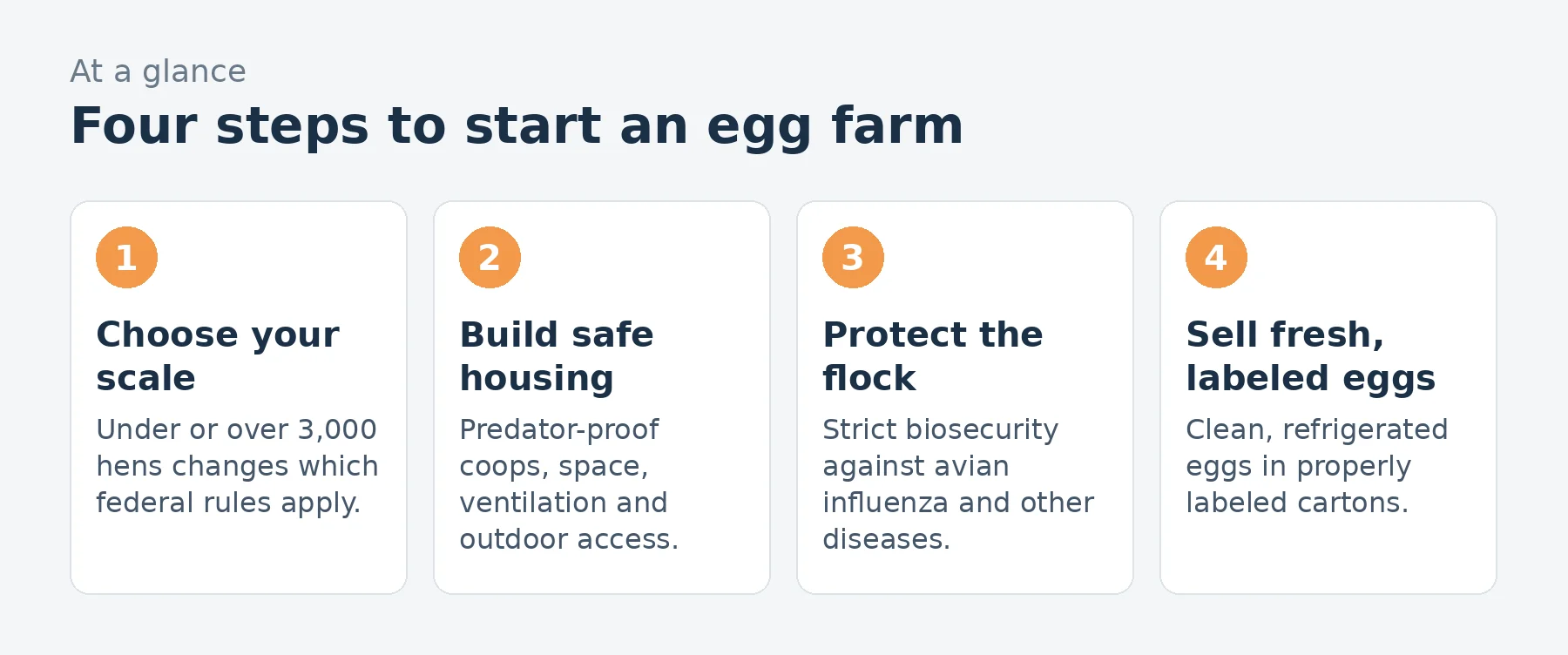
Small farms compete on freshness and how hens are raised, not on supermarket prices. Calculate your cost per dozen (feed, labor, cartons, housing and losses) and price above it; pasture-raised eggs typically sell at premium prices. Sell through farm stands, markets (many accept SNAP), CSAs, restaurants and local grocers, keeping eggs refrigerated throughout.
A worked example: a 500-hen pasture flock
These are illustrative assumptions for a pasture-raised flock of 500 hens, not predictions.
| Assumption | Monthly | |
|---|---|---|
| Egg sales | About 1,000 dozen a month at $7 | $7,000 |
| Revenue | $7,000 | |
| Feed | Layer feed for 500 hens | $(2,300) |
| Bedding, supplements and health | $(300) | |
| Cartons and labels | $(350) | |
| Part-time help | Daily collection, washing and packing | $(1,300) |
| Utilities, fuel and refrigeration | $(300) | |
| Market fees and delivery | $(400) | |
| Flock replacement and housing reserve | Hens lay less as they age | $(500) |
| Profit before owner pay and taxes | $1,550 |
That leaves about $1,550 a month before the farmer’s pay and taxes, on about $7,000 of revenue. Feed is the biggest cost, and a disease outbreak can remove income entirely, so build reserves.
What customers pay for
Customers buying farm eggs are usually paying for freshness, how hens are raised and knowing the farmer. Tell that story honestly: how much outdoor access hens have, what they eat and how you care for them. Clear, truthful claims build trust; vague or misleading ones damage it. Photos of your flock on pasture and invitations to farm events help customers connect.
Collecting, washing and storing
Collect eggs at least daily, more often in hot or cold weather, and handle them gently. Follow your state’s rules on cleaning and washing (some allow dry cleaning of lightly soiled eggs), candle eggs to check for cracks and defects, size or grade as required and refrigerate promptly. Keep eggs cold through storage and delivery.
Flock lifecycle
Plan a replacement schedule so production stays steady: many farms bring in new pullets on a rotation as older hens slow down. Decide in advance what happens to retired hens, whether processing, selling as stewing hens where allowed or other options, and factor that into your costs.
Feed, water and health
Laying hens need a complete layer feed, calcium (such as oyster shell), clean water every day and protection from extreme heat and cold. Watch for signs of illness, parasites and stress, keep housing clean and dry and work with a veterinarian familiar with poultry. Healthy, well-fed hens lay more consistently, which directly affects profit.
Marketing farm eggs
Branded cartons or labels, a farm stand with an honor box or card reader, a simple website and social media posts about your flock help customers find you. Offer egg subscriptions for regular weekly pickup, and partner with bakeries, cafés and restaurants that want local eggs.
Funding a small farm business
Small farm businesses can use several funding sources beyond savings: USDA Farm Service Agency microloans and farm loans (including programs for beginning farmers), state agriculture grants, local farm incubators, crowdfunding and community-supported pre-sales such as CSA shares or presales of products. Talk to your local USDA service center and extension office, which also offer training and technical help for new farmers.
Insurance and records
Carry general and product liability insurance, especially when selling at markets and to stores, and ask about farm property coverage for buildings and equipment. Some crop and livestock insurance programs are available through USDA. Keep clear records of sales, expenses, production and any food safety practices; they support taxes, loans and insurance claims.
Common mistakes to avoid
- Weak biosecurity.
- Underestimating feed costs and price swings.
- Selling without understanding state egg licensing and labeling.
- Inadequate predator protection.
- No plan for aging hens and flock replacement.
Your first 90 days
- Days 1-30: learn your state’s egg rules, choose your flock size and model and plan housing.
- Days 31-60: build coops and fencing, set up biosecurity and order pullets.
- Days 61-90: start collecting eggs, set up washing, refrigeration and labeling, and line up customers.
Frequently asked questions
Do small egg farms need a license?
Most states require some form of egg license or registration for sales, though small direct-sale producers may have simpler rules. Check your state.
When does the FDA Egg Safety Rule apply?
To producers with 3,000 or more laying hens.
How many eggs does a hen lay?
Production varies by breed and age; hens lay most in their first year or two, then decline.
How do I protect my flock from bird flu?
Follow USDA biosecurity guidance: limit visitors, keep wild birds away, clean equipment and report sick birds immediately.
Can I reuse egg cartons?
Many states restrict reused cartons. Check your state’s rules before using them.
Do I need to wash farm eggs before selling?
It depends on your state’s rules. Many require eggs to be clean and some specify washing methods. Check your state’s egg regulations.
Are pasture-raised eggs more profitable?
They usually sell at higher prices, but they also cost more to produce because of land, labor and housing. Price from your actual costs.
How many hens do I need to make a living from eggs?
It depends on prices, costs and your other income. Many small farms combine eggs with vegetables, meat or other products rather than relying on eggs alone.
What breed of chicken is best for eggs?
Many small farms choose hardy, productive laying breeds suited to their climate and housing; hybrids bred for laying produce the most eggs, while heritage breeds may suit pasture systems and customer interest.
Keep learning
- Small farms industry data
- How to start a market garden business
- How to start a beekeeping and honey business
- Pricing calculator
Sources
- FDA, Egg safety final rule
- USDA APHIS, Avian influenza and biosecurity
- US Bureau of Labor Statistics, Farmers, ranchers and other agricultural managers
- USDA Food and Nutrition Service, SNAP at farmers markets
Last reviewed November 2, 2026. Startup costs are estimates; check local prices, licensing and tax rules before you commit money.

