
Permanent jewelry is a chain bracelet, anklet or necklace fitted to the customer and closed with a tiny weld instead of a clasp, so it stays on until cut off. The appointment itself is an experience: friends come together, choose chains and charms and leave with matching pieces.
It became a popular trend because it is quick, social and relatively affordable to start: a micro welder, a chain inventory and good customer service. Because it is a trend, owners do best by building repeat business, events and partnerships rather than relying on novelty. The Bureau of Labor Statistics reports a median pay of $49,140 for jewelers and precious stone and metal workers (May 2024), with about 35,100 jobs and employment projected to decline about 5% over the decade. This guide covers equipment, chains, metal claims, safety, business models, pricing, a worked example and a 90-day plan.
A permanent jewelry business at a glance
Table of Contents
| Topic | What to expect |
|---|---|
| Startup cost | Low to moderate: a jewelry micro welder, chain inventory, tools, safety gear, display and training |
| Licenses | Business license and sales tax permit; event and vendor permits for pop-ups |
| Key rules | Truthful metal descriptions (solid gold, gold-filled, sterling); safe welding practices |
| How you sell | Studio appointments, pop-ups in boutiques and salons, events and private parties |
| Best for | Outgoing, steady-handed people who enjoy events and social selling |
Who permanent jewelry suits
It suits outgoing people who enjoy events and conversation, have steady hands and like a mobile, flexible schedule. Much of the work happens at pop-ups and parties, so you are part jeweler, part host.
Equipment and training
- Micro welder designed for permanent jewelry, with argon gas if your machine uses it.
- Chain cutters, pliers and jump rings.
- Safety gear: eye protection for you and a shield or guard to protect the customer.
- Leather patch or protective pad under the weld point.
- Display for chains and charms, mirror and lighting.
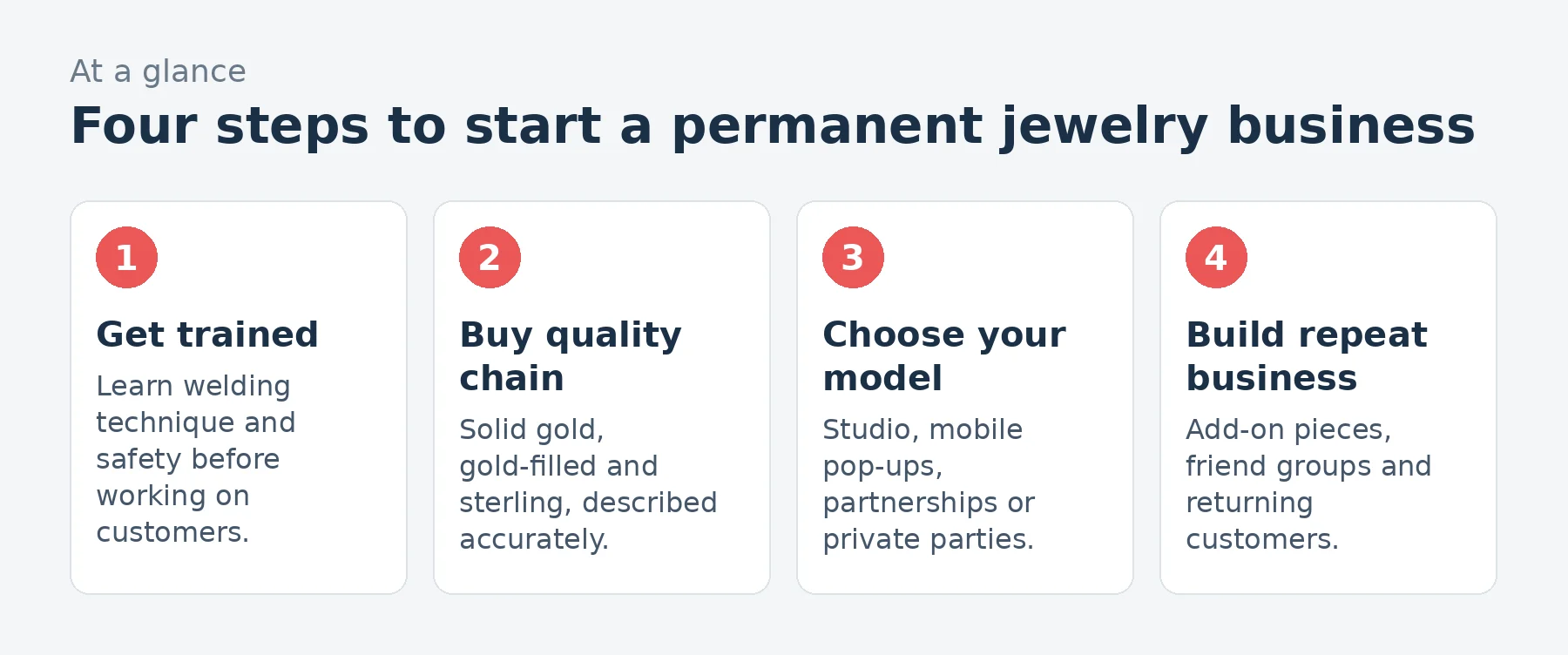
Take hands-on training from an equipment supplier or experienced artist, and practice extensively before welding on customers. Follow the welder manufacturer’s safety instructions.
Chains and metals
Offer chains in 14k solid gold, gold-filled and sterling silver in several styles. Describe them accurately: The FTC’s Jewelry Guides explain how to describe metals truthfully: karat gold markings must be accurate, and terms such as gold-filled, gold-plated and vermeil have specific meanings. Under the National Gold and Silver Stamping Act, if you stamp a quality mark such as "14K" or "925" on jewelry, you must also stamp a registered trademark. Describe stones accurately too, distinguishing natural, lab-grown and simulated stones. Many customers prefer solid gold or gold-filled for durability and skin sensitivity.
Safety and insurance
Protect eyes with appropriate shielding, keep the weld point away from skin with a protective patch, sanitize tools and keep a calm, careful process. Explain to customers how to remove a piece quickly (for medical imaging, for example) and offer free re-welds within a set period. Carry general and professional liability insurance; many host businesses and events require it.
Business models
- Studio appointments: walk-ins and bookings in a small studio or shared space.
- Pop-ups in boutiques and salons: the host brings customers; you share a commission.
- Events and markets: festivals, holiday markets and community events.
- Private parties: bachelorette parties, birthdays and corporate team events.
- Add-on to an existing business: salons, boutiques and tattoo studios adding a service.
Startup costs to plan for
| Item | What to budget for |
|---|---|
| Welder and training | Permanent jewelry welder, argon if required, course |
| Chain inventory | Gold, gold-filled and sterling chains, jump rings, charms |
| Tools and safety | Cutters, pliers, eye protection, shields |
| Display and setup | Display boards, mirror, lighting, table |
| Booking and payments | Online booking, card reader |
| Insurance | General and professional liability |
Use our startup cost calculator for your total.
Pricing
Price by chain type and length: chain cost per inch, a jump ring, your time and a margin, with solid gold priced well above gold-filled and sterling. Offer stacking discounts, party packages and charm add-ons. Research local prices and update for gold price changes. Use our pricing calculator.
A worked example: a month of pop-ups and parties
These are illustrative assumptions for a busy month of pop-ups and parties, not predictions; trend-driven demand can change.
| Assumption | Monthly | |
|---|---|---|
| Pop-up and studio pieces | 180 pieces at $70 average | $12,600 |
| Private parties and events | 6 parties at $500 (beyond per-piece sales) | $3,000 |
| Revenue | $15,600 | |
| Chain, jump rings and charms | Materials | $(3,200) |
| Host commissions | Share paid to partner boutiques and salons | $(1,500) |
| Assistant | Help at busy events | $(1,000) |
| Travel and event fees | $(500) | |
| Marketing and booking software | $(500) | |
| Insurance and supplies | $(300) | |
| Profit before owner pay and taxes | $8,600 |
That leaves about $8,600 a month before the owner’s pay and taxes, on about $15,600 of revenue. Chain costs vary sharply by metal; solid gold pieces cost far more and should be priced accordingly.
Building repeat business
Trends fade, so build loyalty: invite customers back to add pieces, offer friendship and anniversary events, run seasonal charm launches and keep a list of customers for announcements. Partnerships with boutiques and salons that host monthly pop-ups bring steady traffic.
Running a smooth pop-up
Set up a compact station with chains displayed by metal and price, a mirror, lighting and a clear menu. Use a sign-up list or booking app to manage lines, work efficiently with one customer at a time and keep the experience friendly and unhurried even when busy.
Hosting private parties
Parties bring groups who buy together. Offer packages with a minimum spend or a set number of pieces, travel to homes or venues and include a host reward. Confirm guest count, space and lighting in advance, and bring enough chain variety.
Charms and add-ons
Charms, connectors and initial pendants raise the average sale and give customers reasons to return to add more. Rotate seasonal charms and themed collections for holidays and occasions.
Managing chain inventory
Track chain by metal, style and length used, and reorder before running low on best sellers. Gold chains tie up significant cash, so stock a few popular styles deeply rather than many styles thinly.
Booking and payments
Online booking for studio appointments and parties, deposits for private events and a reliable card reader keep things organized. Collect customer emails for re-weld reminders and new collection announcements.
Aftercare and re-welds
Explain care: avoiding catching chains, removing them if needed for medical procedures and what to do if a chain breaks. Offer free or low-cost re-welds within a set period, which builds trust and brings customers back.
Studio or mobile?
A small studio gives a consistent location and walk-in traffic but adds rent. Mobile pop-ups and parties keep costs low and reach more people. Many artists combine a studio base with regular pop-ups.
Working with salons and boutiques
Partner businesses provide customers and space; you provide the service. Agree on commission or rent, schedule, marketing responsibilities and how bookings are handled. Regular monthly pop-ups at the same partner build a following.
Hiring help
As demand grows, train an assistant to manage lines, payments and chain cutting, or train additional welders to cover more events. Keep safety training and consistent technique as priorities.
Records and taxes
Track sales by event and metal, collect sales tax where required and keep receipts for chain and equipment purchases.
Common mistakes to avoid
- Welding on customers before mastering technique.
- Inaccurate metal descriptions.
- Skipping eye and skin protection.
- Relying only on the trend without repeat business.
- Underpricing solid gold pieces.
Your first 90 days
- Days 1-30: take training, buy a welder and practice, choose chains and set prices.
- Days 31-60: buy insurance, set up online booking and run pop-ups for friends and family.
- Days 61-90: partner with two boutiques or salons, book private parties and collect reviews.
Frequently asked questions
What is permanent jewelry?
A chain fitted to the customer and closed with a small weld instead of a clasp, so it stays on until cut off.
Do I need a license for permanent jewelry?
Usually a business license and sales tax permit, plus event or vendor permits for pop-ups. Check local rules.
Is permanent jewelry safe?
When done with proper equipment, eye protection and a protective patch under the weld, it is a quick, low-risk process.
What chains should I offer?
Solid gold, gold-filled and sterling silver in several styles, described accurately.
How do customers remove permanent jewelry?
By cutting the chain at a jump ring; many artists offer free re-welds within a set period.
How long does a permanent jewelry appointment take?
Often just a few minutes per piece once the customer chooses a chain, which makes events efficient.
Do permanent jewelry artists need argon gas?
Some welders use argon for cleaner welds; follow your equipment manufacturer’s instructions.
Is permanent jewelry a passing trend?
Demand may change, so build repeat business, events and partnerships rather than relying on novelty alone.
Keep learning
- Jewelry and accessories industry data
- How to start a handmade jewelry business
- How to start a boutique clothing store
- Pricing calculator
Sources
- FTC, Guides for the jewelry, precious metals and pewter industries
- US Code, National Gold and Silver Stamping Act (15 U.S.C. 291-300)
- OSHA, Eye and face protection
- US Bureau of Labor Statistics, Jewelers and precious stone and metal workers
- US Small Business Administration, Apply for licenses and permits
Last reviewed November 2, 2026. Startup costs are estimates; check local prices, licensing and tax rules before you commit money.

