
Parents need summer care, and kids want adventure, friends and new skills. Summer camps meet both needs, from week-long specialty programs to traditional day camps and overnight camps. The Bureau of Labor Statistics counted about 327,700 recreation workers in 2024, with a median wage of $35,380 in May 2024, 4% projected growth and about 68,100 openings a year.
Camps range from specialty day camps in rented spaces (sports, STEM, art, theater) to traditional day camps and overnight camps with facilities, waterfronts and large seasonal staffs. Safety, staffing and parent trust are the foundation of every camp.
The workforce
| Occupation | Jobs (2024) | Median pay (May 2024) | Projected growth, 2024 to 2034 |
|---|---|---|---|
| Recreation workers | 327,700 | $35,380 | +4% |
Source: U.S. Bureau of Labor Statistics, Occupational Outlook Handbook and Occupational Employment and Wage Statistics.
Market data
| Measure | Value |
|---|---|
| Openings projected each year, 2024 to 2034 | about 68,100 |
Business models compared
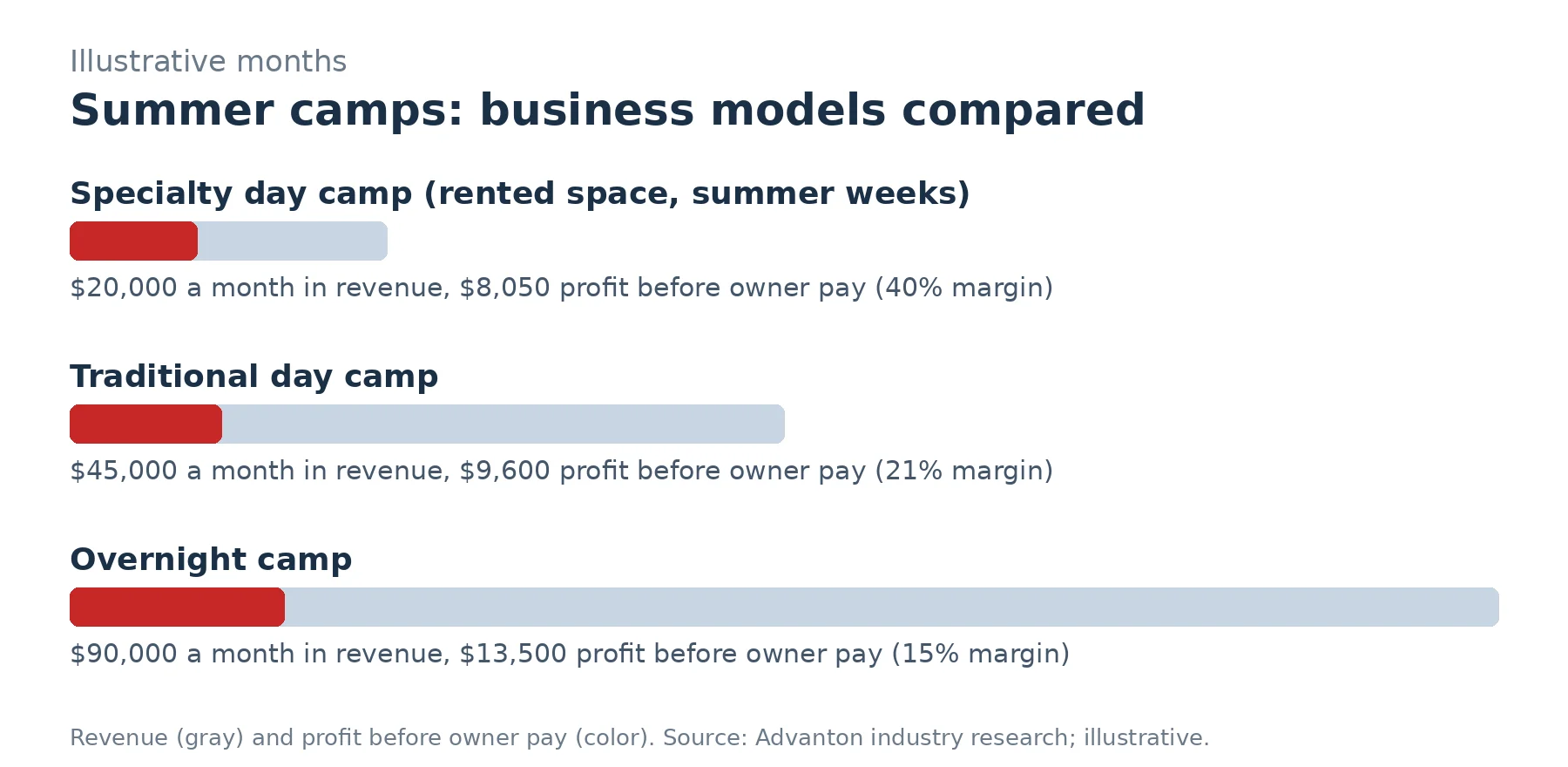
The figures below are illustrative months from our research, not industry averages. They show how revenue and costs typically fit together; your market, prices and costs will differ.
| Business model | Startup costs | Example monthly revenue | Costs | Profit before owner pay | Margin |
|---|---|---|---|---|---|
| Specialty day camp (rented space, summer weeks) | Low: curriculum, supplies, rented space, insurance | $20,000 | $11,950 | $8,050 | 40% |
| Traditional day camp | Moderate: facility lease, transportation, staff, equipment | $45,000 | $35,400 | $9,600 | 21% |
| Overnight camp | Very high: land, cabins, dining hall, waterfront, staff | $90,000 | $76,500 | $13,500 | 15% |
Fixed and variable costs
For projections, the most useful split is between variable costs, which rise and fall with sales (materials, supplies, hourly labor, fees), and fixed costs, which you pay every month regardless (rent, salaried staff, insurance, loan payments).
| Business model | Variable costs (% of revenue) | Fixed costs per month | What it means |
|---|---|---|---|
| Specialty day camp (rented space, summer weeks) | 39.0% | $4,150 | Balanced: margins improve as volume grows |
| Traditional day camp | 50.4% | $12,700 | Mostly variable: profitable early, but watch cash flow |
| Overnight camp | 49.4% | $32,000 | Balanced: margins improve as volume grows |
What the numbers say
Staff pay is the largest cost, because safe ratios require many counselors.
Specialty day camps start lean in rented space with focused programs.
Overnight camps carry heavy property costs year-round while earning revenue mostly in summer.
The three models in brief
Specialty day camp. Sports, STEM, arts or theater camps by the week. See tutoring and education data.
Traditional day camp. Full-day summer programs with varied activities. See childcare data.
Overnight camp. Residential camps with cabins, dining and waterfront programs.
Cost structure: traditional day camp
Each cost as a share of the example month’s revenue ($45,000):
| Cost | Monthly amount | Share of revenue | Type |
|---|---|---|---|
| Staff pay | $16,000 | 35.6% | Variable |
| Facility lease | $5,000 | 11.1% | Fixed |
| Director | $3,500 | 7.8% | Fixed |
| Food and supplies | $3,000 | 6.7% | Variable |
| Payroll taxes and workers’ comp | $2,400 | 5.3% | Variable |
| Transportation | $2,000 | 4.4% | Fixed |
| Payment fees | $1,300 | 2.9% | Variable |
| Marketing | $1,200 | 2.7% | Fixed |
| Insurance | $800 | 1.8% | Fixed |
| Software | $200 | 0.4% | Fixed |
| Profit before owner pay | $9,600 | 21% |
A first-year projection: traditional day camp
New businesses rarely start at full speed. This projection assumes revenue ramps from 35% of the example month in month 1 to 100% by month 12, variable costs move with revenue, and fixed costs stay the same every month. It’s a planning illustration, not a forecast.
| Month | Revenue | Variable costs | Fixed costs | Profit | Cumulative |
|---|---|---|---|---|---|
| 1 | $15,750 | $7,938 | $12,700 | -$4,888 | -$4,888 |
| 2 | $20,250 | $10,206 | $12,700 | -$2,656 | -$7,544 |
| 3 | $24,750 | $12,474 | $12,700 | -$424 | -$7,968 |
| 4 | $27,900 | $14,062 | $12,700 | $1,138 | -$6,830 |
| 5 | $31,500 | $15,876 | $12,700 | $2,924 | -$3,906 |
| 6 | $34,200 | $17,237 | $12,700 | $4,263 | $357 |
| 7 | $36,900 | $18,598 | $12,700 | $5,602 | $5,959 |
| 8 | $39,150 | $19,732 | $12,700 | $6,718 | $12,677 |
| 9 | $40,950 | $20,639 | $12,700 | $7,611 | $20,288 |
| 10 | $42,750 | $21,546 | $12,700 | $8,504 | $28,792 |
| 11 | $44,100 | $22,226 | $12,700 | $9,174 | $37,966 |
| 12 | $45,000 | $22,680 | $12,700 | $9,620 | $47,586 |
Year one: revenue $403,200, profit before owner pay $47,586. The first profitable month is month 4. Cumulative results bottom out at -$7,968, which is the minimum cash cushion this plan would need, before any startup costs.
The facility lease, director and transportation start before registrations fill, so this day camp illustration turns profitable in month 4, with a cumulative low of about $8,000. Real camp revenue arrives through spring registrations for summer sessions.
How camps earn
- Weekly tuition by session.
- Early registration and sibling packages.
- Extended care before and after camp.
- Field trips and specialty add-ons.
- Off-season programs and facility rentals.
Licensing and safety
Camp rules vary by state and city. Learn requirements for ratios, health staff, medication, food, swimming and transportation, and build written emergency plans and daily safety routines.
Hiring and training staff
Counselors make or break a camp. Recruit early, run background checks, train on supervision, behavior management, child protection and emergencies, and assign experienced leaders to newer staff.
A startup checklist
- Check camp licensing and permits.
- Run background checks for all staff.
- Write safety, health and emergency plans.
- Insure the camp.
- Set up online registration and medical forms.
Waterfront and activity safety
Swimming, boating and adventure activities require certified staff, clear rules and constant supervision. Many camps follow accreditation standards for high-risk activities.
Where the opportunities are
- STEM and coding camps.
- Sports skills camps.
- Arts, theater and music camps.
- Inclusive camps for children with disabilities.
- Outdoor and nature camps.
Key terms
| Term | Meaning |
|---|---|
| Ratio | Number of campers per counselor |
| ACA accreditation | Voluntary standards from the American Camp Association |
| Session | A week or multi-week camp period |
| Extended care | Supervised time before or after camp |
Registration and cash flow
Most families register in winter and spring. Early-bird pricing, deposits and online registration bring cash in before summer costs begin.
Key numbers to track
Track enrollment by session, capacity utilization, retention year to year, staff ratio and incidents.
Common mistakes
- Late staff hiring.
- Weak safety plans.
- Underpricing for real staffing costs.
- Poor parent communication.
- Ignoring licensing rules.
Marketing a summer camp
Camp fairs, school partnerships, social media, referral discounts and reviews fill sessions. See childcare data.
Parent communication
Daily photos, clear schedules, weekly newsletters and quick responses reassure parents and drive re-enrollment for next summer.
Health and medication
Collect health forms, store medications safely and train every staff member on allergies, heat illness and emergencies.
Inclusion
Accommodating campers with disabilities requires planning, trained staff and may be required by law; it also broadens your community.
Off-season revenue
School breaks, weekend programs, retreats and facility rentals help cover year-round costs.
Facilities
Shaded areas, restrooms, indoor backup space for bad weather and secure pickup procedures matter for day camps.
Pricing a camp week
Price each week from real costs: counselor ratios, supplies, facility, insurance, food and transportation, plus overhead and profit. Compare with local camps, and offer extended care, sibling discounts and early registration to fill sessions without cutting below cost.
Counselors in training
Programs that train older campers as junior counselors build future staff, keep teens returning and strengthen camp culture. Pair them with experienced counselors and clear responsibilities.
Day-one experience
The first morning sets the tone for families and campers. Smooth check-in, friendly greetings, clear name tags and a quick photo update to parents build confidence for the whole session.
Retention
Returning campers and counselors are the heart of a camp; build traditions families love and look forward to.
Test these numbers with your own plan
Open this industry in our free Business Idea Reality Check to start from any model above, change prices, costs, startup budget and your own pay, and see your break-even month, the cash you’d need, three scenarios and how new businesses in this sector survive in your state.
- Start with the closest model and its cost structure.
- Replace every price and cost with local quotes.
- Estimate your ramp: how fast customers will realistically come in year one.
- Map cash month by month with the free Cash & Payroll Planner.
- Build the full plan in the free Business Planner.
About this data
Workforce figures come from the U.S. Bureau of Labor Statistics (Occupational Outlook Handbook and Occupational Employment and Wage Statistics, May 2024 wages and the 2024 to 2034 projections, unless noted). Market figures cite their sources above. Business model figures are illustrative months built from typical prices and costs to show how revenue, fixed costs and variable costs fit together; they are not industry averages or guarantees. We review these profiles when new government data is released, at least once a year, and the same figures power the Business Idea Reality Check.
Licensing and rules
Many states and localities license youth camps, with rules on staff ratios, health care, food service, water safety, transportation and inspections, while some programs may be exempt depending on structure; background checks for staff working with children are essential and often required; waterfront activities require certified lifeguards; food service requires health permits; accreditation from the American Camp Association is voluntary but widely recognized; insurance, emergency plans and parent agreements are standard. Requirements change; confirm with your state and local agencies before you start.
Frequently asked questions
Do summer camps need a license?
Many states and localities license youth camps; check your area.
Do camp counselors need background checks?
Background checks for staff working with children are essential and often required.
What is ACA accreditation?
Voluntary standards from the American Camp Association that many parents recognize.
What do recreation workers earn?
BLS reported a median of $35,380 in May 2024.
Is a summer camp profitable?
It can be, with full sessions, efficient staffing and early registration.
When do families register for camp?
Mostly in winter and spring.
How many counselors does a camp need?
It depends on ages, activities and state rules; plan ratios by group and activity.
Can I run a camp in a rented school or church?
Many specialty day camps do; confirm insurance, permits and space agreements.
How can I test these numbers?
Open summer camps in the Business Idea Reality Check and enter your own tuition and costs.
Keep learning
Sources
Last reviewed November 1, 2026. Startup costs are estimates; check local prices, licensing and tax rules before you commit money.

