
Weddings, corporate events, reunions, fundraisers and parties all need a place to happen, and distinctive venues book dates months or years ahead. A venue is real estate plus hospitality: property costs are fixed, and revenue depends on how many dates you sell and at what price. Event planners, who book and run many venues, earned a median of $59,440 in May 2024, and the Bureau of Labor Statistics counted about 155,800 of them, with 5% projected growth.
Venues range from rustic barns and estates to urban lofts and all-inclusive wedding venues offering catering, coordination and rentals. Zoning, occupancy permits and parking are often the hardest parts to get right.
The workforce
| Occupation | Jobs (2024) | Median pay (May 2024) | Projected growth, 2024 to 2034 |
|---|---|---|---|
| Meeting, convention and event planners | 155,800 | $59,440 | +5% |
Source: U.S. Bureau of Labor Statistics, Occupational Outlook Handbook and Occupational Employment and Wage Statistics.
Business models compared
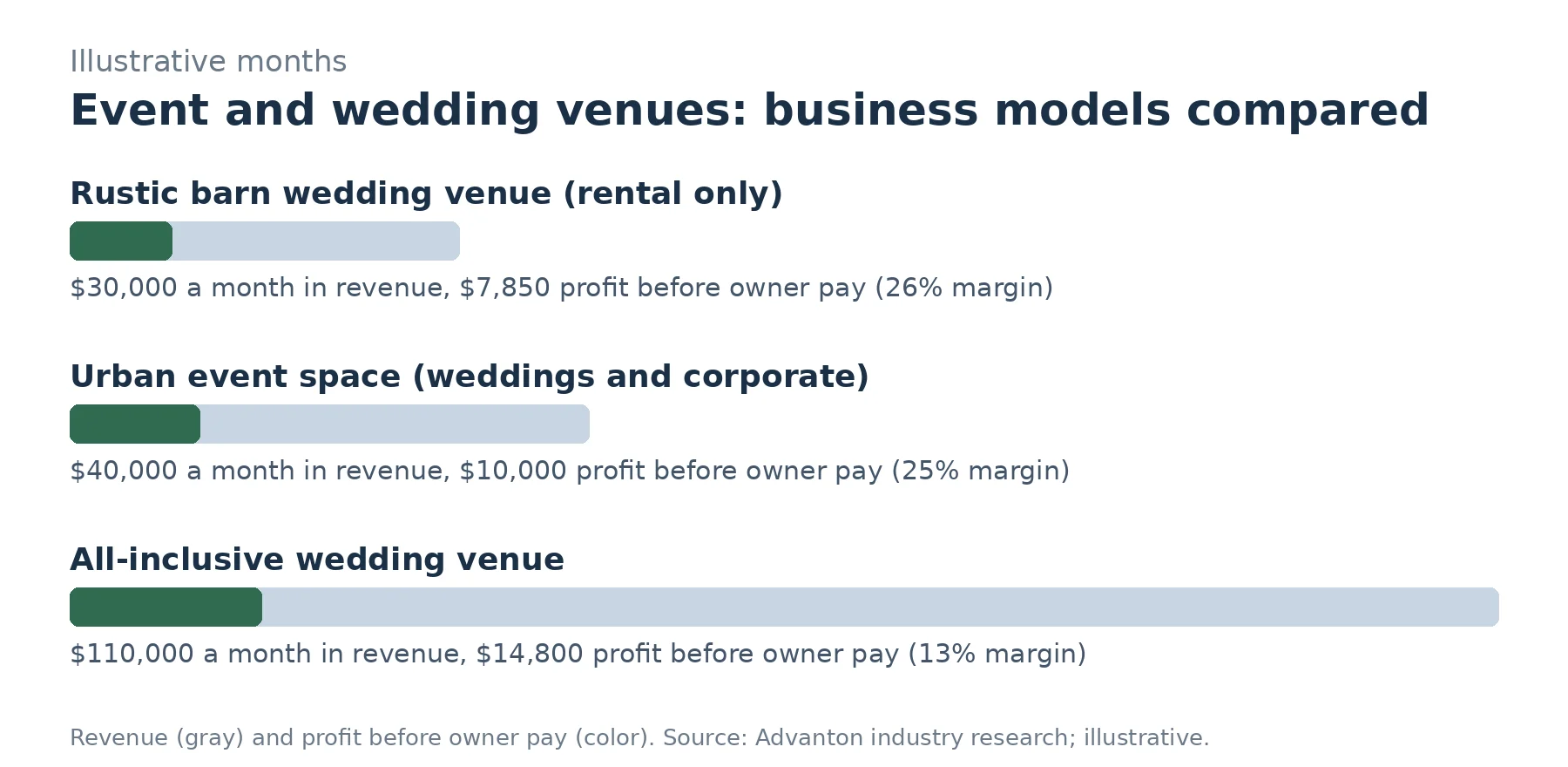
The figures below are illustrative months from our research, not industry averages. They show how revenue and costs typically fit together; your market, prices and costs will differ.
| Business model | Startup costs | Example monthly revenue | Costs | Profit before owner pay | Margin |
|---|---|---|---|---|---|
| Rustic barn wedding venue (rental only) | High: property, renovation, restrooms, parking, permits | $30,000 | $22,150 | $7,850 | 26% |
| Urban event space (weddings and corporate) | High: lease, build-out, AV, furnishings | $40,000 | $30,000 | $10,000 | 25% |
| All-inclusive wedding venue | Very high: property, kitchen, staff, rentals inventory | $110,000 | $95,200 | $14,800 | 13% |
Fixed and variable costs
For projections, the most useful split is between variable costs, which rise and fall with sales (materials, supplies, hourly labor, fees), and fixed costs, which you pay every month regardless (rent, salaried staff, insurance, loan payments).
| Business model | Variable costs (% of revenue) | Fixed costs per month | What it means |
|---|---|---|---|
| Rustic barn wedding venue (rental only) | 16.7% | $17,150 | Mostly fixed: needs steady volume to cover overhead |
| Urban event space (weddings and corporate) | 18.0% | $22,800 | Mostly fixed: needs steady volume to cover overhead |
| All-inclusive wedding venue | 46.5% | $44,000 | Balanced: margins improve as volume grows |
What the numbers say
Property costs are mostly fixed, so every unsold Saturday is lost revenue that can’t be recovered.
All-inclusive venues earn far more per event through catering, bar and coordination, with higher staffing and food costs.
Midweek and off-season events add revenue on dates that would otherwise sit empty.
The three models in brief
Rustic barn wedding venue. Rental-only venue with couples bringing their own caterers and planners. See events and weddings data.
Urban event space. Flexible space for weddings, corporate events and parties.
All-inclusive wedding venue. Venue, catering, bar, coordination and rentals in one package. See catering data.
Cost structure: urban event space (weddings and corporate)
Each cost as a share of the example month’s revenue ($40,000):
| Cost | Monthly amount | Share of revenue | Type |
|---|---|---|---|
| Rent | $10,000 | 25.0% | Fixed |
| Event staff | $6,000 | 15.0% | Variable |
| Sales and venue manager | $6,000 | 15.0% | Fixed |
| Marketing | $2,000 | 5.0% | Fixed |
| Utilities | $1,500 | 3.8% | Fixed |
| Cleaning and maintenance | $1,500 | 3.8% | Fixed |
| Card fees | $1,200 | 3.0% | Variable |
| AV and equipment payments | $1,000 | 2.5% | Fixed |
| Insurance | $800 | 2.0% | Fixed |
| Profit before owner pay | $10,000 | 25% |
A first-year projection: urban event space (weddings and corporate)
New businesses rarely start at full speed. This projection assumes revenue ramps from 35% of the example month in month 1 to 100% by month 12, variable costs move with revenue, and fixed costs stay the same every month. It’s a planning illustration, not a forecast.
| Month | Revenue | Variable costs | Fixed costs | Profit | Cumulative |
|---|---|---|---|---|---|
| 1 | $14,000 | $2,520 | $22,800 | -$11,320 | -$11,320 |
| 2 | $18,000 | $3,240 | $22,800 | -$8,040 | -$19,360 |
| 3 | $22,000 | $3,960 | $22,800 | -$4,760 | -$24,120 |
| 4 | $24,800 | $4,464 | $22,800 | -$2,464 | -$26,584 |
| 5 | $28,000 | $5,040 | $22,800 | $160 | -$26,424 |
| 6 | $30,400 | $5,472 | $22,800 | $2,128 | -$24,296 |
| 7 | $32,800 | $5,904 | $22,800 | $4,096 | -$20,200 |
| 8 | $34,800 | $6,264 | $22,800 | $5,736 | -$14,464 |
| 9 | $36,400 | $6,552 | $22,800 | $7,048 | -$7,416 |
| 10 | $38,000 | $6,840 | $22,800 | $8,360 | $944 |
| 11 | $39,200 | $7,056 | $22,800 | $9,344 | $10,288 |
| 12 | $40,000 | $7,200 | $22,800 | $10,000 | $20,288 |
Year one: revenue $358,400, profit before owner pay $20,288. The first profitable month is month 5. Cumulative results bottom out at -$26,584, which is the minimum cash cushion this plan would need, before any startup costs.
Mortgage, taxes, insurance and the venue manager continue while the calendar fills, so this barn venue illustration turns profitable in month 5, with a cumulative low of about $26,600, before property and renovation investment. Real bookings cluster in peak seasons.
How venues earn
- Venue rental fees by day, season and day of week.
- Packages with tables, chairs, linens and coordination.
- Catering and bar revenue for all-inclusive venues.
- Ceremony fees, rehearsal dinners and overnight lodging.
- Corporate meetings and community events on weekdays.
Selling dates
Venues sell time. Price Saturdays in peak season highest, offer lower rates for Fridays, Sundays and off-season dates, and fill weekdays with corporate and community events. Track how far ahead dates sell and adjust pricing accordingly.
Zoning and permits first
Before buying or renovating, confirm zoning allows events, learn occupancy and fire requirements, and understand parking, road access and noise rules. Many venue projects stall because permits cost more or take longer than expected.
A startup checklist
- Confirm zoning and special use permits.
- Plan occupancy, exits and restrooms with code requirements.
- Decide on catering and alcohol policies.
- Get event liability insurance.
- Choose booking and contract software.
Vendor policies
Rental-only venues often keep preferred vendor lists; all-inclusive venues control catering and bar service. Clear policies protect quality, safety and your license, especially for alcohol.
Where the opportunities are
- Micro weddings and elopements.
- Corporate retreats and team events.
- Venues with on-site lodging.
- Cultural and community celebrations.
- Off-season themed events.
Key terms
| Term | Meaning |
|---|---|
| Assembly occupancy | Building code category for event spaces |
| Preferred vendor list | Vendors a venue recommends or requires |
| Peak date | High-demand dates such as fall Saturdays |
| Buyout | Exclusive use of the venue for an event |
Contracts and deposits
Contracts should cover fees, payment schedules, deposits, cancellation and postponement terms, guest counts, vendor rules, cleanup and damage responsibilities. Deposits secure dates and protect cash flow.
Key numbers to track
Track booked dates by season, average revenue per event, inquiry-to-tour and tour-to-booking rates, weekday utilization and review scores.
Common mistakes
- Buying property before confirming zoning.
- Underestimating parking and restroom requirements.
- Discounting peak dates.
- Unclear alcohol policies.
- No weekday or off-season strategy.
Marketing a venue
Professional photos, wedding directories, Instagram, open houses, styled shoots and planner partnerships bring inquiries. See wedding planning data.
Insurance and risk
Events involve crowds, alcohol, weather and vendors. Require vendors to carry insurance and name the venue as additional insured, ask couples to buy event insurance, and keep incident procedures ready so problems are handled calmly and documented.
Neighbors and noise
Good neighbor relationships protect permits. Set end times, manage music volume and traffic, and communicate with neighbors about large events.
On-site lodging and add-ons
Venues with cottages, bridal suites or nearby lodging partnerships keep wedding parties on site, raising revenue and convenience. Add-ons such as rehearsal dinners, farewell brunches, upgraded lighting and ceremony arches increase average event value without much extra cost.
Running event days
Clear timelines, a venue coordinator on site, cleanup crews and checklists make event days smooth and reviews strong. A final walkthrough with each couple or client a week before the event prevents surprises.
Test these numbers with your own plan
Open this industry in our free Business Idea Reality Check to start from any model above, change prices, costs, startup budget and your own pay, and see your break-even month, the cash you’d need, three scenarios and how new businesses in this sector survive in your state.
- Start with the closest model and its cost structure.
- Replace every price and cost with local quotes.
- Estimate your ramp: how fast customers will realistically come in year one.
- Map cash month by month with the free Cash & Payroll Planner.
- Build the full plan in the free Business Planner.
About this data
Workforce figures come from the U.S. Bureau of Labor Statistics (Occupational Outlook Handbook and Occupational Employment and Wage Statistics, May 2024 wages and the 2024 to 2034 projections, unless noted). Market figures cite their sources above. Business model figures are illustrative months built from typical prices and costs to show how revenue, fixed costs and variable costs fit together; they are not industry averages or guarantees. We review these profiles when new government data is released, at least once a year, and the same figures power the Business Idea Reality Check.
Licensing and rules
Zoning approval is critical, and many rural or residential properties need special or conditional use permits for events; building and fire codes set occupancy limits, exits and sprinkler requirements for assembly use; alcohol must be served under the venue’s or a licensed caterer’s license, depending on state law; noise ordinances, parking requirements and road access affect approvals; ADA accessibility applies; health permits apply if the venue provides food; event liability insurance is standard. Requirements change; confirm with your state and local agencies before you start.
Frequently asked questions
Is owning an event venue profitable?
It can be, if you sell enough dates at strong prices and manage fixed property costs.
Do venues need special permits?
Usually zoning or special use permits, plus occupancy and fire approvals.
Can venues serve alcohol?
Depending on state law, alcohol may need the venue’s license or a licensed caterer.
How do venues price events?
By season, day of week, guest count and included services.
What insurance do venues need?
Event liability, property and liquor liability coverage where alcohol is served.
What do event planners earn?
BLS reported a median of $59,440 in May 2024.
How far ahead do weddings book venues?
Often a year or more for popular dates.
How can I test these numbers?
Open event and wedding venues in the Business Idea Reality Check and enter your own prices and costs.
Keep learning
Sources
Last reviewed November 1, 2026. Startup costs are estimates; check local prices, licensing and tax rules before you commit money.

