
Weddings combine dozens of vendors, tight timelines, family dynamics and big budgets, and many couples hire planners to keep everything on track. The Bureau of Labor Statistics counted about 155,800 meeting, convention and event planners in 2024, with a median wage of $59,440 in May 2024 and 5% projected growth. Below is the key industry data on wedding planning businesses, with costs, business models and a first-year projection.
Wedding planning businesses range from day-of coordinators to full-service planners and luxury or destination firms. Reputation, vendor relationships and clear contracts decide success.
The workforce
| Occupation | Jobs (2024) | Median pay (May 2024) | Projected growth, 2024 to 2034 |
|---|---|---|---|
| Meeting, convention and event planners | 155,800 | $59,440 | +5% |
Source: U.S. Bureau of Labor Statistics, Occupational Outlook Handbook and Occupational Employment and Wage Statistics.
Business models compared
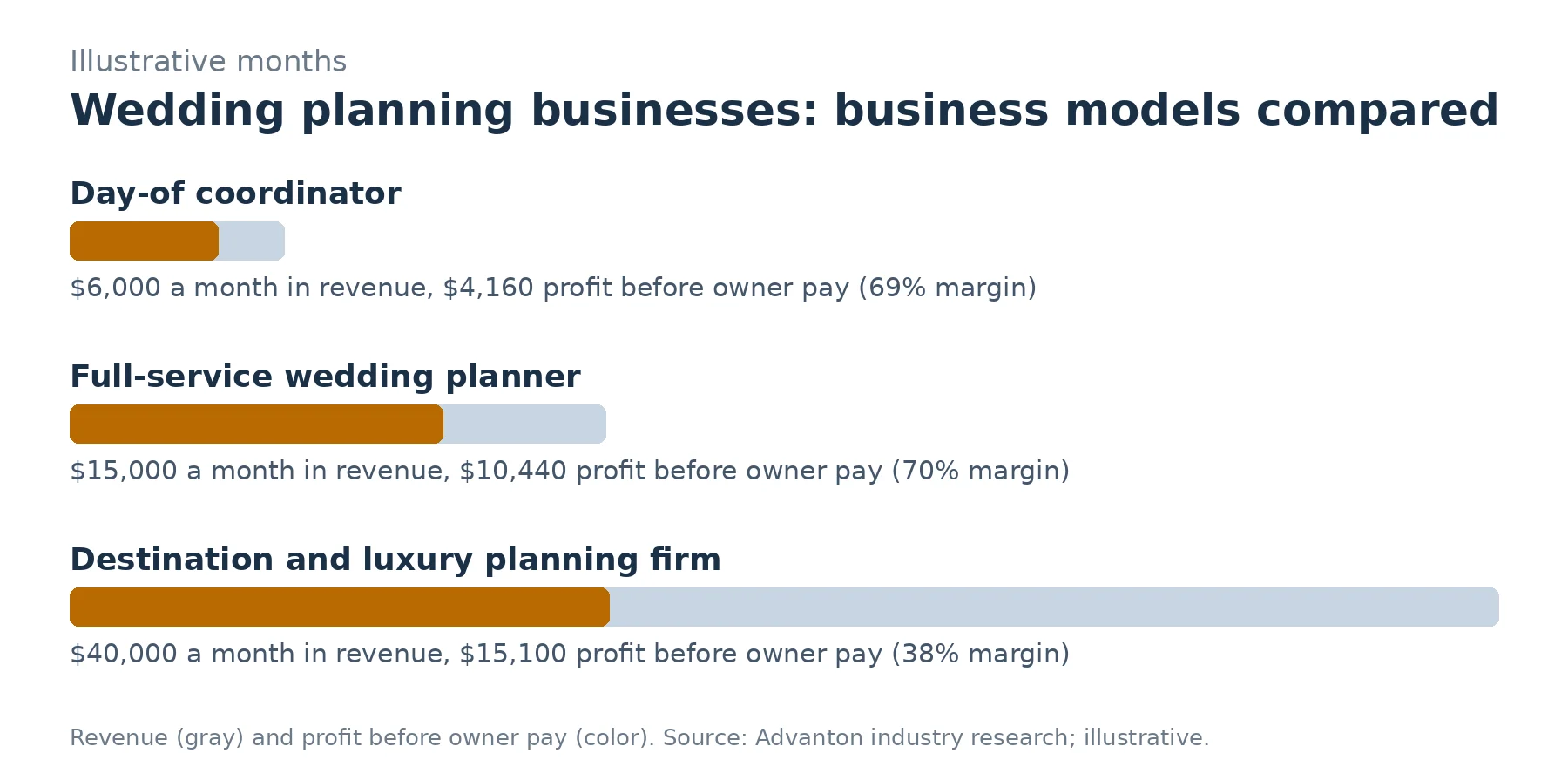
The figures below are illustrative months from our research, not industry averages. They show how revenue and costs typically fit together; your market, prices and costs will differ.
| Business model | Startup costs | Example monthly revenue | Costs | Profit before owner pay | Margin |
|---|---|---|---|---|---|
| Day-of coordinator | Low: website, portfolio, contracts, insurance | $6,000 | $1,840 | $4,160 | 69% |
| Full-service wedding planner | Low to moderate: portfolio, listings, assistants | $15,000 | $4,560 | $10,440 | 70% |
| Destination and luxury planning firm | Moderate: team, travel, design inventory | $40,000 | $24,900 | $15,100 | 38% |
Fixed and variable costs
For projections, the most useful split is between variable costs, which rise and fall with sales (materials, supplies, hourly labor, fees), and fixed costs, which you pay every month regardless (rent, salaried staff, insurance, loan payments).
| Business model | Variable costs (% of revenue) | Fixed costs per month | What it means |
|---|---|---|---|
| Day-of coordinator | 16.3% | $860 | Mostly fixed: needs steady volume to cover overhead |
| Full-service wedding planner | 19.0% | $1,710 | Mostly fixed: needs steady volume to cover overhead |
| Destination and luxury planning firm | 40.5% | $8,700 | Balanced: margins improve as volume grows |
What the numbers say
Planning has low overhead, so most fees become income for solo planners.
Revenue is seasonal and lumpy: weddings cluster in certain months, and payments arrive in installments.
Luxury and destination firms command higher fees but need teams, travel and design resources.
The three models in brief
Day-of coordinator. Final-month planning and wedding-day management. See events and weddings data.
Full-service planner. Planning from engagement through the wedding, including budgets, vendors and design.
Destination and luxury firm. High-budget and destination weddings with design and travel coordination. See travel and tourism data.
Cost structure: full-service wedding planner
Each cost as a share of the example month’s revenue ($15,000):
| Cost | Monthly amount | Share of revenue | Type |
|---|---|---|---|
| Assistant pay | $2,400 | 16.0% | Variable |
| Marketing and photography | $600 | 4.0% | Fixed |
| Wedding directory listings | $500 | 3.3% | Fixed |
| Payment fees | $450 | 3.0% | Variable |
| Travel | $300 | 2.0% | Fixed |
| Office and phone | $150 | 1.0% | Fixed |
| Planning software | $80 | 0.5% | Fixed |
| Insurance | $80 | 0.5% | Fixed |
| Profit before owner pay | $10,440 | 70% |
A first-year projection: full-service wedding planner
New businesses rarely start at full speed. This projection assumes revenue ramps from 35% of the example month in month 1 to 100% by month 12, variable costs move with revenue, and fixed costs stay the same every month. It’s a planning illustration, not a forecast.
| Month | Revenue | Variable costs | Fixed costs | Profit | Cumulative |
|---|---|---|---|---|---|
| 1 | $5,250 | $998 | $1,710 | $2,542 | $2,542 |
| 2 | $6,750 | $1,282 | $1,710 | $3,758 | $6,300 |
| 3 | $8,250 | $1,568 | $1,710 | $4,972 | $11,272 |
| 4 | $9,300 | $1,767 | $1,710 | $5,823 | $17,095 |
| 5 | $10,500 | $1,995 | $1,710 | $6,795 | $23,890 |
| 6 | $11,400 | $2,166 | $1,710 | $7,524 | $31,414 |
| 7 | $12,300 | $2,337 | $1,710 | $8,253 | $39,667 |
| 8 | $13,050 | $2,480 | $1,710 | $8,860 | $48,527 |
| 9 | $13,650 | $2,594 | $1,710 | $9,346 | $57,873 |
| 10 | $14,250 | $2,708 | $1,710 | $9,832 | $67,705 |
| 11 | $14,700 | $2,793 | $1,710 | $10,197 | $77,902 |
| 12 | $15,000 | $2,850 | $1,710 | $10,440 | $88,342 |
Year one: revenue $134,400, profit before owner pay $88,342. The first profitable month is month 1. Cumulative results stay positive from the start, before any startup costs.
Costs are small and mostly tied to each wedding, so this planner illustration is profitable from month 1. The real challenge is building enough bookings, and real income arrives in installments tied to wedding dates rather than evenly each month.
How wedding planners charge
- Flat package fees by service level.
- Percentage of budget for full-service planning.
- Hourly consulting.
- Design and rental add-ons.
- Destination planning fees plus travel.
Vendor relationships and commissions
Planners work closely with venues, caterers, photographers and florists. If vendors pay commissions or referral fees, disclose them to clients; transparency protects your reputation.
Contracts protect everyone
Contracts should define services, timelines, fees, payment schedules, cancellations, postponements and liability. Clear contracts prevent disputes in emotional situations.
A startup checklist for wedding planning businesses
- Build a portfolio through styled shoots or assisting established planners.
- Write contracts and payment schedules.
- Get event liability insurance.
- Choose planning software for timelines and budgets.
- Build vendor relationships.
Where the opportunities are
- Micro weddings and elopements.
- Cultural and multicultural weddings.
- Destination weddings.
- Corporate events in off-seasons.
- Venue coordination partnerships.
Key terms
| Term | Meaning |
|---|---|
| Day-of coordination | Final planning and wedding-day management |
| Full-service planning | Planning from early stages to the wedding |
| Run of show | Detailed timeline for the event |
| Force majeure | Contract clause for events beyond anyone’s control |
Managing stress and families
Planners calm nerves, mediate family preferences and solve last-minute problems. Clear communication and boundaries protect clients and planners.
Key numbers to track
Track weddings booked per year, average fee, inquiry-to-booking rate, referral sources and hours per wedding.
Common mistakes
- Underpricing hours spent planning.
- Weak contracts.
- Undisclosed commissions.
- Overbooking weekends.
- No off-season plan.
Marketing a wedding planning business
Instagram, Pinterest, wedding directories, venue partnerships, styled shoots and reviews bring couples. See events and weddings data.
Seasonality
Wedding seasons vary by region. Use slower months for corporate events, styled shoots and planning next season’s marketing.
Timelines and checklists
Detailed timelines, vendor contact sheets and checklists keep weddings on track and give planners credibility with vendors. Share the final timeline with every vendor a week before the wedding and confirm arrival times.
Day-of emergency kit
Sewing kits, stain removers, first aid, chargers and backup supplies solve common wedding-day problems. A well-stocked kit lets planners fix small emergencies quietly, so couples never notice anything went wrong.
Building referrals
Vendors and past couples refer most new clients. Treat vendors as partners, share photos and credit them online, and follow up with couples after the wedding to ask for reviews and referrals.
Off-season income
Corporate events, milestone celebrations, consultations, styled shoots and education for new planners can fill slower months and smooth income across the year.
Growing a team
Assistant coordinators let you handle more weddings, including overlapping dates, while keeping quality high.
Managing the budget
Couples rely on planners to keep budgets realistic. Build budgets by category, track deposits and payments, and flag overruns early. Budget management alone can justify a planner’s fee.
Your vendor team
Reliable vendors make planners look good. Build a trusted list of photographers, florists, caterers, rental companies and musicians at different price points, and recommend vendors based on fit, not commissions.
The planner’s real hours
Full-service planning can take many hours spread over months, plus long wedding days. Track your time on each wedding to price packages profitably and avoid burnout.
Payment schedules
Deposits at booking and installments before the wedding protect cash flow and commit couples to the plan.
Test these numbers with your own plan
Open this industry in our free Business Idea Reality Check to start from any model above, change prices, costs, startup budget and your own pay, and see your break-even month, the cash you’d need, three scenarios and how new businesses in this sector survive in your state.
- Start with the closest model and its cost structure.
- Replace every price and cost with local quotes.
- Estimate your ramp: how fast customers will realistically come in year one.
- Map cash month by month with the free Cash & Payroll Planner.
- Build the full plan in the free Business Planner.
About this data
Workforce figures come from the U.S. Bureau of Labor Statistics (Occupational Outlook Handbook and Occupational Employment and Wage Statistics, May 2024 wages and the 2024 to 2034 projections, unless noted). Market figures cite their sources above. Business model figures are illustrative months built from typical prices and costs to show how revenue, fixed costs and variable costs fit together; they are not industry averages or guarantees. We review these profiles when new government data is released, at least once a year, and the same figures power the Business Idea Reality Check.
Licensing and rules
Register the business and collect sales tax where planning services or goods are taxable; written contracts should cover services, fees, payment schedules, cancellation, force majeure and liability; event liability insurance is often required by venues; if planners receive commissions from vendors, disclosing them to clients builds trust and may be required by local consumer rules; alcohol and permits are handled by licensed vendors and venues. Requirements change; confirm with your state and local agencies before you start.
Frequently asked questions about wedding planning businesses
What do event planners earn?
BLS reported a median of $59,440 in May 2024.
Do wedding planners need a license?
Usually just business registration, written contracts and event liability insurance.
How do wedding planners charge?
Flat packages, percentages of budget or hourly consulting.
Should planners accept vendor commissions?
If they do, they should disclose them to clients.
How do new planners build a portfolio?
Styled shoots, assisting established planners and small events.
What insurance do wedding planners need?
Event liability insurance, often required by venues.
How many weddings can a planner handle each year?
It depends on service level; full-service planners take fewer weddings than day-of coordinators.
Do wedding planners work weekends?
Yes. Most weddings are on weekends, so planners schedule client meetings during the week.
How far ahead do couples book planners?
Often many months before the wedding, especially for full-service planning.
How can I test these numbers?
Open wedding planning in the Business Idea Reality Check and enter your own fees and costs.
Keep learning
Sources
Last reviewed November 1, 2026. Startup costs are estimates; check local prices, licensing and tax rules before you commit money.
In India
Small businesses like this in India
In MoSPI’s survey of unincorporated businesses (proprietorships, partnerships and similar firms), this falls under Administrative and support services. In 2023-24 India had 23.6 lakh such establishments employing 43.1 lakh workers, and 80.7% were run without hired workers. Across the wider other services group, the number of establishments grew 10.29% between 2023-24 and 2025.
| Urban | Rural | All India | |
|---|---|---|---|
| Value added per business a year | ₹3,40,306 | ₹1,94,921 | ₹2,57,316 |
| Value added per worker a year | ₹1,64,755 | ₹1,18,208 | ₹1,40,784 |
| Pay per hired worker a year | ₹1,29,813 | ₹86,299 | ₹1,12,714 |
Running it alone or with staff: businesses with no hired workers added about ₹1,52,541 a year on average, while those with hired workers added about ₹6,94,636 (all India).
Where these businesses are: the states with the most small other services businesses are West Bengal (13.1%), Uttar Pradesh (11.6%), Maharashtra (8.8%), Tamil Nadu (6.2%), Gujarat (6.0%) of the national total (2023-24).
Value added is what a business produces minus what it spends on materials and other inputs, before paying its workers and owner, so it’s a rough guide to the income a typical small business generates. These figures cover the whole activity, which can be broader than this one business type. Across all small businesses, average fixed assets such as equipment, furniture and vehicles were ₹3,42,242 per establishment in 2025.
Licences and registrations to expect
- Police and local authority permissions for public events, and a fire NOC for venues.
- Licences for playing recorded music in public, for example from PPL and IPRS.
- Registration under your state’s Shops and Establishments Act if you have premises or employees.
- A trade licence from your municipal corporation or council for many shop and service businesses.
- GST registration once turnover crosses ₹40 lakh for goods or ₹20 lakh for services (lower in some special category states), or earlier if you sell goods to other states or through e-commerce marketplaces.
- Professional tax registration in states that levy it.
- Free Udyam (MSME) registration, which helps with loans, government schemes and delayed-payment protection.
Rules differ by state and city. Check with your municipal corporation, state departments and a chartered accountant before you start.
Run a business like this in India? List it free in the India Business Directory, with your hours, deals and GST registration.
Free tools for India: Make a GST invoice · Compare business credit cards
Build a market report for Wedding Planning Businesses in India Pick your state and see market size, earnings, competition and licences, from official data. Free, with a PDF download.
Sources: MoSPI, Annual Survey of Unincorporated Sector Enterprises (ASUSE) 2023-24, full report, Appendix A Tables 4, 29, 33, 35 and 37 (survey period October 2023 to September 2024); MoSPI, Annual Survey of Unincorporated Sector Enterprises (ASUSE) 2025, factsheet (survey period January to December 2025, released 24 March 2026). Licensing summary by Advanton, checked November 2026.