
Buying or refinancing a home is the largest financial decision most families make, and many turn to mortgage brokers who shop multiple lenders for them. Brokers earn when loans close, so volume rises and falls with interest rates and home sales. Loan officers earned a median of about $76,690 in May 2025, with employment projected to grow about 1.7% from 2024 to 2034, according to BLS figures as reported by a data aggregator; top producers earn far more.
Mortgage brokerage is heavily regulated: individuals and companies must be licensed through the Nationwide Multistate Licensing System (NMLS), and federal rules govern disclosures and how originators are paid.
The workforce
| Occupation | Jobs (2024) | Median pay (May 2024) | Projected growth, 2024 to 2034 |
|---|---|---|---|
| Loan officers (figures as reported, May 2025) | n/a | $76,690 | +1.7% |
Source: U.S. Bureau of Labor Statistics, Occupational Outlook Handbook and Occupational Employment and Wage Statistics.
Business models compared
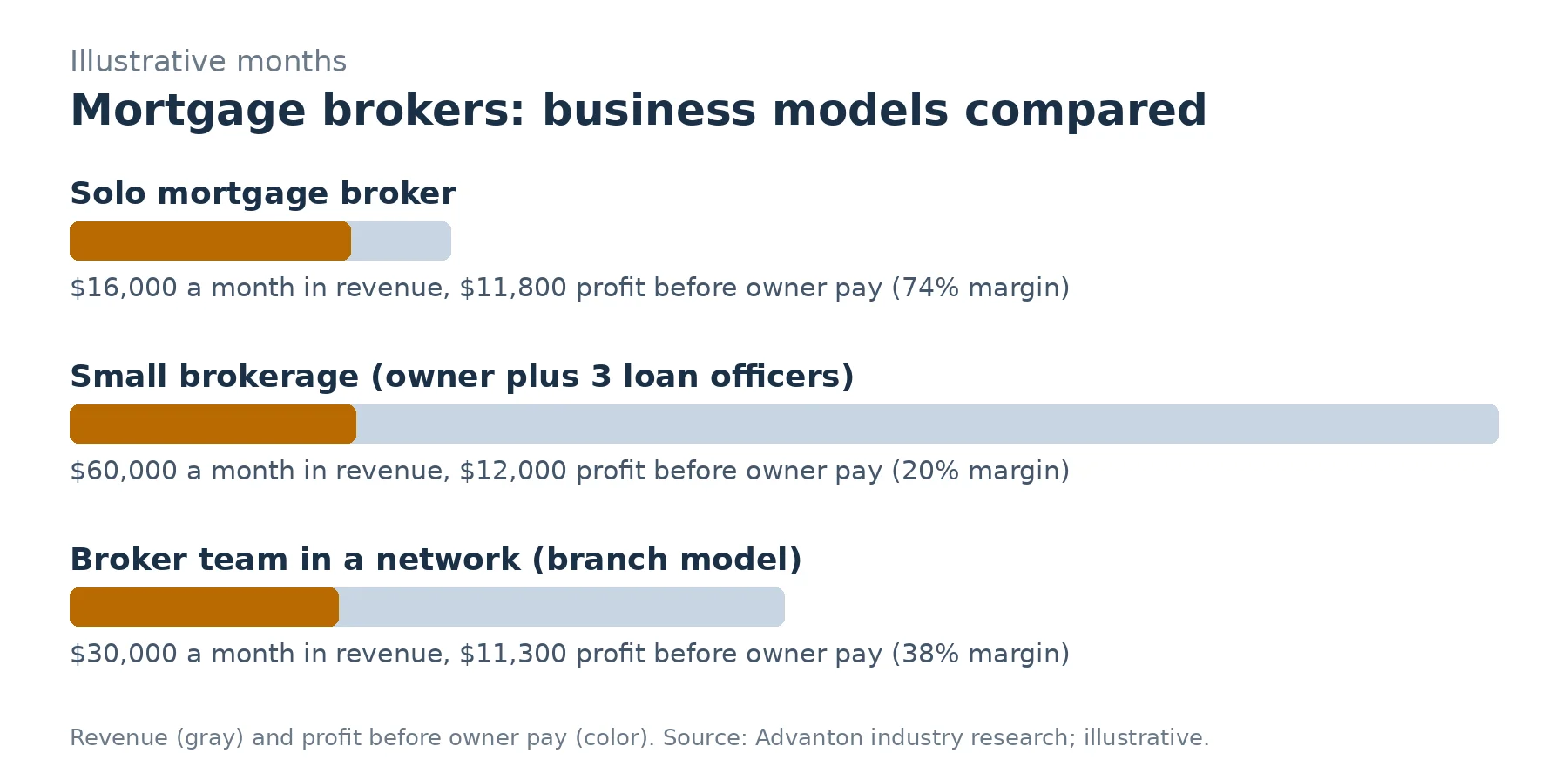
The figures below are illustrative months from our research, not industry averages. They show how revenue and costs typically fit together; your market, prices and costs will differ.
| Business model | Startup costs | Example monthly revenue | Costs | Profit before owner pay | Margin |
|---|---|---|---|---|---|
| Solo mortgage broker | Low to moderate: licensing, NMLS, technology, errors and omissions coverage | $16,000 | $4,200 | $11,800 | 74% |
| Small brokerage (owner plus 3 loan officers) | Moderate: company licensing, office, processors, technology | $60,000 | $48,000 | $12,000 | 20% |
| Broker team in a network (branch model) | Low: licensing, network fees | $30,000 | $18,700 | $11,300 | 38% |
Fixed and variable costs
For projections, the most useful split is between variable costs, which rise and fall with sales (materials, supplies, hourly labor, fees), and fixed costs, which you pay every month regardless (rent, salaried staff, insurance, loan payments).
| Business model | Variable costs (% of revenue) | Fixed costs per month | What it means |
|---|---|---|---|
| Solo mortgage broker | 13.1% | $2,100 | Mostly fixed: needs steady volume to cover overhead |
| Small brokerage (owner plus 3 loan officers) | 52.5% | $16,500 | Mostly variable: profitable early, but watch cash flow |
| Broker team in a network (branch model) | 53.0% | $2,800 | Mostly variable: profitable early, but watch cash flow |
What the numbers say
Revenue depends on closed loans, so pipeline management and rate-cycle planning matter more than monthly averages suggest.
Commissions and processing are the main costs in brokerages, with technology and compliance as fixed costs.
Network or branch models lower startup costs in exchange for fees and splits.
The three models in brief
Solo mortgage broker. One licensed originator working with wholesale lenders. See financial planning data.
Small brokerage. Several loan officers, processors and a licensed company.
Broker team in a network. Operating under an established company’s license and systems for a fee or split.
Cost structure: small brokerage (owner plus 3 loan officers)
Each cost as a share of the example month’s revenue ($60,000):
| Cost | Monthly amount | Share of revenue | Type |
|---|---|---|---|
| Loan officer commissions | $30,000 | 50.0% | Variable |
| Processor salaries | $8,000 | 13.3% | Fixed |
| Office rent | $2,500 | 4.2% | Fixed |
| Marketing | $2,500 | 4.2% | Fixed |
| Credit and verification services | $1,500 | 2.5% | Variable |
| Loan origination and pricing software | $1,200 | 2.0% | Fixed |
| Payroll taxes | $1,000 | 1.7% | Fixed |
| Licensing and compliance | $800 | 1.3% | Fixed |
| Insurance and bonds | $500 | 0.8% | Fixed |
| Profit before owner pay | $12,000 | 20% |
A first-year projection: small brokerage (owner plus 3 loan officers)
New businesses rarely start at full speed. This projection assumes revenue ramps from 35% of the example month in month 1 to 100% by month 12, variable costs move with revenue, and fixed costs stay the same every month. It’s a planning illustration, not a forecast.
| Month | Revenue | Variable costs | Fixed costs | Profit | Cumulative |
|---|---|---|---|---|---|
| 1 | $21,000 | $11,025 | $16,500 | -$6,525 | -$6,525 |
| 2 | $27,000 | $14,175 | $16,500 | -$3,675 | -$10,200 |
| 3 | $33,000 | $17,325 | $16,500 | -$825 | -$11,025 |
| 4 | $37,200 | $19,530 | $16,500 | $1,170 | -$9,855 |
| 5 | $42,000 | $22,050 | $16,500 | $3,450 | -$6,405 |
| 6 | $45,600 | $23,940 | $16,500 | $5,160 | -$1,245 |
| 7 | $49,200 | $25,830 | $16,500 | $6,870 | $5,625 |
| 8 | $52,200 | $27,405 | $16,500 | $8,295 | $13,920 |
| 9 | $54,600 | $28,665 | $16,500 | $9,435 | $23,355 |
| 10 | $57,000 | $29,925 | $16,500 | $10,575 | $33,930 |
| 11 | $58,800 | $30,870 | $16,500 | $11,430 | $45,360 |
| 12 | $60,000 | $31,500 | $16,500 | $12,000 | $57,360 |
Year one: revenue $537,600, profit before owner pay $57,360. The first profitable month is month 4. Cumulative results bottom out at -$11,025, which is the minimum cash cushion this plan would need, before any startup costs.
Processors, software and office costs start before the pipeline closes loans, so this brokerage illustration turns profitable in month 4, with a cumulative low of about $11,000. Rate changes can swing real results sharply.
How mortgage brokers earn
- Lender-paid compensation on closed loans.
- Borrower-paid compensation where chosen and allowed.
- Refinances when rates fall.
- Purchase loans from agent referrals.
- Specialty loans: self-employed, investor and jumbo borrowers.
Licensing under the SAFE Act
Every mortgage loan originator needs an NMLS license in each state where they originate loans. Requirements include pre-licensing education, a national exam with state components, background and credit checks and yearly continuing education. Companies also need state licenses.
Compensation and disclosure rules
Federal rules limit how originators are paid (for example, compensation can’t vary based on loan terms other than amount), prohibit steering borrowers for higher pay, and require timely Loan Estimates and Closing Disclosures. Compliance is part of every file.
A startup checklist
- Complete NMLS education and pass the exam.
- License the company in your target states.
- Get approved with wholesale lenders.
- Set up loan origination and compliance systems.
- Build referral relationships with real estate agents and financial professionals.
Rate cycles
Refinance volume surges when rates fall and nearly disappears when they rise. Purchase business, past-client relationships and specialty niches help brokers survive slow periods.
Where the opportunities are
- Self-employed borrowers needing alternative documentation.
- First-time buyers and down payment assistance programs.
- Real estate investors.
- Bilingual services.
- Past-client refinance opportunities when rates drop.
Key terms
| Term | Meaning |
|---|---|
| NMLS | Nationwide Multistate Licensing System |
| Wholesale lender | A lender that funds loans brought by brokers |
| TRID | Federal disclosure rules combining TILA and RESPA |
| Pipeline | Loans in process from application to closing |
Referral relationships
Real estate agents, builders, financial planners and accountants refer most purchase loans. RESPA prohibits paying for referrals, so earn them with service: fast preapprovals, clear communication and on-time closings.
Key numbers to track
Track applications, pull-through rate (applications that close), average loan amount, compensation per loan, days to close and referral sources.
Common mistakes
- Relying only on refinances.
- Paying for referrals in violation of RESPA.
- Late or inaccurate disclosures.
- Weak data security.
- Overpromising rates or timelines.
Marketing a mortgage business
Agent partnerships, past-client follow-up, educational content for first-time buyers, Google Business Profile and reviews bring borrowers. Advertising must follow federal rules for rates and terms. See directory listings for professional services.
Technology and processing
Loan origination software, pricing engines, secure document portals and e-signatures speed files. Strong processors keep loans moving and borrowers informed.
Data security
Borrowers share tax returns, bank statements and Social Security numbers. Secure portals, encryption and the FTC Safeguards Rule’s requirements protect them and your license.
Past clients are the best pipeline
Homeowners refinance, buy again and refer friends. Annual check-ins and rate alerts keep you their mortgage professional for life.
Fair lending
Treat every applicant consistently and document decisions. Fair lending laws prohibit discrimination in credit decisions and marketing.
Broker vs lender vs loan officer
Brokers shop multiple lenders; retail loan officers work for one lender. Brokers can often offer more options, while lenders control underwriting. Explain the difference to borrowers.
Test these numbers with your own plan
Open this industry in our free Business Idea Reality Check to start from any model above, change prices, costs, startup budget and your own pay, and see your break-even month, the cash you’d need, three scenarios and how new businesses in this sector survive in your state.
- Start with the closest model and its cost structure.
- Replace every price and cost with local quotes.
- Estimate your ramp: how fast customers will realistically come in year one.
- Map cash month by month with the free Cash & Payroll Planner.
- Build the full plan in the free Business Planner.
About this data
Workforce figures come from the U.S. Bureau of Labor Statistics (Occupational Outlook Handbook and Occupational Employment and Wage Statistics, May 2024 wages and the 2024 to 2034 projections, unless noted). Market figures cite their sources above. Business model figures are illustrative months built from typical prices and costs to show how revenue, fixed costs and variable costs fit together; they are not industry averages or guarantees. We review these profiles when new government data is released, at least once a year, and the same figures power the Business Idea Reality Check.
Licensing and rules
Under the federal SAFE Act, mortgage loan originators must be licensed through NMLS in each state where they work, completing pre-licensing education, a national test, background and credit checks and annual continuing education; brokerage companies need state licenses and often surety bonds; federal rules under the Truth in Lending Act and RESPA govern disclosures (Loan Estimate and Closing Disclosure), loan originator compensation and referral fees; the Equal Credit Opportunity Act and fair lending laws prohibit discrimination; advertising and data security rules apply. Requirements change; confirm with your state and local agencies before you start.
Frequently asked questions
Do mortgage brokers need a license?
Yes. Loan originators must be licensed through NMLS in each state where they work.
How do mortgage brokers get paid?
Usually through lender-paid or borrower-paid compensation on closed loans, under federal rules.
What do loan officers earn?
About a $76,690 median in May 2025 (BLS, as reported); top producers earn much more.
Can mortgage brokers pay real estate agents for referrals?
No. RESPA prohibits kickbacks for referrals.
How do brokers survive high-rate periods?
By focusing on purchase loans, niches and past-client relationships.
What is a wholesale lender?
A lender that funds loans submitted by brokers.
How can I test these numbers?
Open mortgage brokers in the Business Idea Reality Check and enter your own volume and costs.
Keep learning
- Financial planning industry data
- Real estate services data
- Rental property investing data
- Business Idea Reality Check
Sources
Last reviewed November 1, 2026. Startup costs are estimates; check local prices, licensing and tax rules before you commit money.

