
Ask almost any contractor what limits growth and the answer is people: finding skilled workers, training new ones and keeping good ones. The data backs that up. Construction faces a persistent labor shortage driven largely by retirements, while demand for trades such as electrical work keeps rising. For small contractors, workforce strategy is now as important as marketing.
This page collects the most useful workforce data for contractors in 2026 and turns it into practical steps.
The shortage in numbers
Table of Contents
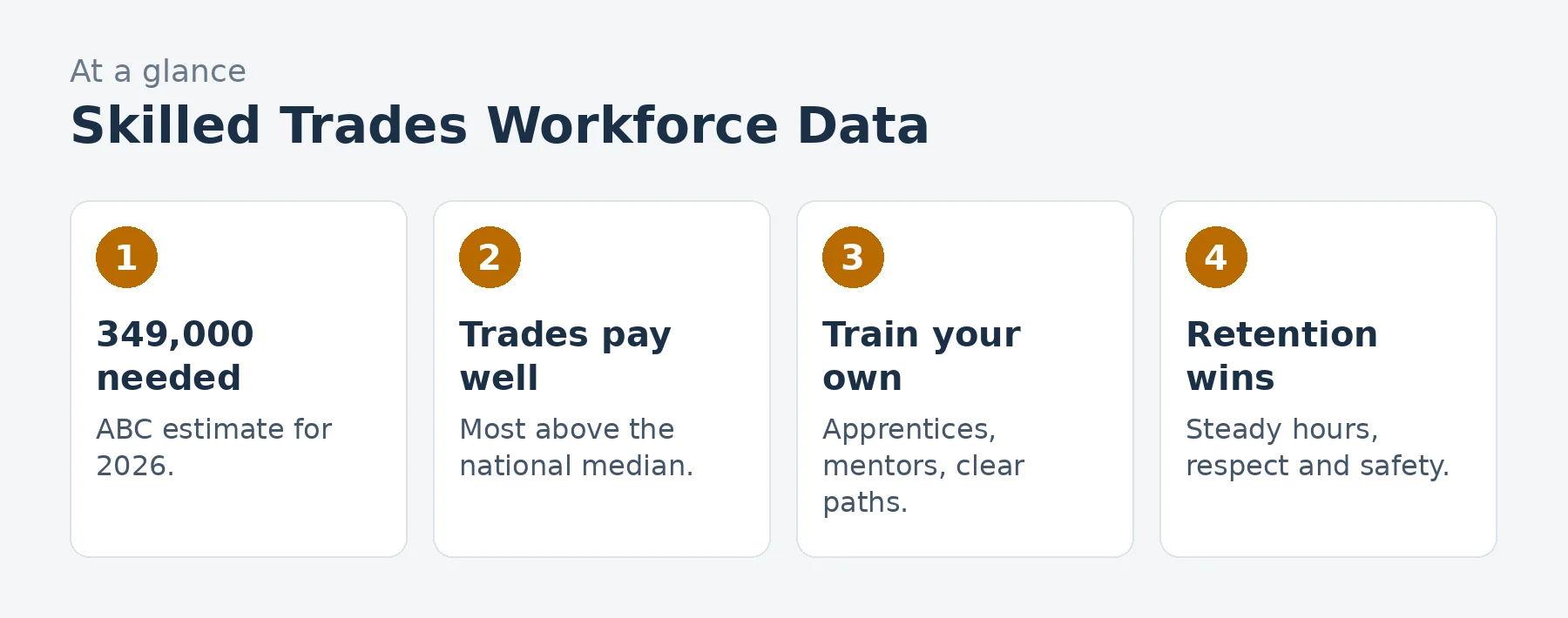
Associated Builders and Contractors (ABC), a national construction trade association, estimates that the U.S. construction industry needs to attract about 349,000 net new workers in 2026, rising to about 456,000 in 2027 as construction spending growth is expected to resume. ABC’s model links construction spending forecasts with employment data, and its economists say retirements drive much of the 2026 demand, rather than rapid growth in construction activity.
| Measure | Figure | Source |
|---|---|---|
| New workers needed in 2026 | About 349,000 | ABC, January 2026 |
| New workers needed in 2027 | About 456,000 | ABC, January 2026 |
| Main driver of 2026 demand | Retirements | ABC |
Pay, jobs and growth by trade
| Occupation | Median pay (May 2024) | Jobs (2024) | Projected growth, 2024 to 2034 |
|---|---|---|---|
| Electricians | $62,350 | n/a | About 81,000 openings a year |
| Plumbers, pipefitters and steamfitters | $62,970 | 504,500 | +4% |
| HVAC mechanics and installers | $59,810 | 425,200 | +8% |
| Flooring installers and tile and stone setters | $52,000 | 112,300 | +6% |
| Construction laborers and helpers | $46,050 | 1,649,100 | +7% |
| Solar photovoltaic installers | n/a | n/a | +42% |
| Insulation workers | $50,730 | n/a | +4% |
| Glaziers | $55,440 | n/a | +3% |
Source: U.S. Bureau of Labor Statistics. "n/a" marks figures not used here.
The median wage for all U.S. occupations was $49,500 in May 2024, so most skilled trades pay above the national median, often without a four-year degree.
What the data means for contractors
Labor costs will stay high
When demand for workers exceeds supply, wages rise. Price your work to cover realistic labor costs, including training, benefits and overtime.
Retention beats recruiting
Replacing a skilled worker costs time, training and lost productivity. Keeping good people is usually cheaper than finding new ones.
Training is a competitive advantage
Contractors who train apprentices build their own pipeline instead of competing for the same small pool of experienced workers.
Capacity limits growth
Marketing that brings more leads than your crews can handle wastes money and frustrates customers. Plan hiring and marketing together.
Building labor costs into your prices
A worker’s hourly wage is only part of what an hour of their time costs you. Payroll taxes, workers’ compensation, benefits, paid time off, training, vehicles and unbillable time (driving, estimates, callbacks) all add up.
| Cost item | Illustrative hourly amount |
|---|---|
| Wage | $30.00 |
| Payroll taxes and workers’ compensation | $5.50 |
| Benefits and paid time off | $4.50 |
| Vehicle, tools and training | $6.00 |
| Fully loaded cost per paid hour | $46.00 |
| Billable share of paid hours | 70% |
| Cost per billable hour | about $65.70 |
These figures are illustrative. The point: if only 70% of paid hours are billable, each billable hour must cover the full cost of all paid hours, before overhead and profit. Use your own numbers in the free break-even calculator.
Employees or subcontractors?
Many contractors use subcontractors to add capacity without hiring. That can work, but worker classification follows legal tests, not labels. The IRS and Department of Labor look at control, independence and the nature of the relationship; misclassifying employees as contractors can bring back taxes and penalties. Ask a qualified advisor before relying heavily on subcontractors for core work.
Licensing pathways
Many trades follow a path from helper or apprentice to journeyman and master, with state or local licenses at each step. Licensing requirements (hours of supervised experience, exams and continuing education) vary by state and trade. Helping employees earn licenses builds loyalty and lets your company take on more complex work.
Where new workers come from
- Registered apprenticeships that combine paid work with classroom training. See Apprenticeship.gov.
- High schools and career and technical education programs.
- Community colleges and trade schools.
- Career changers looking for hands-on, well-paid work.
- Veterans with technical and leadership experience.
- Referrals from your current team.
Recruiting that works for small contractors
- Write job posts like marketing: pay range, schedule, training, tools and growth path.
- Show your culture: photos and short videos of your team at work.
- Pay referral bonuses to employees who bring good hires.
- Respond to applicants within a day. Good candidates have options.
- Offer a clear path from helper to apprentice to licensed professional.
- Partner with schools for internships and ride-alongs.
Keeping good people
| What workers value | What contractors can do |
|---|---|
| Fair, predictable pay | Clear wage scales and raises tied to skills and licenses |
| Steady hours | Plan marketing and scheduling to avoid feast-or-famine weeks |
| Training and growth | Pay for certifications, licenses and continuing education |
| Good equipment | Reliable vehicles and tools |
| Respect and recognition | Regular feedback and public thanks |
| Safety | Training, equipment and a culture that stops unsafe work |
Experienced hires vs helpers you train
| Approach | Advantages | Trade-offs |
|---|---|---|
| Hire experienced technicians | Productive quickly; can work independently | Higher pay; harder to find; may bring habits you’ll need to change |
| Hire helpers and train them | Larger candidate pool; learn your standards; loyalty | Months before full productivity; needs mentors and patience |
Most growing contractors do both: a core of experienced professionals who mentor a steady pipeline of trainees.
The first 90 days
New hires decide early whether to stay. Plan the first 90 days: a welcome with tools and uniforms ready, a mentor for ride-alongs, clear checklists for common tasks, weekly check-ins, and a skills review with a raise path at 90 days. A structured start reduces early turnover and gets new workers productive faster.
Training new workers
Pair new hires with experienced mentors, use checklists for common tasks, and set skill milestones with pay increases. Short, regular training sessions on safety, customer service and technical skills build a team that represents your brand well in every home.
Technology and productivity
Scheduling software, digital estimates, photo documentation and better tools help each worker do more, which matters when hiring is hard. Invest in tools that save time on every job, and train your team to use them consistently.
Immigration and uncertainty
ABC has described immigration policy as a wildcard for construction labor, noting uncertainty about how many workers have left the industry. Contractors should verify employment eligibility for every hire as required by law and plan for continued tightness in labor supply.
A yearly workforce plan
- Forecast demand by season from last year’s jobs and your marketing plan.
- Identify gaps: how many workers, with which skills, and when.
- Start recruiting early, months before your busy season.
- Schedule training during slower periods.
- Review pay against local market rates at least once a year.
- Hold stay conversations with your best people: ask what keeps them and what would make them leave.
Planning ahead turns hiring from an emergency into a routine.
Trades with the strongest outlook
BLS projects solar photovoltaic installers to grow fastest from a small base, HVAC and construction laborers to grow faster than average, and electricians to have one of the largest numbers of openings each year among construction trades. Growth in data centers, electrification, energy efficiency and repairs to aging housing all support demand for skilled workers, though local conditions vary.
Safety as a workforce strategy
Injuries cost far more than medical bills: lost workdays, higher insurance premiums, overtime for others and damage to morale. A safety program with training, the right equipment, daily job-site checks and permission for anyone to stop unsafe work protects people and keeps crews intact. OSHA requirements apply to construction work, and many workers choose employers with strong safety records.
Common mistakes
- Hiring only when desperate, which leads to poor fits.
- Underpricing jobs that don’t cover real labor costs.
- No training plan for new workers.
- Inconsistent hours that push good workers away.
- Ignoring safety, which drives injuries and turnover.
Frequently asked questions
How many construction workers are needed?
ABC estimates about 349,000 net new workers in 2026 and about 456,000 in 2027.
Why is there a skilled trades shortage?
Retirements, too few young people entering the trades and strong demand in some sectors all contribute.
Do skilled trades pay well?
Many do. BLS reports medians of $62,970 for plumbers and $62,350 for electricians in May 2024, above the national median for all occupations.
How can small contractors compete for workers?
Offer fair pay, steady hours, training paths, good equipment and a respectful culture.
What are registered apprenticeships?
Programs that combine paid on-the-job training with related instruction, registered with the Department of Labor or a state agency.
Should I raise prices because labor costs are rising?
Review prices at least yearly against your fully loaded labor costs; underpricing labor is a common reason busy contractors struggle.
Where can I find apprentices?
Local high schools, career and technical programs, community colleges, trade associations and Apprenticeship.gov.
How can I keep workers during slow seasons?
Plan maintenance work, training and slower-season marketing so hours stay steady year-round.
How Advanton helps
Advanton is a free resource for small businesses. Plan payroll with the free Cash & Payroll Planner, build job post graphics with the Brand & Print Studio and add your business to the Advanton directory for free. Advanton earns money when you buy a domain or hosting through our store, which helps keep everything else free.
Keep learning
- Contractor marketing statistics
- Plumbing contractors industry data
- Electrical contractors industry data
Sources
- Associated Builders and Contractors, Construction Industry Must Attract 349,000 Workers in 2026 (January 2026)
- U.S. Bureau of Labor Statistics, Occupational Outlook Handbook
- U.S. Department of Labor, Apprenticeship.gov
Last reviewed November 1, 2026. Startup costs are estimates; check local prices, licensing and tax rules before you commit money.


Leave a Reply