
Every building needs water in and wastewater out, and when something fails, it usually can’t wait. The Bureau of Labor Statistics counted about 504,500 plumbers, pipefitters and steamfitters in 2024, with a median wage of $62,970 in May 2024 and 4% projected growth from 2024 to 2034; about two-thirds work for plumbing, heating and air-conditioning contractors.
Plumbing businesses usually choose between service and repair work for homeowners, where speed and trust win jobs, and new-construction or remodel rough-in work for builders, where bids, schedules and volume matter. Many successful companies combine both, then add higher-value services such as water heaters, drain cleaning and repiping.
The workforce
| Occupation | Jobs (2024) | Median pay (May 2024) | Projected growth, 2024 to 2034 |
|---|---|---|---|
| Plumbers, pipefitters and steamfitters | 504,500 | $62,970 | +4% |
Source: U.S. Bureau of Labor Statistics, Occupational Outlook Handbook and Occupational Employment and Wage Statistics.
Market data
| Measure | Value |
|---|---|
| Projected job change, 2024 to 2034 | 22,700 |
| Share employed by plumbing, heating and air-conditioning contractors (2024) | 66% |
Business models compared
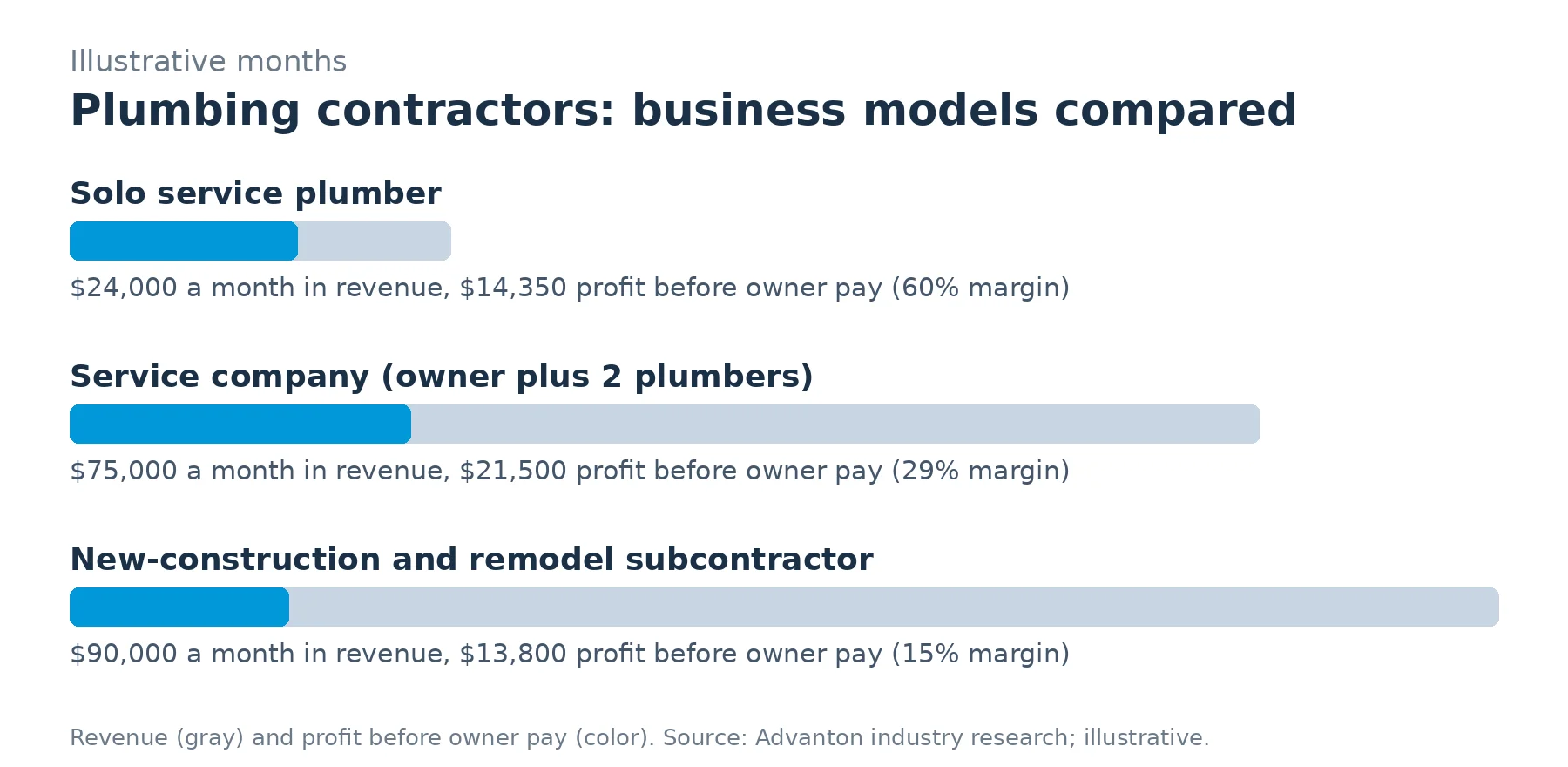
The figures below are illustrative months from our research, not industry averages. They show how revenue and costs typically fit together; your market, prices and costs will differ.
| Business model | Startup costs | Example monthly revenue | Costs | Profit before owner pay | Margin |
|---|---|---|---|---|---|
| Solo service plumber | Moderate: van, tools, license, insurance | $24,000 | $9,650 | $14,350 | 60% |
| Service company (owner plus 2 plumbers) | Moderate to high: two vans, stock, staff, office | $75,000 | $53,500 | $21,500 | 29% |
| New-construction and remodel subcontractor | Moderate to high: crew, trucks, bonding capacity | $90,000 | $76,200 | $13,800 | 15% |
Fixed and variable costs
For projections, the most useful split is between variable costs, which rise and fall with sales (materials, supplies, hourly labor, fees), and fixed costs, which you pay every month regardless (rent, salaried staff, insurance, loan payments).
| Business model | Variable costs (% of revenue) | Fixed costs per month | What it means |
|---|---|---|---|
| Solo service plumber | 20.8% | $4,650 | Mostly fixed: needs steady volume to cover overhead |
| Service company (owner plus 2 plumbers) | 21.1% | $37,700 | Mostly fixed: needs steady volume to cover overhead |
| New-construction and remodel subcontractor | 40.0% | $40,200 | Balanced: margins improve as volume grows |
What the numbers say
Service work earns the highest margins because homeowners pay for speed, expertise and convenience, but it depends on steady marketing and fast response.
New construction trades margin for volume. Materials pass through at low markup, bids are competitive, and payments can be slow, but schedules are predictable.
People are the biggest fixed cost. Adding plumbers raises capacity and payroll at the same time, so marketing and dispatch must keep every van busy.
The three models in brief
Solo service plumber. One licensed plumber handling repairs, drains, fixtures and water heaters. Low overhead, high margin, limited by hours in the day.
Service company. An owner with two plumbers, a dispatcher and steady marketing. Higher revenue and the start of a business that runs without the owner on every call.
New-construction and remodel subcontractor. Rough-in and finish work for builders and remodelers, priced by bid. See how to win commercial contracting jobs.
Cost structure: service company (owner plus 2 plumbers)
Each cost as a share of the example month’s revenue ($75,000):
| Cost | Monthly amount | Share of revenue | Type |
|---|---|---|---|
| Plumber wages | $18,000 | 24.0% | Fixed |
| Parts and materials | $15,800 | 21.1% | Variable |
| Marketing and lead costs | $6,000 | 8.0% | Fixed |
| Vans, fuel and insurance | $4,200 | 5.6% | Fixed |
| Office and dispatcher | $4,200 | 5.6% | Fixed |
| Payroll taxes and workers’ comp | $3,600 | 4.8% | Fixed |
| Insurance | $900 | 1.2% | Fixed |
| Software and phones | $800 | 1.1% | Fixed |
| Profit before owner pay | $21,500 | 29% |
A first-year projection: service company (owner plus 2 plumbers)
New businesses rarely start at full speed. This projection assumes revenue ramps from 35% of the example month in month 1 to 100% by month 12, variable costs move with revenue, and fixed costs stay the same every month. It’s a planning illustration, not a forecast.
| Month | Revenue | Variable costs | Fixed costs | Profit | Cumulative |
|---|---|---|---|---|---|
| 1 | $26,250 | $5,539 | $37,700 | -$16,989 | -$16,989 |
| 2 | $33,750 | $7,121 | $37,700 | -$11,071 | -$28,060 |
| 3 | $41,250 | $8,704 | $37,700 | -$5,154 | -$33,214 |
| 4 | $46,500 | $9,812 | $37,700 | -$1,012 | -$34,226 |
| 5 | $52,500 | $11,078 | $37,700 | $3,722 | -$30,504 |
| 6 | $57,000 | $12,027 | $37,700 | $7,273 | -$23,231 |
| 7 | $61,500 | $12,976 | $37,700 | $10,824 | -$12,407 |
| 8 | $65,250 | $13,768 | $37,700 | $13,782 | $1,375 |
| 9 | $68,250 | $14,401 | $37,700 | $16,149 | $17,524 |
| 10 | $71,250 | $15,034 | $37,700 | $18,516 | $36,040 |
| 11 | $73,500 | $15,508 | $37,700 | $20,292 | $56,332 |
| 12 | $75,000 | $15,825 | $37,700 | $21,475 | $77,807 |
Year one: revenue $672,000, profit before owner pay $77,807. The first profitable month is month 5. Cumulative results bottom out at -$34,226, which is the minimum cash cushion this plan would need, before any startup costs.
Plumber wages, vans and marketing start before the schedule fills, so this service company illustration turns profitable in month 5, with a cumulative low of about $34,200. That cushion, plus vans, tools and stock, is the real cash a two-plumber launch needs.
How plumbing businesses price
- Flat-rate pricing for common repairs, so customers know the price before work begins.
- Service call or trip fees, often credited toward the repair.
- Hourly rates for diagnosis and unusual jobs.
- Project bids for remodels, repiping and new construction.
- Maintenance plans with annual inspections and priority service.
A startup checklist
- Confirm licensing for your state and city, including any business or master license.
- Carry insurance: general liability, commercial auto and workers’ compensation once you hire.
- Stock the van with the parts that solve most calls on the first visit.
- Choose software for scheduling, invoicing and customer history.
- Set flat-rate prices from your real costs and target margin.
Where the opportunities are
- Water heaters, including tankless and heat pump models.
- Drain cleaning and camera inspections.
- Repiping older homes.
- Maintenance plans that smooth slow months.
- Property managers and real estate agents who need fast, reliable repairs. See property manager work.
Key terms
| Term | Meaning |
|---|---|
| Rough-in | Pipes installed before walls and floors are closed |
| Flat-rate pricing | A set price per task rather than hourly billing |
| First-time fix rate | Share of calls solved on the first visit |
| Backflow prevention | Devices that stop contaminated water flowing back into supply lines |
Answer every call
Emergency plumbing customers call the next company if you don’t answer. Missed-call text-back, an answering service and fast scheduling often matter more than any advertising. See speed to lead.
Seasonality and demand
Plumbing demand is steadier than many trades, but it still has peaks: frozen and burst pipes in cold snaps, water heater failures in winter, sewer and drain problems after heavy rain, and remodel work in spring and summer. Plan staffing and stock for winter emergencies, and use steadier months to sell maintenance plans and planned replacements. Many companies track the age of every water heater they service, then contact owners before units fail. See the plumbing marketing calendar.
Hiring and training
Licensed plumbers are in demand, so growing companies often hire apprentices and train them, pair new hires with experienced plumbers, and pay for continuing education and certifications. Clear flat-rate pricing, good vans and steady schedules help keep good plumbers. Track first-time fix rates and callbacks by technician to coach consistently.
Vans, tools and stock
A well-stocked van is a profit tool: every trip back to the supply house costs time and goodwill. Stock the parts behind most of your repairs, keep a simple inventory list per van, and restock daily. Larger investments (drain cameras, jetters and pipe-locating equipment) open higher-value services and pay back quickly when marketed well.
Common mistakes
- Underpricing service calls to compete with the cheapest plumber in town.
- Hiring before marketing can keep a second van busy.
- Skipping permits to save time.
- Ignoring callbacks, which erode margins and reviews.
- Relying on one builder for most revenue.
Marketing a plumbing business
A complete Google Business Profile, steady reviews, Local Services Ads and partnerships with property managers and agents bring most jobs. See plumbing SEO and the plumbing marketing calendar.
Test these numbers with your own plan
Open this industry in our free Business Idea Reality Check to start from any model above, change prices, costs, startup budget and your own pay, and see your break-even month, the cash you’d need, three scenarios and how new businesses in this sector survive in your state.
- Start with the closest model and its cost structure.
- Replace every price and cost with local quotes.
- Estimate your ramp: how fast customers will realistically come in year one.
- Map cash month by month with the free Cash & Payroll Planner.
- Build the full plan in the free Business Planner.
About this data
Workforce figures come from the U.S. Bureau of Labor Statistics (Occupational Outlook Handbook and Occupational Employment and Wage Statistics, May 2024 wages and the 2024 to 2034 projections, unless noted). Market figures cite their sources above. Business model figures are illustrative months built from typical prices and costs to show how revenue, fixed costs and variable costs fit together; they are not industry averages or guarantees. We review these profiles when new government data is released, at least once a year, and the same figures power the Business Idea Reality Check.
Licensing and rules
Most states or cities license plumbers (often apprentice, journeyman and master levels) and may require a separate contractor license to run a plumbing business; work typically needs permits and inspections; backflow testing often requires separate certification; liability insurance and workers’ compensation for employees. Requirements change; confirm with your state and local agencies before you start.
Frequently asked questions
What do plumbers earn?
BLS reported a median of $62,970 in May 2024.
Do I need a license to start a plumbing business?
Most states or cities require plumbing licenses and may require a contractor license; check your state and local rules.
Is plumbing service or new construction more profitable?
Service and repair usually earns higher margins; new construction offers volume and predictable schedules.
How much does it cost to start a plumbing business?
Moderate: a van, tools, licenses, insurance and stock; adding employees raises costs substantially.
How can I test these numbers?
Open plumbing contractors in the Business Idea Reality Check and replace the figures with your own prices and costs.
Keep learning
Sources
Last reviewed November 1, 2026. Startup costs are estimates; check local prices, licensing and tax rules before you commit money.

