
Homes and businesses keep adding electrical load: EV chargers, heat pumps, solar, generators, smart devices and kitchen upgrades. The Bureau of Labor Statistics reported a median wage of $62,350 for electricians in May 2024 and projects about 81,000 electrician job openings a year from 2024 to 2034, one of the largest numbers among construction trades.
Electrical businesses range from solo residential electricians handling repairs and upgrades to service companies with several vans and commercial subcontractors wiring offices, stores and apartments. Licensing, safety and permits shape every model.
The workforce
| Occupation | Jobs (2024) | Median pay (May 2024) | Projected growth, 2024 to 2034 |
|---|---|---|---|
| Electricians | n/a | $62,350 | n/a |
Source: U.S. Bureau of Labor Statistics, Occupational Outlook Handbook and Occupational Employment and Wage Statistics.
Market data
| Measure | Value |
|---|---|
| Electrician openings projected each year, 2024 to 2034 | about 81,000 |
Business models compared
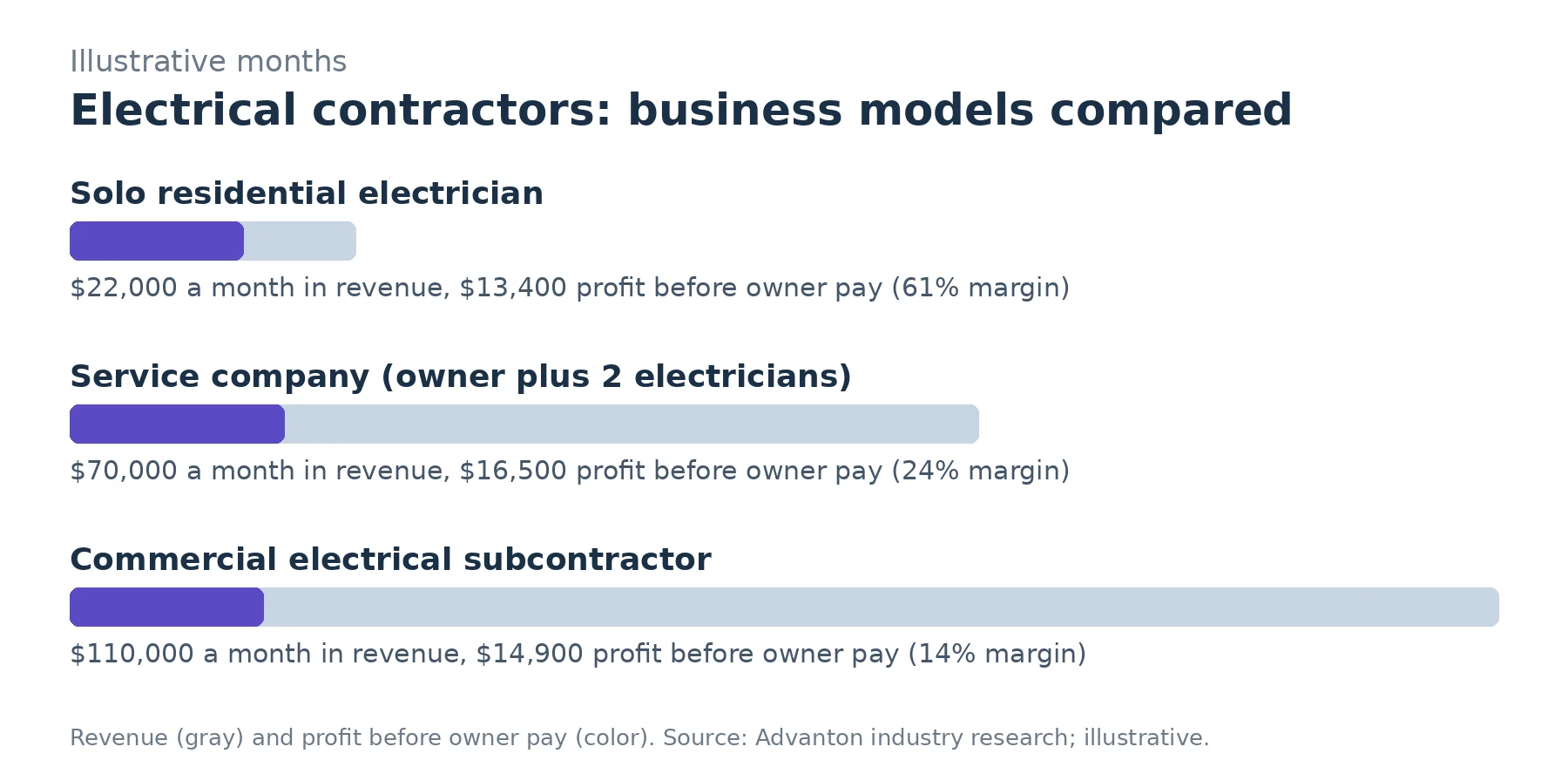
The figures below are illustrative months from our research, not industry averages. They show how revenue and costs typically fit together; your market, prices and costs will differ.
| Business model | Startup costs | Example monthly revenue | Costs | Profit before owner pay | Margin |
|---|---|---|---|---|---|
| Solo residential electrician | Moderate: van, tools, license, insurance | $22,000 | $8,600 | $13,400 | 61% |
| Service company (owner plus 2 electricians) | Moderate to high: vans, staff, stock | $70,000 | $53,500 | $16,500 | 24% |
| Commercial electrical subcontractor | High: crew, lifts, bonding, estimating | $110,000 | $95,100 | $14,900 | 14% |
Fixed and variable costs
For projections, the most useful split is between variable costs, which rise and fall with sales (materials, supplies, hourly labor, fees), and fixed costs, which you pay every month regardless (rent, salaried staff, insurance, loan payments).
| Business model | Variable costs (% of revenue) | Fixed costs per month | What it means |
|---|---|---|---|
| Solo residential electrician | 20.0% | $4,200 | Mostly fixed: needs steady volume to cover overhead |
| Service company (owner plus 2 electricians) | 23.0% | $37,400 | Mostly fixed: needs steady volume to cover overhead |
| Commercial electrical subcontractor | 40.0% | $51,100 | Balanced: margins improve as volume grows |
What the numbers say
Residential service carries strong margins on troubleshooting, panels, EV chargers and upgrades, as long as marketing keeps the schedule full.
Commercial work is larger but tighter. Material costs are high, bids are competitive and payment terms longer, so estimating accuracy decides profit.
Licensed labor is the constraint. Growing means hiring and keeping licensed electricians, which takes planning well ahead of demand.
The three models in brief
Solo residential electrician. Repairs, lighting, panels, EV chargers and small remodel work.
Service company. Two or more electricians, a dispatcher and steady marketing, often with maintenance and generator work.
Commercial subcontractor. Tenant improvements, retail and multifamily wiring for general contractors. See how to win commercial contracting jobs.
Cost structure: service company (owner plus 2 electricians)
Each cost as a share of the example month’s revenue ($70,000):
| Cost | Monthly amount | Share of revenue | Type |
|---|---|---|---|
| Electrician wages | $18,500 | 26.4% | Fixed |
| Materials and devices | $16,100 | 23.0% | Variable |
| Marketing | $5,500 | 7.9% | Fixed |
| Vans, fuel and insurance | $4,000 | 5.7% | Fixed |
| Office and dispatcher | $4,000 | 5.7% | Fixed |
| Payroll taxes and workers’ comp | $3,700 | 5.3% | Fixed |
| Insurance | $1,000 | 1.4% | Fixed |
| Software and phones | $700 | 1.0% | Fixed |
| Profit before owner pay | $16,500 | 24% |
A first-year projection: service company (owner plus 2 electricians)
New businesses rarely start at full speed. This projection assumes revenue ramps from 35% of the example month in month 1 to 100% by month 12, variable costs move with revenue, and fixed costs stay the same every month. It’s a planning illustration, not a forecast.
| Month | Revenue | Variable costs | Fixed costs | Profit | Cumulative |
|---|---|---|---|---|---|
| 1 | $24,500 | $5,635 | $37,400 | -$18,535 | -$18,535 |
| 2 | $31,500 | $7,245 | $37,400 | -$13,145 | -$31,680 |
| 3 | $38,500 | $8,855 | $37,400 | -$7,755 | -$39,435 |
| 4 | $43,400 | $9,982 | $37,400 | -$3,982 | -$43,417 |
| 5 | $49,000 | $11,270 | $37,400 | $330 | -$43,087 |
| 6 | $53,200 | $12,236 | $37,400 | $3,564 | -$39,523 |
| 7 | $57,400 | $13,202 | $37,400 | $6,798 | -$32,725 |
| 8 | $60,900 | $14,007 | $37,400 | $9,493 | -$23,232 |
| 9 | $63,700 | $14,651 | $37,400 | $11,649 | -$11,583 |
| 10 | $66,500 | $15,295 | $37,400 | $13,805 | $2,222 |
| 11 | $68,600 | $15,778 | $37,400 | $15,422 | $17,644 |
| 12 | $70,000 | $16,100 | $37,400 | $16,500 | $34,144 |
Year one: revenue $627,200, profit before owner pay $34,144. The first profitable month is month 5. Cumulative results bottom out at -$43,417, which is the minimum cash cushion this plan would need, before any startup costs.
Wages, vans and marketing start before the calendar fills, so this service company illustration turns profitable in month 5, with a cumulative low of about $43,400. Many owners start solo and hire once demand is proven, which lowers that early cash need.
How electrical businesses price
- Flat-rate pricing for common tasks such as outlets, fixtures and panel swaps.
- Service call fees for troubleshooting.
- Project quotes for EV chargers, generators and remodels.
- Bids for commercial work, often with progress billing.
- Maintenance agreements for businesses.
A startup checklist
- Confirm licensing for electricians and electrical contractors in your state and city.
- Pull permits and schedule inspections as required.
- Carry insurance: general liability, commercial auto and workers’ compensation.
- Invest in testing equipment and safety gear.
- Build a price book for common jobs.
Where the opportunities are
- EV chargers for homes and businesses.
- Panel and service upgrades for electrification.
- Standby generators.
- Lighting retrofits for commercial clients.
- Solar and battery partnerships.
Key terms
| Term | Meaning |
|---|---|
| Service upgrade | Increasing the capacity of a building’s electrical service |
| NEC | National Electrical Code, adopted with local amendments |
| Rough-in | Wiring installed before walls are closed |
| Load calculation | Estimating whether a panel can handle added equipment |
EV chargers and panel upgrades
Electric vehicles, heat pumps and induction cooking are pushing many homes toward their electrical limits. A typical EV charger job starts with a load calculation, may require a panel or service upgrade, and needs a permit and inspection. Electricians who explain these steps clearly, quote options (a smart load-management device versus a full service upgrade) and coordinate with the utility when service changes are needed win more of this work. Partnerships with car dealers, solar installers and HVAC companies can bring steady referrals.
Safety and permits first
Unpermitted electrical work can create fire risk, failed inspections and liability. Make permits, inspections and safe work practices part of every job, and explain their value to customers.
Seasonality and demand
Electrical work is less seasonal than HVAC or roofing, but storms bring generator and repair calls, summer brings air-conditioning load issues, and the holidays bring lighting work. Remodel and new-construction schedules follow the building season in colder regions. Many electrical businesses smooth the year with commercial maintenance agreements and EV charger and panel upgrade campaigns.
Hiring and training
Licensed electricians are scarce in many markets. Apprenticeship programs, clear advancement paths and steady work help recruit and keep them. Pair apprentices with journeymen, budget for continuing education required for license renewal, and track quality through inspection pass rates and callbacks.
Vans, tools and equipment
Residential electricians need well-organized vans with breakers, devices, wire and testing equipment; commercial work adds lifts, conduit benders and larger stock. Track tool and equipment costs per job, and rent specialized equipment until steady volume justifies buying it.
Common mistakes
- Taking unpermitted work to win price-sensitive customers.
- Underestimating materials on commercial bids.
- Growing faster than licensed staff can support.
- Neglecting cash flow on large projects with retainage.
- Skipping safety training and documentation.
Key numbers to track
Watch average ticket per call, close rate on estimates, inspection pass rate, callbacks, revenue per electrician per week and cost per booked job by marketing channel. These few numbers show whether growth is profitable or simply busier.
Marketing an electrical business
Google Business Profile, reviews, Local Services Ads, builder relationships and EV charger partnerships bring steady work. See electrical SEO.
Test these numbers with your own plan
Open this industry in our free Business Idea Reality Check to start from any model above, change prices, costs, startup budget and your own pay, and see your break-even month, the cash you’d need, three scenarios and how new businesses in this sector survive in your state.
- Start with the closest model and its cost structure.
- Replace every price and cost with local quotes.
- Estimate your ramp: how fast customers will realistically come in year one.
- Map cash month by month with the free Cash & Payroll Planner.
- Build the full plan in the free Business Planner.
About this data
Workforce figures come from the U.S. Bureau of Labor Statistics (Occupational Outlook Handbook and Occupational Employment and Wage Statistics, May 2024 wages and the 2024 to 2034 projections, unless noted). Market figures cite their sources above. Business model figures are illustrative months built from typical prices and costs to show how revenue, fixed costs and variable costs fit together; they are not industry averages or guarantees. We review these profiles when new government data is released, at least once a year, and the same figures power the Business Idea Reality Check.
Licensing and rules
States or cities license electricians (often apprentice, journeyman and master levels) and many require an electrical contractor license; most work requires permits and inspections under the adopted National Electrical Code; liability insurance, workers’ compensation and OSHA safety requirements apply. Requirements change; confirm with your state and local agencies before you start.
Frequently asked questions
What do electricians earn?
BLS reported a median of $62,350 in May 2024.
Do I need a license to start an electrical business?
Yes in most places; states or cities license electricians and electrical contractors.
What electrical services are growing?
EV chargers, panel upgrades, generators and electrification projects.
Is commercial electrical work profitable?
It can be, with accurate estimating and careful cash flow management.
Do EV charger installations need a permit?
Usually yes; most jurisdictions require permits and inspections for new circuits and service upgrades.
Should I start residential or commercial?
Many electricians start with residential service, which needs less capital, and add commercial work as crews and bonding capacity grow.
How can I test these numbers?
Open electrical contractors in the Business Idea Reality Check and enter your own prices and costs.
Keep learning
- How to get more electrical leads
- Electrical SEO
- Google Local Services Ads for electricians
- Business Idea Reality Check
Sources
Last reviewed November 1, 2026. Startup costs are estimates; check local prices, licensing and tax rules before you commit money.

