
Marketing gets the phone to ring; booking turns calls into jobs. Two contractors with the same number of leads can have very different results because one books far more of them. Improving your booking rate is often the fastest, cheapest way to grow, because you’ve already paid for the leads.
This guide explains how to measure your booking rate, find what’s holding it back and improve it.
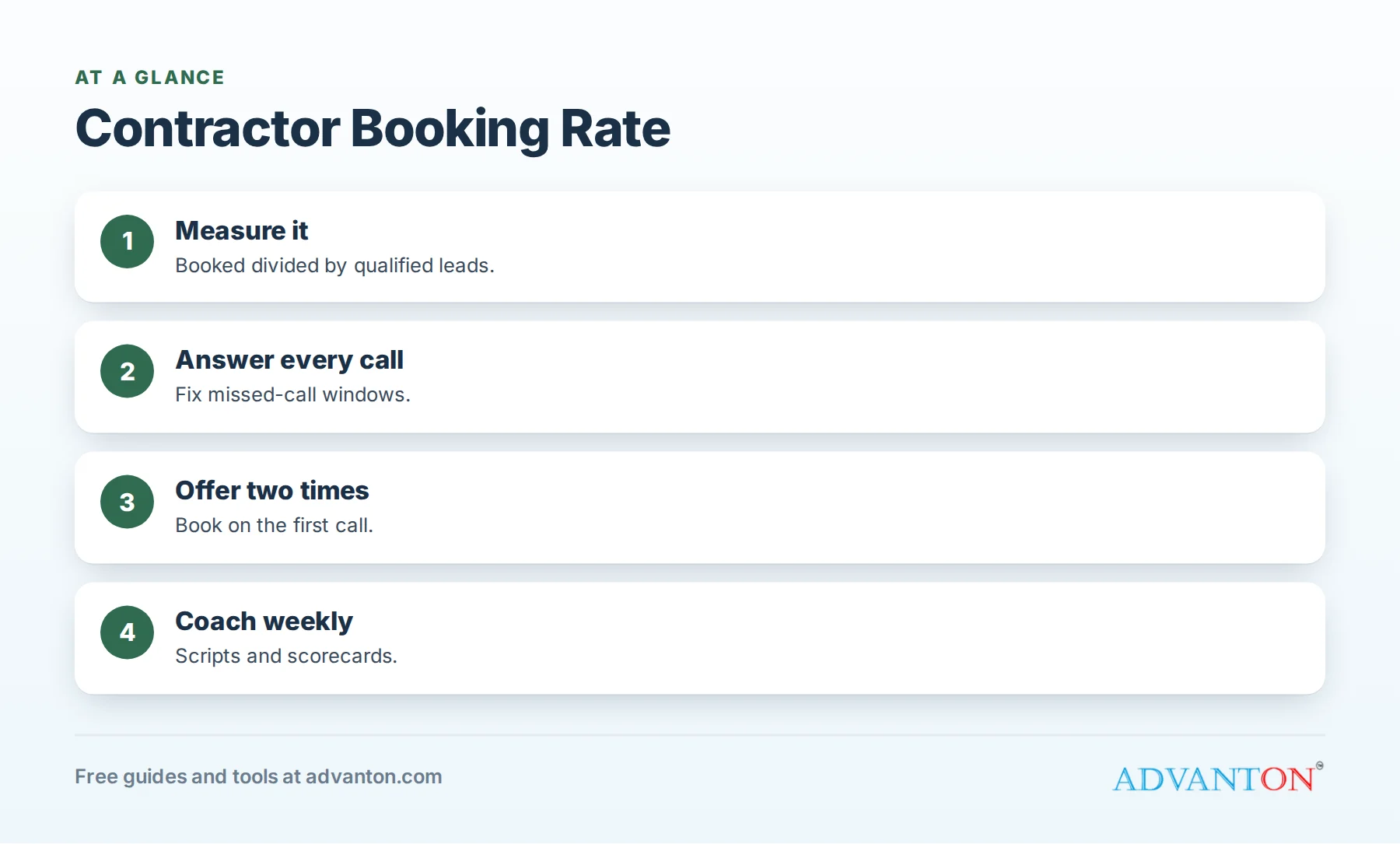
What booking rate means
Table of Contents
Booking rate = appointments or jobs booked ÷ qualified leads received.
| Example | Number |
|---|---|
| Qualified leads this month | 120 |
| Appointments booked | 72 |
| Booking rate | 60% |
Count only qualified leads: real customers in your service area asking for services you offer. Exclude spam, wrong numbers and job seekers.
Track it by source and person
| Breakdown | Why it matters |
|---|---|
| By lead source | Shows which channels bring ready customers |
| By team member | Shows who needs coaching |
| By time of day | Reveals missed-call windows |
| By service | Shows where pricing or availability may be a problem |
Your own trend matters more than comparisons with other companies. Track monthly and aim to improve.
Diagnose a low booking rate
| Symptom | Likely cause | Fix |
|---|---|---|
| Many missed calls | Not enough phone coverage | Answering service, missed-call text-back |
| Slow callbacks | No response process | 15-minute response rule |
| Callers ask price, then leave | No value explanation | Price ranges plus value talking points |
| Low rate from one source | Poor lead quality | Adjust targeting or the channel |
| Low rate for one person | Script or training gap | Coaching and role-play |
| Long wait for appointments | Capacity problem | Adjust scheduling or hire |
Answer every call
Missed calls are the biggest booking leak. Use call routing, an answering service for overflow and after hours, and missed-call text-back. See speed to lead and call tracking for contractors.
A booking call script
"Thanks for calling [Business], this is [Name]. How can I help?"
(Listen and take notes.)
"I’m sorry you’re dealing with that. Let me get a few details: what’s the address? … We serve that area. We can have a technician out [option one] or [option two]. Our visit fee is [$X], credited toward the repair. Which works better for you?"
Key elements: a warm greeting, listening, confirming the address and service, offering two specific times and explaining fees clearly.
Handling price questions
Many callers ask "How much?" first. Give honest ranges where possible, explain what affects price, and move to booking:
"Most [jobs] like this fall between [range], depending on [factors]. The technician will give you an exact price before starting any work. Would [time] work for a visit?"
Book the appointment on the first call
"We’ll call you back" loses jobs. Offer specific times on the first call, confirm by text and send a reminder before the appointment.
Review calls weekly
Listen to a handful of calls each week (with proper consent notices), especially ones that didn’t book. Share good examples, coach gently and update scripts. Small improvements in greetings, questions and closing often lift booking rates quickly.
Train your team
- Role-play common calls: emergencies, price shoppers, scheduling conflicts.
- Give everyone the same script and price ranges.
- Celebrate good bookings and share what worked.
- Measure progress monthly by person.
Capacity and scheduling
If your schedule is full for weeks, booking rates drop. Offer the earliest available slot, keep a cancellation list, and plan staffing for busy seasons. Sometimes the best marketing investment is another technician or office person.
A weekly booking review
| Item | What to check |
|---|---|
| Missed calls | When and why |
| Booking rate | Overall, by source and by person |
| Lost leads | Main reasons |
| Call recordings | Two or three examples to coach |
| Changes | One improvement to try next week |
Booking web and message leads
Form submissions and messages need the same speed as calls. Reply within minutes with two appointment options, and call if the customer gave a phone number. Leads from forms often book at lower rates simply because responses are slow.
After-hours booking
Online booking or an answering service that can schedule appointments captures evening and weekend leads. Confirm bookings by text, and follow up first thing in the morning.
Reduce no-shows
A booking only counts if the appointment happens. Send confirmation texts immediately and reminders the day before, with the technician’s name and arrival window. Make rescheduling easy so customers don’t simply skip.
Booking software
Scheduling and CRM tools show availability, send confirmations and track booking rates automatically. See best free CRMs for contractors.
A coaching scorecard
| Call element | Yes / No |
|---|---|
| Friendly greeting with name and business | |
| Listened and asked about the problem | |
| Confirmed address and service area | |
| Offered two specific times | |
| Explained fees clearly | |
| Confirmed by text |
Use the scorecard for a few calls each week to coach consistently.
Incentives done right
If you reward team members for bookings, focus on quality bookings that become jobs, not just appointments. Rewarding appointments alone can lead to poorly qualified visits.
Qualify without losing good leads
Some leads don’t fit (outside your area, services you don’t offer, budgets far below your minimum). Qualify politely with a few questions, refer them elsewhere when appropriate, and keep notes on why. Removing unqualified leads makes your booking rate more meaningful, and helps you adjust marketing so fewer unqualified leads arrive.
Booking rate and marketing decisions
Booking rate by source shows which marketing brings ready customers. A channel with fewer leads but a high booking rate may be worth more than a channel with many leads that rarely book. Combine booking rate with cost per lead to calculate cost per booked job for every channel. See shared vs exclusive leads.
The customer experience starts on the call
A friendly, confident, helpful call sets expectations for the whole job. Customers who feel well treated on the first call are more likely to book, show up, accept your estimate and leave a good review afterward.
Booking rate by trade situation
| Situation | What helps most |
|---|---|
| Emergency repairs | Answering live, fast arrival windows, clear fees |
| Planned replacements | Explaining options and booking an in-home estimate |
| Maintenance and tune-ups | Simple online booking and reminders |
| Large remodels | Consultation offers and patient follow-up |
Adjust scripts and expectations for each type of lead.
Track lost leads and reasons
For every qualified lead that doesn’t book, record a short reason: price, timing, chose competitor, no response, outside capacity. After a month, patterns show where to focus. If many leads are lost to timing, your scheduling may be the bottleneck; if many go silent, follow-up needs work.
Improve one thing at a time
Choose one improvement each month (lunch-hour coverage, a new script line, faster form replies) and measure the effect before adding another. Steady, measured changes add up to large improvements over a year.
Share results with the team
Post your monthly booking rate where the team can see it, celebrate improvements and discuss what changed. When everyone understands that each lead costs money and each booking matters, call handling improves naturally. Recognize team members whose calls consistently turn into happy customers, and ask them to share their approach.
Common mistakes
- Not measuring booking rate at all.
- Counting spam as leads.
- "We’ll call you back" instead of booking.
- No price guidance on calls.
- Ignoring missed-call patterns.
A worked example
A plumbing company tracking calls finds a 45% booking rate, with most missed calls between noon and 2 p.m. It adds lunch coverage, missed-call text-back and a two-time booking script. Over the next few months, its booking rate rises noticeably from the same marketing spend. This example is illustrative; measure your own.
Frequently asked questions
What is a good booking rate for contractors?
It varies by trade and lead source; track your own trend and focus on improving it.
How do I calculate booking rate?
Divide appointments or jobs booked by qualified leads received in the same period.
What’s the fastest way to improve booking rate?
Answer every call, respond to messages within minutes and offer specific appointment times on the first call.
Should I give prices over the phone?
Give honest ranges and explain what affects price, then book a visit for an exact quote.
How often should I review booking rate?
Weekly for your team, with monthly trends.
What’s the difference between booking rate and close rate?
Booking rate measures leads that become appointments; close rate measures estimates or appointments that become paid jobs.
Should the owner answer calls?
In small businesses, often yes at first; as you grow, train dedicated staff and review calls regularly.
Do text messages help booking rates?
Yes. Fast texts after missed calls and form submissions, plus confirmation texts, help book and keep appointments.
How many leads should become appointments?
As many qualified leads as possible; track your own baseline and work to raise it steadily.
How Advanton helps
Advanton is a free resource for small businesses. Track leads and bookings by source with our free lead source tracker, and send professional quotes with the quote and invoice generator. You can also add your business to the Advanton directory for free. Advanton earns money when you buy a domain or hosting through our store, which helps keep everything else free.
Keep learning
Last reviewed October 30, 2026. Startup costs are estimates; check local prices, licensing and tax rules before you commit money.


Leave a Reply