
Every business needs accurate books, and many owners would rather pay someone than do it themselves. The Bureau of Labor Statistics counted about 1.58 million accountants and auditors in 2024, with a median wage of $81,680 and 5% projected growth, and about 1.61 million bookkeeping, accounting and auditing clerks, with a median of $49,210 and a projected 6% decline as software automates routine tasks. Notably, 8% of bookkeeping clerks worked in construction.
The shift toward automation favors firms that offer advice, not just data entry: cash flow planning, job costing, tax strategy and financial reporting owners can act on.
The workforce
| Occupation | Jobs (2024) | Median pay (May 2024) | Projected growth, 2024 to 2034 |
|---|---|---|---|
| Accountants and auditors | about 1.6 million | $81,680 | +5% |
| Bookkeeping, accounting and auditing clerks | about 1.6 million | $49,210 | -6% |
Source: U.S. Bureau of Labor Statistics, Occupational Outlook Handbook.
Market data
| Measure | Value |
|---|---|
| Share of bookkeeping clerks employed in construction (2024) | 8% |
Business models compared
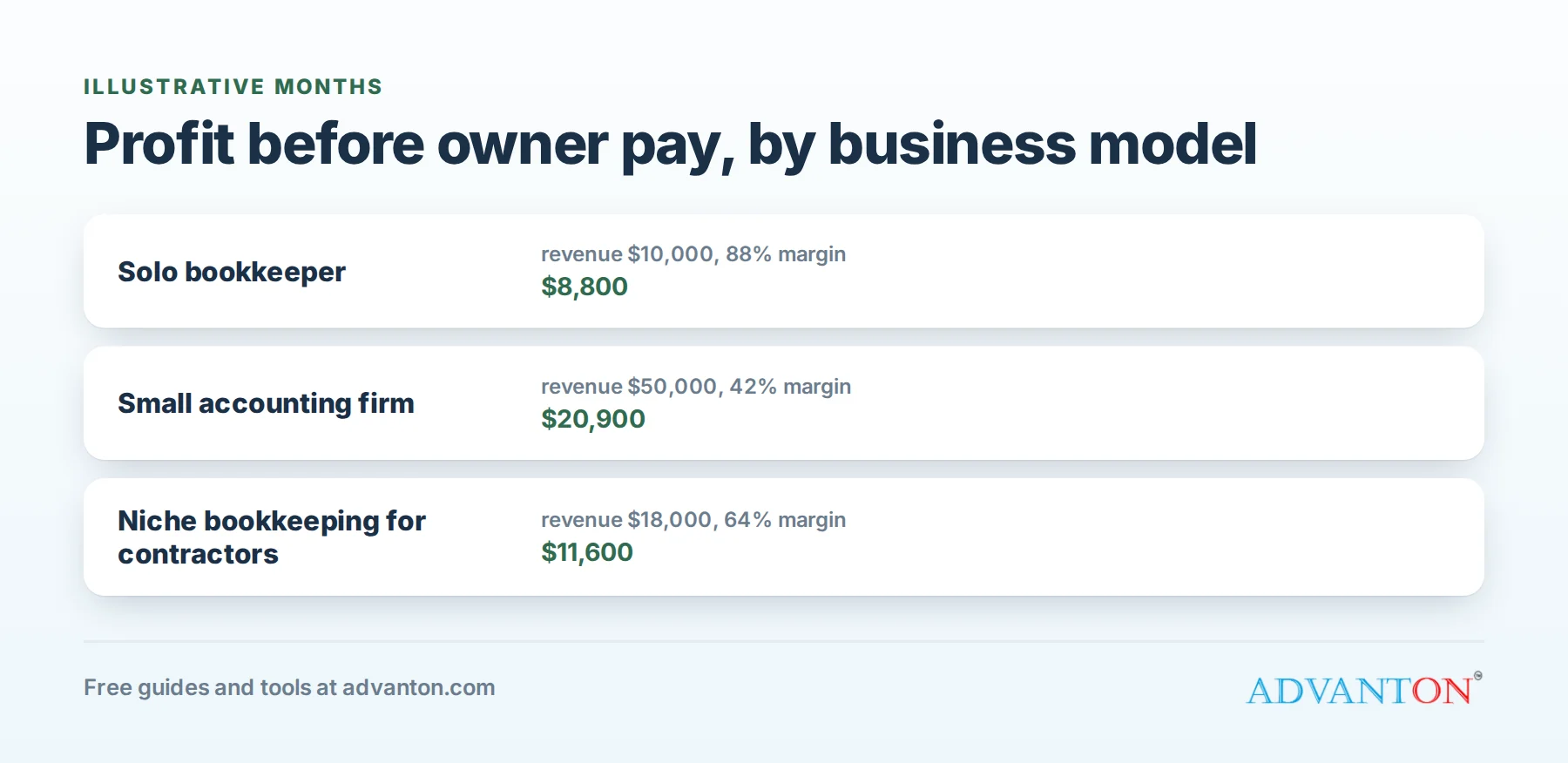
The figures below are illustrative months from our step-by-step guides, not industry averages. They show how revenue and costs typically fit together; your market, prices and costs will differ.
| Business model | Startup costs | Example monthly revenue | Costs | Profit before owner pay | Margin |
|---|---|---|---|---|---|
| Solo bookkeeper (25 monthly clients) | Low: software, insurance, certifications | $10,000 | $1,200 | $8,800 | 88% |
| Small accounting firm (owner plus 3 staff) | Moderate: licensed staff, tax software, office | $50,000 | $29,100 | $20,900 | 42% |
| Niche bookkeeping for contractors | Low: job-costing expertise, software, templates | $18,000 | $6,400 | $11,600 | 64% |
Fixed and variable costs
For projections, the most useful split is between variable costs, which rise and fall with sales (materials, parts, hourly labor), and fixed costs, which you pay every month regardless (rent, salaried staff, insurance, loan payments).
| Business model | Variable costs (% of revenue) | Fixed costs per month | What it means |
|---|---|---|---|
| Solo bookkeeper (25 monthly clients) | 0.0% | $1,200 | Low costs overall: time is the main constraint |
| Small accounting firm (owner plus 3 staff) | 0.0% | $29,100 | Mostly fixed: slow start-up months are expensive |
| Niche bookkeeping for contractors | 0.0% | $6,400 | Mostly fixed: slow start-up months are expensive |
What the numbers say
Solo bookkeepers keep most revenue, with income limited by client count and hours.
Firms trade margin for capacity. Staff, tax software and offices add fixed costs.
Niches command higher fees. Contractor bookkeeping with job costing is specialized and valued.
The three models in brief
Solo bookkeeper. Monthly bookkeeping for small businesses.
Small accounting firm. Bookkeeping, tax preparation and advisory work.
Contractor bookkeeping niche. Job costing, progress billing and cash flow for trades. See small business taxes and bookkeeping.
Cost structure: small accounting firm (owner plus 3 staff)
Each cost as a share of the example month’s revenue ($50,000):
| Cost | Monthly amount | Share of revenue | Type |
|---|---|---|---|
| Staff | $19,000 | 38.0% | Fixed |
| Payroll taxes and benefits | $3,800 | 7.6% | Fixed |
| Office | $2,500 | 5.0% | Fixed |
| Tax and accounting software | $1,500 | 3.0% | Fixed |
| Marketing | $1,500 | 3.0% | Fixed |
| Insurance | $500 | 1.0% | Fixed |
| Continuing education | $300 | 0.6% | Fixed |
| Profit before owner pay | $20,900 | 42% |
A first-year projection: small accounting firm (owner plus 3 staff)
New businesses rarely start at full speed. This projection assumes revenue ramps from 35% of the example month in month 1 to 100% by month 12, variable costs move with revenue, and fixed costs stay the same every month. It’s a planning illustration, not a forecast.
| Month | Revenue | Variable costs | Fixed costs | Profit | Cumulative |
|---|---|---|---|---|---|
| 1 | $17,500 | $0 | $29,100 | -$11,600 | -$11,600 |
| 2 | $22,500 | $0 | $29,100 | -$6,600 | -$18,200 |
| 3 | $27,500 | $0 | $29,100 | -$1,600 | -$19,800 |
| 4 | $31,000 | $0 | $29,100 | $1,900 | -$17,900 |
| 5 | $35,000 | $0 | $29,100 | $5,900 | -$12,000 |
| 6 | $38,000 | $0 | $29,100 | $8,900 | -$3,100 |
| 7 | $41,000 | $0 | $29,100 | $11,900 | $8,800 |
| 8 | $43,500 | $0 | $29,100 | $14,400 | $23,200 |
| 9 | $45,500 | $0 | $29,100 | $16,400 | $39,600 |
| 10 | $47,500 | $0 | $29,100 | $18,400 | $58,000 |
| 11 | $49,000 | $0 | $29,100 | $19,900 | $77,900 |
| 12 | $50,000 | $0 | $29,100 | $20,900 | $98,800 |
Year one: revenue $448,000, profit before owner pay $98,800. The first profitable month is month 4. Cumulative results bottom out at -$19,800, which is the minimum cash cushion this plan would need, before any startup costs.
Staff and software costs come before the client roster fills, so this firm illustration turns profitable in month 4, with a cumulative low of about $19,800. Tax season can bring uneven monthly revenue.
How firms price
- Monthly packages for bookkeeping.
- Fixed fees for tax returns.
- Advisory retainers for planning and reporting.
- Hourly for cleanup and special projects.
A startup checklist
- Get the credentials you need: CPA licensure for CPA services; a PTIN for paid tax preparation.
- Choose accounting and tax software and secure systems.
- Write engagement letters for every client.
- Buy professional liability insurance.
- Choose a niche where you understand the business.
Where the opportunities are
- Contractor job costing and progress billing.
- Cleanup projects for businesses behind on books.
- Fractional CFO services.
- Payroll and sales tax compliance.
Key terms
| Term | Meaning |
|---|---|
| Job costing | Tracking costs and profit for each project |
| Reconciliation | Matching books to bank and card statements |
| Accrual vs cash | When revenue and expenses are recorded |
| Engagement letter | A written agreement defining services |
Advice is the future
As software handles routine entries, clients value interpretation: what the numbers mean and what to do next.
Marketing an accounting firm
Referrals from clients, bankers and attorneys, niche expertise and local search bring steady clients.
Protect client data
Secure systems, strong passwords and careful document handling protect clients and your reputation.
How to use these numbers for your own plan
- Start with the closest model above and its cost structure.
- Replace every price and cost with local quotes: insurance, wages, vehicles, materials and your expected prices.
- Estimate your ramp: how many jobs you can realistically win each month in year one.
- Separate fixed and variable costs, then calculate your break-even point with our free break-even calculator.
- Map cash month by month with our cash flow forecast, including equipment and loan payments.
- Build the plan in our free Business Planner.
These figures will also feed a planned Advanton projection tool, so you’ll be able to start from an industry template and adjust it to your situation.
About this data
Workforce figures come from the U.S. Bureau of Labor Statistics (Occupational Outlook Handbook and Occupational Employment and Wage Statistics, May 2024 and the 2024 to 2034 projections). Market figures cite their sources in the list above. Business model figures are illustrative months built from typical prices and costs to show how revenue, fixed costs and variable costs fit together; they are not industry averages or guarantees. We review these profiles when new government data is released, at least once a year. The same figures are available in a structured format for Advanton’s upcoming business projection tool.
Licensing and rules
CPA licensure for certified public accountants; enrolled agent or PTIN requirements for tax preparation; bookkeepers generally don’t need a license but certifications help; data security rules for client information. Requirements change; confirm with your state and local agencies before you start.
Frequently asked questions
What do accountants earn?
BLS reported a median of $81,680 for accountants and auditors in May 2024.
Is bookkeeping declining?
BLS projects bookkeeping clerk jobs to decline 6% from 2024 to 2034 as software automates tasks.
Do bookkeepers need a license?
Generally no, but CPAs need licensure and paid tax preparers need a PTIN.
How can I use these numbers?
Start with the closest accounting model, then replace every figure with your local prices, commissions, wages and expected volume.
Keep learning
- Solo bookkeeper
- Local SEO for contractors
- How to get more contractor leads
- Specialty trades industry data
Sources
- U.S. Bureau of Labor Statistics, Accountants and auditors
- U.S. Bureau of Labor Statistics, Bookkeeping, accounting and auditing clerks
Last reviewed October 30, 2026. Startup costs are estimates; check local prices, licensing and tax rules before you commit money.

