
Search for your business online and you’ll likely find it in more places than you expected: Google, Apple Maps, Bing, Yelp, Facebook, directories, review sites and data aggregators. If those listings show different phone numbers, an old address or a slightly different business name, customers get confused and some will call the wrong number. Keeping your Name, Address and Phone (NAP) identical everywhere is one of the simplest, most valuable things a local business can do online.
This guide explains why NAP consistency matters, where mismatches come from and how to fix them, step by step.
What NAP consistency means
Table of Contents
| Detail | Consistent example | Inconsistent examples |
|---|---|---|
| Name | Springfield Plumbing Co. | Springfield Plumbing; Springfield Plumbing Co. – Emergency Plumber |
| Address | 120 Main St, Suite 200, Springfield, IL 62701 | 120 Main Street #200; 118 Main St (old address) |
| Phone | (555) 012-3456 | An old number; a different tracking number on each site |
Many marketers also include your website and hours in the same rule, since they change just as often.
Why it matters
- Customers reach you. A wrong number or old address is a lost customer.
- Search engines trust your information. Google explains that prominence draws on information about your business from across the web, such as links, articles and directories. Conflicting details make that information less reliable.
- Fewer duplicate listings. Inconsistent details often create duplicates that split your reviews.
- A professional impression. Matching details everywhere signal an established, organized business.
Common causes of mismatches
| Cause | What happens |
|---|---|
| Moving | Old addresses linger on directories for years |
| New phone numbers | Old numbers stay live on forgotten listings |
| Rebranding | Old names remain on review and directory sites |
| Data aggregators | Outdated information spreads to many sites automatically |
| Tracking numbers | Different numbers appear on different platforms |
| Staff or agencies creating listings | Duplicates with slightly different names |
| Formatting differences | "Street" vs "St," "Suite" vs "#" |
How to audit your listings
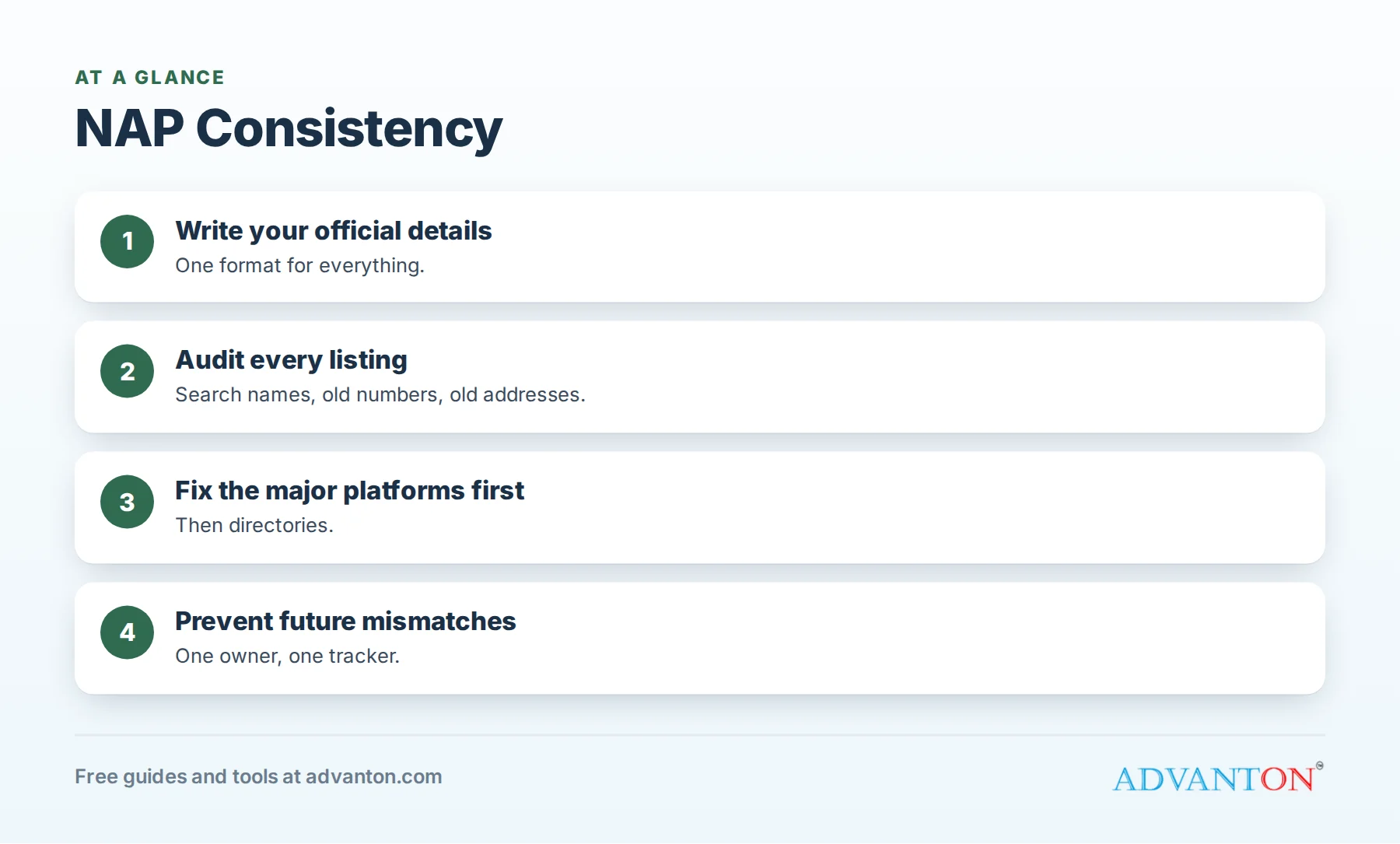
- Write down your official details exactly as they should appear everywhere.
- Search your business name in Google and note every listing on the first few pages.
- Search your old phone numbers and old addresses; they often reveal forgotten listings.
- Check the major platforms directly: Google, Apple Maps, Bing, Yelp, Facebook, Nextdoor and BBB.
- Check industry and local directories you’ve used, including the Advanton directory.
- Record everything in a spreadsheet: platform, link, login, current details and what needs fixing.
How to fix listings, platform by platform
| Platform | How to fix |
|---|---|
| Google Business Profile | Edit your profile; report duplicates through Google’s process |
| Apple Business Connect | Claim and edit your place card |
| Bing Places | Claim and edit, or import from Google |
| Yelp | Claim your page and edit business information |
| Edit your page details | |
| Nextdoor | Claim and edit your business page |
| Directories | Log in to claim and edit, or contact the site |
| Advanton directory | Contact us with your listing and the correct details |
Fix the major platforms first; their information often spreads to smaller sites.
Handling a move
- Update your Google Business Profile first, then Apple, Bing, Yelp and Facebook.
- Update your website, invoices, email signatures and vehicles.
- Update directories and industry listings.
- Search for your old address a few weeks later to catch stragglers.
- Watch for duplicates created by platforms that treat the new address as a new business.
Handling a new phone number
Keep the old number forwarding to the new one for as long as you can while you update every listing. Search for the old number periodically until it no longer appears.
Handling a rebrand
Change your name only when the new name is official on your signage and documents, then follow each platform’s process. Some platforms require verification for name changes; keep proof ready.
Tracking numbers: use carefully
Call tracking numbers help measure marketing, but scattering different numbers across listings undermines consistency. Keep your main local number as the primary number on listings, and use tracking numbers mainly in ads, or as secondary numbers where platforms support them.
Service-area businesses
If customers don’t visit you, hide your address on platforms that allow it and show your service area instead. Be consistent: if your address is hidden on Google, consider hiding it elsewhere too, and always keep your name and phone identical.
Multi-location businesses
Each real location needs its own consistent name, address, phone and page on your website. Never create listings for addresses where you don’t operate; virtual offices and fake locations can lead to suspensions.
Prevent future mismatches
- Keep one master document of your official details.
- Keep a listing tracker with every platform and login.
- Assign one person to manage listings.
- Review listings twice a year, and whenever something changes.
- Ask agencies for access lists if they create listings for you.
See our business listing checklist for a complete routine.
How data aggregators spread information
Many smaller directories, map apps and navigation systems get business information from data providers rather than from you directly. If a provider has your old address or number, the error can spread to dozens of sites at once. Correcting your major listings and claiming profiles on the platforms that feed others helps correct errors at the source over time. Be patient: updates can take weeks to appear everywhere.
A worked audit example
A plumbing company moved across town two years ago and changed its phone number. Its audit found: the Google profile correct; Apple Maps with the old address; Bing with the old phone; two Yelp pages (old and new); a directory listing with a misspelled name; and a supplier’s "find a plumber" page with the old number. The owner claimed and corrected Apple and Bing, asked Yelp to merge the duplicate pages, updated the directory and emailed the supplier. Within a few weeks, searches for the business showed consistent details, and calls from the old number stopped.
Keep your website consistent too
Your website is part of your NAP. Show the same name, address and phone in your footer and on your contact page, use the same format as your listings, and add structured data (schema markup) if your website builder supports it. Your website is often the reference other sites use.
Consistency and AI answers
Search engines and AI assistants increasingly summarize local options using information gathered from across the web. When your details match everywhere, those summaries are more likely to describe your business, hours and contact information correctly.
When a listing won’t update
Some old directories are abandoned or hard to edit. Try claiming the listing, then contacting the site through its support or contact page with your correct details. If a listing can’t be updated and isn’t important, focus your time on the platforms customers actually use.
Make one person responsible
Inconsistencies often creep in when several people (owners, staff, agencies) create and edit listings over the years. Assign one person to own your listings, keep the master document and tracker, and approve any change. When an agency or employee leaves, review access and update logins.
Customers notice inconsistency
A customer who finds a different phone number on your website and on a directory may wonder whether you’re still in business. Consistent details everywhere quietly reassure customers that your business is active, established and easy to reach.
Common mistakes
- Fixing Google but forgetting everything else.
- Leaving old listings live after a move.
- Different tracking numbers on every directory.
- Adding keywords to your business name on some sites but not others.
- Ignoring duplicates.
Frequently asked questions
What does NAP stand for?
Name, address and phone number, the core details that should match across every listing and your website.
Does NAP consistency affect rankings?
Consistent details help search engines trust your information, and Google says information from across the web contributes to prominence. Consistency also prevents lost customers and duplicate listings.
Does "Street" vs "St" matter?
Small formatting differences are usually understood, but using one format everywhere avoids confusion and duplicates.
How do I find old listings?
Search your business name, old phone numbers and old addresses, and check the major platforms directly.
How often should I check my listings?
At least twice a year, and whenever you move, change numbers or rebrand.
Should I include my website and hours in my audit?
Yes. Websites and hours change often and matter to customers as much as your phone number.
What should I do first if my listings are inconsistent?
Write down your official details, fix your Google Business Profile, then work through Apple, Bing, Yelp, Facebook and directories.
Can an old listing hurt my business?
It can send customers to a wrong number or address, and create duplicates that split your reviews.
How Advanton helps
Advanton is a free resource that helps small businesses start, get online, find customers and grow. Run our free online presence checkup to spot gaps, and add your business to the Advanton directory with consistent details, for free. Advanton earns money when you buy a domain or hosting through our store, which helps keep everything else free.
Keep learning
Sources
Last reviewed October 30, 2026. Startup costs are estimates; check local prices, licensing and tax rules before you commit money.


Leave a Reply