
Ask ten marketers whether business directories still help local SEO and you’ll hear everything from "essential" to "a waste of time." The honest answer sits in between. Accurate listings on the right directories help customers find you, help search engines trust your business details, and occasionally bring customers directly. Hundreds of low-quality listings, on the other hand, do little and can cause confusion.
This guide explains what directories really do for a local business in 2026, which ones are worth your time, and how to keep them working for you.
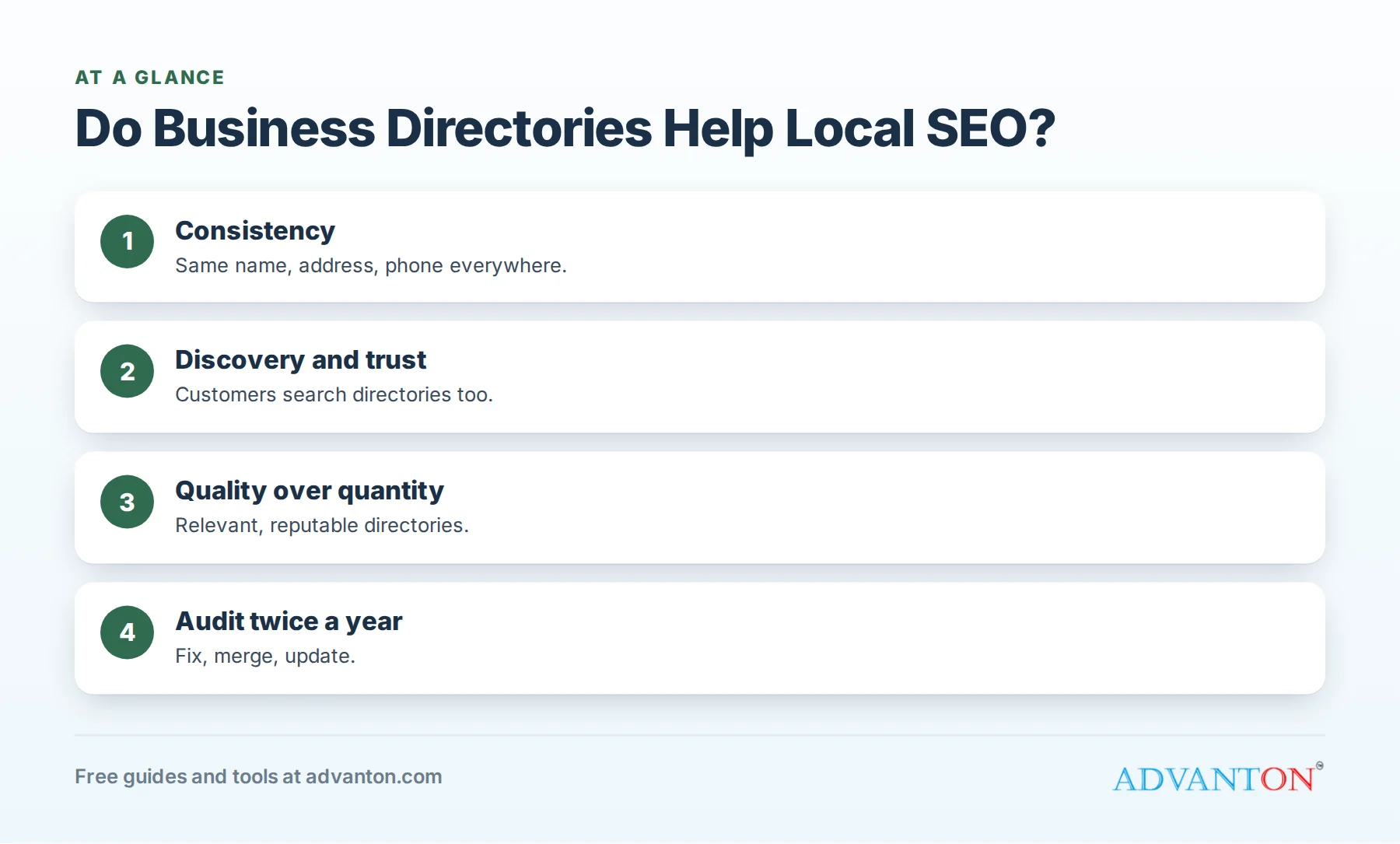
How Google decides local results
Table of Contents
Google says local results depend mainly on three factors: relevance (how well your business matches the search), distance (how close you are), and prominence (how well-known your business is). Google also explains that prominence draws on information about your business from across the web, such as links, articles and directories. Directory listings are one of many signals that contribute, not a shortcut.
What directories do for your business
| Benefit | How it works |
|---|---|
| Consistent business details | Matching name, address and phone across the web helps search engines and customers trust your information |
| Discovery | Some customers search directories, maps apps and review sites directly |
| Trust | A complete listing with photos and reviews reassures customers |
| Referral visits | Listings link to your website and phone |
| Prominence | Information about your business across the web contributes to Google’s prominence factor |
What directories don’t do
- They don’t replace your Google Business Profile, which remains the most important local listing for most businesses.
- They don’t guarantee rankings. Reviews, relevance, distance and your website matter more.
- They don’t help if details are wrong. Old addresses and phone numbers send customers to dead ends.
- More isn’t always better. A handful of accurate, relevant listings beats hundreds of spammy ones.
Name, address and phone consistency
Local SEO professionals call it "NAP consistency": your business name, address and phone number should match everywhere. Mismatches happen when businesses move, change phone numbers, rebrand or let old listings linger. Customers who find an outdated phone number may never reach you, and conflicting details make it harder for search engines to be confident about your information.
| Detail | Consistency rule |
|---|---|
| Name | Your real business name, without extra keywords |
| Address | Same format everywhere, or hidden consistently for service-area businesses |
| Phone | One main local number |
| Website | The same address with https |
| Hours and categories | Updated everywhere when they change |
Which directories are worth your time
Start with the platforms most customers use:
- Google Business Profile.
- Apple Business Connect (Apple Maps).
- Bing Places.
- Yelp, Facebook and Nextdoor.
Then add directories relevant to your business:
- General small business directories such as the free Advanton Business Directory, where your listing gets its own page with your logo, photo, description, hours and contact options.
- Industry directories: trade associations, professional associations, manufacturer and supplier "find a pro" pages.
- Local directories: chambers of commerce, downtown associations and community sites.
See our full list of free business listing sites.
Directories to avoid
- Sites that exist only to sell links, with no real visitors.
- Directories that charge to "keep" a free listing active or send unexpected invoices.
- Listings that require keyword-stuffed names or misleading categories.
- Services promising hundreds of listings overnight without explaining where.
When in doubt, ask whether a real customer would ever use the directory to find a business like yours.
Realistic expectations
| Expectation | Reality |
|---|---|
| "Directories will put me in the map pack" | They support trust and consistency; your Business Profile, reviews and website drive ranking |
| "More listings means more customers" | A few accurate, relevant listings outperform many low-quality ones |
| "Directories are set-and-forget" | Details change; review listings at least twice a year |
| "Directories bring no customers" | Some customers do search directories, review sites and maps apps directly |
How to audit your listings in an afternoon
- Search your business name and phone number on Google, and note every listing that appears.
- Check the major platforms: Google, Apple Maps, Bing, Yelp, Facebook, Nextdoor and BBB.
- Record each listing in a spreadsheet: platform, link, login and whether details match.
- Claim and correct listings with wrong names, addresses, phones, hours or websites.
- Merge or remove duplicates using each platform’s process.
- Add missing listings that matter for your industry.
- Set a reminder to review everything twice a year.
Our free online presence checkup helps you spot gaps.
Make every listing count
A listing is only as good as its content. Use the same strong description, real photos, accurate hours and a clear call to action everywhere. See our guide to writing a business directory listing that gets calls.
Directories and reviews
Many directories display reviews, and customers often read them before calling. Focus review requests on the platform that matters most (usually Google), reply to reviews everywhere you have a listing, and keep photos and details as strong as your reviews.
Service-area businesses
If you serve customers at their locations, many platforms let you hide your address and show a service area instead. Be consistent: decide how you present your location, and apply it everywhere, while keeping your business name and phone identical.
New businesses benefit most
New businesses have little else online, so accurate listings matter more. Claim your main profiles as soon as your name, address and phone are final, then add relevant directories one by one. Starting consistent prevents duplicates and mismatches that are harder to fix later.
Tracking phone numbers: use with care
Call tracking numbers help measure marketing, but scattering different numbers across directories can create inconsistent listings. Keep your main local number as the primary number on directories, and use tracking numbers carefully, for example on ads or as a secondary number where a platform supports it.
Directories and AI search
Search engines and AI assistants increasingly summarize local options for users. They rely on business information gathered from across the web: your profile, website, listings and reviews. Accurate, consistent listings make it more likely that summaries describe your business correctly.
Multi-location businesses
If you have several real locations, each should have its own consistent listings with its own address, phone and page on your website. Don’t create listings for addresses where you don’t operate; virtual offices and fake locations can lead to suspended listings.
Measure what directories bring
Ask every new customer how they found you, check website analytics for referral visits from directories, and use each platform’s insights where available. Advanton directory owners see listing views, website clicks and phone taps in their free dashboard. Spend more time on the listings that bring customers.
A twice-yearly routine
Every six months: check every listing for accuracy, update photos and hours, reply to new reviews, remove duplicates and note any new directories customers mention. It takes an hour or two and keeps your information working for you.
Industry directories carry extra weight with customers
A listing on a directory your customers already trust (a trade association’s member list, a manufacturer’s certified installer page, a professional licensing directory or a local chamber of commerce) can bring better-qualified visitors than a general directory. These listings also signal credibility: customers see that an organization in your field recognizes your business. Ask your associations, suppliers and manufacturers whether they offer member or partner listings, and keep those details consistent with the rest of your profiles.
Common mistakes
- Different phone numbers across listings, such as old numbers or tracking numbers without care.
- Keyword-stuffed business names.
- Abandoned listings with outdated hours.
- Paying for listings that bring no visitors.
- Ignoring duplicates after a move.
Frequently asked questions
Do business directories help SEO in 2026?
Accurate listings on reputable, relevant directories support trust and consistency, and Google says information from across the web contributes to prominence. They complement, not replace, your Business Profile, reviews and website.
How many directory listings does a small business need?
Cover the major platforms, then add directories your customers actually use. Quality and accuracy matter more than quantity.
What is NAP consistency?
Keeping your business name, address and phone number identical across every listing and your website.
Should I pay for directory listings?
Only when a directory clearly brings customers in your industry, pricing is transparent and you can measure results.
Is the Advanton Business Directory free?
Yes. Listings are free and reviewed before publishing.
Do directory links help my website rank?
Links from reputable, relevant sites can contribute to prominence; spammy directory links don’t help and aren’t worth paying for.
How often should I audit my listings?
At least twice a year, and whenever you move, change phone numbers or rebrand.
How Advanton helps
Advanton is a free resource that helps small businesses start, get online, find customers and grow. Add your business to the Advanton directory for free, check your listings with the online presence checkup and earn reviews with the review request kit. Advanton earns money when you buy a domain or hosting through our store, which helps keep everything else free.
Keep learning
- Free business listing sites
- How to add your business to the Advanton directory
- Local SEO for contractors
Sources
Last reviewed October 30, 2026. Startup costs are estimates; check local prices, licensing and tax rules before you commit money.


Leave a Reply