
Fences and decks are among the most visible home improvements: they add privacy, safety, outdoor living space and curb appeal, and every finished project advertises your work to the neighborhood. Demand comes from homeowners, new home buyers, pet owners, pool owners, builders and property managers.
Fence erectors earned a median wage of $46,940 in May 2024, with about 22,640 employed, according to BLS wage data; deck builders are typically counted among carpenters, who earned a median of $59,310. Business owners earn more by selling and managing projects efficiently, but materials take a large share of every job, so pricing and purchasing matter.
The workforce
| Occupation | Jobs (2024) | Median pay (May 2024) | Projected growth, 2024 to 2034 |
|---|---|---|---|
| Fence erectors | n/a | $46,940 | n/a |
| Carpenters (deck builders are included) | about 959,000 | $59,310 | +4% |
Source: U.S. Bureau of Labor Statistics, Occupational Outlook Handbook.
Market data
| Measure | Value |
|---|---|
| Fence erectors employed (BLS OEWS, May 2024) | 22,640 |
Business models compared
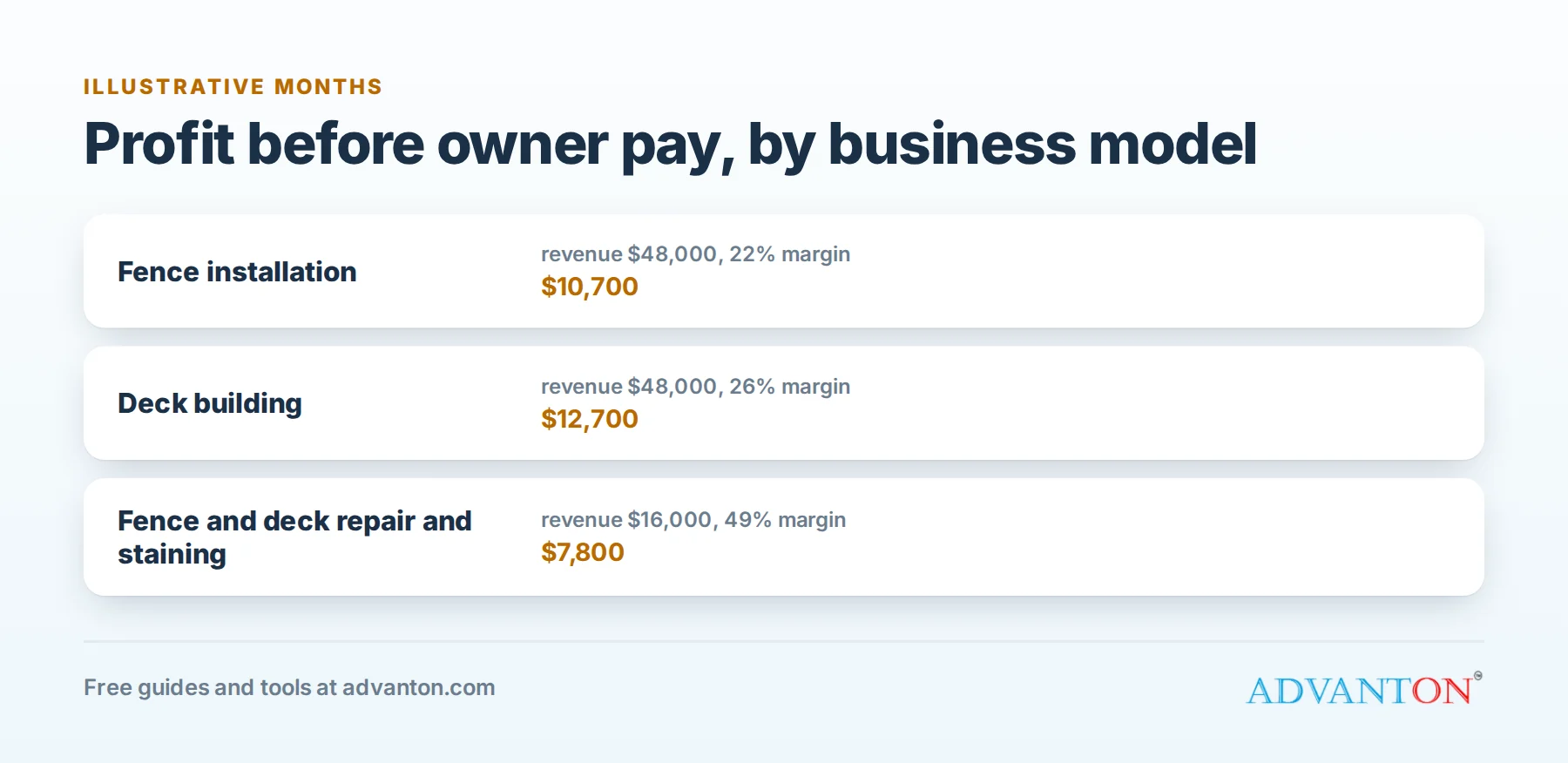
The figures below are illustrative months from our step-by-step guides, not industry averages. They show how revenue and costs typically fit together; your market, prices and costs will differ.
| Business model | Startup costs | Example monthly revenue | Costs | Profit before owner pay | Margin |
|---|---|---|---|---|---|
| Fence installation | Moderate: truck, trailer, auger, tools, insurance | $48,000 | $37,300 | $10,700 | 22% |
| Deck building | Moderate: tools, truck, permits knowledge | $48,000 | $35,300 | $12,700 | 26% |
| Fence and deck repair and staining | Low: tools, sprayer, truck | $16,000 | $8,200 | $7,800 | 49% |
Fixed and variable costs
For projections, the most useful split is between variable costs, which rise and fall with sales (materials, parts, hourly labor), and fixed costs, which you pay every month regardless (rent, salaried staff, insurance, loan payments).
| Business model | Variable costs (% of revenue) | Fixed costs per month | What it means |
|---|---|---|---|
| Fence installation | 65.8% | $5,700 | Mostly variable: profitable early, but watch cash flow |
| Deck building | 62.7% | $5,200 | Mostly variable: profitable early, but watch cash flow |
| Fence and deck repair and staining | 15.0% | $5,800 | Mostly fixed: slow start-up months are expensive |
What the numbers say
Materials take the biggest bite. In fence installation, materials can be close to half of revenue, so supplier pricing, accurate takeoffs and minimizing waste protect margins.
Projects are visible marketing. A new fence or deck is seen by every neighbor, which makes yard signs, door hangers and referrals especially effective.
Repair and staining smooth the season. Smaller jobs keep crews busy and build relationships for future installs.
The three models in brief
Fence installation. Wood, vinyl, aluminum and chain link fences for homes and businesses; fast, repeatable projects with heavy material costs.
Deck building. Higher-value projects with permits, inspections and design choices.
Repair and staining. Lower startup costs and higher margins; a steady source of repeat customers.
Cost structure: fence installation
Each cost as a share of the example month’s revenue ($48,000):
| Cost | Monthly amount | Share of revenue | Type |
|---|---|---|---|
| Materials | $21,600 | 45.0% | Variable |
| Crew | $9,600 | 20.0% | Variable |
| Marketing | $2,400 | 5.0% | Fixed |
| Truck and trailer | $1,600 | 3.3% | Fixed |
| Insurance | $1,100 | 2.3% | Fixed |
| Auger and equipment payment | $600 | 1.2% | Fixed |
| Disposal | $400 | 0.8% | Variable |
| Profit before owner pay | $10,700 | 22% |
A first-year projection: fence installation
New businesses rarely start at full speed. This projection assumes revenue ramps from 35% of the example month in month 1 to 100% by month 12, variable costs move with revenue, and fixed costs stay the same every month. It’s a planning illustration, not a forecast.
| Month | Revenue | Variable costs | Fixed costs | Profit | Cumulative |
|---|---|---|---|---|---|
| 1 | $16,800 | $11,060 | $5,700 | $40 | $40 |
| 2 | $21,600 | $14,220 | $5,700 | $1,680 | $1,720 |
| 3 | $26,400 | $17,380 | $5,700 | $3,320 | $5,040 |
| 4 | $29,760 | $19,592 | $5,700 | $4,468 | $9,508 |
| 5 | $33,600 | $22,120 | $5,700 | $5,780 | $15,288 |
| 6 | $36,480 | $24,016 | $5,700 | $6,764 | $22,052 |
| 7 | $39,360 | $25,912 | $5,700 | $7,748 | $29,800 |
| 8 | $41,760 | $27,492 | $5,700 | $8,568 | $38,368 |
| 9 | $43,680 | $28,756 | $5,700 | $9,224 | $47,592 |
| 10 | $45,600 | $30,020 | $5,700 | $9,880 | $57,472 |
| 11 | $47,040 | $30,968 | $5,700 | $10,372 | $67,844 |
| 12 | $48,000 | $31,600 | $5,700 | $10,700 | $78,544 |
Year one: revenue $430,080, profit before owner pay $78,544. The first profitable month is month 1. Cumulative results stay positive, so the main cash need is the startup investment itself.
Most fence costs are materials and crew time, so this illustration is profitable from month 1. The cash risk lies elsewhere: materials are often bought before customers pay in full, so deposits and supplier credit matter.
How fence and deck contractors price
- Fences per linear foot by material and height, plus gates, removal of old fencing and difficult terrain.
- Decks per square foot or by project, by material (pressure-treated wood, cedar or composite), height, railings and stairs.
- Repairs by the job, with minimum charges.
- Staining and sealing per square foot or by project.
Seasonality and demand patterns
Fence and deck work is busiest in spring and summer, with strong demand before outdoor living season and pool season. Frozen ground slows post installation in cold regions. Many contractors book winter consultations and offer early-season discounts.
A startup checklist
- Check contractor licensing and permit rules for fences and decks.
- Learn local rules: fence height limits, setbacks, pool barrier requirements and HOA approvals.
- Call 811 before every dig, and wait for utilities to be marked.
- Buy or rent equipment: auger, post driver, saws and a truck and trailer.
- Arrange insurance: general liability, workers’ comp and commercial auto.
- Set up supplier accounts and estimating templates.
- Build your local presence; see local SEO for contractors.
Questions to answer before you start
- Will you specialize in fences, decks or both?
- How will you manage material costs and price changes?
- Who handles permits and HOA approvals, you or the homeowner?
- How will you stay busy in winter?
- How will you mark property lines and avoid disputes?
Where the opportunities are
- Privacy and pet fencing for new homeowners.
- Pool barriers that meet local safety codes.
- Composite decks and low-maintenance outdoor living spaces.
- Repair, staining and sealing for aging fences and decks.
- Builder and property manager contracts.
Key terms
| Term | Meaning |
|---|---|
| Linear foot | The standard pricing unit for fences |
| Setback | Required distance from property lines or structures |
| Ledger board | The board attaching a deck to the house; critical for safety |
| 811 | The free national call-before-you-dig number |
| Composite decking | Low-maintenance decking made from wood fibers and plastic |
Property lines and permits
Many fence disputes start with property lines. Ask homeowners to confirm boundaries (with a survey if there’s any doubt), put responsibility for line locations in your contract, and follow setback rules and HOA requirements. For decks, permits and inspections protect both you and the homeowner by confirming footings, ledgers, guards and stairs meet code. Careful paperwork prevents the costly problems that hurt reputations.
Materials and suppliers
Because materials can approach half of every job, supplier relationships matter. Compare pricing from several suppliers, ask about contractor accounts and volume discounts, and track price changes, since lumber and metal prices can move quickly. Quote with a validity period, such as 30 days, so price changes don’t erase your margin. Order accurately, store materials securely, and return unused items promptly.
Neighborhood marketing works especially well
A new fence or deck is visible to every passerby, which makes neighborhood marketing unusually effective. With permission, place a yard sign during and after installation, hang door hangers on nearby homes, and ask satisfied customers to recommend you in local online groups. Spring postcards to neighborhoods with older fences and decks bring repair and replacement calls. Our free yard sign maker and EDDM postcard maker make these easy.
Maintenance plans for past customers
Wood fences and decks need cleaning, sealing and occasional repairs every few years, and the customers you’ve already served are your easiest sales. Keep a list of every installation with the date and materials, then send a friendly reminder when it’s time for staining or an inspection. A simple yearly or two-year maintenance plan creates repeat revenue in quieter months, keeps your work looking good in the neighborhood, and gives you first chance at the replacement project years later. A referral reward, such as a discount for each neighbor who books, turns past customers into a steady source of new jobs.
An example price list
| Job | Example price |
|---|---|
| Wood privacy fence, 6 feet (per linear foot) | $38 |
| Vinyl privacy fence, 6 feet (per linear foot) | $50 |
| Chain link fence, 4 feet (per linear foot) | $22 |
| Pressure-treated deck (per square foot) | $45 |
| Composite deck (per square foot) | $70 |
These prices are illustrative; materials, terrain and local labor rates change them significantly.
Pool barriers and safety
Fences around pools must usually meet specific safety codes for height, gaps, gates and self-closing, self-latching hardware. Learn your local pool barrier rules before quoting, explain them to homeowners, and confirm inspection requirements. Getting pool fencing right protects children and protects your business from serious liability. Keep photos of every finished gate and latch, and give homeowners a short care note explaining how to keep gates closing and latching properly over time, since hardware adjustments are a common cause of later problems. Offer an annual gate and latch check as part of a maintenance plan; it protects families and keeps you in regular touch with past customers year after year.
How to use these numbers for your own plan
- Start with the closest model above and its cost structure.
- Replace every price and cost with local quotes: insurance, wages, vehicles, materials and your expected prices.
- Estimate your ramp: how many jobs you can realistically win each month in year one.
- Separate fixed and variable costs, then calculate your break-even point with our free break-even calculator.
- Map cash month by month with our cash flow forecast, including equipment and loan payments.
- Build the plan in our free Business Planner.
These figures will also feed a planned Advanton projection tool, so you’ll be able to start from an industry template and adjust it to your situation.
About this data
Workforce figures come from the U.S. Bureau of Labor Statistics (Occupational Outlook Handbook and Occupational Employment and Wage Statistics, May 2024 and the 2024 to 2034 projections). Market figures cite their sources in the list above. Business model figures are illustrative months built from typical prices and costs to show how revenue, fixed costs and variable costs fit together; they are not industry averages or guarantees. We review these profiles when new government data is released, at least once a year. The same figures are available in a structured format for Advanton’s upcoming business projection tool.
Licensing and rules
Contractor licensing varies by state; fence height and placement rules, HOA approvals and permits in many areas; call 811 before digging post holes; deck permits and inspections are common, with codes for footings, ledgers, guards and stairs. Requirements change; confirm with your state and local agencies before you start.
Frequently asked questions
What do fence erectors earn?
The BLS reported a median wage of $46,940 for fence erectors in May 2024; carpenters earned a median of $59,310.
Do I need permits for fences and decks?
Often, yes. Many cities require permits for fences above certain heights and for most decks. Check local rules and HOA requirements.
Do I need to call 811 before installing a fence?
Yes. Calling 811 before digging gets underground utilities marked, protecting your crew and avoiding costly damage.
Which is more profitable, fences or decks?
Decks usually bring higher tickets, while fences are faster and more repeatable; many contractors do both.
Wood, vinyl or composite: what should I offer?
Offer the materials your market wants and your crews install well. Many contractors offer wood for budget-conscious customers and vinyl or composite for low-maintenance buyers, with clear comparisons of cost and upkeep.
How long does a fence installation take?
Many residential fences take one to three days once materials arrive, depending on length, terrain and gates; decks take longer, especially with permits and inspections.
How can I use these numbers?
Start with the closest model, then replace every figure with your local material prices, crew costs and expected job volume.
Keep learning
- Fence installation
- Local SEO for contractors
- How to get more contractor leads
- Specialty trades industry data
Sources
- BLS Occupational Employment and Wage Statistics, May 2024 (construction and extraction occupations)
- U.S. Bureau of Labor Statistics, Carpenters
Last reviewed October 29, 2026. Startup costs are estimates; check local prices, licensing and tax rules before you commit money.

