
Every contractor knows the feeling: one month the phone won’t stop ringing, the next it’s quiet and you’re wondering where the next job will come from. Steady work doesn’t come from one magic source. It comes from a system of lead sources that keeps calls coming in all year, so a slow week on one channel is covered by the others.
This guide covers 25 proven ways to get more contractor leads, grouped into five categories. For each, you’ll see what it costs, how fast it works, and how to make it pay. Pick the ones that fit your trade and budget, start with the fastest wins, and track what books jobs.
The five categories at a glance
Table of Contents
| Category | Examples | Cost | Speed | Best for |
|---|---|---|---|---|
| Google and local search | Business Profile, reviews, website, Local Services Ads | Free to moderate | Weeks to months (ads: days) | Every contractor |
| Your existing customers | Referrals, repeat work, maintenance plans | Low | Fast | Contractors with past customers |
| Your neighborhood | Yard signs, door hangers, truck lettering, postcards | Low | Fast | Residential trades |
| Partnerships | Realtors, property managers, suppliers, other trades | Low | Medium | Every contractor |
| Lead platforms and ads | Angi, Thumbtack, Nextdoor, Google Ads | Moderate to high | Fast | Filling gaps quickly |
Part 1: Google and local search
When homeowners need a contractor, most start with a search like "plumber near me" or "roof repair [town]." Showing up there is the single most valuable long-term lead source.
1. Claim and complete your Google Business Profile
Your Business Profile is your listing in Google Maps and the local results. Fill out everything: correct categories, service areas, hours, services with descriptions, photos and a link to your website. Google says local results are based mainly on relevance, distance and prominence, and a complete, accurate profile helps relevance. Our Google Business Profile guide for contractors walks through every setting, and our free online presence checkup shows what’s missing.
2. Get a steady flow of Google reviews
Google says review count and rating factor into local ranking, and reviews are often the deciding factor for homeowners comparing contractors. Ask every happy customer, right after the job, with a direct link. Our free review request kit creates the message and a QR code for your invoices and truck.
3. Reply to every review
Replies show future customers you care. Thank people by name, mention the job, and handle complaints calmly with an offer to make it right.
4. Post photos of every job
Before-and-after photos on your profile and website show quality and keep your listing active. Shoot in daylight, from the same angle, and get the customer’s permission.
5. Build a website that turns visitors into calls
Your website should say what you do and where in the first lines, show a click-to-call button on every page, and include service pages, project photos, reviews and a simple quote form. Our free contractor website builder creates one in about 10 minutes, with versions for plumbers, HVAC, electricians, roofers and more.
6. Create a page for each service and town
A page for "water heater replacement in [town]" can rank for that exact search, while a single generic page can’t. Write genuinely useful pages with local details, photos and reviews, not copies with town names swapped.
7. Try Google Local Services Ads
Local Services Ads appear above the regular results with the Google Verified badge, and you pay per lead, not per click. Verification checks your license, insurance and background. See our Local Services Ads guide.
8. Run focused Google search ads
Search ads can bring calls within days. Start small, target only your service area and high-intent searches ("emergency plumber [town]"), and track cost per booked job.
Part 2: Your existing customers
9. Ask for referrals, at the right moment
The best time to ask is right after a job goes well. Make it easy: give two business cards, or send a text with your link. A small thank-you, such as a gift card for each referral that books, turns happy customers into your sales team.
10. Stay in touch with past customers
A short email or postcard each season (maintenance reminders, seasonal tips, a special offer) brings repeat work from people who already trust you.
11. Sell maintenance plans
HVAC tune-ups, plumbing inspections, gutter cleaning and roof checks bring recurring revenue and first call when something breaks.
12. Follow up on every estimate
Many jobs are lost simply because nobody followed up. Call or text two to three days after every estimate, and again a week later.
Part 3: Your neighborhood
13. Put a yard sign on every job
With the homeowner’s permission, a clean sign tells the whole street who’s doing the work. Neighbors often call within days. Design one free with our yard sign maker.
14. Door-hang the street around each job
Leave a door hanger on 20 to 30 nearby homes: "We’re working on your neighbor’s roof this week. Ask about a free inspection." Our Brand & Print Studio makes matching hangers and cards.
15. Letter your truck
Your truck is a moving billboard. Show your business name, trade, phone number and website clearly enough to read at a stoplight.
16. Mail postcards to target neighborhoods
USPS Every Door Direct Mail lets you mail every home on chosen routes without a mailing list. Try our free EDDM postcard maker.
17. Join local groups and events
Community events, sponsorships of local teams, and neighborhood groups build recognition, and people hire contractors they recognize.
Part 4: Partnerships
18. Real estate agents
Agents need contractors before listings and after inspections. Be fast, reliable and clear with pricing, and they’ll send repeat work.
19. Property managers
Managers oversee many units and need dependable contractors for repairs and turnovers.
20. Suppliers and supply houses
Counter staff often know which homeowners and builders need help. Be known, friendly and reliable.
21. Other trades
Plumbers, electricians, painters, roofers and remodelers constantly meet customers who need other trades. Swap referrals with good contractors you trust.
22. Insurance and restoration companies
After water, fire and storm damage, restoration firms need trades they can rely on.
Part 5: Lead platforms and ads
23. Lead sites (Angi, Thumbtack and others)
Lead platforms can fill a calendar quickly, but you often pay per lead and compete with other contractors for the same customer. Respond fast, track cost per booked job, and use them to fill gaps rather than as your only source.
24. Nextdoor and local social media
Neighborhood platforms and local Facebook groups are full of "Can anyone recommend…?" posts. Be helpful, show your work, and ask happy customers to recommend you.
25. Answer the phone, fast
The fastest way to get more jobs from the leads you already have: answer, or call back within minutes. Many homeowners call the next contractor if nobody picks up. A business phone app with text-back helps; see business phone options.
Cost per lead vs cost per booked job
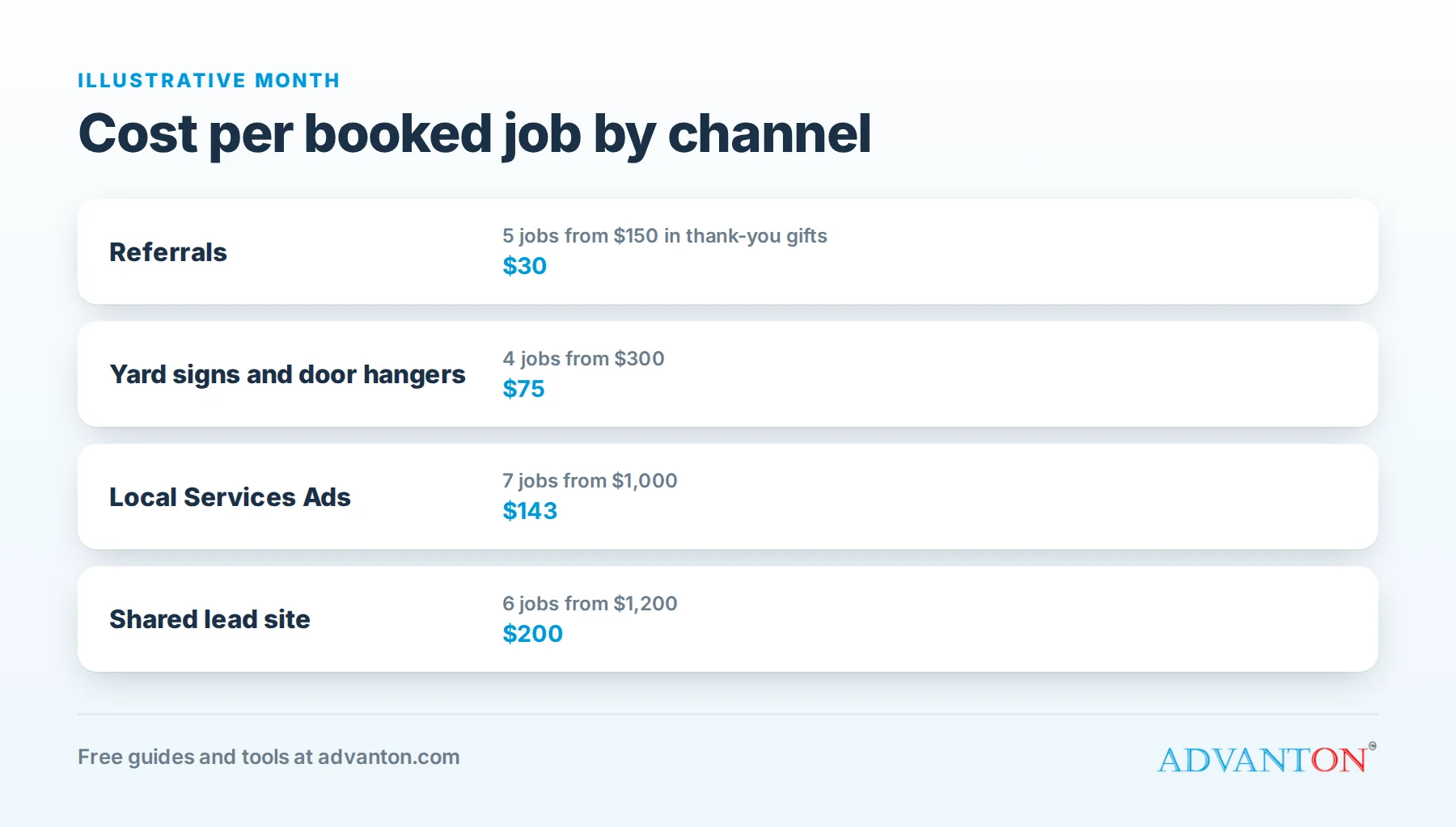
The cheapest leads aren’t always the cheapest jobs. What matters is how much you spend for each job you actually book. Here’s an illustrative month for a contractor using three channels:
| Channel | Spend | Leads | Booked jobs | Cost per lead | Cost per booked job |
|---|---|---|---|---|---|
| Shared lead site | $1,200 | 40 | 6 | $30 | $200 |
| Local Services Ads | $1,000 | 20 | 7 | $50 | $143 |
| Yard signs and door hangers | $300 | 8 | 4 | $38 | $75 |
| Referrals (thank-you gifts) | $150 | 6 | 5 | $25 | $30 |
Shared leads look cheap per lead, but they’re often contacted by several contractors, so fewer turn into jobs. Referrals and neighborhood marketing book at much higher rates. Track your own numbers for a few months, then move money toward the channels with the lowest cost per booked job and the best customers.
Build a fast lead-response system
Speed wins jobs. Homeowners with urgent problems often call several contractors and hire whoever responds first with a clear answer. A simple system:
- One business number that rings your phone and, if you’re busy, a teammate’s.
- A voicemail greeting promising a callback time.
- Missed-call text-back so callers get an instant reply.
- Online booking or a short quote form for customers who prefer not to call.
- A rule: every lead gets a response within 15 minutes during business hours.
- Follow-up reminders for every estimate that hasn’t been accepted.
Scripts you can use today
Referral request (after a finished job):
"Thanks again for choosing us. If you know anyone who needs [service], we’d be grateful if you’d pass along our card. We send a $50 gift card as a thank-you for every referral who books a job."
Door hanger:
"We’re replacing your neighbor’s water heater this week. If you’d like a free inspection of yours while we’re nearby, call or text [number]."
Review request (text):
"Hi [name], thanks for having us out today. If you were happy with the work, would you leave us a quick Google review? It really helps a small business: [link]"
Quick tips by trade
| Trade | Best quick win |
|---|---|
| Plumbing | Rank for emergency searches; answer 24/7 or use an answering service |
| HVAC | Sell maintenance agreements before peak seasons |
| Electrical | Promote EV chargers, panel upgrades and generators |
| Roofing | Yard signs and door hangers around every job; inspections after storms |
| Painting | Before-and-after photos and neighborhood postcards in spring |
| Remodeling | Project galleries, designer and realtor partnerships |
| Handyman | Nextdoor recommendations and repeat customers |
| Landscaping | Route-dense neighborhood marketing and seasonal contracts |
| Flooring | Retailer partnerships and showroom referrals |
| Concrete | Builder relationships and driveway postcards |
| Fencing | Yard signs; fences are visible advertisements themselves |
| Pressure washing | Before-and-after videos and HOA partnerships |
Measure lead quality, not just volume
Ten calls that turn into eight good jobs beat forty calls that turn into five price-shoppers. For each channel, track the booking rate, average job value, cancellation rate and how often customers come back or refer others. Our free lead source tracker helps you see which channels bring the best customers.
Plan around your seasons
Most trades have busy and slow seasons. Use slow months to build the long-term channels (reviews, website pages, partnerships and maintenance plans), and save paid channels for times when you have capacity to take jobs. Offering early-booking discounts before your busy season fills your calendar in advance.
A five-minute weekly visibility routine
Small, consistent actions keep you visible in local search:
- Upload two or three job photos to your Business Profile.
- Reply to new reviews and send review requests for the week’s finished jobs.
- Post one update or offer on your profile.
- Answer any questions customers asked on your listing.
- Check your hours, especially around holidays.
Use short videos
A 30-second clip of a finished job, a quick tip ("how to shut off your water main") or a walkthrough of a repair builds trust faster than text. Post videos on your profile, website and social media. Our free video editing roundup lists simple tools.
Seasonal promotions that work
| Season | Example promotion |
|---|---|
| Spring | Roof and gutter inspections, exterior painting bookings, AC tune-ups |
| Summer | Emergency AC repair, deck and fence projects |
| Fall | Furnace tune-ups, gutter cleaning, winterization |
| Winter | Frozen pipe prevention, indoor remodels, early booking discounts for spring |
Protect your reputation
One bad experience can cost more than any ad brings in. Communicate schedule changes promptly, clean up every day, resolve complaints quickly and in writing, and keep promises small enough to keep. A reputation for reliability is the foundation every other lead source builds on.
Handle price shoppers without losing your margin
Some callers only want the lowest price. Rather than racing to the bottom, explain what’s included in your work (permits, cleanup, warranty, licensed technicians), offer good-better-best options, and point to your reviews. Customers who choose on price alone are often the hardest to please; customers who choose on trust become referrals. It’s fine to let the lowest-price shoppers go, and focus your energy on customers who value quality work.
Show up in AI search answers
Search engines increasingly show AI-generated summaries that recommend local businesses. The same basics help you appear there: an accurate, complete Business Profile; consistent name, address and phone across the web; strong, recent reviews; and clear website pages explaining your services, areas, prices and process. Helpful pages that answer real customer questions (costs, timelines, what to expect) are more likely to be cited.
Make your business easy to recommend
Referrals happen when people can easily describe and share you. Use a memorable business name and phone number, give customers a simple way to share your website or booking link, leave two business cards or a fridge magnet after every job, and send a short thank-you message that includes your link. When a neighbor asks "Who did your roof?", your customer should be able to answer in seconds, and the neighbor should be able to find you just as fast, on their phone, in seconds.
Common mistakes to avoid
- Relying on one source that can disappear overnight.
- Slow responses that hand jobs to competitors.
- Not tracking where jobs come from.
- Paying for leads you can’t serve because they’re outside your area or services.
- Skipping follow-up on estimates.
- Neglecting past customers, your cheapest source of new work.
Which lead sources should you start with?
| If you are… | Start with |
|---|---|
| Brand new, small budget | Business Profile, reviews, yard signs, referrals, a free website |
| Established, need more volume | Service area pages, Local Services Ads, postcards, partnerships |
| Busy but low-margin | Fewer paid leads; more referrals, maintenance plans and better pricing |
| Seasonal trade | Maintenance plans, off-season services and early booking offers |
Track what actually books jobs
Ask every caller "How did you hear about us?" and record it. After a month or two, you’ll see which channels bring the best jobs, not just the most calls. Our free lead source tracker calculates your cost per customer for each channel.
How to set a marketing budget
Start from your numbers, not a guess. Decide how many new jobs you need each month, estimate your booking rate, and work backward:
- Goal: 12 new jobs a month.
- Booking rate: 1 in 3 leads becomes a job, so you need about 36 leads.
- Expected cost per lead: about $40 across your paid channels, so about $1,440 a month.
- Check: if your average job earns $900 in gross profit, 12 jobs bring about $10,800, and $1,440 of marketing is a sound investment.
These figures are illustrative. Put in your own booking rate, cost per lead and job value, and review the numbers monthly.
Your free marketing toolkit
| Need | Free Advanton tool |
|---|---|
| A website that brings calls | Contractor website builder |
| Yard signs | Yard sign maker |
| Door hangers, flyers and cards | Brand & Print Studio |
| Neighborhood postcards | EDDM postcard maker |
| More reviews | Review request kit |
| Know what’s working | Lead source tracker |
| A quick health check | Online presence checkup |
| Professional quotes | Quote and invoice generator |
Win more jobs from the leads you already get
More leads help, but converting more of them is often cheaper:
- Visit or call quickly and arrive on time.
- Explain the problem and options clearly, with photos.
- Offer choices: good, better and best options let customers pick what fits their budget, and many choose the middle option.
- Send a professional written estimate the same day.
- Follow up two to three days later, and again a week later.
- Offer financing for larger jobs, where it suits your business.
Raising your booking rate from one in four to one in three can add as many jobs as a significant increase in marketing spend.
An illustrative 90-day turnaround
A solo plumber gets most work from a lead site and is tired of paying for shared leads.
- Month 1: completes his Google Business Profile, asks 40 past customers for reviews (15 leave one), and launches a simple website with pages for water heaters, drain cleaning and repiping.
- Month 2: adds yard signs and door hangers on every job, sends a postcard to 1,000 homes near his best customers, and starts asking for referrals.
- Month 3: his profile starts appearing in more local searches, neighbors call from signs, and referrals pick up. He cuts lead-site spending in half while booking the same number of jobs.
Every business is different, but the pattern is common: building your own lead sources takes a few months and then keeps paying.
When to hire marketing help
Consider outside help when you’re too busy to keep up with your profile, website and reviews, or when you’re spending heavily on ads without tracking results. Choose partners who report on calls and booked jobs, not just clicks and impressions, and avoid long contracts or promises of guaranteed rankings.
A 30-day action plan
| Week | Actions |
|---|---|
| 1 | Complete your Google Business Profile; ask your last 10 customers for reviews |
| 2 | Launch or fix your website; add click-to-call and a quote form |
| 3 | Order yard signs and door hangers; start using them on every job |
| 4 | Contact three referral partners; set up lead tracking |
Frequently asked questions
What’s the best source of contractor leads?
For most contractors, Google local search, reviews and referrals bring the most valuable leads over time; paid platforms and ads fill gaps quickly.
How much should a contractor spend on marketing?
It varies by trade and growth goals. Start with free and low-cost methods, then add paid channels while tracking cost per booked job.
Are lead sites worth it?
They can be, if you respond fast and track results. Many contractors use them to fill gaps rather than relying on them entirely.
How quickly can I get more leads?
Paid ads and lead sites work in days; yard signs and referrals in weeks; local search over months. Combine them for both short and long-term results.
Should I buy leads or generate my own?
Most successful contractors do both at first, then shift spending toward their own channels (local search, reviews, referrals and neighborhood marketing) as those start producing.
Do yard signs really work?
Yes, especially in residential neighborhoods. Neighbors trust a contractor they can see working nearby. Always ask the homeowner’s permission and check local sign rules.
Keep learning
- Local SEO for contractors
- Google Local Services Ads for contractors
- Contractor website builder
- HVAC, plumbing and electrical industry data
Sources
- Google Business Profile Help, Tips to improve your local ranking on Google
- PushLeads, Google Local Service Ads in 2026 for contractors (Google Verified badge)
Last reviewed October 29, 2026. Startup costs are estimates; check local prices, licensing and tax rules before you commit money.


Leave a Reply