
One lawsuit, fire or injured employee can undo years of work. Business insurance turns those unpredictable, potentially ruinous costs into a predictable monthly bill. It’s also often required: by state law once you hire, by landlords before you sign a lease, and by clients before you start a job.
This guide explains which policies most small businesses need, what they cost in 2026, and how to buy the right coverage without paying for things you don’t need.
The policies most small businesses consider
Table of Contents
| Policy | What it covers | Who needs it |
|---|---|---|
| General liability | Customer injuries, damage to other people’s property, and some advertising claims | Almost every business that meets customers or works at their properties |
| Business owner’s policy (BOP) | General liability plus commercial property (your equipment, inventory and space), usually at a discount | Small businesses with a location, equipment or inventory |
| Workers’ compensation | Employees’ medical costs and lost wages from work injuries | Required in most states once you have employees |
| Professional liability (errors and omissions) | Claims that your advice or work caused a client financial loss | Consultants, accountants, designers, IT providers, real estate and other professionals |
| Commercial auto | Vehicles used for business | Businesses that own vehicles, or drive for work regularly |
| Cyber liability | Data breaches, ransomware and related costs | Businesses that store customer data or take payments online |
What business insurance costs in 2026
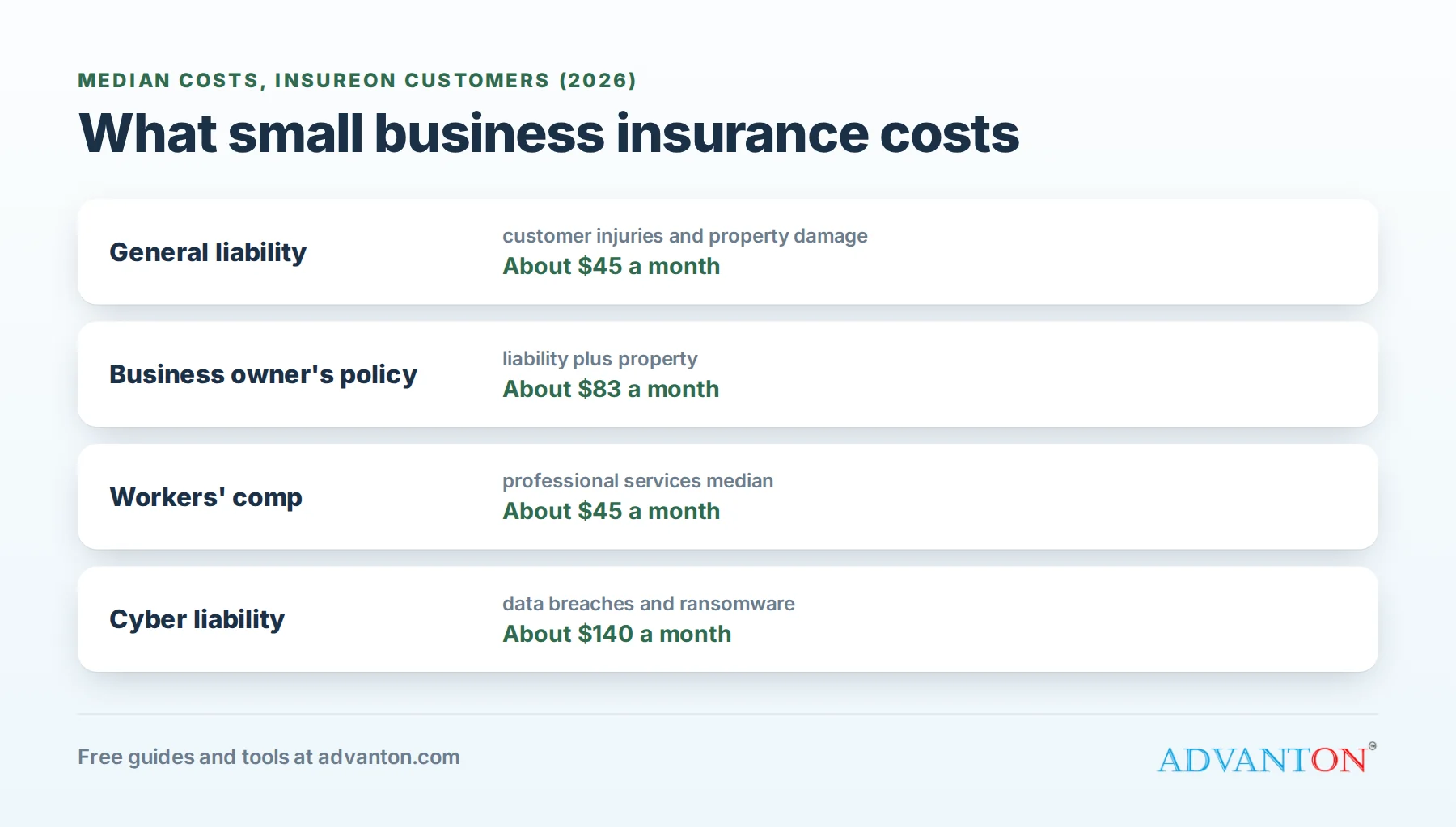
Insureon, an online insurance marketplace, publishes the median cost of policies its small business customers actually buy:
| Policy | Median cost |
|---|---|
| General liability | About $45 a month ($538 a year) |
| Business owner’s policy | About $83 a month ($990 a year) |
| Workers’ compensation (professional services) | About $45 a month ($550 a year) |
| Cyber liability | About $140 a month ($1,675 a year) |
These are medians. Your price depends on your industry and risk, location, revenue, number of employees, claims history, and the limits and deductible you choose. A roofer pays far more than a bookkeeper; a business in a big city usually pays more than one in a small town.
Insurance by type of business
| Business | Usually needs | Often adds |
|---|---|---|
| Home-based consultant or freelancer | Professional liability | General liability, cyber liability |
| Contractor or trade | General liability; workers’ comp with employees; commercial auto | Tools and equipment coverage, umbrella, surety bonds where required |
| Cleaning business | General liability | Janitorial bond, workers’ comp, commercial auto |
| Retail shop | Business owner’s policy | Workers’ comp, cyber liability, product liability |
| Food truck | General liability; commercial auto | Workers’ comp, equipment and spoilage coverage |
| Online store | General liability or BOP | Product liability, cyber liability |
Bonds are not insurance
Contractors and cleaning businesses often hear about bonds too. A surety bond guarantees that you’ll meet obligations, such as following licensing laws or finishing a job; if you don’t, the bonding company pays the claim and then expects you to repay it. A janitorial bond (fidelity bond) protects clients against theft by your employees. Some licenses and contracts require bonds in addition to insurance, so ask your licensing board and clients what they need.
Two policies owners often overlook
- Product liability: if you make, sell or import physical products, such as food, cosmetics, candles or toys, a customer injured by a product can sue you even if someone else made it. Many general liability policies include some product coverage; check the limits, and ask whether your marketplace or retailer requires a specific amount.
- Employment practices liability (EPLI): covers claims from employees or job applicants, such as wrongful termination, harassment or discrimination. It becomes worth considering as soon as you have employees, because these claims can be expensive to defend even when they’re unfounded.
What’s actually required?
- Workers’ compensation: required in most states once you have employees, sometimes from the first employee. Texas is a notable exception, where most private employers can choose not to carry it, but then lose important legal protections.
- Commercial auto: every state requires liability coverage for vehicles. Business-owned vehicles need a commercial policy, and a personal auto policy may not cover regular business driving.
- Unemployment insurance and, in some states, disability insurance are required for employers. These are usually paid through state programs.
- Professional requirements: some licensed trades and professions must carry specific coverage or bonds to get or keep their license.
- Contract requirements: landlords, clients, general contractors and event venues often require general liability with specific limits, and ask for a certificate of insurance naming them as an additional insured.
Occurrence vs claims-made policies
- Occurrence policies, common for general liability, cover incidents that happen while the policy is active, even if the claim arrives years later.
- Claims-made policies, common for professional liability, cover claims made while the policy is active. If you cancel, you may need extra "tail" coverage to stay protected for past work.
Ask which type you’re buying, especially before switching insurers.
Choosing coverage limits
- Common starting limits for general liability are $1 million per occurrence and $2 million in total per policy year. Many leases and contracts ask for these figures.
- Higher limits cost more but may be needed for larger clients or riskier work. An umbrella policy adds extra liability coverage on top of your other policies at relatively low cost.
- Deductibles: a higher deductible lowers your premium, but make sure you could pay it from cash if you had to.
Property coverage: replacement cost vs actual cash value
If your equipment is stolen or destroyed, how it’s valued matters:
- Replacement cost pays what it costs to buy new equipment of similar quality today.
- Actual cash value pays the depreciated value, which can be far less for older equipment.
Replacement cost coverage costs more, but it’s usually what lets you get back to work quickly. Make a list of your equipment with photos and receipts, and update it every year.
Business interruption coverage
Often included in a business owner’s policy, business interruption (or business income) coverage replaces lost income and pays ongoing bills if a covered event, such as a fire, forces you to close temporarily. Check how long it pays and whether there’s a waiting period before it starts.
How to buy business insurance, step by step
- List your risks: customers visiting, working at clients’ properties, equipment and inventory, vehicles, employees, customer data and professional advice.
- Check what’s required by your state, your landlord, your licensing board and your clients’ contracts.
- Gather your details: business structure, EIN, revenue, payroll, number of employees, years in business, and any past claims.
- Get at least three quotes. Options include online marketplaces that compare several insurers, independent agents who work with many insurers, and direct insurers.
- Compare like for like: limits, deductibles, what’s excluded, and whether it’s occurrence-based or claims-made coverage.
- Ask about bundles: a BOP is usually cheaper than buying general liability and property separately.
- Buy before you need it: before opening, signing a lease, starting your first job or hiring your first employee.
- Review every year and whenever you hire, add services, buy equipment or move.
A worked example: a first-year insurance budget
A two-person cleaning business visits clients’ homes and offices in one van. These are illustrative figures using Insureon’s medians where available; get quotes for real prices.
| Coverage | Monthly estimate | Notes |
|---|---|---|
| General liability | About $45 | Insureon median; cleaning may cost more |
| Janitorial bond | Small yearly fee | Often requested by commercial clients |
| Workers’ compensation | Quote needed | Based on payroll and job risk |
| Commercial auto | Quote needed | For the business-owned van |
Add each quote to your startup cost calculator and your cash flow forecast, so insurance never comes as a surprise.
What to do if you have a claim
- Make sure everyone is safe, and get medical help if anyone is hurt.
- Write down what happened: date, time, people involved, witnesses and photos.
- Tell your insurer quickly. Most policies require prompt notice.
- Don’t admit fault or promise payment before speaking to your insurer.
- Keep records of every conversation, bill and repair.
- Cooperate with the adjuster, and ask what happens next and when.
Questions to ask before you buy
- What exactly is covered, and what’s excluded for my type of work?
- Is this occurrence-based or claims-made coverage?
- Are my limits enough for my lease and client contracts?
- Is property covered at replacement cost?
- Is business interruption included, and for how long?
- Can I add clients as additional insureds, and how fast can I get certificates?
- What discounts are available for bundling or paying yearly?
Where to buy: agent, marketplace or direct
| Option | Best for | Trade-off |
|---|---|---|
| Independent agent | Businesses with several risks, or anyone wanting personal advice | Takes a little longer; quality varies by agent |
| Online marketplace | Comparing several insurers quickly for common policies | Less hands-on advice for unusual risks |
| Buying direct | Simple needs, or an insurer that specializes in your industry | You only see one company’s price |
Whichever route you choose, compare at least three quotes for the same limits and deductible, and check each insurer’s financial strength rating.
Ways to lower your premium
- Bundle general liability and property into a BOP.
- Raise your deductible to a level you can afford.
- Pay annually if your insurer offers a discount.
- Manage risk: safety training, written procedures, secure data practices and good record keeping can all lower costs over time.
- Classify your business accurately. The wrong industry code can mean overpaying, or a denied claim.
- Shop around at renewal rather than auto-renewing for years.
Home-based businesses
A homeowners or renters policy usually covers little or no business property or liability. If customers visit your home, or you keep business equipment or inventory there, ask about a home business endorsement on your policy, or a separate small business policy.
Common mistakes
- Assuming an LLC protects you from everything. An LLC can protect personal assets from business debts, but it doesn’t pay for a claim. Insurance does.
- Relying on personal auto insurance for regular business driving.
- Choosing limits that are too low for client or landlord contracts.
- Not reading exclusions, such as excluded types of work.
- Letting coverage lapse, especially workers’ comp, which can bring state penalties.
Frequently asked questions
Do I need insurance if I’m a sole proprietor with no employees?
Usually not by law, unless your license or contracts require it. But one lawsuit can reach your personal assets as a sole proprietor, so general liability is usually worth it if you meet customers or work at their properties.
How fast can I get covered?
Often the same day for common policies like general liability, once you’ve completed an application and paid.
What is a certificate of insurance?
A one-page document from your insurer proving your coverage. Clients and landlords often require one before work starts.
Is business insurance tax-deductible?
Generally, premiums for business insurance are deductible business expenses. Check with your tax professional.
Keep learning
- Business licenses and permits explained
- How much does it cost to start a business?
- Hiring cost calculator: the true cost of an employee
Sources
- Insureon, Small business insurance costs (median of policies purchased by its customers)
- Insureon, Professional services business insurance costs
- Insureon, Research consultant insurance costs (cyber liability median)
Last reviewed October 28, 2026. Startup costs are estimates; check local prices, licensing and tax rules before you commit money.


Leave a Reply