
Few parts of starting a business cause more uncertainty than licenses and permits. There’s no single national business license in the United States. Instead, the licenses you need depend on what you do, where you do it, and how you do it, and they can come from three levels of government: federal, state and local.
The good news: most small businesses need only a handful, and once you know where to look, finding them is straightforward. This guide explains the main types, how to find exactly which ones apply to you, typical costs, and how to keep everything current once you’re open.
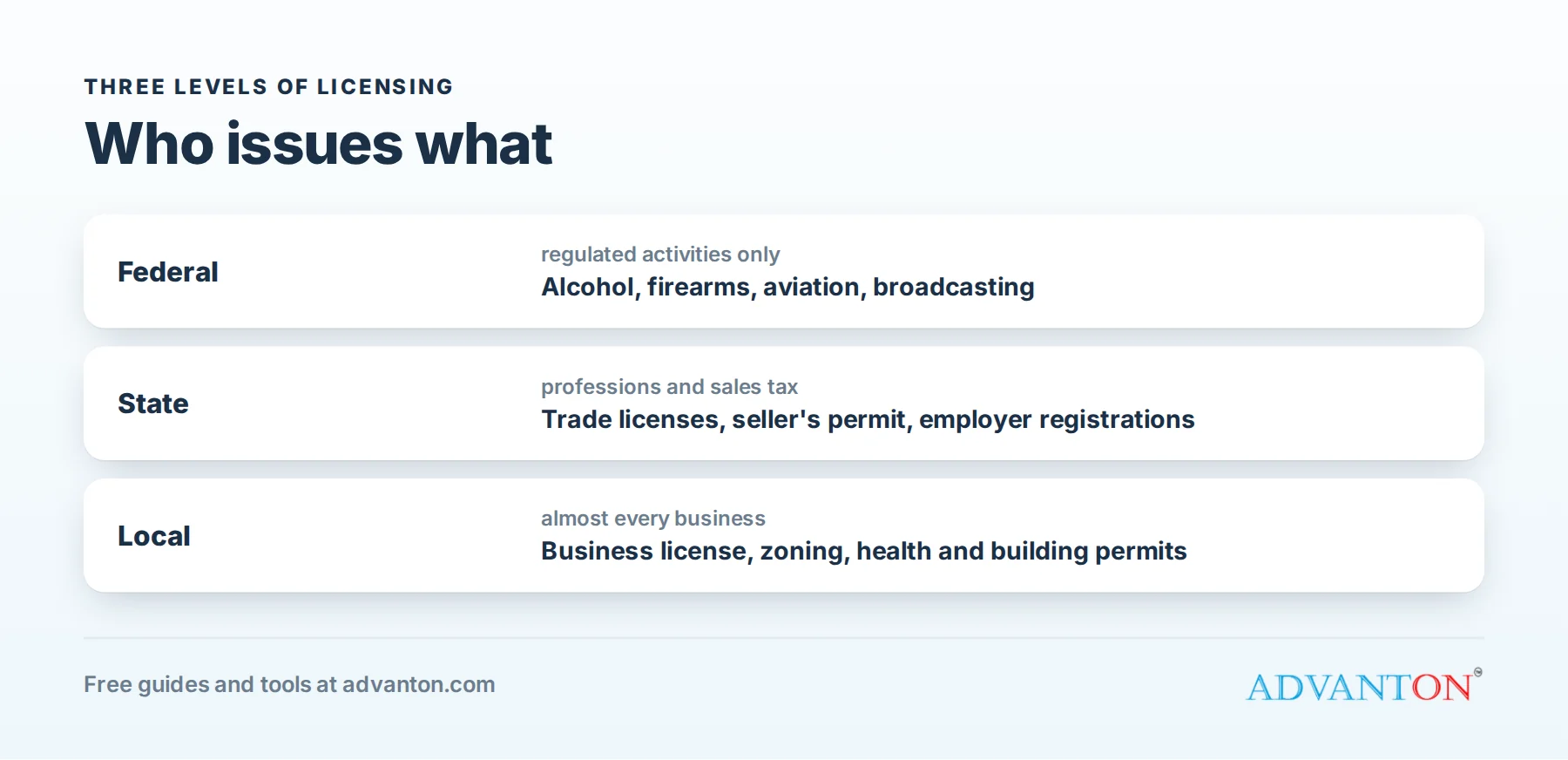
The three levels, at a glance
Table of Contents
| Level | Who issues it | Who usually needs it |
|---|---|---|
| Federal | Federal agencies | Only businesses in regulated activities, such as alcohol, firearms, aviation or broadcasting |
| State | State agencies and licensing boards | Licensed professions and trades, businesses that collect sales tax, and some specific industries |
| Local | City or county offices | Almost every business: a general business license, plus zoning, building, health and sign permits where relevant |
Federal licenses: only for regulated activities
Most small businesses don’t need anything from the federal government beyond an EIN (an employer identification number, which is a tax ID, not a license). According to the SBA, a federal license or permit is needed when your business does something regulated by a federal agency, such as:
- Agriculture, including importing or transporting animals, plants and some biological materials.
- Alcoholic beverages, including making, wholesaling or importing.
- Aviation, such as operating aircraft or transporting goods by air.
- Commercial fisheries.
- Firearms, ammunition and explosives.
- Maritime transportation.
- Mining and drilling.
- Nuclear energy.
- Radio and television broadcasting.
- Transportation and logistics, such as some trucking and moving across state lines.
If your business isn’t in one of these areas, you can usually skip federal licensing entirely. If it is, the responsible agency’s website explains the application.
State licenses and permits
States handle the licenses most likely to apply to a new business:
- Professional and occupational licenses. Many professions need a state license before you can work: contractors and many trades (electricians, plumbers, HVAC technicians), cosmetologists and barbers, accountants, real estate agents, insurance agents, healthcare workers, childcare providers and many more. Requirements often include training hours, an exam and continuing education.
- Sales tax permits. If you sell taxable goods or services, most states require a seller’s permit (also called a sales tax permit or license) so you can collect sales tax. It’s often free or low-cost, but operating without one can mean paying the uncollected tax yourself.
- Employer registrations. Once you hire, you’ll register for state unemployment insurance tax and state income tax withholding where the state has income tax.
- Industry-specific permits, such as for selling alcohol, handling food at scale, operating childcare, or certain environmental activities.
Local licenses and permits
Your city or county is where most businesses pick up the bulk of their paperwork:
- General business license (sometimes called a business tax certificate or business registration). Many cities and counties require one for every business operating within their limits, including home-based businesses.
- Zoning and land use approval. Confirms your business is allowed at your location. Check this before signing a lease.
- Home occupation permit. Many places require one for home-based businesses, often with limits on signs, customer visits, parking and employees.
- Building, electrical and plumbing permits for renovations or build-outs.
- Health permits for food service, food sales and personal care such as salons and tattoo studios.
- Fire department permits for some occupancies and activities.
- Sign permits for exterior signs.
- Alarm permits in some cities, if you install a monitored security alarm.
How to find exactly which licenses you need
- Describe your business precisely: what you sell or do, where, and whether customers visit, you have employees, you handle food, or you do work that requires a license.
- Check the SBA’s licenses and permits guide for federal requirements and links to state resources.
- Search your state’s business portal. Most states have a "one-stop" business site or license lookup tool. Your Secretary of State’s site often links to it.
- Check your state licensing board if your trade or profession is licensed.
- Call or visit your city or county business license office. Ask what a business like yours needs at your exact address. Local staff are usually very helpful.
- Ask a free adviser. SCORE mentors and Small Business Development Centers (SBDCs) help owners work through local requirements at no cost.
- Make a list with each license, the issuing office, cost, renewal date and requirements.
Three examples: what different businesses need
These examples show the pattern. Exact requirements depend on your state and city, so confirm each one locally.
| Business | Federal | State | Local |
|---|---|---|---|
| Home-based bookkeeping service | None (an EIN if hiring or forming an LLC) | Sales tax permit only if the state taxes the services; a CPA license only if offering CPA services | General business license; possibly a home occupation permit |
| Food truck | None | Sales tax permit; state food safety rules and possibly a mobile food license | Business license; health permit and inspection; fire inspection for cooking equipment; permits for where you park and sell; commissary agreement where required |
| Roofing contractor | None | Contractor license where the state licenses roofers; employer registrations if hiring | Business license; local contractor registration in some cities; a building permit for most jobs |
Notice the pattern: federal licensing rarely applies, the state handles professional licenses and sales tax, and the city or county handles the rest.
Questions to ask your local license office
- What licenses and permits does a business like mine need at this exact address?
- Is my type of business allowed in this zone? Are there limits on signs, parking or customer visits?
- What does each license cost, and when does it renew?
- Do I need inspections before opening? How long do they usually take to schedule?
- Are there separate city and county licenses, or just one?
Write down the name of the person you spoke to and the date. If you’re told you don’t need something, it’s worth having that record.
How long does licensing take?
A general business license or sales tax permit can take anywhere from the same day (online) to a few weeks. Professional licenses take longest, because of training hours and exams, and so do health permits and building permits, which need inspections. Start applications as early as you can, ideally while you’re still planning, so licensing doesn’t delay your opening.
What do licenses and permits cost?
There’s no national price list. Costs depend on your state, city and industry:
| Type | Typical cost pattern |
|---|---|
| General local business license | Often modest, and sometimes based on revenue or number of employees |
| Sales tax permit | Free in many states; a small fee or deposit in some |
| Professional or trade license | Application and exam fees, plus required training; often the largest licensing cost |
| Health permits | Annual fees, often by business type and size |
| Building permits | Based on the project’s value or scope |
Budget tip: call your local license office and state board early, and add every fee to your startup costs. Our startup cost calculator includes a line for licenses and permits.
Common situations
Home-based businesses. You’ll usually still need a local business license, and possibly a home occupation permit. Check your lease, homeowners association rules and homeowners insurance too, since many policies exclude business activity.
Online businesses. Selling online doesn’t remove licensing. You’ll usually still need a local business license where you’re based, and a sales tax permit in states where you must collect sales tax.
Contractors and trades. Expect a state or local contractor license, often with insurance and bonding requirements, plus permits for each job. Licensed contractors usually display their license number on estimates, vehicles and their website.
Food businesses. Expect health permits, food handler or manager certifications, and inspections. Cottage food laws in many states allow some low-risk foods made at home with simpler rules, within sales limits.
Using a business name. If you operate under a name that isn’t your legal name or your LLC’s registered name, you’ll usually register a DBA ("doing business as"). See how to register a DBA.
Staying compliant after you open
- Track renewal dates. Many licenses renew every year or two. Put each date in your calendar with a reminder a month before.
- Display licenses where required, often near the entrance or register.
- Keep continuing education current for professional licenses.
- Update licenses when things change: a new address, a new owner, new services or a new business structure can all require updates.
- Keep copies of every license and permit in one folder, digital and paper.
When you hire your first employee
Hiring adds registrations, even if your business licenses stay the same:
- An EIN, if you don’t have one yet.
- State unemployment insurance tax registration.
- State income tax withholding registration, in states with an income tax.
- New hire reporting to your state within its deadline.
- Workers’ compensation insurance, required in most states.
- Required workplace posters, federal and state.
A simple renewal tracker
| License or permit | Issued by | Cost | Renews | Reminder set |
|---|---|---|---|---|
| City business license | City business license office | Every January | ✓ | |
| Sales tax permit | State revenue department | Check your state | ✓ | |
| Trade license | State licensing board | Every two years, with continuing education | ✓ |
Keep it in a spreadsheet or calendar, and review it every January.
Common mistakes
- Signing a lease before checking zoning.
- Assuming online or home businesses don’t need a license.
- Forgetting the sales tax permit before the first sale.
- Letting a license lapse, which can mean fines or having to stop work.
- Paying "compliance" services that send official-looking notices and charge fees for things you can do yourself for free or less.
Frequently asked questions
Is there a single business license for the whole country?
No. Most licenses come from your state and local government. Federal licenses apply only to regulated activities.
Do I need a license for an LLC?
Forming an LLC registers your business with the state, but it isn’t a license to operate. You may still need local business licenses and professional licenses. See LLC vs sole proprietorship vs corporation.
Is an EIN a license?
No. An EIN is a federal tax ID. Many businesses need one, but it doesn’t give permission to operate. See how to get an EIN.
What happens if I operate without a license?
Penalties vary: fines, back fees, having to stop work until you’re licensed, and, for licensed trades, possible trouble collecting payment. Getting licensed first is cheaper.
Do I need new licenses if I move or open a second location?
Usually, yes. Local licenses, zoning approval and health permits are tied to a specific address, so a new location needs its own. State professional licenses usually stay with you, but update your address with the board.
Keep learning
- How much does it cost to start a business?
- How to get business insurance
- Plan your business step by step in the Business Planner
Sources
Last reviewed October 28, 2026. Startup costs are estimates; check local prices, licensing and tax rules before you commit money.


Leave a Reply