
Trees grow, storms break branches, and homeowners, businesses and municipalities need skilled crews to prune, remove and care for trees safely. A tree service can earn well per job, with steady demand from routine pruning and spikes after storms.
It’s also one of the most dangerous trades in the country, involving chainsaws, heights, heavy limbs and power lines. Federal workplace safety agency OSHA treats tree care as a high-hazard industry. Success depends on training, safety systems and proper insurance as much as on climbing and cutting skills. This guide covers licensing, certification, safety, equipment, pricing, a worked profit example and how to win customers.
Tree service at a glance
Table of Contents
| Topic | What to expect |
|---|---|
| Startup cost | Moderate to high: chainsaws, climbing gear, a truck and chipper, and eventually a bucket truck or stump grinder |
| License required? | Varies by state: some states license tree experts or arborists, and some require contractor licenses for larger jobs |
| Certification | ISA Certified Arborist is the most recognized credential |
| Insurance | Essential and costly: general liability and workers’ compensation |
| Best for | Experienced climbers and arborists who take safety seriously |
Licensing: check your state
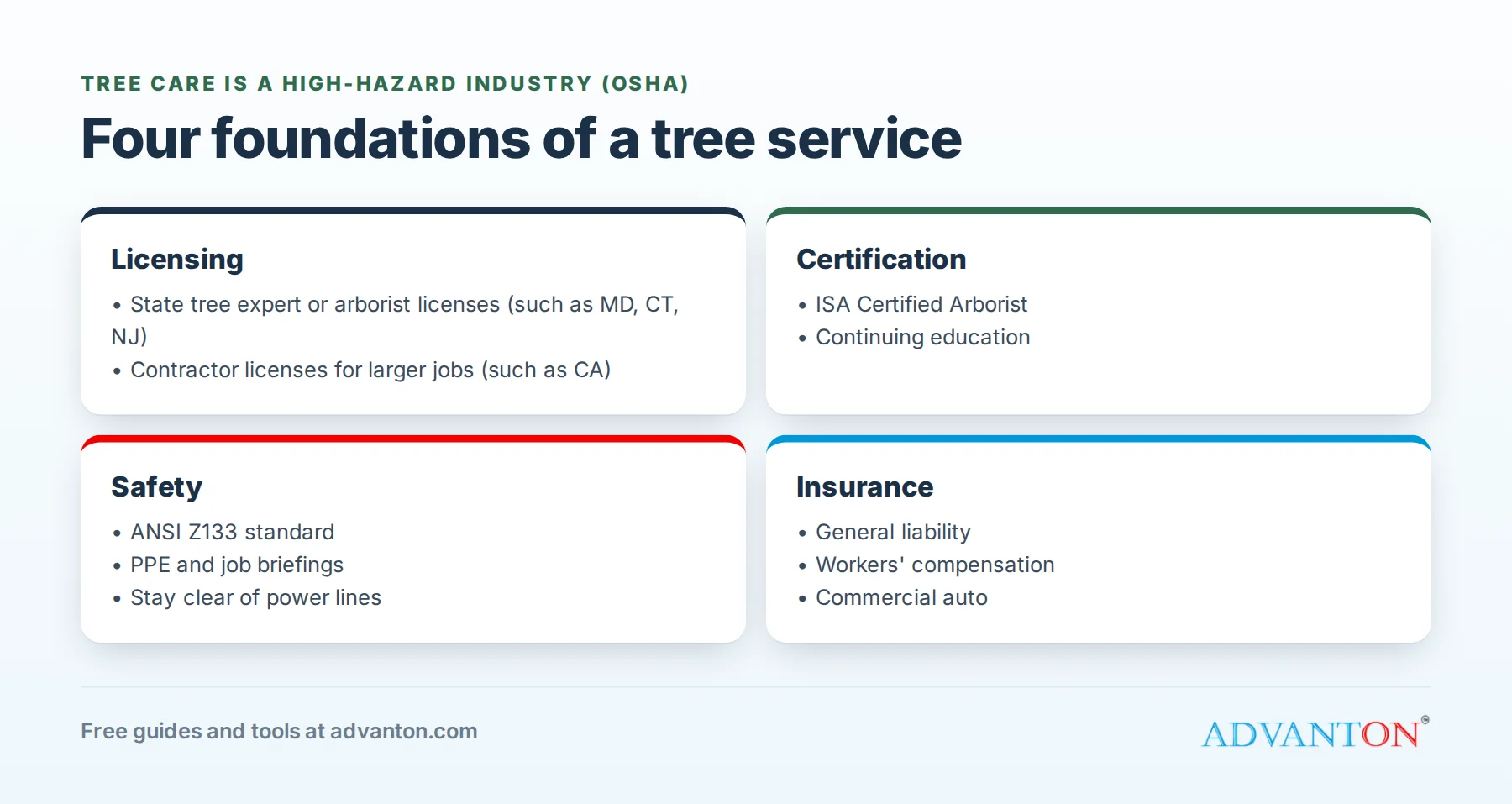
Requirements vary widely:
- Some states license tree experts or arborists. For example, Maryland requires a tree expert license, Connecticut requires an arborist license, and New Jersey licenses tree experts.
- Some states require a contractor license for tree work above a certain job value; California, for example, requires a contractor license for jobs of $1,000 or more in labor and materials.
- Pesticide applicator licenses are required to apply pesticides, including many tree treatments.
- Local business licenses and permits, and sometimes permits to remove protected trees.
Check your state’s licensing boards, and your city’s tree protection rules, before you start.
Certification and training
- ISA Certified Arborist: from the International Society of Arboriculture, requiring experience or education plus an exam, and continuing education to maintain. It’s the credential customers, insurers and municipalities recognize.
- Safety training: climbing, rigging, chainsaw handling, aerial rescue and electrical hazard awareness.
- The ANSI Z133 standard: the American National Standard for arboricultural operations safety, which sets safety requirements for tree work.
Safety first
- Never work near power lines unless qualified and authorized; contact the utility.
- Use proper personal protective equipment: helmets, eye and hearing protection, chainsaw-resistant legwear and gloves.
- Plan every job: a job briefing, a drop zone, rigging plans and an emergency plan.
- Train every worker and supervise new crew members closely.
- Maintain equipment and inspect climbing gear before every use.
Insurance
Insurance is one of the largest costs in tree care, and one of the most important:
- General liability for damage to homes, vehicles and property.
- Workers’ compensation for employees, required in most states and essential given the risks.
- Commercial auto for trucks and equipment.
- Equipment coverage for chippers, stump grinders and lifts.
Customers increasingly ask for proof of insurance before hiring, and you should always provide a certificate.
Equipment
| Stage | Equipment |
|---|---|
| Starting out | Chainsaws, climbing gear and ropes, rigging equipment, safety gear, a pickup truck and trailer |
| Growing | A wood chipper, dump truck or chip truck |
| Established | A bucket truck or aerial lift, stump grinder, crane access through partners |
Many owners start by climbing and renting larger equipment as needed, then buy once work is steady. Keep a maintenance log for every saw and machine: well-maintained equipment is safer, lasts longer and breaks down less often in the middle of a job.
Services you can offer
| Service | Notes |
|---|---|
| Pruning and trimming | Crown cleaning, thinning, raising and reduction; follow proper pruning standards |
| Tree removal | Higher value and higher risk, especially near structures |
| Stump grinding | Usually priced separately |
| Storm cleanup and emergency work | Urgent jobs at premium rates; prioritize safety |
| Tree health care | Assessments, fertilization and pest treatments (pesticides need a license) |
| Plant health and risk assessments | Valuable for property managers and HOAs, especially from certified arborists |
| Land and lot clearing | Larger jobs needing more equipment |
Pricing tree work
Tree work is usually priced per job, based on:
- Tree size, species and condition.
- Access and hazards: proximity to buildings, power lines, fences and gardens.
- Equipment needed: climbing, bucket truck or crane.
- Cleanup and disposal: hauling, chipping and dump fees.
- Stump grinding, usually priced separately.
Give written estimates with a clear scope, including cleanup, and photograph the site before and after. Use our quote and invoice generator for professional estimates.
A worked example: a two-person crew
These are illustrative assumptions, not market rates. Price jobs based on your area and the work involved.
| Assumption | Monthly | |
|---|---|---|
| Jobs | 2 jobs a day, 20 working days, $600 average | $24,000 |
| Crew member wages and payroll taxes | $(4,800) | |
| Insurance (including workers’ compensation) | $(2,500) | |
| Fuel and maintenance | $(2,000) | |
| Equipment financing | $(2,500) | |
| Dump and disposal fees | $(800) | |
| Marketing | $(600) | |
| Profit before owner pay and taxes | $10,800 |
Weather, seasons and storm work make income uneven, so build a cash cushion and plan winter work such as dormant pruning and commercial contracts. The levers are average job value, jobs per day (efficient scheduling and tight service areas) and repeat and commercial contracts.
Running a job safely, step by step
- Assess the site: the tree’s condition, structures, power lines, access and drop zones.
- Brief the crew: roles, communication signals, the work plan and the emergency plan.
- Set up the work zone: cones, signs and a clear drop area away from people and property.
- Inspect equipment: saws, ropes, harnesses and rigging.
- Work the plan: climbing, rigging or aerial lift, with constant communication.
- Clean up thoroughly: chip, haul and rake, leaving the site cleaner than you found it.
- Walk through with the customer, and take after photos.
Hiring crew members
Hire carefully: tree work rewards experience and judgment. Train new crew as ground workers first, teach chainsaw safety, rigging and communication, and move them into climbing only when they’re ready. Clear safety rules, the right equipment and supervision protect your people and your insurance record.
How to get customers
- Complete your Google Business Profile with before-and-after photos, and ask every customer for a review with our review request kit.
- Build a website with a page for each service and town, free with our contractor website builder.
- Partner with landscapers, property managers and homeowner associations.
- Offer maintenance plans for regular pruning.
- Use yard signs at job sites, with permission; make them with our yard sign maker.
- Be ready for storm season, with a clear plan to prioritize urgent and dangerous work.
Working with utilities and local governments
Utilities, cities and counties hire tree contractors for line clearance, street trees and park work. These contracts are larger and steadier, but they require specialized training (especially near power lines), strong safety records, insurance at higher limits and experience with public bidding. Many tree services build toward them after establishing a residential business.
Beware of storm chasers
After major storms, unlicensed and uninsured crews often arrive offering cheap work. Stand apart by showing your license, insurance certificate, ISA certification and local reviews, and give written estimates. Homeowners who’ve been burned before value credible local businesses.
Common mistakes to avoid
- Skipping workers’ compensation or liability insurance.
- Taking on jobs beyond your skills or equipment, especially near power lines or large removals over structures.
- Underpricing cleanup and disposal.
- Weak safety systems and training.
- Ignoring licensing and tree protection rules.
Your first 90 days
- Confirm state licensing and local permit rules.
- Earn or plan your ISA Certified Arborist credential.
- Get insurance, including workers’ compensation.
- Buy or rent core equipment and safety gear.
- Set up written estimates and safety procedures.
- Launch your website and Google Business Profile.
- Contact five landscapers, property managers or HOAs.
Frequently asked questions
Do I need a license to start a tree service?
It depends on your state. Some states license tree experts or arborists, some require contractor licenses for larger jobs, and pesticide work needs its own license. Check before you start.
Is ISA certification required?
Usually not by law, but it’s the most recognized credential and builds trust with customers and insurers.
How dangerous is tree work?
Very. OSHA considers tree care a high-hazard industry. Training, safety equipment, job planning and following the ANSI Z133 standard are essential.
How do tree services price jobs?
Usually per job, based on tree size, access, hazards, equipment and cleanup. Stump grinding is often priced separately.
When is the busiest season for tree services?
Demand often rises in spring and after storms, while dormant-season pruning in late fall and winter keeps crews busy when other outdoor trades slow down.
Can I start a tree service part-time?
Some owners start with weekend pruning and small removals, but because of the risks and equipment involved, it’s important to have full insurance and safety systems in place from the first job.
Do I need a bucket truck to start?
No. Many tree services start with climbing gear and rent lifts or bucket trucks for specific jobs, buying their own once the work justifies the cost.
Keep learning
Sources
- International Society of Arboriculture, Certification
- OSHA, Tree care industry
- Tree Care Industry Association, Safety and ANSI Z133
- US Bureau of Labor Statistics, Grounds maintenance workers
Last reviewed October 26, 2026. Startup costs are estimates; check local prices, licensing and tax rules before you commit money.


Leave a Reply