
Carpet cleaning is a practical, repeatable service business: most homes and offices with carpet need professional cleaning regularly, and satisfied customers book again every year. You can start with a portable machine and a van, grow into a truck-mounted system, and add profitable services such as upholstery, tile and grout, and water damage restoration.
According to 2026 pricing data compiled by Housecall Pro from Angi, HomeAdvisor and Thumbtack listings, carpet cleaning pros typically charge $25 to $75 per room, or $0.20 to $0.50 per square foot. Add-ons such as stain removal ($20 to $40 per room) and carpet protector ($20 to $50 per room) raise the average ticket. This guide covers equipment, certification, pricing, a worked profit example and how to win steady customers.
Carpet cleaning at a glance
Table of Contents
| Topic | What to expect |
|---|---|
| Startup cost | Low to moderate with portable equipment; higher with a truck-mounted system |
| License required? | Usually just a business license; certification is voluntary but valued |
| What customers pay | Typically $25 to $75 per room, or $0.20 to $0.50 per square foot |
| Repeat business | Many customers rebook every 12 to 18 months |
| Best for | Hands-on owners who like physical work, visible results and building a local reputation |
Equipment: portable or truck-mounted?
| Option | Pros | Cons |
|---|---|---|
| Portable extraction machine | Lower cost; works in apartments and high-rise buildings; easy to transport | Less power and heat; slower on large or heavily soiled jobs |
| Truck-mounted system | Powerful suction and heat; faster drying; better results on large jobs | Major investment; needs a suitable van; hoses limit access in tall buildings |
| Low-moisture systems | Fast drying; good for offices | Different chemistry and techniques to learn |
Many owners start with a quality portable machine, then add a truck-mount once they have steady work. You’ll also need a commercial vacuum, pre-spray equipment, spotters and solutions, air movers for drying, and protective gear.
Certification and training
Carpet cleaners usually don’t need a state license beyond a business license, though rules vary. The IICRC (Institute of Inspection, Cleaning and Restoration Certification) offers widely recognized certifications, including carpet cleaning and water damage restoration. Certification teaches proper chemistry and techniques, builds customer trust, and is often required for insurance restoration work and some carpet warranties.
Startup costs to plan for
| Item | What to budget for |
|---|---|
| Cleaning machine | Portable extractor, or truck-mount system later |
| Vehicle | A van for equipment and supplies |
| Supporting equipment | Commercial vacuum, air movers, sprayers, tools |
| Chemicals and supplies | Pre-sprays, spotters, rinses, protectors, deodorizers |
| Training and certification | IICRC courses and exams |
| Insurance | General liability, and commercial auto |
| Business setup and marketing | LLC, license, website, vehicle graphics |
Use our startup cost calculator for your total.
What customers pay
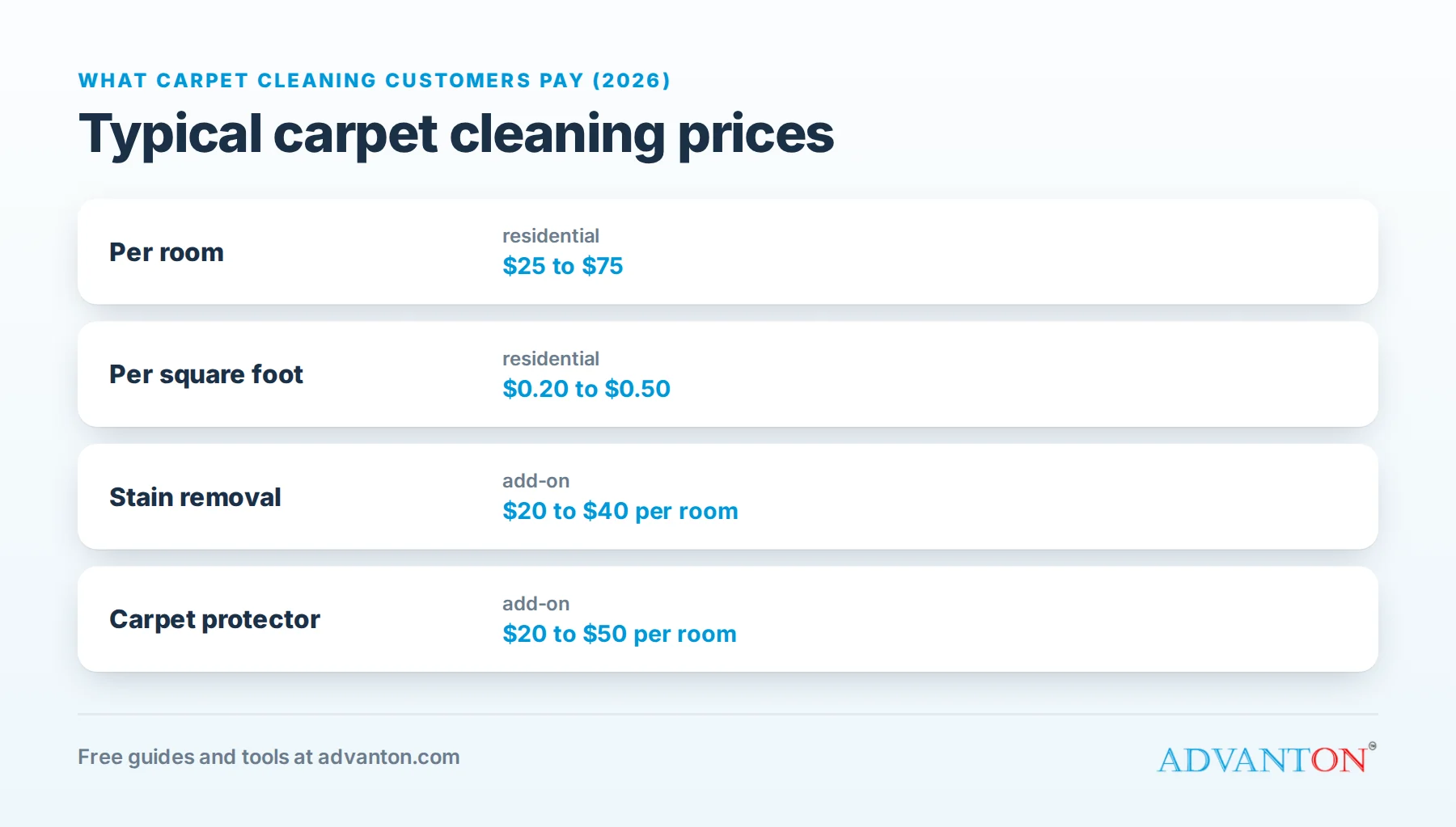
| Service | Typical 2026 prices |
|---|---|
| Carpet cleaning per room | $25 to $75 |
| Per square foot | $0.20 to $0.50 |
| Stain removal | $20 to $40 per room |
| Carpet protector | $20 to $50 per room |
| Upholstery, rugs, tile and grout | Priced per piece or per square foot |
Avoid bait-and-switch pricing. Some companies advertise very low per-room prices, then add charges at the door. Clear pricing and a written estimate build trust and reviews; surprise charges destroy both.
Set minimums. A minimum job charge protects you from driving across town for one small room. Many cleaners also price by area served, adding a travel charge outside their core zone, so long drives don’t erase the profit on smaller jobs.
A worked example: one van, one technician
These are illustrative assumptions, not predictions.
| Assumption | Monthly | |
|---|---|---|
| Residential jobs | 3 jobs a day, 22 days, $220 average (several rooms plus add-ons) | $14,520 |
| Commercial accounts | 4 monthly office contracts at $400 | $1,600 |
| Revenue | $16,120 | |
| Chemicals and supplies | About 6% of revenue | $(970) |
| Van, fuel and maintenance | $(1,500) | |
| Equipment financing | $(900) | |
| Insurance, software and phone | $(700) | |
| Marketing | $(1,200) | |
| Profit before owner pay and taxes | $10,850 |
The levers are average ticket (add-ons such as protector and upholstery), route density (jobs close together), and repeat business (annual reminders and commercial contracts).
How a professional job runs, step by step
- Confirm the details before arrival: rooms, stains, pets and parking.
- Walk through with the customer, note problem areas and agree the price in writing before starting.
- Protect the home: corner guards, floor runners and moving light furniture.
- Vacuum thoroughly to remove dry soil, which makes cleaning far more effective.
- Pre-treat traffic lanes and spots with the right chemistry for the fiber.
- Clean and rinse with hot water extraction or your chosen method, without over-wetting.
- Groom the carpet, set air movers to speed drying, and replace furniture on protective blocks.
- Final walk-through with the customer, explain drying time and care, and ask for a review.
Drying and customer care
Fast drying prevents odors and complaints. Use air movers, good ventilation and the right amount of water, and tell customers how long carpets will take to dry and when they can walk on them. Leave a short care card with spot-cleaning tips and your phone number. A follow-up message the next day catches any problems early and turns happy customers into reviewers.
Pricing commercial contracts
Offices, apartment communities and property managers often want regular maintenance: monthly or quarterly cleaning of high-traffic areas, plus deep cleans once or twice a year. Price contracts by square footage and frequency, schedule work after hours to suit the client, and put the scope, frequency and price in a written agreement. Commercial contracts smooth out seasonal dips in residential work.
Profitable add-on services
- Upholstery and rug cleaning.
- Tile and grout cleaning and sealing.
- Pet odor treatment.
- Water damage restoration, which requires additional training and equipment, and often works with insurance companies.
- Commercial maintenance contracts for offices, apartments and property managers.
Hiring your first technician
When you’re turning work away, a second technician (and later a second van) is the main way to grow. Hire for reliability and care in customers’ homes, train thoroughly in your methods and chemistry, and use checklists so every job meets your standard. Consider sending new hires to an IICRC course, and ride along until you’re confident in their work.
Handling seasonal demand
Demand often rises in spring and before major holidays, and dips in midsummer or after the new year in some areas. Smooth the dips with commercial contracts, upholstery and tile promotions, and annual reminders scheduled for quieter months.
How to get customers
- Complete your Google Business Profile with before-and-after photos, and ask every customer for a review with our review request kit.
- Partner with property managers, real estate agents and landlords for move-in and move-out cleaning.
- Send annual reminders to past customers: your easiest source of repeat work.
- Offer bundles, such as a whole-home package including a sofa.
- Build a website with pages for each service and town. Our free website builder creates one in about 10 minutes.
- Use door hangers in neighborhoods where you’re already working; make them with our door hanger maker.
Common mistakes to avoid
- Over-wetting carpets, causing slow drying, odors or damage.
- Using the wrong chemicals on wool or delicate fibers.
- Bait-and-switch pricing.
- No follow-up system for annual rebooking.
- Skipping insurance.
Your first 90 days
- Take an IICRC carpet cleaning course.
- Buy or lease a quality portable machine and supporting equipment.
- Form your business and get insurance.
- Set clear prices, add-ons and minimums.
- Launch your website and Google Business Profile.
- Contact ten property managers, agents and landlords.
- Ask every customer for a review, and schedule annual reminders.
Frequently asked questions
How much can a carpet cleaning business make?
It depends on jobs per day, average ticket and costs. Our worked example shows how the numbers fit together; your local prices and efficiency make the biggest difference.
Do I need a truck-mounted machine to start?
No. Many owners start with a quality portable machine and upgrade once demand is steady.
Is certification required?
Usually not by law, but IICRC certification builds trust, improves results and is often required for restoration work.
How do I get commercial clients?
Approach property managers, offices and apartment communities with a simple maintenance plan and references from residential customers.
How often should customers have carpets cleaned?
Many carpet manufacturers recommend professional cleaning every 12 to 18 months, and more often for homes with pets, children or allergies. Use this in your annual reminder messages.
Can I start part-time?
Yes. Many owners start with evening and weekend jobs using a portable machine, then go full-time as repeat customers and referrals build.
What chemicals do carpet cleaners use?
Professionals use pre-sprays matched to the soil and fiber, spotters for specific stains, rinses that leave carpets neutral, and protectors. Learn fiber identification and chemistry through training, because the wrong product can damage wool, silk or delicate rugs.
Should I offer water damage restoration?
It can be lucrative, but it requires additional IICRC training, drying equipment, emergency availability and experience working with insurance companies. Many owners add it once their cleaning business is established.
Keep learning
- Home services industry profile
- How to start a short-term rental turnover cleaning business
- All contractor tools
Sources
- Housecall Pro, Carpet cleaning prices 2026
- IICRC, Institute of Inspection, Cleaning and Restoration Certification
- US Small Business Administration, Apply for licenses and permits
Last reviewed October 26, 2026. Startup costs are estimates; check local prices, licensing and tax rules before you commit money.


Leave a Reply