
More dogs live in American homes than ever, and more of their owners work long days. That combination is driving steady demand for dog daycare. According to the American Pet Products Association, pet services (including boarding, daycare, grooming and training) were the fastest-growing part of the $158 billion US pet industry in 2025, up 8% to $14.3 billion.
A dog daycare can build something most small businesses envy: regular customers who come several days a week, every week. But it’s also one of the more demanding pet businesses to start. You need the right building, zoning approval, safety systems and trained staff before you open. This guide walks through all of it, with market prices, a worked profit example, and the mistakes that sink new daycares.
Dog daycare at a glance
Table of Contents
| Topic | What to expect |
|---|---|
| Startup cost | Moderate to high: lease, build-out, permits, equipment, insurance and staff before opening |
| License required? | Zoning approval and often kennel or animal facility licensing; rules vary by state and city |
| Typical prices | About $30 a full day nationally (Rover, June 2026); about $25 to $45 by city; half days about $15 to $22 |
| Staffing | A commonly recommended maximum is about 15 dogs per attendant in a playgroup |
| Best for | Organized operators who enjoy dogs, managing people and running a facility |
Is a dog daycare right for you?
Strengths:
- Recurring revenue: many dogs attend two to five days a week.
- Natural add-ons: overnight boarding, baths, nail trims and training sessions.
- Community loyalty: owners who trust you with their dog rarely switch.
Challenges:
- Real estate and zoning can take months to sort out.
- It’s a people business: hiring, training and scheduling staff is constant work.
- Safety and cleanliness must be excellent every day; one serious incident can damage your reputation.
- Long hours: early drop-offs and evening pickups.
Step 1: Check zoning and licensing before anything else
This is the step that trips up most new daycares. Before you sign a lease:
- Confirm zoning. Many cities allow dog daycares only in certain commercial or industrial zones, and some require a special or conditional use permit. Ask the planning department about noise, outdoor play areas and waste disposal.
- Check state licensing. Some states license pet care facilities. For example, Colorado licenses pet care facilities under its Pet Animal Care and Facilities Act, and Pennsylvania licenses kennels through its Department of Agriculture. Many cities and counties also require animal establishment permits and inspections.
- Plan for building and fire permits for your build-out, plus a general business license.
The SBA’s licensing guide explains how to find federal, state and local requirements. Getting written confirmation from your city before signing is worth the delay.
Step 2: Find and design your space
| Feature | Why it matters |
|---|---|
| Indoor play areas with non-slip, sealed flooring | Safe footing and easy, frequent cleaning |
| Separate rooms or zones for small, large and senior dogs | Reduces injuries and stress |
| Secure outdoor space with safe fencing and shade | Exercise and bathroom breaks; check local noise rules |
| Drainage, ventilation and sanitation plan | Odor and disease control |
| Double-gated entry | Prevents escapes at drop-off and pickup |
| Rest areas | Dogs need downtime; overstimulated dogs get into fights |
| Parking and easy drop-off | Busy owners judge you on convenience |
| Cameras | Staff oversight, and live views many owners love |
Step 3: Set your safety rules
- Vaccinations: decide your requirements with local veterinarians (commonly rabies, distemper combination and kennel cough) and check them for every dog.
- Temperament assessments before any dog joins group play, and a trial day.
- Playgroups by size and play style, supervised at all times.
- Staff-to-dog ratios: a commonly recommended maximum is about 15 dogs per attendant, and fewer for puppies or high-energy groups.
- Emergency plans: the nearest emergency vet, first-aid kits, staff training and written procedures for fights, injuries and heat.
- Clear policies for illness, aggression, late pickups and cancellations, signed by every owner.
Startup costs to plan for
| Item | What to budget for |
|---|---|
| Lease and deposit | Often several months upfront; industrial and flex spaces can be cheaper than retail |
| Build-out | Flooring, walls, gates, drainage, ventilation and fencing |
| Permits and licensing | Zoning approvals, inspections, state and local licenses |
| Equipment | Gates, crates or kennels, washing and sanitation systems, play equipment, cameras |
| Insurance | General liability, care, custody and control coverage, property and workers’ compensation |
| Software | Booking, vaccination tracking, payments and report cards |
| Pre-opening payroll | Hiring and training staff before your first paying customer |
| Marketing | Website, signage, open house and launch offers |
| Working capital | Several months of expenses while you build attendance |
Build-out and lease are usually the largest costs. Use our startup cost calculator for your total, and our break-even calculator to see how many dogs a day you need to cover your costs.
What dog daycares charge
| Service | Typical market prices |
|---|---|
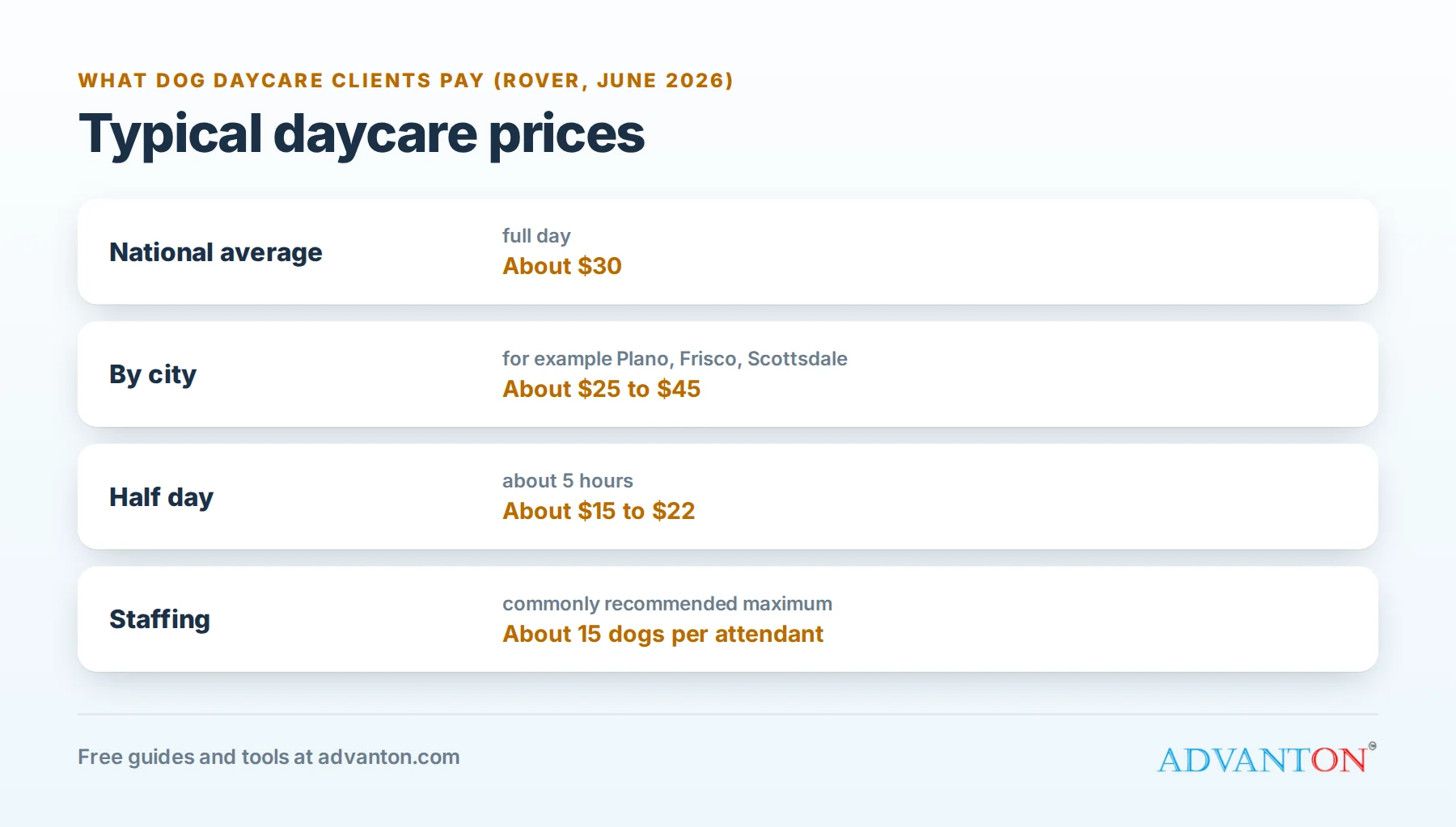
| Full day | About $30 nationally (Rover, June 2026); for example about $35 in Plano and Frisco, Texas, and $38 in Scottsdale, Arizona |
| Half day | Often about $15 to $22 |
| Packages and memberships | Discounted multi-day packs and monthly unlimited plans |
| Add-ons | Baths, nail trims, training sessions, transport and overnight boarding |
| Extra dogs | Discounts for second dogs from the same family are common |
Memberships are worth prioritizing: they make revenue predictable, reduce no-shows and reward your best customers.
A worked example: monthly profit at a small daycare
These are illustrative assumptions for a small facility, not predictions. Your rent, wages and prices will differ.
| Assumption | Monthly | |
|---|---|---|
| Daycare revenue | 35 dogs a day on average, 22 open days, $32 average per dog per day | $24,640 |
| Add-ons | Baths, nail trims and boarding | $3,000 |
| Revenue | $27,640 | |
| Staff | 4 attendants (about 15 dogs each at peak, plus breaks), front desk and payroll taxes | $(13,500) |
| Rent and utilities | $(5,000) | |
| Insurance, software and supplies | $(1,800) | |
| Cleaning, maintenance and marketing | $(1,500) | |
| Profit before owner pay and taxes | $5,840 |
The biggest levers are average daily attendance and staff scheduling: every extra dog a day adds revenue with little extra cost, while overstaffing quiet hours erodes profit quickly. Memberships and add-ons raise revenue per dog.
What a well-run day looks like
| Time | What happens |
|---|---|
| Opening (often 6:30 to 9:00 a.m.) | Staggered drop-offs through the double-gated entry; quick health check for each dog |
| Morning play | Dogs grouped by size and play style, with attendants rotating through play areas |
| Midday | Rest period in quieter areas or crates; feeding for dogs that need lunch |
| Afternoon play | Shorter, calmer play sessions; enrichment such as puzzle toys |
| Pickup (often 4:00 to 7:00 p.m.) | Dogs returned clean and calm; a short report or photo for owners |
| Close | Full cleaning and disinfection of play areas, laundry and restocking |
Two habits separate great daycares from average ones: structured rest periods (overtired dogs are more likely to squabble) and a short daily report for owners, which builds trust and reviews.
Staffing
- Hire for dog sense and reliability: attendants must read body language and stay alert all shift.
- Train everyone on playgroup management, cleaning protocols and emergencies.
- Schedule for peaks: mornings and late afternoons need the most hands.
- Keep good staff: turnover is a common problem in daycares, so fair pay, clear schedules and recognition matter.
See our guide to hiring your first employee and best payroll software.
How to find clients
- Pre-sell memberships before you open, with founding-member pricing.
- Hold open houses and free temperament assessments.
- Partner with vets, trainers and groomers for referrals, and offer training add-ons with a local trainer.
- Complete your Google Business Profile with photos of your space, staff and happy dogs.
- Send daily photos or “report cards” to owners; happy owners share them.
- Ask every client for a review with our review request kit.
- Build a website with your services, prices, vaccination requirements and booking. Our free website builder makes one in about 10 minutes.
Common mistakes to avoid
- Signing a lease before zoning approval.
- Underestimating build-out, especially drainage and flooring.
- Accepting dogs without assessments, which leads to fights and injuries.
- Overcrowding playgroups to boost revenue.
- Weak cleaning routines, which quickly lead to illness outbreaks and bad reviews.
Your first 90 days before opening
- Confirm zoning and licensing in writing.
- Sign your lease and complete the build-out.
- Set vaccination, assessment and safety policies.
- Hire and train staff.
- Launch your website, booking system and Google Business Profile.
- Pre-sell memberships and hold an open house.
- Run assessments and trial days before opening day.
Frequently asked questions
Do I need a license to open a dog daycare?
Often, yes. Requirements vary: some states license pet care facilities or kennels, and many cities and counties require animal establishment permits and inspections, plus zoning approval. Check with your state agriculture department and city planning office.
How many dogs can one staff member supervise?
A commonly recommended maximum is about 15 dogs per attendant in a playgroup, with fewer for puppies, small dogs or energetic groups. Some states and cities set their own rules.
Can I run a dog daycare from home?
In some places, yes, with limits on the number of dogs, and subject to zoning, permits and homeowner association rules. In-home daycare is a lower-cost way to start, but check local rules first.
How do daycares make the most money?
High average attendance, memberships, and add-ons such as boarding, baths and training.
Keep learning
- Pet care industry profile
- How to start a dog training business
- Dog walking and pet sitting
- Mobile dog grooming
Sources
- American Pet Products Association, 2026 State of the Industry (via Global Pet Industry)
- Rover, Dog daycare prices by city (June 2026), for example Plano, TX
- DaySmart Pet, Dog daycare costs and staffing
- US Small Business Administration, Apply for licenses and permits
Last reviewed October 26, 2026. Startup costs are estimates; check local prices, licensing and tax rules before you commit money.


Leave a Reply