
Dogs need regular baths, haircuts and nail trims, and owners return every four to eight weeks, making grooming one of the most repeat-driven service businesses. Groomers are counted among animal caretakers, which the Bureau of Labor Statistics projects to grow about 12% from 2024 to 2034 from about 392,100 jobs, with a median wage of about $33,470 in 2024, as reported by Stacker from BLS data. Experienced groomers who own their businesses often earn far more than that median.
Grooming businesses include home-based groomers, storefront salons with several groomers and bathers, and mobile vans that groom at the customer’s door. Each trades startup cost, capacity and convenience differently.
The workforce
| Occupation | Jobs (2024) | Median pay (May 2024) | Projected growth, 2024 to 2034 |
|---|---|---|---|
| Animal caretakers (includes groomers; figures as reported) | 392,100 | $33,470 | +12% |
Source: U.S. Bureau of Labor Statistics, Occupational Outlook Handbook and Occupational Employment and Wage Statistics.
Market data
| Measure | Value |
|---|---|
| Projected animal caretaker job change, 2024 to 2034 (as reported) | 47,600 |
Business models compared
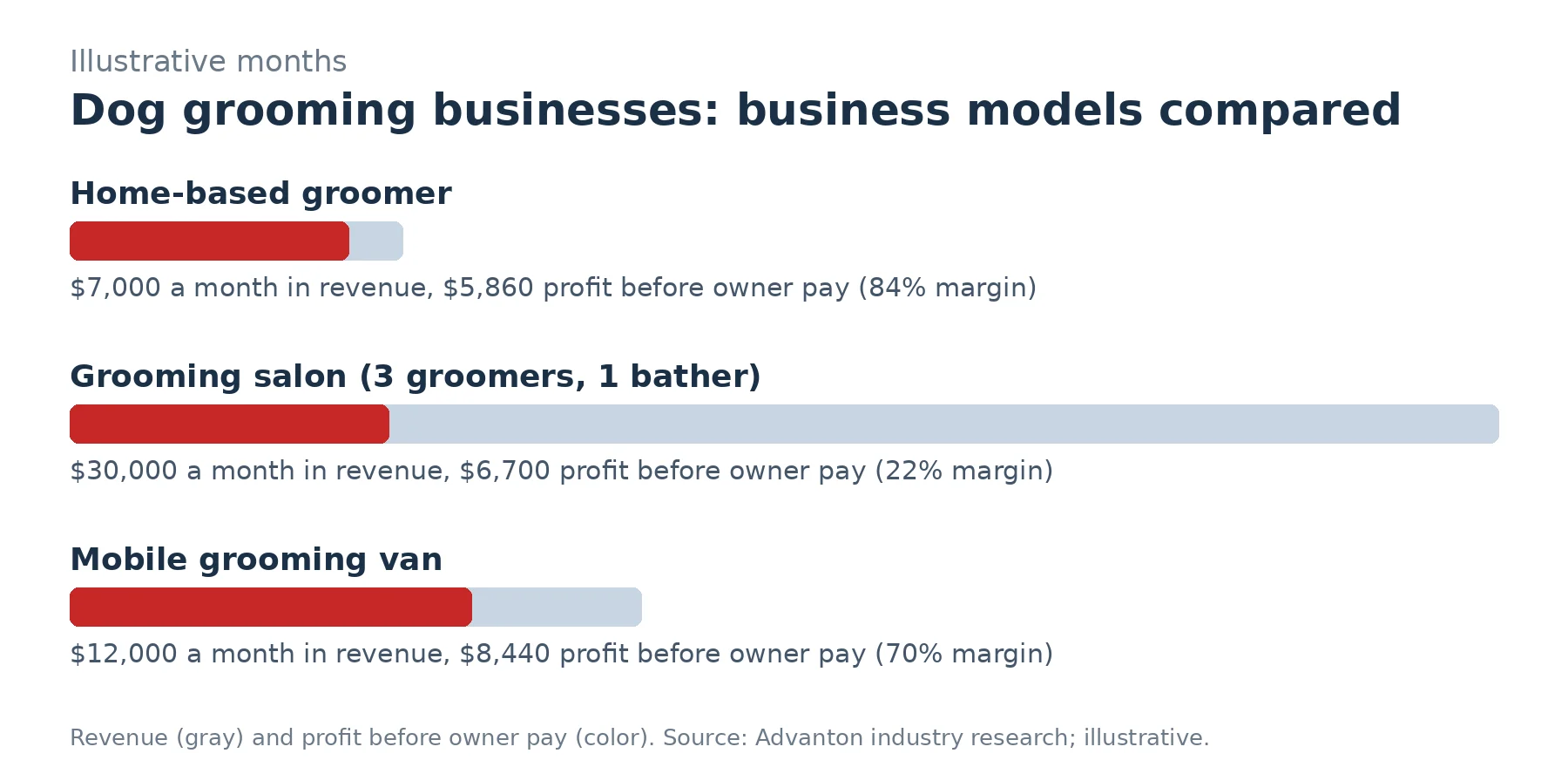
The figures below are illustrative months from our research, not industry averages. They show how revenue and costs typically fit together; your market, prices and costs will differ.
| Business model | Startup costs | Example monthly revenue | Costs | Profit before owner pay | Margin |
|---|---|---|---|---|---|
| Home-based groomer | Low: grooming table, tub, dryer, tools, zoning check | $7,000 | $1,140 | $5,860 | 84% |
| Grooming salon (3 groomers, 1 bather) | Moderate: storefront build-out, tubs, tables, dryers, kennels | $30,000 | $23,300 | $6,700 | 22% |
| Mobile grooming van | Moderate to high: outfitted van, generator, water systems | $12,000 | $3,560 | $8,440 | 70% |
Fixed and variable costs
For projections, the most useful split is between variable costs, which rise and fall with sales (materials, supplies, hourly labor, fees), and fixed costs, which you pay every month regardless (rent, salaried staff, insurance, loan payments).
| Business model | Variable costs (% of revenue) | Fixed costs per month | What it means |
|---|---|---|---|
| Home-based groomer | 7.6% | $610 | Mostly fixed: needs steady volume to cover overhead |
| Grooming salon (3 groomers, 1 bather) | 55.2% | $6,750 | Mostly variable: profitable early, but watch cash flow |
| Mobile grooming van | 11.7% | $2,160 | Mostly fixed: needs steady volume to cover overhead |
What the numbers say
Groomer pay is the largest cost in salons, often paid as commission, so pricing and scheduling decide margins.
Home-based groomers keep overhead minimal but are limited by space and local zoning.
Mobile vans command premium prices for convenience, though the van is a significant investment and capacity is limited to one dog at a time.
The three models in brief
Home-based groomer. A converted room or garage, with loyal regulars and low costs. See pet care data.
Grooming salon. Several groomers and bathers, walk-in visibility and retail add-ons.
Mobile grooming van. Full grooming in a self-contained van at the customer’s home.
Cost structure: grooming salon (3 groomers, 1 bather)
Each cost as a share of the example month’s revenue ($30,000):
| Cost | Monthly amount | Share of revenue | Type |
|---|---|---|---|
| Groomer commissions | $12,000 | 40.0% | Variable |
| Rent | $3,500 | 11.7% | Fixed |
| Bather wages | $2,600 | 8.7% | Variable |
| Front desk (part-time) | $1,600 | 5.3% | Fixed |
| Shampoo and supplies | $1,200 | 4.0% | Variable |
| Card fees | $750 | 2.5% | Variable |
| Utilities | $700 | 2.3% | Fixed |
| Marketing | $600 | 2.0% | Fixed |
| Insurance | $250 | 0.8% | Fixed |
| Booking software | $100 | 0.3% | Fixed |
| Profit before owner pay | $6,700 | 22% |
A first-year projection: grooming salon (3 groomers, 1 bather)
New businesses rarely start at full speed. This projection assumes revenue ramps from 35% of the example month in month 1 to 100% by month 12, variable costs move with revenue, and fixed costs stay the same every month. It’s a planning illustration, not a forecast.
| Month | Revenue | Variable costs | Fixed costs | Profit | Cumulative |
|---|---|---|---|---|---|
| 1 | $10,500 | $5,796 | $6,750 | -$2,046 | -$2,046 |
| 2 | $13,500 | $7,452 | $6,750 | -$702 | -$2,748 |
| 3 | $16,500 | $9,108 | $6,750 | $642 | -$2,106 |
| 4 | $18,600 | $10,267 | $6,750 | $1,583 | -$523 |
| 5 | $21,000 | $11,592 | $6,750 | $2,658 | $2,135 |
| 6 | $22,800 | $12,586 | $6,750 | $3,464 | $5,599 |
| 7 | $24,600 | $13,579 | $6,750 | $4,271 | $9,870 |
| 8 | $26,100 | $14,407 | $6,750 | $4,943 | $14,813 |
| 9 | $27,300 | $15,070 | $6,750 | $5,480 | $20,293 |
| 10 | $28,500 | $15,732 | $6,750 | $6,018 | $26,311 |
| 11 | $29,400 | $16,229 | $6,750 | $6,421 | $32,732 |
| 12 | $30,000 | $16,560 | $6,750 | $6,690 | $39,422 |
Year one: revenue $268,800, profit before owner pay $39,422. The first profitable month is month 3. Cumulative results bottom out at -$2,748, which is the minimum cash cushion this plan would need, before any startup costs.
Rent, utilities and a part-time front desk start before every table is booked, so this salon illustration turns profitable in month 3, with a cumulative low of about $2,700.
How grooming businesses price
- By breed, size and coat condition.
- Full grooms, baths and nail trims as separate services.
- Add-ons: teeth brushing, de-shedding treatments, dematting fees.
- Rebooking discounts for regular schedules.
- Mobile convenience premiums.
Rebooking is the business
Regulars returning every four to eight weeks fill calendars predictably. Rebook every client before they leave, send reminders, and keep notes on each dog’s cut, behavior and health. A groomer with a full book of regulars can plan income months ahead and spend less on marketing.
A startup checklist
- Get trained or certified through grooming schools or apprenticeships.
- Check zoning and facility licensing, especially for home-based or new salons.
- Insure the business with coverage for animals in your care.
- Buy quality equipment: tables, tubs, dryers, clippers and shears.
- Set up online booking with reminders.
Safety and animal welfare
Grooming carries real risks: nicks, heat stress and anxious animals. Never leave dogs unattended on tables or in dryers, follow safe drying practices, keep emergency vet contacts, and document pre-existing conditions. Calm, safe handling builds trust with owners, and many groomers take pet first aid courses to be ready for emergencies.
Where the opportunities are
- Mobile grooming in busy suburbs.
- Senior and anxious dog grooming with gentle handling.
- Cat grooming.
- Add-on retail: shampoos, brushes and treats.
- Partnerships with vets, trainers and daycares.
Equipment that lasts
Hydraulic or electric tables, quality tubs with good drainage, high-velocity and stand dryers, and professional clippers and shears are the core investment. Good equipment reduces strain on groomers’ backs and wrists, speeds each groom and lasts for years. Budget for regular blade sharpening and replacement.
Communicating with owners
Before each groom, confirm the cut, health issues and behavior notes; afterward, share a photo and any concerns such as skin problems or matting. Honest conversations about matted coats, including when a shave-down is kinder than dematting, prevent unhappy surprises and build trust.
Hiring groomers
Experienced groomers are in demand. Commission structures, steady bookings, good equipment and a positive culture help recruit them. Many salons train bathers to become groomers over time.
Key terms
| Term | Meaning |
|---|---|
| Rebooking rate | Share of clients who book their next visit before leaving |
| Dematting | Removing tangled, matted fur, often priced separately |
| Hand stripping | A technique for certain wire-coated breeds |
| Care, custody and control | Insurance coverage for animals in your care |
Key numbers to track
Track dogs groomed per groomer per day, average ticket, rebooking rate, no-shows, retail sales and groomer commission as a share of revenue.
Common mistakes
- Underpricing large or matted dogs.
- Overbooking that rushes grooms and stresses animals.
- Skipping insurance for animals in your care.
- Ignoring zoning for home-based grooming.
- No rebooking system.
Marketing a grooming business
Before-and-after photos, Google Business Profile, reviews, Instagram, referral rewards and partnerships with vets and trainers bring clients. See pet care industry data.
Seasonality
Spring and early summer bring shedding and summer cuts; holidays bring a rush of appointments. Book holiday slots early and use slower months for training and promotions.
Test these numbers with your own plan
Open this industry in our free Business Idea Reality Check to start from any model above, change prices, costs, startup budget and your own pay, and see your break-even month, the cash you’d need, three scenarios and how new businesses in this sector survive in your state.
- Start with the closest model and its cost structure.
- Replace every price and cost with local quotes.
- Estimate your ramp: how fast customers will realistically come in year one.
- Map cash month by month with the free Cash & Payroll Planner.
- Build the full plan in the free Business Planner.
About this data
Workforce figures come from the U.S. Bureau of Labor Statistics (Occupational Outlook Handbook and Occupational Employment and Wage Statistics, May 2024 wages and the 2024 to 2034 projections, unless noted). Market figures cite their sources above. Business model figures are illustrative months built from typical prices and costs to show how revenue, fixed costs and variable costs fit together; they are not industry averages or guarantees. We review these profiles when new government data is released, at least once a year, and the same figures power the Business Idea Reality Check.
Licensing and rules
Business license and local zoning (home-based grooming often needs zoning approval); some states and cities license or inspect grooming facilities; mobile groomers must follow wastewater disposal rules; insurance should cover animals in your care (often called care, custody and control coverage) plus general liability; some areas regulate the use of cage dryers. Requirements change; confirm with your state and local agencies before you start.
Frequently asked questions
Is dog grooming profitable?
It can be, with steady regulars, good pricing and efficient scheduling.
Do I need a license to groom dogs?
A business license is usually required, and some states and cities license or inspect grooming facilities.
How much does a mobile grooming van cost?
A significant investment; many owners finance outfitted vans.
How often do dogs need grooming?
Many breeds visit every four to eight weeks.
Should I start home-based, mobile or in a salon?
Home-based has the lowest costs, mobile commands premium prices, and salons support more groomers; choose based on budget, zoning and goals.
What insurance does a groomer need?
General liability plus coverage for animals in your care.
How can I test these numbers?
Open dog grooming in the Business Idea Reality Check and enter your own prices and costs.
Keep learning
- Pet care industry data
- Veterinary clinics industry data
- Directory listings for salons and spas
- Business Idea Reality Check
Sources
Last reviewed November 1, 2026. Startup costs are estimates; check local prices, licensing and tax rules before you commit money.
In India
Small businesses like this in India
In MoSPI’s survey of unincorporated businesses (proprietorships, partnerships and similar firms), this falls under Personal and community services (salons, repair, laundry, recreation). In 2023-24 India had 80 lakh such establishments employing 1.08 crore workers, and 87.8% were run without hired workers. Across the wider other services group, the number of establishments grew 10.29% between 2023-24 and 2025.
| Urban | Rural | All India | |
|---|---|---|---|
| Value added per business a year | ₹1,90,118 | ₹1,18,169 | ₹1,57,707 |
| Value added per worker a year | ₹1,33,879 | ₹95,399 | ₹1,17,836 |
| Pay per hired worker a year | ₹1,23,337 | ₹76,541 | ₹1,10,529 |
Running it alone or with staff: businesses with no hired workers added about ₹1,16,951 a year on average, while those with hired workers added about ₹5,02,402 (all India).
Where these businesses are: the states with the most small other services businesses are West Bengal (13.1%), Uttar Pradesh (11.6%), Maharashtra (8.8%), Tamil Nadu (6.2%), Gujarat (6.0%) of the national total (2023-24).
Value added is what a business produces minus what it spends on materials and other inputs, before paying its workers and owner, so it’s a rough guide to the income a typical small business generates. These figures cover the whole activity, which can be broader than this one business type. Across all small businesses, average fixed assets such as equipment, furniture and vehicles were ₹3,42,242 per establishment in 2025.
Licences and registrations to expect
- Registration of pet shops and dog breeding with your State Animal Welfare Board under the Prevention of Cruelty to Animals rules.
- Registration under your state’s Shops and Establishments Act if you have premises or employees.
- A trade licence from your municipal corporation or council for many shop and service businesses.
- GST registration once turnover crosses ₹40 lakh for goods or ₹20 lakh for services (lower in some special category states), or earlier if you sell goods to other states or through e-commerce marketplaces.
- Professional tax registration in states that levy it.
- Free Udyam (MSME) registration, which helps with loans, government schemes and delayed-payment protection.
Rules differ by state and city. Check with your municipal corporation, state departments and a chartered accountant before you start.
Run a business like this in India? List it free in the India Business Directory, with your hours, deals and GST registration.
Free tools for India: Make a GST invoice · Compare business credit cards
Sources: MoSPI, Annual Survey of Unincorporated Sector Enterprises (ASUSE) 2023-24, full report, Appendix A Tables 4, 29, 33, 35 and 37 (survey period October 2023 to September 2024); MoSPI, Annual Survey of Unincorporated Sector Enterprises (ASUSE) 2025, factsheet (survey period January to December 2025, released 24 March 2026). Licensing summary by Advanton, checked November 2026.

