
A trucking company moves other people’s freight for pay. Most new companies start as an owner-operator: one driver, one tractor and trailer, running under their own operating authority. Some grow into small fleets with hired drivers; others stay solo and focus on lanes and customers that pay well.
It is a business with real money moving through it and thin margins. Freight rates rise and fall with the economy, fuel is a large cost, and the paperwork to get started is detailed. Done carefully, though, it can be a solid business. According to DAT, the largest U.S. load board, the national average spot rate for dry van freight was about $3.09 per mile including fuel surcharge in mid-October 2026, with flatbed at about $3.64. This guide covers authority, insurance, costs, rates, a worked example and how to find loads.
A trucking company at a glance
Table of Contents
| Topic | What to expect |
|---|---|
| Startup cost | High: a tractor and trailer (bought or financed), insurance down payments and several months of operating cash |
| Licenses required | USDOT number, MC operating authority, a CDL for the driver, plus IFTA, IRP and UCR registrations |
| What freight pays | DAT national spot averages in mid-October 2026: about $3.09 a mile for dry van and $3.64 for flatbed, including fuel |
| Biggest risks | Falling rates, fuel prices, breakdowns, insurance costs and slow-paying customers |
| Best for | Experienced CDL drivers who understand the business side as well as the driving |
Who a trucking company suits
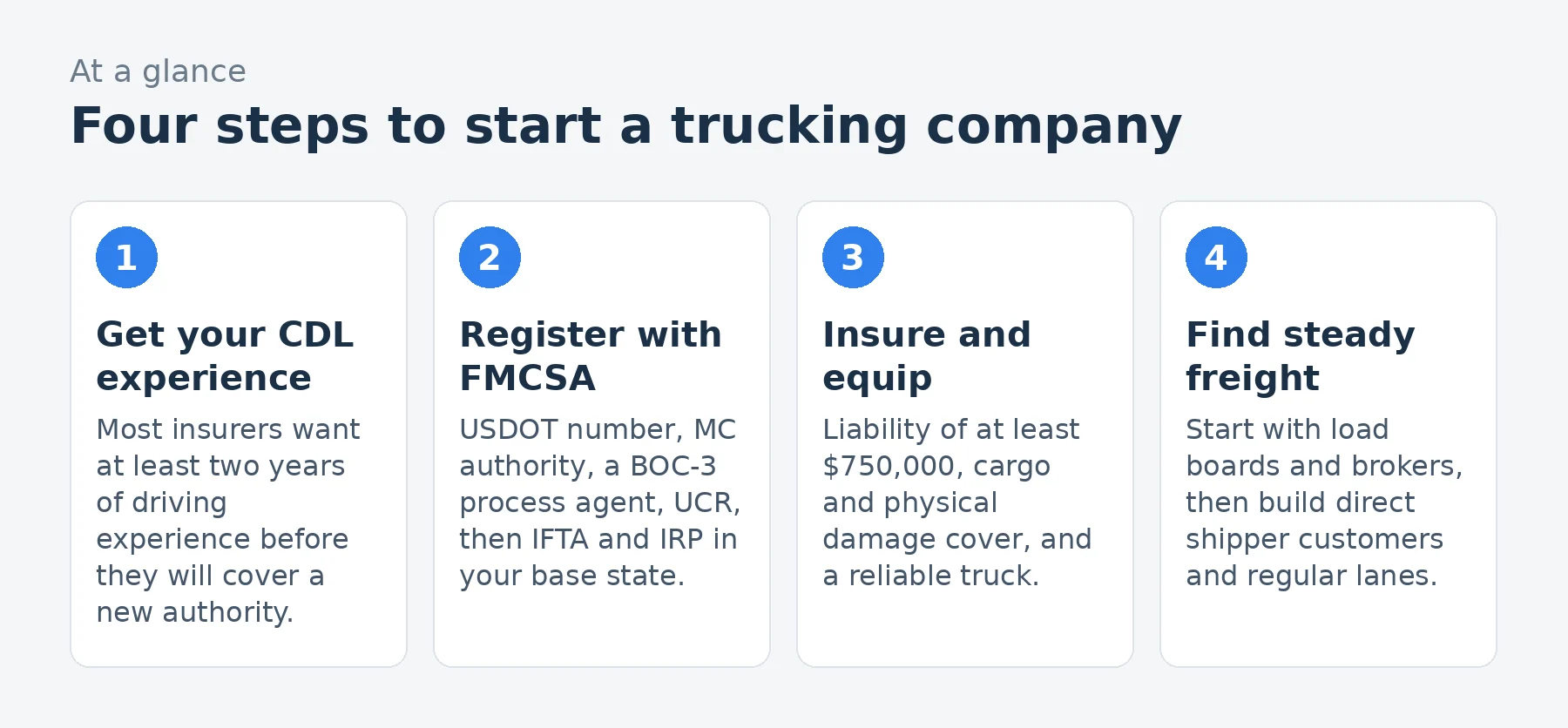
Trucking suits people who already know the work. Most successful owner-operators drove for a carrier for several years first, learning how freight, brokers, hours-of-service rules and maintenance actually work. Insurance companies agree: many will not cover a new authority without at least two years of verifiable CDL experience, and premiums fall as your safety record grows.
The Bureau of Labor Statistics counts about 2.2 million heavy and tractor-trailer truck drivers, with a median pay of $57,440 in May 2024 and employment projected to grow about 4% over the decade. Owning the business means earning what is left after every truck cost, which can be well above a driver’s wage in good markets and well below it in bad ones.
Authority and registrations
Interstate for-hire carriers register with the Federal Motor Carrier Safety Administration (FMCSA). The main steps:
- USDOT number, which identifies your company for safety and inspections.
- MC operating authority for carrying regulated freight for hire across state lines. There is a vetting and waiting period before it becomes active.
- BOC-3 filing naming a process agent in each state where you operate.
- Unified Carrier Registration (UCR), an annual fee based on fleet size.
- IFTA and IRP through your base state, for fuel tax and apportioned plates on qualified vehicles.
- Heavy Highway Vehicle Use Tax (IRS Form 2290) for trucks of 55,000 pounds or more.
Drivers need a commercial driver’s license, a current medical card and enrollment in a drug and alcohol testing program that reports to the FMCSA Clearinghouse. New carriers also go through a new entrant safety audit within their first 12 months, so set up driver files, maintenance records and hours-of-service logs (on an electronic logging device) from day one.
Insurance: plan for it early
Federal rules require for-hire carriers of general freight in vehicles over 10,001 pounds to carry at least $750,000 in liability coverage, and many brokers and shippers require $1 million. You will also want cargo insurance (often $100,000 is requested), physical damage cover for your equipment and occupational accident or workers’ compensation coverage.
Insurance is one of the biggest surprises for new companies. Premiums for a brand-new authority are higher than for established carriers, and insurers usually want a large down payment. Get quotes from agents who specialize in trucking before you buy a truck, because the quote can change your whole plan.
Startup costs to plan for
| Item | What to budget for |
|---|---|
| Tractor | Used or new; financed purchases need a down payment |
| Trailer | Dry van, reefer or flatbed, depending on the freight you want |
| Insurance down payment | Often several thousand dollars for a new authority |
| Registrations and permits | USDOT, MC, BOC-3, UCR, IRP plates, IFTA, Form 2290 |
| ELD and software | Electronic logging device, load boards, accounting |
| Operating cash | Fuel and costs for 30 to 60 days before customers pay |
That last line matters. Brokers and shippers often pay in 30 days or more, while fuel is due today. Many new carriers use a factoring company, which pays invoices in a day or two for a fee of a few percent. Use our startup cost calculator to total your numbers.
What freight pays
Rates are published weekly by DAT, the largest load board. In mid-October 2026, national average spot rates paid by brokers to carriers, including fuel surcharge, were about $3.09 a mile for dry van, $3.66 for refrigerated and $3.64 for flatbed. Flatbed rates set all-time records during 2026, and in June the dry van spot rate moved above the average contract rate for the first time since early 2022.
Treat these as a snapshot, not a promise. Rates swing week to week with freight volume, fuel prices and the number of trucks looking for loads; DAT’s own forecast expected van rates to ease into late November. Your rate per mile also depends on the lane: freight leaving busy manufacturing regions often pays more than freight heading into areas with few outbound loads, where you may have to drive empty ("deadhead") to find the next one.
Know your cost per mile before you accept any load. Add up a month of fuel, payments, insurance, maintenance and fees, divide by total miles (loaded and empty), and never book freight below that number except to escape a bad area.
A worked example: one truck, owner-operator
These are illustrative assumptions, not predictions.
| Assumption | Monthly | |
|---|---|---|
| Linehaul revenue | 9,500 loaded miles at an average of $2.45 a mile | $23,275 |
| Fuel surcharge collected | Passed through on loaded miles | $5,700 |
| Revenue | $28,975 | |
| Fuel | About 11,000 total miles at 6.5 mpg and $3.90 a gallon | $(6,600) |
| Truck and trailer payments | Financed equipment | $(3,800) |
| Insurance | Liability, cargo and physical damage for a new authority | $(1,900) |
| Maintenance and tires | About 18 cents a mile set aside | $(2,000) |
| Tolls, permits, ELD and load boards | $(900) | |
| Factoring fee | About 3% of invoices if you factor | $(870) |
| Profit before owner pay and taxes | $12,905 |
That leaves about $12,905 a month before the owner’s pay, taxes and savings for the next truck, on about $28,975 of revenue. In a weak freight market, a 40-cent drop in the average rate removes about $3,800 a month, which is why cash reserves and good customers matter more than one strong month.
Finding loads: brokers, load boards and direct customers
New carriers usually start on load boards, where brokers post freight. It is quick, but the rates are the most competitive and you compete with thousands of other trucks.
Build from there. Develop relationships with a few brokers who pay on time and offer consistent lanes. Over time, pursue direct shipper customers: manufacturers, distributors and farms that ship regularly. Direct freight usually pays more and is steadier, but shippers want proof that you are reliable, insured and easy to work with.
Check every broker before hauling for them. Look up their authority and bond, read their credit and payment history, and get the rate confirmation in writing before you load.
Growing into a small fleet
Adding trucks multiplies revenue but also management. You will hire drivers, handle their qualification files and testing, plan routes and maintenance for several trucks, and carry larger insurance policies. Many owner-operators find a second and third truck profitable only after they have steady direct customers to keep them loaded. Others choose a different path, such as learning freight brokerage once they understand lanes and pricing.
Common mistakes to avoid
- Buying a truck before getting insurance quotes for a new authority.
- Booking loads without knowing your cost per mile.
- Running out of cash while waiting 30 to 45 days for payment.
- Skipping maintenance to save money, which leads to breakdowns and failed inspections.
- Working with brokers you have not checked.
- Ignoring hours-of-service and record-keeping rules before the new entrant audit.
Your first 90 days
- Days 1-30: form your company, get your USDOT number and file for MC authority, set up a BOC-3, UCR and drug and alcohol testing, and collect insurance quotes.
- Days 31-60: buy or lease equipment, install an ELD, register for IFTA and IRP, set up factoring or a cash buffer and open accounts with a few trusted brokers.
- Days 61-90: run loads, track your real cost per mile every week, keep perfect records for your safety audit and start contacting direct shippers on your best lanes.
Frequently asked questions
How much does it cost to start a trucking company?
Costs vary widely with equipment. A used tractor and trailer, an insurance down payment, registrations and two months of operating cash can easily reach tens of thousands of dollars even when the equipment is financed. Leasing onto an established carrier first is a lower-cost way to learn.
Do I need my own authority?
Not necessarily. Many owner-operators lease onto an established carrier and use its authority and insurance, earning a percentage of each load. Your own authority lets you keep more of each load but makes you responsible for compliance, insurance and finding freight.
How long does MC authority take?
After you apply, FMCSA reviews the application, and there is a waiting and protest period before your authority becomes active. Plan for several weeks, and do not book loads until it is active and your insurance is on file.
What does a truck driver earn compared with an owner?
The BLS median pay for heavy and tractor-trailer truck drivers was $57,440 in May 2024. An owner earns whatever is left after all truck costs, which can be more or less than that depending on rates, miles and expenses.
Is factoring a good idea?
Factoring speeds up cash flow, which helps new carriers pay for fuel. It costs a few percent of each invoice, so compare terms carefully and move away from it once you have enough cash reserves.
Which trailer type should I start with?
Dry van is the most common and simplest. Flatbed often pays more per mile but requires securement skills and equipment. Refrigerated freight pays more too but adds reefer fuel, maintenance and claims risk.
Keep learning
- Trucking and logistics industry data
- How to start a hotshot trucking business
- How to start a box truck business
- Startup cost calculator
Sources
- FMCSA, Registration: get authority to operate
- FMCSA, Insurance requirements (49 CFR Part 387)
- DAT Freight & Analytics spot market data, week of Oct. 10-16, 2026 (via AJOT)
- Trucking Info, DAT June 2026 trucking conditions
- US Bureau of Labor Statistics, Heavy and tractor-trailer truck drivers
- IRS, Form 2290 Heavy Highway Vehicle Use Tax
- FMCSA Drug and Alcohol Clearinghouse
Last reviewed November 2, 2026. Startup costs are estimates; check local prices, licensing and tax rules before you commit money.

