
Hotshot trucking hauls smaller, time-sensitive loads, usually on a flatbed trailer pulled by a heavy-duty pickup. Typical freight includes machinery and parts, construction materials, oilfield equipment, farm equipment and anything a customer needs quickly that does not fill a full semi-trailer.
It costs much less to start than a tractor-trailer operation, which makes it popular with new owner-operators. But it is still trucking: you need authority, insurance and a firm grasp of your costs. Flatbed freight has been strong in 2026; according to DAT, flatbed spot rates set all-time highs during the year and averaged about $3.64 a mile including fuel in mid-October. This guide covers setups, rules, finding loads and a worked example.
Hotshot trucking at a glance
Table of Contents
| Topic | What to expect |
|---|---|
| Startup cost | Moderate: a one-ton pickup, a gooseneck flatbed trailer, securement gear, insurance and operating cash |
| CDL required? | Not if the truck and trailer combined are rated under 26,001 pounds; required for heavier combinations |
| Authority | USDOT number and MC authority to haul for hire across state lines |
| Typical freight | Machinery, construction materials, oilfield and farm equipment, expedited partial loads |
| Best for | Drivers comfortable with flatbed securement, long days and finding their own loads |
Who hotshot trucking suits
Hotshot suits independent drivers who want to own their equipment and set their own schedule, and who do not mind long stretches away from home. You will strap and tarp loads in all weather, deal with brokers and customers directly and manage your own paperwork.
The Bureau of Labor Statistics reports median pay of $44,140 for light truck drivers and $57,440 for heavy and tractor-trailer drivers (May 2024). Hotshot owners earn what is left after truck costs, which depends mostly on rates, miles and how often they drive empty.
Non-CDL vs CDL hotshot
The main decision is your combined gross vehicle weight rating (GCWR), the truck’s rating plus the trailer’s:
- Non-CDL setups stay under 26,001 pounds combined. They are simpler to start and avoid CDL drug and alcohol testing, but they limit how much you can haul, which limits the loads you can take.
- CDL setups exceed 26,000 pounds and can carry heavier, often better-paying loads. They require a Class A CDL, a medical card and a drug and alcohol testing program.
Either way, interstate commercial vehicles over 10,001 pounds need a USDOT number and must follow federal safety rules, including hours of service and electronic logging devices for most operations.
Authority and insurance
To haul freight for pay across state lines you need MC operating authority, a BOC-3 process agent filing and Unified Carrier Registration. For-hire carriers of general freight in vehicles over 10,001 pounds must carry at least $750,000 in liability coverage, and many brokers want $1 million plus cargo coverage.
New authorities pay more for insurance, and some insurers want to see CDL or driving experience first. Get quotes before you buy equipment.
Startup costs to plan for
| Item | What to budget for |
|---|---|
| Truck | Heavy-duty one-ton pickup, often a dually diesel |
| Trailer | Gooseneck flatbed, commonly 32 to 40 feet |
| Securement gear | Straps, chains, binders, edge protectors, tarps |
| Insurance down payment | Liability, cargo and physical damage |
| Registrations | USDOT, MC, BOC-3, UCR and state registrations |
| Operating cash | Fuel and costs until brokers pay |
Use our startup cost calculator for your total.
Finding loads and pricing them
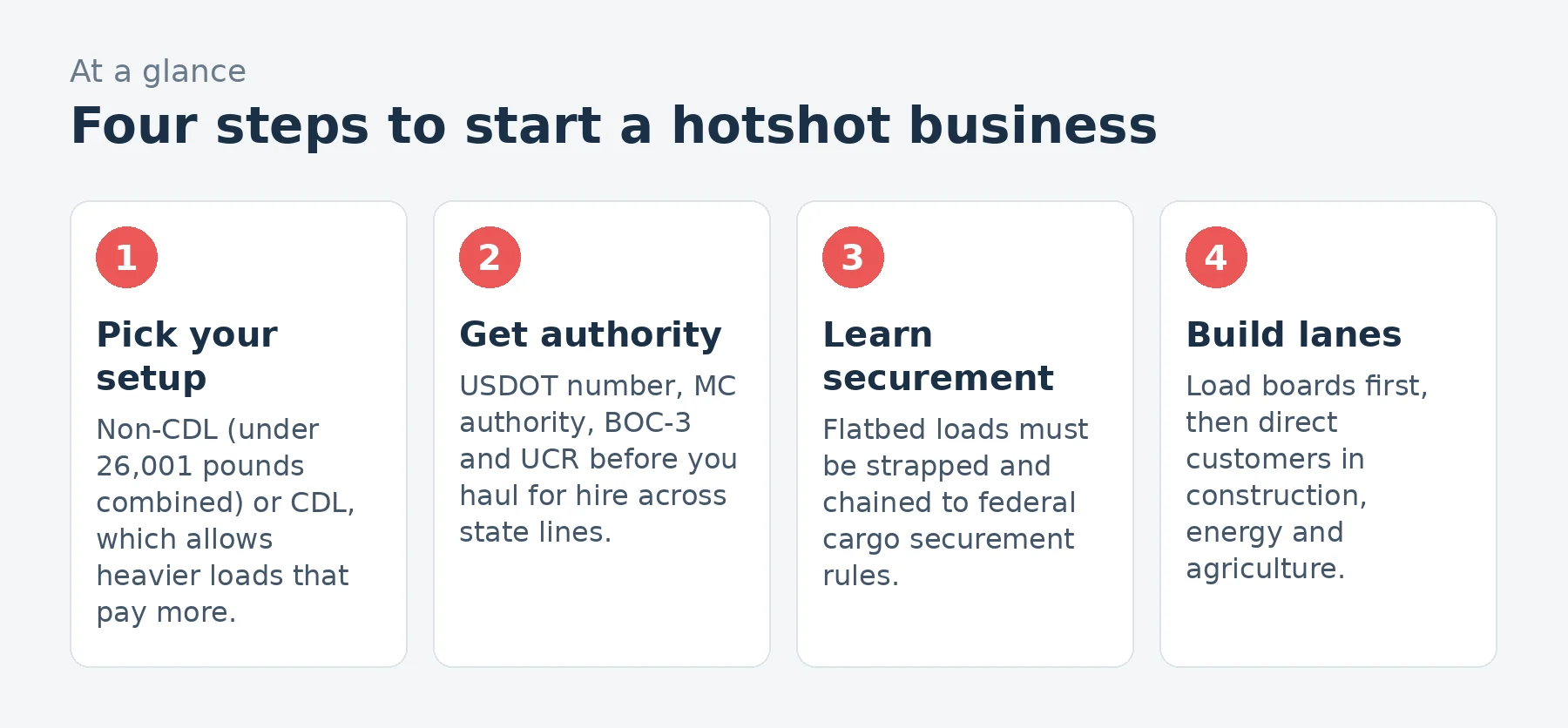
Most new hotshot drivers start on load boards that list partial and expedited flatbed freight. Over time, the best operators build direct customers: equipment dealers, construction companies, fabrication shops, farms and energy companies that need fast deliveries regularly.
Price every load against your cost per mile, including the empty miles to pick it up and to find the next load. Flatbed freight has been strong in 2026, with DAT reporting record flatbed spot rates during the year, but hotshot loads are smaller and rates vary widely by load, lane and urgency.
Who hotshot customers are
Hotshot freight comes from industries where a missing part or machine stops work and costs money every hour:
- Construction: materials, small equipment and urgent deliveries to job sites.
- Agriculture: equipment, parts and supplies, especially during planting and harvest when downtime is expensive.
- Energy: pipe, valves and equipment for oil, gas and renewable projects in regions where they operate.
- Equipment dealers and manufacturers: machinery, vehicles and parts going to customers.
- Fabrication and industrial shops: finished pieces that are too long or awkward for parcel carriers.
Learn which of these are strong in your region, then contact them directly. Customers who call you when something breaks often pay better than load boards and become steady accounts.
Cargo securement
Flatbed freight must be secured under federal cargo securement rules, which set the number and strength of tie-downs based on the cargo’s weight and length. Learn them thoroughly, inspect straps and chains before every trip and check your load during the trip. Poor securement causes accidents, failed inspections and lost customers.
Choosing your equipment
Most hotshot operators run a one-ton dual-rear-wheel diesel pickup with a gooseneck flatbed trailer. Gooseneck trailers carry heavier loads more stably than bumper-pull trailers and are the standard for serious hotshot work. Common lengths are 32 to 40 feet; longer decks fit more loads but can be harder to maneuver on job sites and in cities.
- Match the ratings: confirm the truck’s towing capacity and the trailer’s gross weight rating, and keep the combination under 26,001 pounds if you are running non-CDL.
- Ramps and a winch make it easier to load vehicles and equipment.
- Toolbox and storage for straps, chains, binders, tarps and edge protectors.
- Maintenance budget: pickups pulling heavy loads wear tires, brakes, suspension and transmissions much faster than in normal use.
Working with brokers safely
Most hotshot loads come through brokers. Protect yourself:
- Check the broker’s authority and bond before accepting a load.
- Get a written rate confirmation that lists the rate, pickup and delivery details, accessorial charges and payment terms.
- Agree on detention pay for long waits at pickup or delivery.
- Send clear paperwork (signed bill of lading and photos) right after delivery so you are paid quickly.
- Consider quick-pay options or factoring if waiting 30 days would strain your cash.
Hours of service and logs
Commercial drivers in interstate commerce must follow federal hours-of-service rules, which limit driving and on-duty time and require rest breaks. Most operations must record hours on an electronic logging device (ELD). Plan routes around these limits; a load that cannot legally be delivered on time is not a good load at any rate.
A worked example: one truck, owner-operator
These are illustrative assumptions, not predictions.
| Assumption | Monthly | |
|---|---|---|
| Loaded miles | 7,000 loaded miles at an average of $1.80 a mile | $12,600 |
| Revenue | $12,600 | |
| Fuel | About 9,000 total miles at 11 mpg and $3.90 a gallon | $(3,190) |
| Truck and trailer payments | One-ton dually and 40-foot gooseneck | $(1,800) |
| Insurance | Liability and cargo for a new authority | $(1,000) |
| Maintenance and tires | Heavy use wears pickups quickly | $(900) |
| ELD, load boards, permits and tolls | $(550) | |
| Profit before owner pay and taxes | $5,160 |
That leaves about $5,160 a month before the owner’s pay and taxes on about $12,600 of revenue. The rate per mile used here is an assumption, not a market figure; hotshot loads vary widely, and empty miles between loads can cut real earnings sharply.
Common mistakes to avoid
- Buying a truck and trailer before getting insurance quotes.
- Choosing a non-CDL setup and then discovering the loads you want are too heavy.
- Taking cheap loads that leave you far from good freight.
- Underestimating tire, brake and transmission wear on pickups.
- Ignoring cargo securement rules.
Your first 90 days
- Days 1-30: choose a non-CDL or CDL setup, form your company, apply for USDOT and MC authority and collect insurance quotes.
- Days 31-60: buy or finance your truck and trailer, buy securement gear, install an ELD, activate insurance and set up load board accounts.
- Days 61-90: run loads, track cost per mile weekly and start approaching direct customers in construction, agriculture and equipment.
Frequently asked questions
Do I need a CDL for hotshot trucking?
Not if your truck and trailer combined are rated under 26,001 pounds. Heavier combinations require a Class A CDL.
How much does it cost to start hotshot trucking?
Less than a tractor-trailer operation, but still significant: a heavy-duty pickup, a gooseneck trailer, securement gear, insurance and operating cash. Financing reduces the upfront cost but adds monthly payments.
Do hotshot drivers need MC authority?
Yes, if they haul freight for others for pay across state lines.
What do hotshot loads pay?
Rates vary widely by load, lane and urgency. Flatbed rates were strong in 2026, but always price each load against your own cost per mile, including empty miles.
Is hotshot trucking profitable?
It can be for owners who control costs, avoid excessive empty miles and build direct customers. The worked example above shows how quickly costs add up.
Gooseneck or bumper-pull trailer?
Gooseneck trailers handle heavier loads more stably and are the standard for hotshot work. Bumper-pull trailers cost less but limit the loads you can safely haul.
Do hotshot drivers need an ELD?
Most commercial drivers operating in interstate commerce must record hours of service on an electronic logging device, with limited exceptions. Check FMCSA rules for your operation.
Keep learning
- Hot shot trucking industry data
- How to start a trucking company
- How to start a box truck business
- Business Idea Reality Check
Sources
- FMCSA, Registration: get authority to operate
- FMCSA, Insurance requirements (49 CFR Part 387)
- DAT Freight & Analytics spot market data, week of Oct. 10-16, 2026 (via AJOT)
- Trucking Info, DAT June 2026 trucking conditions
- US Bureau of Labor Statistics, Delivery truck drivers and driver/sales workers
- FMCSA, Commercial driver's license program
Last reviewed November 2, 2026. Startup costs are estimates; check local prices, licensing and tax rules before you commit money.

