
A travel agency (many now say travel advisor) plans and books trips for clients: cruises, all-inclusive resorts, tours, honeymoons, group trips, family vacations and business travel. Advisors earn commissions from suppliers such as cruise lines, tour operators and hotels, and many also charge planning fees.
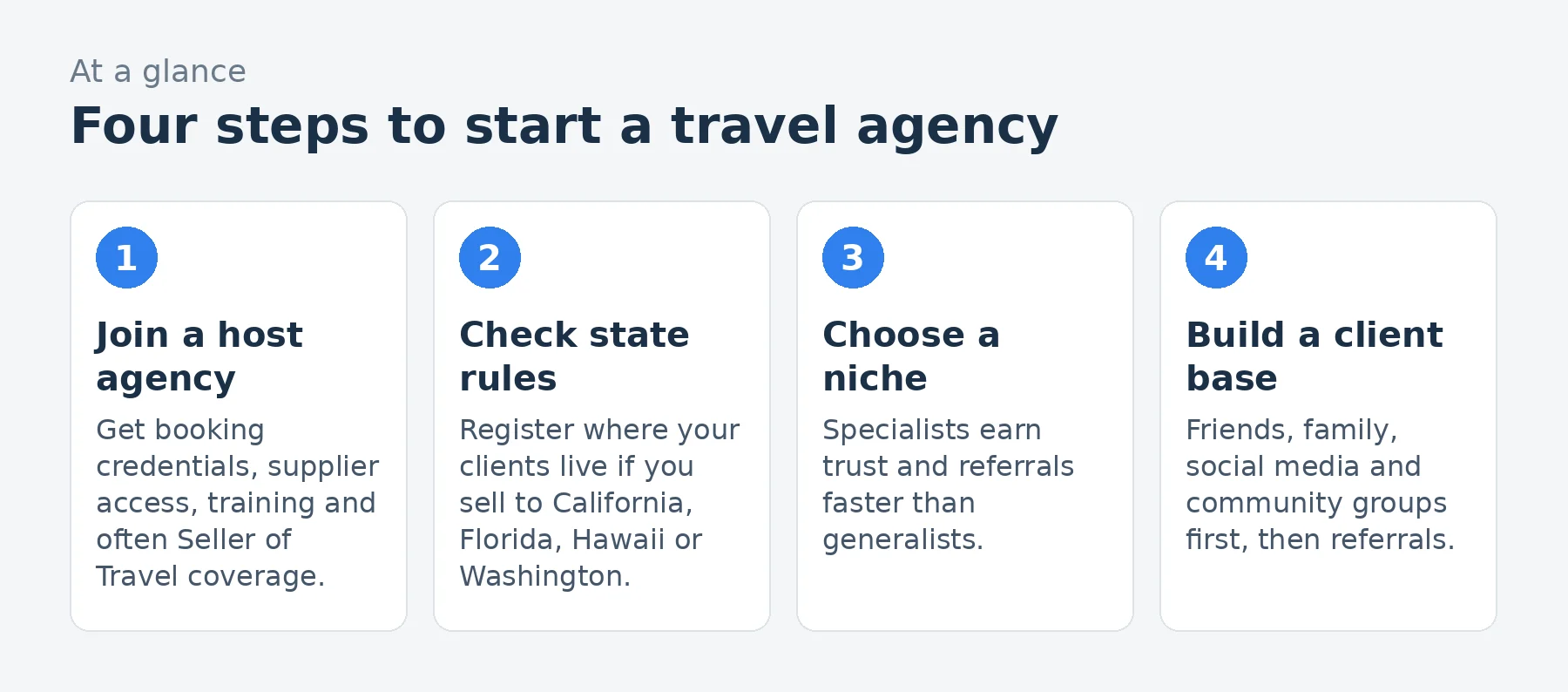
You can start from home with low costs, most often by joining a host agency that supplies booking credentials, supplier relationships and training. There is no federal travel agent license, but a few states require Seller of Travel registration, based on where your clients live. The Bureau of Labor Statistics counts about 65,700 travel agents, with a median pay of $48,450 in May 2024. This guide covers host agencies, state rules, income, a niche, a worked example and finding clients.
A travel agency at a glance
Table of Contents
| Topic | What to expect |
|---|---|
| Startup cost | Low: host agency fees, training, E&O insurance, a website and marketing |
| Licenses | No federal license; Seller of Travel registration in California, Florida, Hawaii and Washington (and Maryland rolling out) |
| How you earn | Supplier commissions, plus planning and service fees |
| Best niches | Cruises, all-inclusives, honeymoons and weddings, group travel, adventure and luxury travel |
| Best for | Organized, well-traveled people who enjoy sales and long-term client relationships |
Who a travel agency suits
It suits organized people who love travel, enjoy solving problems and are comfortable selling. Clients rely on you when flights are canceled or plans change, so responsiveness matters as much as destination knowledge.
Many advisors start part-time while keeping another job, building a client base before going full-time.
Host agency or independent?
To book with suppliers and earn commission, you need recognized credentials such as IATA or CLIA numbers (and ARC to issue airline tickets). New advisors almost always start with a host agency, which provides:
- Booking credentials and supplier relationships with higher commission levels than a newcomer could get alone.
- Training, marketing tools and booking technology.
- Commission processing and payment.
- Often errors and omissions (E&O) insurance and Seller of Travel registration in the states that require it.
In return, hosts keep a share of commissions and may charge monthly or annual fees; one host listed on Host Agency Reviews charges $64.95 a month. Compare commission splits, fees, training, minimum sales requirements and support before joining. Experienced agencies with large sales volumes may later get their own accreditation.
Seller of Travel rules
There is no federal license to sell travel, but some states require registration under Seller of Travel laws: California, Florida, Hawaii and Washington, with Maryland rolling out a requirement in 2026, according to Fora. These laws generally apply based on where your clients live, so an advisor in Ohio booking a California resident must follow California’s rules.
Fees and requirements vary. Florida charges $300 a year (with a reduced filing for advisors under a registered host), and California charges $100 per location each year, according to summaries of state agency rules. Many host agencies cover their advisors under the host’s registration in some states, so ask exactly what your host covers.
How travel advisors earn
- Commissions from cruise lines, tour operators, resorts, hotels and travel insurance, typically a percentage of the booking. Your host keeps part of it.
- Planning and service fees for complex itineraries, groups, destination weddings and custom trips.
- Group travel, where coordinating many travelers earns commission on every booking.
- Incentives and bonuses from suppliers for sales volume.
Airline tickets usually pay little or no commission, so many advisors charge fees for air-only bookings or focus on packages, cruises and tours.
A worked example: an established home-based advisor
These are illustrative assumptions for an established advisor, not predictions; commission rates and splits vary by supplier and host agency.
| Assumption | Monthly | |
|---|---|---|
| Commissions (your share) | $60,000 in monthly bookings, about 12% average commission, 80% share after host split | $5,760 |
| Planning fees | 8 trips at $150 | $1,200 |
| Revenue | $6,960 | |
| Host agency fees | Monthly membership | $(65) |
| E&O insurance and continuing education | $(120) | |
| Marketing | Website, social ads, events | $(500) |
| Familiarization trips and training | Spread across the year | $(400) |
| Software and phone | $(100) | |
| Profit before owner pay and taxes | $5,775 |
That leaves about $5,775 a month before taxes, on about $6,960 of income. New advisors usually earn far less in their first year while building clients, and commissions are often paid after travel, so cash arrives months after the booking.
Choosing a niche
- Cruises: strong commissions and repeat cruisers.
- All-inclusive resorts and honeymoons: popular, easy to package and referral-rich.
- Destination weddings and group travel: larger bookings and many travelers at once.
- Theme parks and family travel: steady demand and repeat families.
- Adventure, luxury or specific destinations: specialists command loyalty and planning fees.
Specializing makes marketing simpler and helps you learn suppliers deeply. Familiarization trips and supplier training make you an expert worth paying for.
Group travel: the fastest way to grow
Groups multiply your work’s value: one family reunion, destination wedding, church trip, alumni tour or company retreat can produce many bookings at once. Suppliers often offer group rates, amenities and sometimes complimentary spaces based on group size. Groups need careful management: clear payment schedules, deadlines for names and deposits, rooming lists and one point of contact on the group’s side. Start with one small group from your network and build from there.
Charging planning fees
Many advisors charge fees for work that commissions do not cover: complex multi-country itineraries, destination weddings, groups, air-only bookings and trips with suppliers that do not pay commission. Explain fees upfront, in writing, and describe what clients receive, such as research, custom itineraries and support while traveling. Some advisors credit the fee toward the trip if the client books. Check whether your state’s Seller of Travel rules affect how you collect fees.
Tools you will use
- Your host agency’s booking tools and supplier portals.
- A customer relationship manager to track clients, trips, birthdays and anniversaries.
- Itinerary software to send clear, branded trip details.
- Email marketing to stay in touch with past clients.
Insurance and protecting clients
Carry errors and omissions (E&O) insurance, which covers mistakes such as a wrong date or a missed detail; many hosts include it. Offer travel insurance to every client and document when they decline. Keep written records of every booking, payment and change, and follow your state’s rules on handling client funds if you collect payments directly.
Finding clients
- Your network: friends, family, colleagues and community groups.
- Social media and email: share trips, deals and destination tips consistently.
- Partnerships: wedding planners, bridal shops, clubs, schools and churches for group travel.
- Reviews and referrals: thank every client and ask for introductions.
- Local search: a Google Business Profile helps clients find you; check it with our Local SEO Check.
Supplier training and continuing education
Cruise lines, tour operators, resort brands and tourism boards offer free training programs and specialist certifications. Completing them builds knowledge clients can feel, can unlock better supplier support and sometimes higher commission levels, and gives you material for your marketing. Familiarization trips, where suppliers host advisors at reduced cost, let you experience destinations and properties firsthand. Choose training that fits your niche rather than collecting every certificate.
Common mistakes to avoid
- Ignoring Seller of Travel rules for clients in regulated states.
- Joining a host without comparing splits, fees and support.
- Trying to sell every kind of travel.
- Spending heavily on marketing before building a niche and network.
- Not offering travel insurance.
Your first 90 days
- Days 1-30: compare host agencies, join one, register your business and confirm Seller of Travel coverage.
- Days 31-60: complete host and supplier training in your niche, build a simple website and announce your business to your network.
- Days 61-90: book your first trips, collect reviews and plan one small group trip to grow faster.
Frequently asked questions
Do I need a license to become a travel agent?
There is no federal travel agent license. Some states, including California, Florida, Hawaii and Washington, require Seller of Travel registration based on where clients live.
What is a host agency?
A larger agency that provides booking credentials, supplier relationships, training and commission processing to independent advisors in exchange for a share of commissions and sometimes fees.
How do travel agents get paid?
Mainly through supplier commissions, plus planning and service fees. Commissions are often paid after the client travels.
How much do travel agents make?
The BLS reported a median pay of $48,450 for travel agents in May 2024. Independent advisors’ income depends on their sales and niche.
Can I start a travel agency part-time?
Yes. Many advisors start part-time with a host agency and grow as their client base builds.
Should travel advisors charge fees?
Many do for complex trips, groups and bookings that pay little or no commission. Explain fees upfront in writing and check any state rules that apply.
Do I need travel experience to become an advisor?
Personal travel helps, but training, supplier programs and a focused niche matter more. Many successful advisors start by specializing in destinations or trip types they know well and learn the rest through host agency and supplier training.
Keep learning
- Travel and tourism industry data
- How to start a tour guide business
- How to start a wedding planning business
- Local SEO Check
Sources
- Fora, Do you need a travel agent license?
- Host Agency Reviews, Travel agent license and Seller of Travel registration
- Host Agency Reviews, KHM Travel host profile (example host fees)
- L'Express Franchise, How to open a travel agency (state Seller of Travel fees)
- US Bureau of Labor Statistics, Travel agents
Last reviewed November 2, 2026. Startup costs are estimates; check local prices, licensing and tax rules before you commit money.

