
A tour guide business leads visitors and locals through places worth knowing: historic walking tours, ghost tours, architecture and art tours, bike tours, hikes and outdoor adventures, private tours and school groups. Good guides combine deep knowledge with storytelling and the ability to keep a group engaged and safe.
It is a low-cost business to start, often needing little more than knowledge, a route, insurance and a booking system. Success depends on a distinctive tour, strong reviews and the visitor traffic in your area. This guide covers tour concepts, licenses and permits, pricing, booking, a worked example and building reviews.
A tour guide business at a glance
Table of Contents
| Topic | What to expect |
|---|---|
| Startup cost | Low: research, insurance, a booking website, marketing; more for bikes, vehicles or outdoor gear |
| Licenses | Business license; some cities license guides (such as New York City); parks may require commercial use permits |
| How you charge | Per person for public tours, flat rates for private and group tours |
| Demand | Follows visitor seasons, with peaks in summer, holidays and special events |
| Best for | Knowledgeable, energetic storytellers who love their city or region |
Who tour guiding suits
It suits outgoing, knowledgeable people who enjoy performing, love history or nature and can manage groups. You will walk or ride for hours in all weather, answer endless questions and keep everyone safe and on schedule.
Designing a tour people book
- History and architecture: the classic city tour, deepened with stories and access visitors cannot get alone.
- Ghost and crime tours: popular evening tours with strong storytelling.
- Food tours: see our food tour guide.
- Outdoor tours: hikes, kayaking, birding and bike tours, which need extra safety planning and equipment.
- Niche tours: art, music, film locations, local industry, breweries or specific communities’ history.
- Private and school tours: custom tours for families, companies and schools.
Walk your route many times, time each stop, find restrooms and shade, plan for weather and check that stops are accessible or offer alternatives.
Licenses and permits
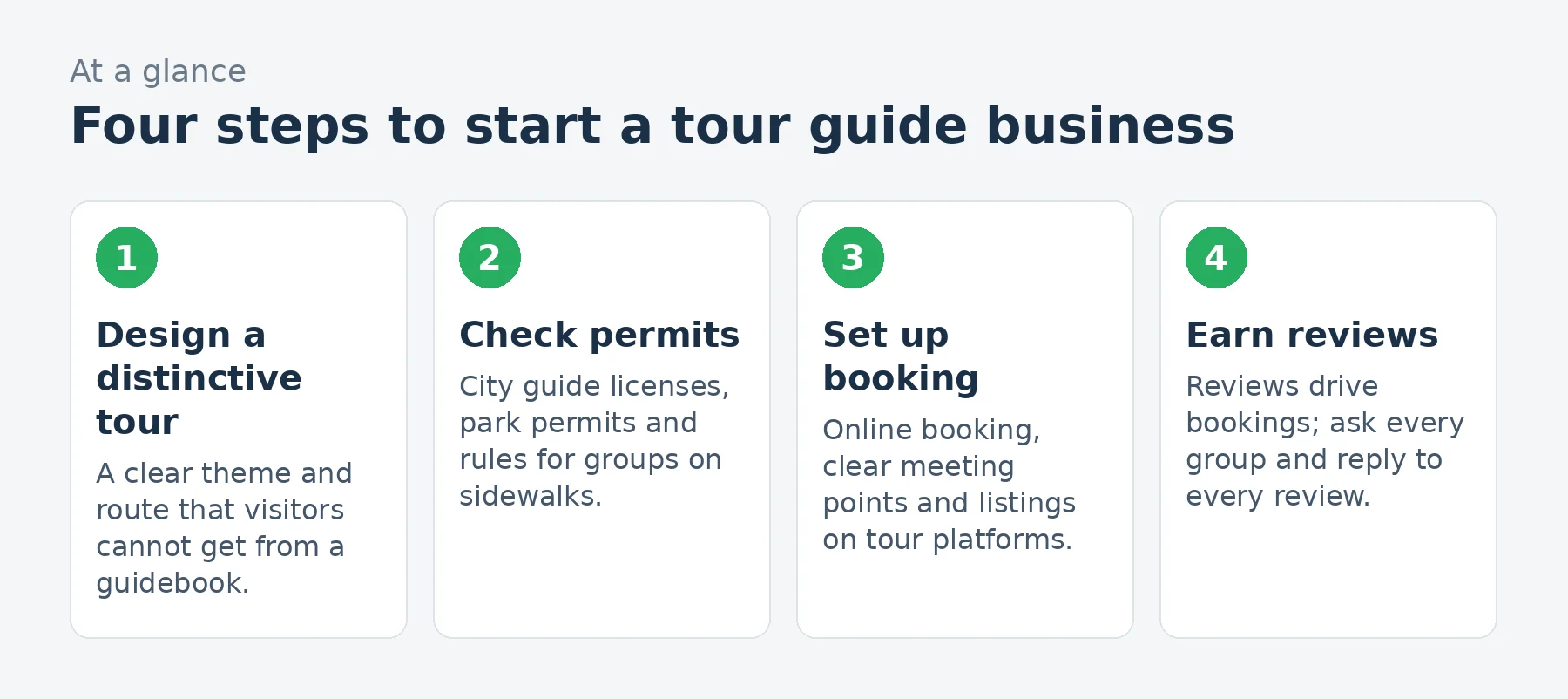
Most places do not license tour guides, but some cities do. New York City, for example, requires a sightseeing guide license from its Department of Consumer and Worker Protection. Other cities have dropped their licensing rules after court challenges, including Washington, D.C., and Charleston, South Carolina, so check your city’s current rules.
Permits often apply to where you guide. Commercial tours in national parks generally require a Commercial Use Authorization from the National Park Service, and state parks, city parks and some historic sites have their own permits. Large groups on sidewalks or in plazas may need city permits. Always get permission before entering private property.
Insurance and safety
Carry general liability insurance, and add coverage for vehicles, bikes or outdoor activities you provide. Outdoor and adventure tours need waivers, first aid training, emergency plans and equipment checks. Keep group sizes manageable and know the route’s hazards.
Telling stories that stick
Guests forget dates but remember stories. Build each stop around a person, a conflict or a surprising detail, connect it to what guests can see, and end with something to look for later. Research carefully and separate legend from documented history, especially on ghost and crime tours; guests appreciate knowing which is which. Practice until the tour flows naturally, then keep improving it as you learn which stories land best.
Managing groups
- Start with a short welcome, safety notes and how long each stop will be.
- Stand where everyone can see and hear you, away from traffic; use a voice amplifier or headsets for larger groups.
- Count guests at every stop and set a clear meeting point if anyone gets separated.
- Keep the pace comfortable for the slowest walker.
- Watch the time and end on schedule; guests often have plans afterward.
Private and school tours
Private tours for families, companies and special occasions are often booked by locals and command flat rates. School tours need curriculum connections, extra supervision and clear policies for chaperones. Both can fill weekdays and quieter seasons when public tours slow down.
Handling seasonality
Visitor demand rises and falls with seasons, holidays and local events. Use busy months to build cash and reviews, and use quiet months for new tours, partnerships, private and corporate bookings, and themed seasonal tours such as holiday lights or Halloween ghost walks.
Pricing your tours
Price per person for public tours, with family or group discounts, and offer flat rates for private tours. Research comparable tours in your city on booking platforms, then price according to length, group size, inclusions (such as admission tickets) and your reviews. Many guides also accept tips. Make sure your price covers guide time, platform commissions and any admission costs.
Booking and platforms
Use an online booking system on your own website so guests can book and pay instantly, with automatic confirmations and meeting point details. List your tours on major tour and activity platforms to reach visitors, but remember those platforms charge commissions; encourage repeat guests and referrals to book directly.
A worked example: owner plus two part-time guides
These are illustrative assumptions for a busy month, not predictions.
| Assumption | Monthly | |
|---|---|---|
| Public walking tours | 60 tours, 9 guests average, $32 per person | $17,280 |
| Private and group tours | 10 tours at $300 | $3,000 |
| Revenue | $20,280 | |
| Booking platform commissions | On about half of public tour revenue | $(2,200) |
| Guide wages | Two part-time guides | $(6,200) |
| Insurance | General liability | $(150) |
| Marketing and software | Booking system, ads, website | $(700) |
| Supplies and admission costs | Headsets, umbrellas, entry fees where included | $(400) |
| Profit before owner pay and taxes | $10,630 |
That leaves about $10,630 a month before the owner’s pay and taxes, on about $20,280 of revenue in a busy month. Off-season months are much slower in most destinations, so plan for seasonal cash flow.
Earning great reviews
Reviews drive bookings more than anything else. Start on time, learn guests’ names, tell stories rather than reciting facts, invite questions and finish with personal recommendations for the rest of their visit. Ask for a review at the end of each tour, follow up by email and reply to every review, positive or not.
Accessibility
Describe each tour’s walking distance, terrain, stairs and rest stops clearly on your booking page so guests can choose well. Where possible, offer an accessible route or private tours adapted for guests using wheelchairs or with limited mobility, and provide audio and visual alternatives where you can. Inclusive tours reach more guests and earn loyal reviews.
Hotel and concierge partnerships
Hotel concierges, bed-and-breakfast owners and vacation rental hosts recommend tours every day. Invite them on a free tour, give them simple booking cards or links, and thank them for referrals. Visitor centers, cruise terminals and convention bureaus are also worth contacting in many cities.
Common mistakes to avoid
- Skipping park or city permits.
- A route with no restrooms, shade or weather plan.
- Reciting facts instead of telling stories.
- Relying entirely on commission-heavy platforms.
- Ignoring accessibility.
Your first 90 days
- Days 1-30: research and design your tour, check city licenses and park permits, register your business and buy insurance.
- Days 31-60: run free or discounted test tours for friends and locals, refine the route and stories and set up online booking.
- Days 61-90: list on tour platforms and your Google Business Profile, partner with hotels and visitor centers and ask every group for a review.
Frequently asked questions
Do I need a license to be a tour guide?
Most places do not require one, but some cities do, such as New York City. Parks and historic sites often require permits for commercial tours.
Do I need a permit to give tours in a national park?
Generally yes. Commercial tours in national parks usually require a Commercial Use Authorization from the National Park Service.
How much should I charge for a walking tour?
Research comparable tours in your city and price per person based on length, inclusions and reviews, with flat rates for private tours.
Should I use tour booking platforms?
They help reach visitors but charge commissions. Many guides use both platforms and direct booking on their own websites.
What insurance does a tour guide need?
General liability at a minimum, plus coverage for vehicles, bikes or outdoor activities you provide.
How many people should be on a walking tour?
Many guides keep public walking tours small enough that everyone can hear and keep up, often well under 20 people, and use amplifiers for larger groups.
Do tour guides accept tips?
Many do, especially on public walking tours, where tipping is common in the United States. Set your ticket price so the business is profitable without tips, and treat tips as a bonus for guides.
How long should a walking tour be?
Many public walking tours run about 90 minutes to two hours, which keeps guests engaged without tiring them. Longer tours need more rest stops and should say so clearly on the booking page.
Keep learning
- Travel and tourism industry data
- How to start a food tour business
- How to start a travel agency
- Local SEO Check
Sources
- NYC Department of Consumer and Worker Protection, Sightseeing guide license
- National Park Service, Commercial Use Authorizations
- US Bureau of Labor Statistics, Travel agents
- US Small Business Administration, Apply for licenses and permits
Last reviewed November 2, 2026. Startup costs are estimates; check local prices, licensing and tax rules before you commit money.

