
A senior fitness business leads exercise classes for older adults: strength, balance, mobility, chair exercise, walking groups, water aerobics and tai chi, at senior centers, retirement and senior living communities, churches, community centers and online. Regular exercise helps older adults stay strong, independent and less likely to fall.
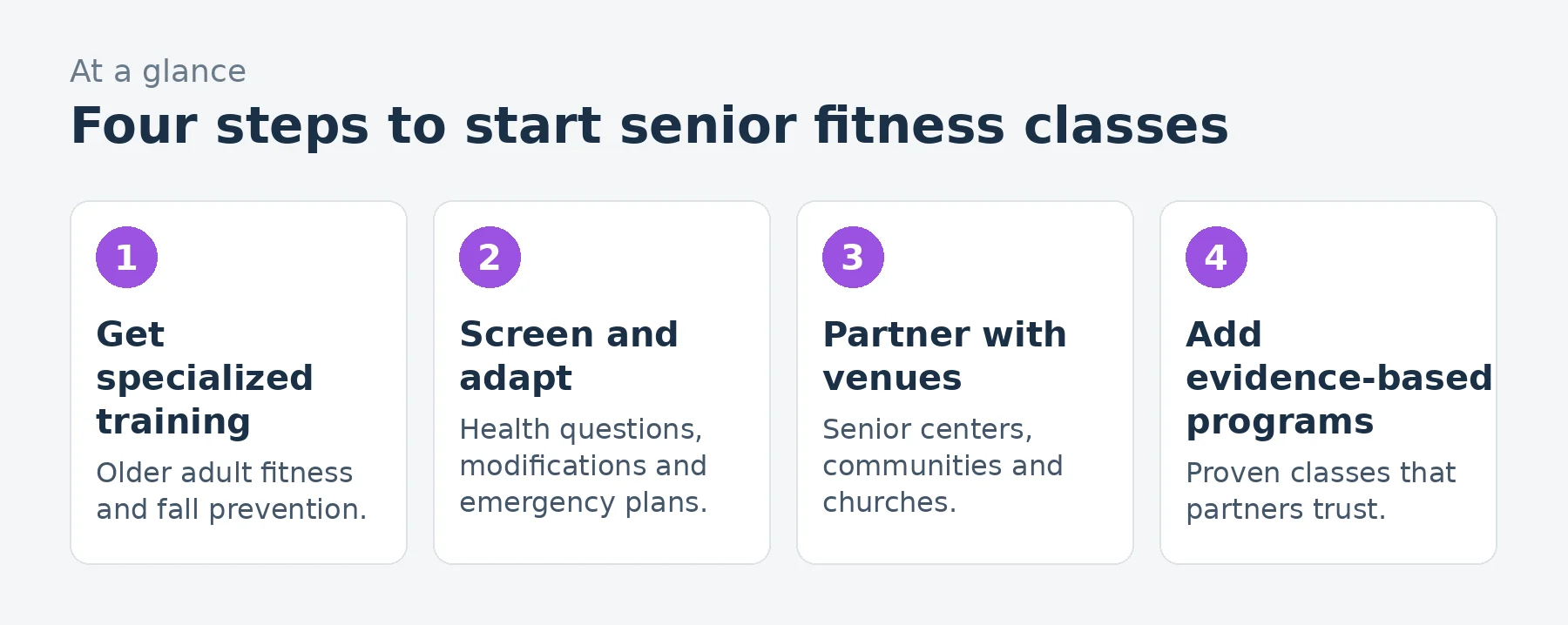
Safety and credibility matter: specialized older adult fitness certifications, health screening and emergency plans protect participants. Evidence-based fall prevention programs, promoted by the CDC and the National Council on Aging, offer proven class formats, and many Medicare Advantage plans include fitness benefits that may pay for classes at participating locations. The Bureau of Labor Statistics reports a median pay of $46,180 for fitness trainers and instructors (May 2024). Owners earn the profit after space, platforms, marketing and insurance. This guide covers credentials, safety, programs, venues, payment sources, pricing, a worked example and a 90-day plan.
A senior fitness classes business at a glance
Table of Contents
| Topic | What to expect |
|---|---|
| Startup cost | Low: certification, portable equipment such as chairs, bands and light weights, a speaker, insurance and marketing |
| Credentials | Personal trainer or group fitness certification plus older adult specialty training, CPR and AED |
| Safety | Health screening, modifications, fall prevention focus, emergency plans and accessible venues |
| Payment sources | Participant fees, contracts with senior living communities and centers, and Medicare Advantage fitness programs at participating locations |
| Best for | Patient, encouraging instructors who enjoy working with older adults |
Who senior fitness suits
It suits patient, warm instructors who enjoy older adults, can adapt exercises for different abilities and create social, encouraging classes. Many participants come as much for community as for exercise.
Certifications
Start with an accredited personal training or group fitness certification, then add older adult specialty training and CPR and AED certification. Leaders of evidence-based programs complete program-specific training and licensing.
Safety and screening
Use health screening tools such as the PAR-Q+, ask about conditions and medications that affect exercise, and request medical clearance when appropriate. Offer chair and standing options, progress gradually, watch for dizziness or distress, keep water available, know emergency procedures and AED locations and stay within fitness scope rather than giving medical advice.
Fall prevention and evidence-based programs
Falls are a leading cause of injury among older adults, and the CDC’s STEADI initiative promotes fall risk screening and strength and balance exercise. The National Council on Aging lists evidence-based falls prevention programs, such as A Matter of Balance and Tai Chi for Arthritis for Fall Prevention, which require trained leaders. Hospitals, area agencies on aging and senior centers often fund or host these programs.
Medicare Advantage fitness programs
Many Medicare Advantage plans include fitness benefits through national programs that pay participating gyms and class locations, so members can attend at no extra cost. Studios and community locations may apply to join these networks. Requirements and payments vary by program.
Venues and accessibility
Partner with senior centers, retirement and assisted living communities, churches, libraries, parks and community centers. Choose accessible spaces with ramps, restrooms, stable chairs, non-slip floors and good lighting, consistent with ADA requirements for public accommodations.
Startup costs for a senior fitness classes business
| Item | What to budget for |
|---|---|
| Certification | Fitness certification, older adult specialty, CPR/AED |
| Equipment | Bands, light weights, balls, mats |
| Sound | Portable speaker and microphone |
| Music licensing | Licensed fitness music services |
| Insurance | Professional and general liability |
| Marketing | Flyers, partnerships, website |
Use our startup cost calculator for your total.
Pricing
Charge senior living communities and centers per class or per month, offer affordable drop-in or punch-card prices for community classes and price evidence-based workshops as series. Many older adults live on fixed incomes, so contracts and sponsored programs help keep classes affordable. Use our pricing calculator.
A worked example: 30 classes a month
These are illustrative assumptions for an instructor teaching about 30 classes a month, not predictions.
| Assumption | Monthly | |
|---|---|---|
| Senior living community contracts | 16 classes at $85 | $1,360 |
| Community classes | 10 classes, 15 participants at $8 | $1,200 |
| Evidence-based workshops | Fall prevention series | $900 |
| Private and small-group sessions | $1,000 | |
| Revenue | $4,460 | |
| Room rentals | $(300) | |
| Equipment and music licensing | $(80) | |
| Insurance and certifications | Averaged monthly | $(70) |
| Mileage and marketing | $(250) | |
| Profit before owner pay and taxes | $3,760 |
That leaves about $3,760 a month before taxes, on about $4,460 of revenue. Contracts with communities and centers provide stable income, while community classes build visibility.
Loading the calculator…
Online and at-home options
Live online classes and recorded chair workouts reach homebound older adults, though they require extra attention to safety and clear instructions. Private in-home sessions serve clients recovering from illness or with mobility challenges, after clearance from their providers.
Building community
Learn participants’ names, celebrate milestones, encourage socializing before and after class and invite family members to special events. Community keeps participants coming back.
Class formats
- Chair-based strength and mobility for limited mobility.
- Balance and fall prevention classes.
- Low-impact cardio and dance.
- Strength training with light weights and bands.
- Tai chi and gentle yoga.
- Walking groups in parks or malls.
Water exercise
Water aerobics and aquatic therapy-style classes reduce joint stress and are popular with older adults. Partner with pools that have lifeguards and accessible entries, and follow pool safety rules.
Partnerships
Area agencies on aging, hospitals, physical therapy clinics, senior housing operators and churches can sponsor classes, refer participants and share space. Partnerships make classes affordable and keep them full.
Dementia-friendly classes
Some communities serve residents with memory loss. Simple routines, familiar music, clear cues, small groups and coordination with staff create safe, enjoyable classes. Specialized training helps.
Measuring progress
Simple assessments, such as chair stands, balance tests and walking tests, show participants their progress and help partners see results. Track attendance and outcomes to support contract renewals and grant funding.
Emergency planning
Know each venue’s emergency exits, AED location and how to call for help, carry participant emergency contacts and have a plan for falls, chest pain or other medical events during class.
Grants and sponsorships
Area agencies on aging, community foundations, health systems and local businesses sometimes fund older adult fitness and fall prevention programs. Track attendance and outcomes, since sponsors want evidence of impact.
Music and engagement
Familiar music, clear cues, humor and social time make classes enjoyable. Use licensed music services for public classes, and invite participant input on music and themes.
Marketing to older adults
Flyers at senior centers, libraries and churches, newsletters, community calendars, local radio and word of mouth often reach older adults better than social media alone. Adult children also search online for activities for their parents.
Common mistakes to avoid when starting a senior fitness classes business
- Skipping screening and emergency planning.
- Classes too intense for participants.
- Giving medical advice.
- Inaccessible venues.
- Using music without licenses in public classes.
Your first 90 days as a senior fitness classes business owner
- Days 1-30: complete older adult fitness training, CPR and AED and buy insurance and equipment.
- Days 31-60: pitch senior centers and communities and offer free demo classes.
- Days 61-90: start regular classes, train for an evidence-based program and explore Medicare Advantage networks.
Frequently asked questions about starting a senior fitness classes business
What certification do I need to teach senior fitness?
An accredited fitness certification plus older adult specialty training and CPR/AED are recommended.
Do Medicare Advantage plans pay for fitness classes?
Many include fitness benefits through national programs that pay participating locations.
What are evidence-based fall prevention programs?
Programs proven to reduce fall risk, such as A Matter of Balance, which require trained leaders.
How do I keep older adults safe in class?
Screen participants, offer modifications, progress gradually and have emergency plans and AED access.
Where can I teach senior fitness?
Senior centers, retirement and assisted living communities, churches, community centers and online.
How much do senior fitness instructors charge?
Communities often pay per class, while community classes use affordable drop-in or punch-card pricing.
Do I need special insurance for senior fitness?
Professional and general liability insurance that covers group classes and older adults is recommended.
Can I teach senior fitness online?
Yes, with clear instructions, chair-based options and safety guidance for participants at home.
How long should senior fitness classes be?
Many classes run 30 to 60 minutes, including warm-up, main work and cool-down.
Can I teach seniors with chronic conditions?
Yes, with screening, modifications and medical clearance when appropriate, staying within fitness scope.
Do senior centers pay instructors?
Many do, per class or through contracts, while others offer space for instructors to charge participants.
What equipment do senior fitness classes need?
Sturdy chairs, resistance bands, light hand weights, balls and a speaker with a microphone.
Is senior fitness a growing field?
Yes. An aging population and focus on healthy aging and fall prevention support growing demand.
Do I need music licenses for classes?
Public fitness classes generally need licensed music, often through fitness music services.
How do I get senior living contracts?
Offer demo classes, explain safety practices and share participant outcomes with activity directors.
What is chair exercise?
Seated or chair-supported exercise that builds strength, mobility and balance for people with limited mobility.
Can I charge participants and venues?
Some instructors charge venues per class, while others rent space and charge participants directly.
Keep learning
- Fitness industry data
- How to start a non-medical home care agency
- How to start an online fitness coaching business
- Pricing calculator
Sources
- CDC, STEADI older adult fall prevention
- National Council on Aging, Evidence-based falls prevention programs
- American College of Sports Medicine, Physical activity guidelines
- PAR-Q+ (Physical Activity Readiness Questionnaire for Everyone)
- ADA.gov, Title III regulations for public accommodations
- US Bureau of Labor Statistics, Fitness trainers and instructors
Last reviewed November 4, 2026. Startup costs are estimates; check local prices, licensing and tax rules before you commit money.

