
A roofing company replaces and repairs roofs on homes and commercial buildings: asphalt shingles, metal, tile, flat and low-slope systems, plus gutters, skylights and storm damage repairs. Roofs eventually need replacement on every building, and storms create surges in demand.
Roofing is one of the most dangerous trades: fall protection is OSHA’s most frequently cited standard year after year. Many states and localities require roofing licenses and permits, and storm work brings rules on insurance claims, since many states prohibit contractors from negotiating claims for homeowners unless they are licensed public adjusters. The Bureau of Labor Statistics reports a median pay of $50,970 for roofers (May 2024). This guide covers licensing, safety, operations, insurance work, estimating, a worked example and a 90-day plan.
A roofing company at a glance
Table of Contents
| Topic | What to expect |
|---|---|
| Startup cost | Moderate: licensing, insurance (often expensive), safety equipment, ladders, a truck and trailer, tools and working capital for materials |
| Licensing | State or local roofing or contractor licenses in many places, plus building permits and inspections |
| Key safety | OSHA fall protection, ladder and roof safety, heat illness prevention and training |
| Insurance work | Many states prohibit contractors from negotiating insurance claims as public adjusters; follow state rules |
| Best for | Experienced roofers and contractors who prioritize safety, quality and honest sales |
Who roofing suits
It suits experienced roofers and contractors who are comfortable with heights, physical work, estimating and managing crews, and who will never compromise on safety. Sales and customer communication matter, especially for replacements.
Licensing and permits
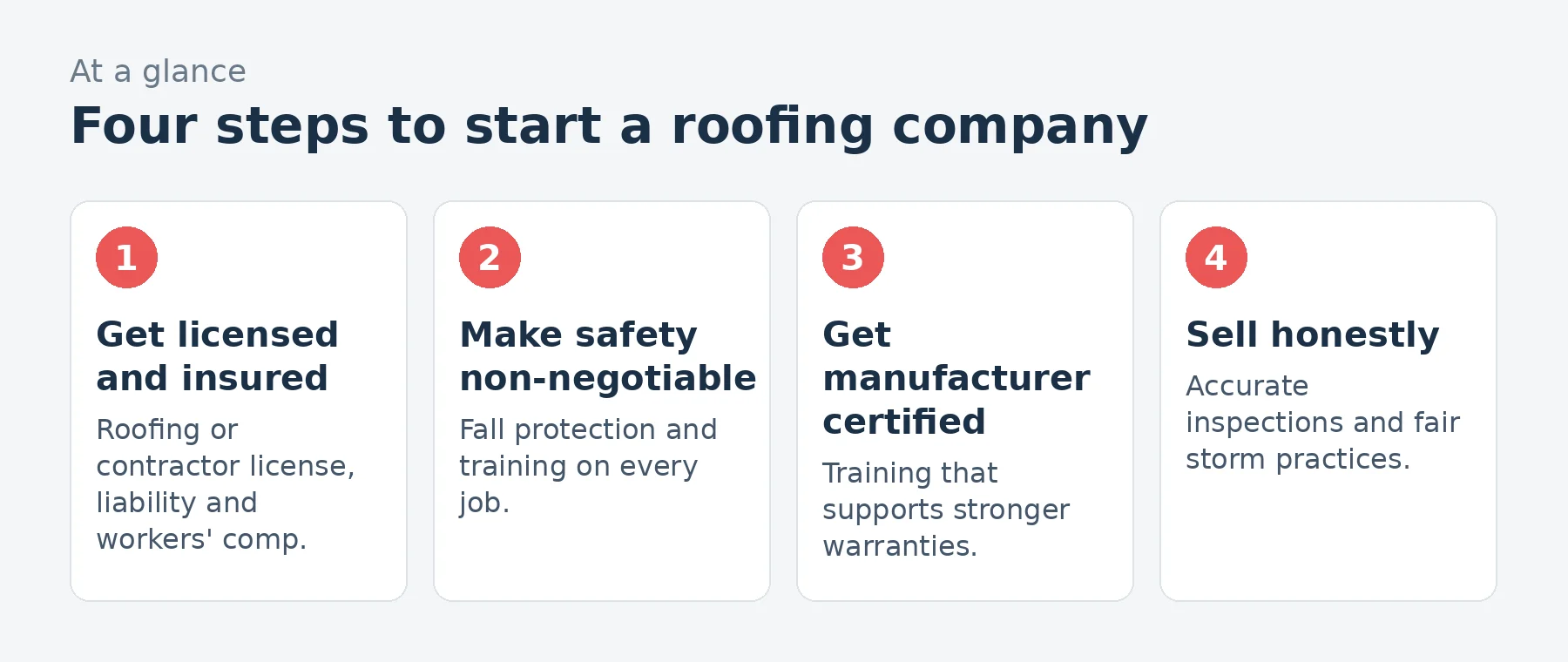
Contractor licensing varies widely: some states license painting or roofing contractors statewide (often above a project dollar threshold), some leave licensing to cities and counties and some only register contractors. Check state and local requirements, carry general liability and workers’ compensation insurance and pull permits where required.
Some states, such as Florida, have specific roofing contractor licenses with experience, exam and insurance requirements. Most roof replacements need building permits and inspections.
Fall protection and safety
OSHA’s construction fall protection rules (Subpart M) require protection such as guardrails, safety nets or personal fall arrest systems for many roofing tasks, and fall protection is consistently OSHA’s most frequently cited standard. Train crews, inspect harnesses and anchors, use ladders safely, protect against heat illness and keep job sites clean of debris.
Manufacturer certifications and warranties
Shingle and roofing manufacturers offer contractor certification programs with training and requirements. Certified contractors can often offer enhanced system warranties, which reassure homeowners. Install according to manufacturer instructions, since improper installation can void warranties.
Storm work and insurance claims
After hail and windstorms, roofers help homeowners repair damage, often paid through insurance. Many states prohibit contractors from negotiating claims on behalf of homeowners unless licensed as public adjusters, and some have restricted assignment of benefits for residential claims. You can document damage and provide estimates, but follow your state’s rules and never inflate claims or waive deductibles illegally. The FTC warns homeowners about storm repair scams, so honest practices build trust.
Startup costs to plan for
| Item | What to budget for |
|---|---|
| Licensing | Roofing or contractor license, exams, bonds |
| Insurance | General liability, workers’ compensation, auto |
| Safety equipment | Harnesses, anchors, guardrails, ladders |
| Tools and trailer | Nail guns, compressors, dump trailer |
| Truck | Work truck for crews and materials |
| Working capital | Materials and payroll before payments |
Use our startup cost calculator for your total.
Estimating
Roofing is estimated by the square (100 square feet), accounting for roof pitch, layers to tear off, waste, flashing, ventilation, decking repairs, permits, disposal and labor. Measure carefully or use aerial measurement tools, and include allowances for rotten decking. Use our pricing calculator.
A worked example: a small roofing company
These are illustrative assumptions for a small residential roofing company in a busy month, not predictions.
| Assumption | Monthly | |
|---|---|---|
| Roof replacements | 5 roofs averaging $14,500 | $72,500 |
| Repairs and inspections | $6,000 | |
| Revenue | $78,500 | |
| Materials | Shingles, underlayment, flashing, about 38% of revenue | $(29,800) |
| Crew labor | Employees or subcontracted crews, with payroll costs | $(20,000) |
| Dumpsters and disposal | $(2,200) | |
| Insurance | General liability and workers’ compensation | $(4,000) |
| Truck, equipment and permits | $(2,500) | |
| Sales commissions and marketing | $(6,000) | |
| Profit before owner pay and taxes | $14,000 |
That leaves about $14,000 a month before the owner’s pay and taxes, on about $78,500 of revenue. Weather and seasons affect volume, and insurance costs for roofers are high, so price for both.
Loading the calculator…
Crews and subcontractors
Many roofing companies use subcontracted crews, which must be properly licensed and insured and classified correctly. Employee crews give more control over quality and safety. Either way, supervise jobs and inspect work before final payment.
Contracts and payments
Use written contracts with scope, materials, price, payment schedule, warranty, permit responsibilities and cancellation rights, including any required home solicitation cancellation notices for door-to-door sales. Collect deposits as allowed by state law and get lien waivers from suppliers and subcontractors.
Finding customers
- Referrals from past customers and real estate agents.
- Local search and reviews.
- Inspections for home sales and insurance requirements.
- Commercial property managers.
- Storm response with honest, licensed local practices.
Commercial roofing
Commercial and low-slope roofing, such as TPO, EPDM, modified bitumen and coatings, involves different materials, equipment and safety needs than residential shingles. Commercial work brings larger contracts and maintenance agreements but requires experience, bonding and often manufacturer certification.
Repairs and maintenance plans
Repairs and roof maintenance programs (inspections, cleaning, minor repairs and reports) bring steady work between replacements and build relationships that lead to replacement contracts. Commercial property managers value scheduled maintenance.
Metal and specialty roofs
Metal, tile, slate and cedar roofs command premium prices but need specialized skills and tools. Train crews before offering specialty systems, since installation errors can be costly.
Supplier relationships
Good relationships with roofing distributors bring better pricing, credit terms, delivery to rooftops and help with material shortages after storms. Pay suppliers on time and plan orders carefully.
Sales and inspections
Homeowners trust roofers who explain problems clearly. Provide photos from inspections, explain repair versus replacement options honestly and give written estimates with materials and scope. Honest inspections build referrals in a field known for aggressive sales.
Weather and scheduling
Roofing depends on weather. Schedule tear-offs with forecasts in mind, protect open roofs with temporary coverings and communicate schedule changes promptly with homeowners.
Gutters, ventilation and add-ons
Roof replacements often include new gutters, attic ventilation improvements, skylight replacement and ice and water shield upgrades. Offering these add-ons improves results for homeowners and raises job value.
Financing for homeowners
Roof replacements are expensive, so many roofers partner with financing companies. Explain financing terms clearly, follow lending disclosure rules and never pressure homeowners into loans.
Warranties and documentation
Register manufacturer warranties for customers, provide written workmanship warranties and keep photos of each installation stage. Documentation supports warranty claims and builds trust with homeowners and future buyers.
Common mistakes to avoid
- Working without fall protection.
- Roofing without required licenses or permits.
- Negotiating insurance claims where prohibited.
- Underestimating decking and disposal costs.
- Using uninsured subcontractors.
Your first 90 days
- Days 1-30: confirm licensing, buy insurance and safety equipment and write a safety program.
- Days 31-60: pursue manufacturer certification, set estimating systems and build supplier accounts.
- Days 61-90: complete first jobs safely, collect reviews and build referral relationships.
Frequently asked questions
Do I need a license to start a roofing company?
Many states and localities require roofing or contractor licenses, and most replacements require permits.
What is OSHA’s most cited standard?
Fall protection in construction, which applies to much roofing work.
Can roofers help with insurance claims?
They can document damage and provide estimates, but many states prohibit negotiating claims unless licensed as public adjusters.
How are roofs estimated?
By the square (100 square feet), accounting for pitch, tear-off, materials, waste, disposal and labor.
Why is roofing insurance expensive?
Because roofing carries high injury risk, workers’ compensation and liability premiums are high.
Do manufacturer certifications matter?
They provide training and often let contractors offer stronger warranties.
How much does it cost to start a roofing company?
Costs depend on licensing, insurance, equipment and working capital; insurance and materials are major expenses.
Should I use subcontracted crews?
Many companies do, but crews must be licensed and insured where required, and you remain responsible for quality and safety.
What is a roofing square?
A unit of 100 square feet of roof area, used for estimating materials and labor.
Do roofers need workers’ compensation?
Generally yes for employees, and coverage is often expensive because of roofing’s injury risk.
How long does a roof replacement take?
Many residential replacements take one to three days, depending on size, weather and complexity.
Should roofers offer free inspections?
Many do, but inspections must be honest; recommend repairs or replacement only when needed.
What permits do roofers need?
Most roof replacements require building permits and inspections; requirements vary by city.
Is roofing a profitable business?
It can be with accurate estimates, safe and efficient crews and steady referrals, though insurance and material costs are high.
What is assignment of benefits?
A homeowner’s transfer of insurance claim rights to a contractor; some states have restricted it for residential property claims.
Keep learning
- Roofing industry data
- How to start a gutter cleaning and repair business
- How to start a painting contractor business
- Pricing calculator
Sources
- US Bureau of Labor Statistics, Roofers
- OSHA, Fall protection in construction (29 CFR 1926 Subpart M)
- OSHA, Top 10 most frequently cited standards
- Florida DBPR, Construction Industry Licensing Board (roofing contractors)
- NAIC, Public adjusters and contractor restrictions on insurance claims
- FTC, Avoiding home repair scams after storms
- National Roofing Contractors Association (NRCA)
Last reviewed November 3, 2026. Startup costs are estimates; check local prices, licensing and tax rules before you commit money.

