
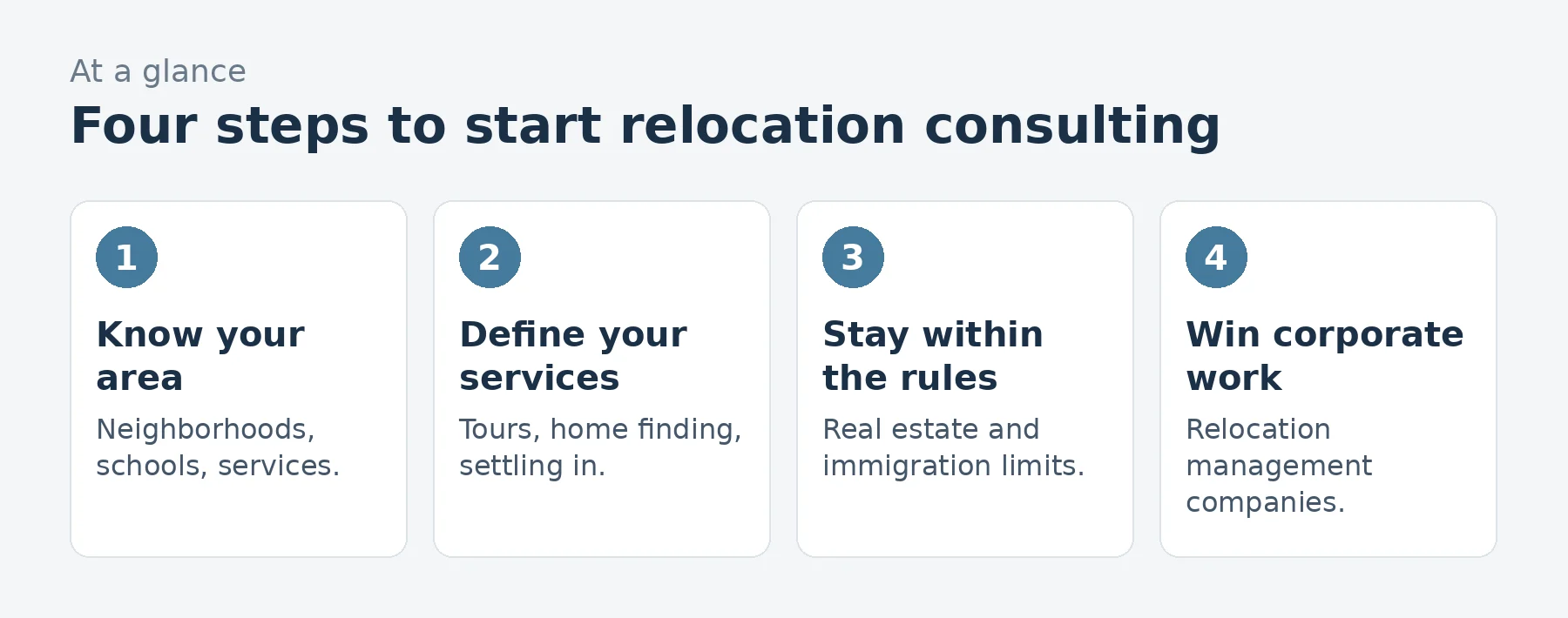
Relocation consultants help people settle into a new city: area orientation tours, finding a rental home, choosing neighborhoods and schools, setting up utilities, registering cars and getting to know local services. Clients include families moving on their own and, more often, employees relocated by their companies, whose employers pay for destination services through relocation management companies. This guide explains how to start a relocation consulting business, from licensing and startup costs to pricing and finding customers.
It’s a people business with low startup costs, built on local knowledge, organization and trust. You also need to know where your services stop: helping someone buy or rent property for a fee can require a real estate license in many states, and immigration advice is limited to lawyers and accredited representatives.
A relocation consulting business at a glance
Table of Contents
| Topic | What to expect |
|---|---|
| Startup cost | Low: a reliable car, phone, website, insurance and local research |
| Key rules | Stay within real estate licensing limits, avoid immigration advice, follow fair housing rules and recommend licensed movers |
| Revenue model | Hourly or day rates and service packages, often paid by employers |
| How you earn | Area tours, home finding, school searches, settling-in services and move coordination |
| Best for | Organized, friendly locals who know their area well and love solving problems |
Who relocation consulting suits
It suits people who know their city in depth, enjoy helping others through a stressful change and stay organized under deadlines. Clients may arrive with a week to find a home and enroll children in school. Experience in real estate, human resources, hospitality, teaching or moving yourself several times helps, and a second language can open doors with international transferees.
Services you can offer
- Area orientation tours of neighborhoods, commutes, shops and amenities.
- Rental home searches, within real estate licensing limits.
- School searches and help with enrollment paperwork.
- Settling-in services: utilities, internet, driver’s licenses, car registration, banks and doctors.
- Move coordination with licensed movers and storage companies.
Real estate licensing limits
In many states, helping someone buy, sell, rent or lease property for a fee is real estate brokerage that requires a license. Showing listings, negotiating leases or accepting referral fees from landlords or agents can cross that line. Many relocation consultants either get a real estate license, work with licensed agents who handle the transaction, or limit themselves to area orientation and information. Check with your state’s real estate commission before offering home finding.
Whatever you do, follow the Fair Housing Act: describe neighborhoods by facts such as commute times and amenities, never steer clients toward or away from areas based on race, religion, national origin, familial status or other protected traits.
Immigration and legal limits
International transferees often ask about visas, work permits and residency. Only licensed attorneys and accredited representatives may give immigration legal advice. You can help with practical tasks, such as finding offices and organizing documents, and refer legal questions to the employer’s immigration lawyer.
Corporate relocation
Many employers pay relocation management companies to run employee moves, and these companies hire local destination service providers. To win this work, build a professional profile, meet their supplier requirements (insurance, background checks, reporting), offer standard packages and deliver detailed reports. Joining Worldwide ERC, the workforce mobility association, connects you with the industry.
Recommending movers
Recommend only licensed, insured movers. Interstate household goods movers must be registered with FMCSA and have a USDOT number, and the FMCSA’s Protect Your Move site helps consumers avoid moving scams. Disclose any referral arrangements, and never steer clients to a mover because of a fee.
Pricing and contracts
Price by the hour, by the half or full day, or by package (such as a two-day home and school search). Corporate clients often set rates through their relocation management company. Use a written agreement covering services, hours, expenses, cancellation and what you don’t do, such as legal or real estate services if you’re not licensed. Use our pricing calculator.
Building local knowledge
Keep updated notes on every neighborhood: rents, commute times at rush hour, school options, parks, safety resources, shopping and community groups. Build relationships with property managers, school admissions offices, utilities and local services, so you can get answers fast.
Startup costs for a relocation consulting business
| Item | What to budget for |
|---|---|
| Vehicle | A clean, comfortable car for tours |
| Insurance | General and professional liability, business auto |
| Website and branding | Site, guides and brochures |
| Memberships | Worldwide ERC and local business groups |
| Background check | Often required by corporate clients |
| Licensing | Real estate license if you’ll do home finding |
Use our startup cost calculator for your total.
A worked example: a solo relocation consultant
These are illustrative assumptions for a solo relocation consultant with corporate and private clients, not predictions.
| Assumption | Monthly | |
|---|---|---|
| Corporate destination service packages | 9 packages averaging $950 | $8,550 |
| Private family consultations and tours | $1,800 | |
| Move coordination and settling-in hours | $1,200 | |
| Revenue | $11,550 | |
| Car, fuel and parking | $(650) | |
| Phone, software and research tools | $(180) | |
| Insurance | $(120) | |
| Marketing and memberships | $(400) | |
| Subcontracted help in busy months | $(600) | |
| Profit before owner pay and taxes | $9,600 |
That leaves about $9,600 a month before the owner’s pay and taxes, on about $11,550 of revenue. Corporate work brings steady volume, while private clients often pay higher hourly rates.
Loading the calculator…
Serving families with children
School searches are often the most important part of a family move. Learn how enrollment, school boundaries, charter and private school applications and special education services work locally, keep a calendar of application deadlines and help families prepare records such as transcripts and vaccinations.
Privacy and safety
You’ll handle clients’ personal details, schedules and sometimes immigration documents. Store information securely, share only what’s needed and delete records when you no longer need them. If corporate clients ask you to run background checks on providers, follow FCRA rules.
Understanding relocation packages
Corporate transferees usually have a relocation policy that sets what the employer pays: house-hunting trips, temporary housing, moving costs, destination services and sometimes a lump sum. Ask to see what’s covered before you start, so you deliver the services the employer has approved and bill correctly. Employees with lump sums decide for themselves, so they may hire you directly.
Temporary housing and arrivals
Many newcomers start in short-term furnished housing while they search for a home. Know the local corporate housing and extended-stay options, help clients plan arrival logistics such as airport pickup, rental cars and the first grocery run, and prepare a welcome packet with essentials: emergency numbers, nearby clinics, transit, shopping and community groups.
International moves and pets
International transferees face extra steps: converting driver’s licenses, getting a Social Security number where eligible, opening bank accounts without US credit history and finding schools that support English learners. Pets need health certificates and airline arrangements, so keep contacts for pet relocation companies and veterinarians.
Marketing
- Relocation management companies and corporate HR teams.
- Real estate agents and property managers who meet newcomers.
- International schools and universities with incoming families.
- A website with area guides for people researching your city.
- Reviews on your Google Business Profile.
Growing into a team
As corporate volume grows, add trained consultants in neighborhoods or cities you can’t cover yourself. Give them your area guides, checklists and report templates, check their work and require the same background checks and insurance corporate clients ask of you. Consistent reports and fast response win repeat business from relocation companies.
Common mistakes to avoid when starting a relocation consulting business
- Negotiating leases or showing homes for a fee without a license.
- Steering clients by neighborhood demographics.
- Giving immigration or legal advice.
- Recommending unlicensed movers.
- Taking undisclosed referral fees.
Your first 90 days as a relocation consulting business owner
- Days 1-30: check real estate licensing rules, define services and research neighborhoods.
- Days 31-60: build area guides, a website and insurance, and contact relocation companies.
- Days 61-90: meet agents, HR teams and schools, and serve your first clients.
Frequently asked questions about starting a relocation consulting business
Do relocation consultants need a real estate license?
Often, if you help clients rent or buy homes for a fee; area tours and information usually don’t require one.
Who pays for relocation services?
Often employers, through relocation management companies; families also hire consultants directly.
Can I help with visas?
Only with practical tasks; immigration legal advice is limited to lawyers and accredited representatives.
How much do relocation consultants charge?
Hourly, daily or by package; corporate rates are often set by relocation companies.
What is Worldwide ERC?
The workforce mobility association that connects relocation professionals and employers.
Can I accept referral fees from movers?
Disclose any arrangements, and recommend only licensed, insured movers.
How do I find corporate clients?
Register with relocation management companies and contact HR teams at large local employers.
Do I need insurance?
Yes; general and professional liability, plus business auto coverage for client tours.
What is a relocation policy?
An employer’s written rules on which moving and settling-in costs it pays for.
Can I help international transferees?
Yes, with practical settling-in tasks; refer legal and immigration questions to qualified professionals.
How long does a typical destination service take?
Often one to three days for tours and home searches, plus settling-in help spread over the following weeks.
Keep learning
- Real estate services industry data
- How to start a moving company
- How to start a senior move manager business
- Pricing calculator
Sources
- Worldwide ERC, workforce mobility association
- FMCSA, Protect your move (household goods)
- ARELLO, State real estate licensing authorities
- HUD, Fair Housing Act overview
- US Small Business Administration, Apply for licenses and permits
- FTC, Using consumer reports: what employers need to know (background checks)
Last reviewed November 4, 2026. Startup costs are estimates; check local prices, licensing and tax rules before you commit money.

