
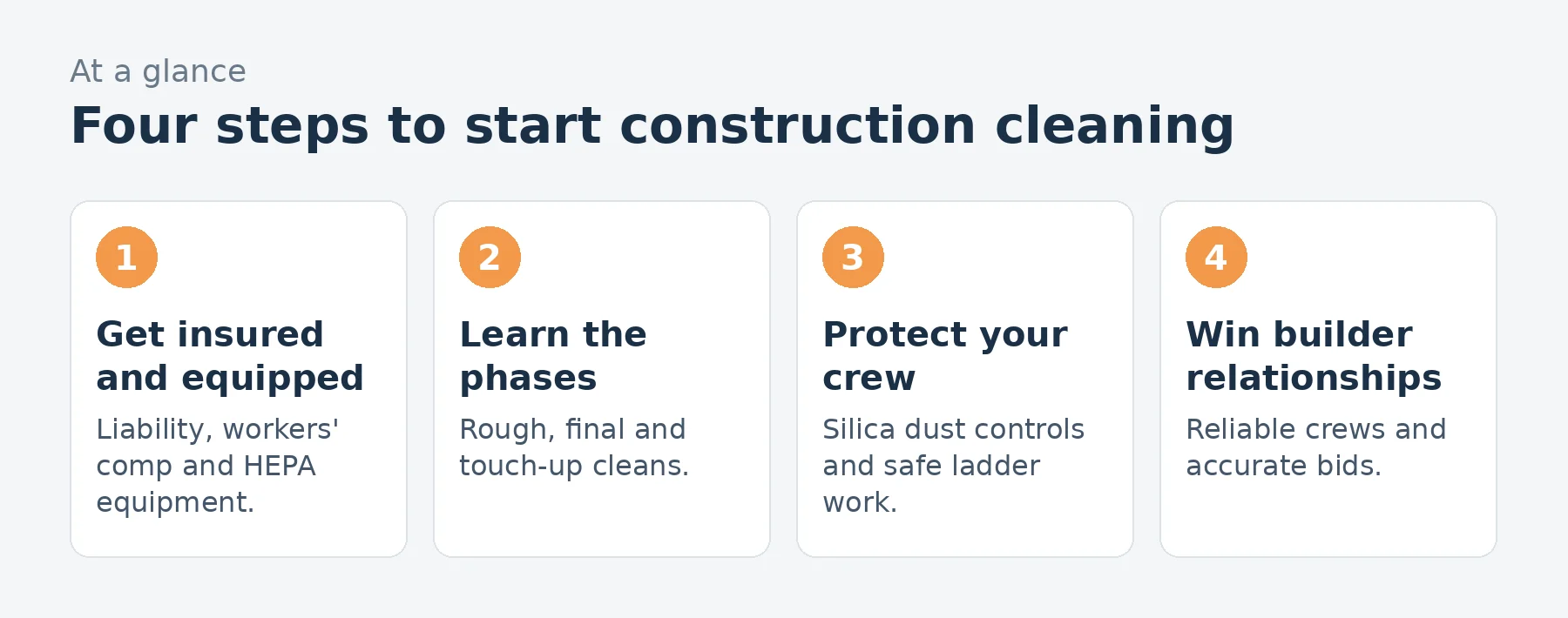
A post-construction cleaning business cleans homes, offices, stores and other buildings after construction or renovation: removing debris, dust and stickers, cleaning windows and fixtures and preparing spaces for owners or tenants. Builders and general contractors hire cleaners at several stages, so steady relationships can produce recurring work.
Construction dust is more than dirt: cutting and grinding concrete, stone and drywall creates respirable crystalline silica, and OSHA’s construction silica standard requires dust controls and protections. Crews also work on ladders and around hazards, and contractors expect insurance certificates, schedules met and professional bids. Advanton’s cleaning data shows a median pay of $35,930 for janitors and building cleaners (May 2024), the closest occupation. Owners earn the profit after labor, equipment, supplies and insurance. This guide covers services, safety, equipment, bidding, contracts, a worked example and a 90-day plan.
A post-construction cleaning business at a glance
Table of Contents
| Topic | What to expect |
|---|---|
| Startup cost | Low to moderate: HEPA vacuums, floor machines, ladders, cleaning supplies, a vehicle or trailer, insurance and marketing |
| Clients | Home builders, general contractors, remodelers, property managers and commercial developers |
| Key safety | OSHA silica dust protections, HEPA vacuums and wet methods, ladder safety and chemical safety |
| How you charge | Per square foot by cleaning phase, with extras for windows, high work and debris |
| Best for | Organized, fast-working crews who can meet tight contractor schedules |
Who construction cleaning suits
It suits organized, hardworking people who can manage crews, work quickly under deadlines and communicate with superintendents and project managers. Construction sites are dusty, physical and fast-paced.
Cleaning phases
- Rough clean: removing debris, sweeping and vacuuming after major construction.
- Final clean: detailed cleaning of surfaces, fixtures, cabinets, windows, floors and vents before inspection or move-in.
- Touch-up or punch clean: last-minute cleaning before closing or tenant move-in.
Many contractors hire cleaners for all three phases on each project.
Silica dust and safety
OSHA’s respirable crystalline silica standard for construction requires employers to control dust from tasks such as cutting and grinding concrete and stone and to protect workers from overexposure. Cleaning crews should avoid dry sweeping and compressed air for silica dust, use HEPA vacuums and wet methods and provide respirators where required. Follow OSHA ladder safety and fall protection for high work. Train workers under OSHA’s Hazard Communication standard, keep safety data sheets, use products according to their labels (the label is the law for EPA-registered disinfectants), never mix incompatible chemicals and provide gloves, eye protection and ventilation.
Equipment
- HEPA vacuums for fine dust.
- Floor machines for scrubbing and polishing.
- Ladders, extension poles and scaffolds for high surfaces.
- Razor scrapers for paint and stickers on glass.
- Microfiber cloths, mops and cleaning solutions.
- Trailer for equipment and debris removal.
Insurance and requirements
Carry general liability insurance, workers’ compensation for employees, commercial auto and, for some clients, janitorial bonds. Commercial and construction clients usually require certificates of insurance before you start.
Some contractors also require safety training, background checks or prequalification paperwork.
Startup costs to plan for
| Item | What to budget for |
|---|---|
| Equipment | HEPA vacuums, floor machines, ladders |
| Supplies | Cleaning solutions, scrapers, microfiber |
| Vehicle or trailer | Transport equipment and crews |
| Insurance | General liability, workers’ compensation, auto |
| Safety gear | Respirators, gloves, eye protection |
| Marketing | Website, builder outreach materials |
Use our startup cost calculator for your total.
Bidding and pricing
Most construction cleaning is priced per square foot by phase, with extras for windows, high ceilings, exterior cleaning, debris removal and rush schedules. Walk the site when possible, ask about the schedule and condition and write clear scopes. Use our pricing calculator.
A worked example: a two-crew company
These are illustrative assumptions for a company with two crews serving builders and contractors, not predictions.
| Assumption | Monthly | |
|---|---|---|
| Residential new construction cleans | 18 homes averaging $900 | $16,200 |
| Commercial and renovation projects | $9,500 | |
| Window and specialty add-ons | $2,000 | |
| Revenue | $27,700 | |
| Crew wages | Two crews, with payroll costs | $(13,500) |
| Supplies and equipment | $(1,200) | |
| Vehicles and fuel | $(1,300) | |
| Insurance | General liability and workers’ compensation | $(1,100) |
| Marketing and software | $(600) | |
| Profit before owner pay and taxes | $10,000 |
That leaves about $10,000 a month before the owner’s pay and taxes, on about $27,700 of revenue. Builder relationships provide recurring work, but slow payment terms make cash flow planning essential.
Loading the calculator…
Contracts and payment terms
Use written subcontracts or agreements covering scope, schedule, price, payment terms and change orders. Contractors may pay 30 to 60 days after invoicing and sometimes hold retainage. Know your state’s mechanic’s lien rights and deadlines, which can protect payment for work on construction projects.
Finding clients
- Home builders with steady new construction.
- General contractors and remodelers.
- Commercial developers and property managers.
- Real estate agents for new listings.
- Builder associations and networking events.
Final clean checklists
Use detailed checklists for every room: dust from top to bottom, clean vents and light fixtures, wipe cabinets inside and out, clean windows, tracks and sills, remove stickers and paint drips, clean appliances and fixtures, vacuum and mop floors and remove debris. Checklists keep quality consistent across crews and help with contractor walkthroughs.
Managing crews
Assign crew leads, train workers on surfaces and products that can scratch new finishes, schedule crews around other trades and inspect work before the superintendent’s walkthrough. Reliable crews that finish on time win repeat contracts.
Commercial projects
Offices, retail stores, medical buildings, schools and apartment complexes bring larger projects with stricter schedules, safety requirements and paperwork. Commercial work may require night or weekend shifts, lifts for high windows and site safety orientation.
Scheduling around other trades
Construction schedules change constantly. Stay in contact with superintendents, confirm dates the day before and be ready to adjust. Flexibility is one of the main reasons contractors keep their cleaners.
Protecting new finishes
New floors, counters, glass and fixtures can be damaged by the wrong tools or chemicals. Use soft pads, test products, avoid abrasive cleaners on sensitive surfaces and follow manufacturer care guidance for materials such as natural stone.
Retainage and cash flow
Some contractors hold back a percentage of payment until project completion, and payment terms can be long. Keep reserves for payroll, invoice promptly with clear documentation and track receivables. Factoring or a line of credit can help growing companies.
Prequalification and safety programs
Larger contractors often require prequalification: safety programs, training records, insurance limits, experience and references. Building a written safety program and training records opens doors to bigger projects.
Growing beyond construction
Many construction cleaners add recurring commercial janitorial contracts, move-in and move-out cleaning, window cleaning and floor care, which smooth the ups and downs of construction activity.
Debris and waste handling
Clarify in your scope who removes construction debris. If you haul debris, price disposal fees, follow local hauling rules and use dumpsters provided by the contractor where possible. Never dump construction waste illegally.
Walkthroughs and punch lists
Walk through finished areas with the superintendent or client, note any missed items and fix them quickly. Prompt response to punch lists builds trust and repeat business.
Common mistakes to avoid
- Dry sweeping silica dust.
- Underbidding detailed final cleans.
- No certificates of insurance.
- Ignoring payment terms and lien rights.
- Missing contractor deadlines.
Your first 90 days
- Days 1-30: buy insurance, HEPA equipment and safety gear and create bid templates.
- Days 31-60: meet builders and contractors and complete first projects carefully.
- Days 61-90: document results, secure repeat contractor relationships and add a second crew.
Frequently asked questions
What is post-construction cleaning?
Cleaning buildings after construction or renovation, usually in rough, final and touch-up phases.
How do construction cleaners price jobs?
Usually per square foot by phase, with extras for windows, high work and debris removal.
Does OSHA regulate construction dust cleanup?
Yes. OSHA’s silica standard for construction requires dust controls and protections for workers.
Do I need insurance to clean construction sites?
Yes. Contractors require general liability and workers’ compensation certificates.
How do I get builder clients?
Through direct outreach, builder associations, referrals and reliable work on first projects.
When do contractors pay?
Often 30 to 60 days after invoicing, sometimes with retainage.
What equipment do construction cleaners need?
HEPA vacuums, floor machines, ladders, scrapers, microfiber cloths and safe cleaning solutions.
Is construction cleaning profitable?
It can be, with steady builder relationships, efficient crews and accurate per-square-foot bids.
Do construction cleaners need to be bonded?
Some clients require bonds; check contract requirements and local rules.
How long does a final clean take?
It depends on size and condition; a typical home may take a crew several hours to a full day.
Who are the best clients for construction cleaning?
Home builders, general contractors and commercial developers with steady project pipelines.
Can a residential cleaner do construction cleaning?
Yes, with HEPA equipment, safety training, insurance and an understanding of construction schedules.
What is retainage?
A portion of payment a contractor holds until the project is complete.
Should I charge by the hour or square foot?
Most construction cleaning is bid per square foot by phase, with hourly rates for extras.
Keep learning
- Cleaning services industry data
- How to start a short-term rental turnover cleaning business
- How to start a window cleaning business
- Pricing calculator
Sources
- OSHA, Respirable crystalline silica standard for construction (29 CFR 1926.1153)
- OSHA, Ladder safety
- OSHA, Hazard Communication standard
- US Bureau of Labor Statistics, Janitors and building cleaners
- US Small Business Administration, Apply for licenses and permits
Last reviewed November 4, 2026. Startup costs are estimates; check local prices, licensing and tax rules before you commit money.

