
A customs brokerage helps importers clear goods through U.S. Customs and Border Protection: classifying products, calculating duties, filing entries and other data electronically, responding to CBP requests and advising on compliance. Only licensed customs brokers may conduct customs business on behalf of others.
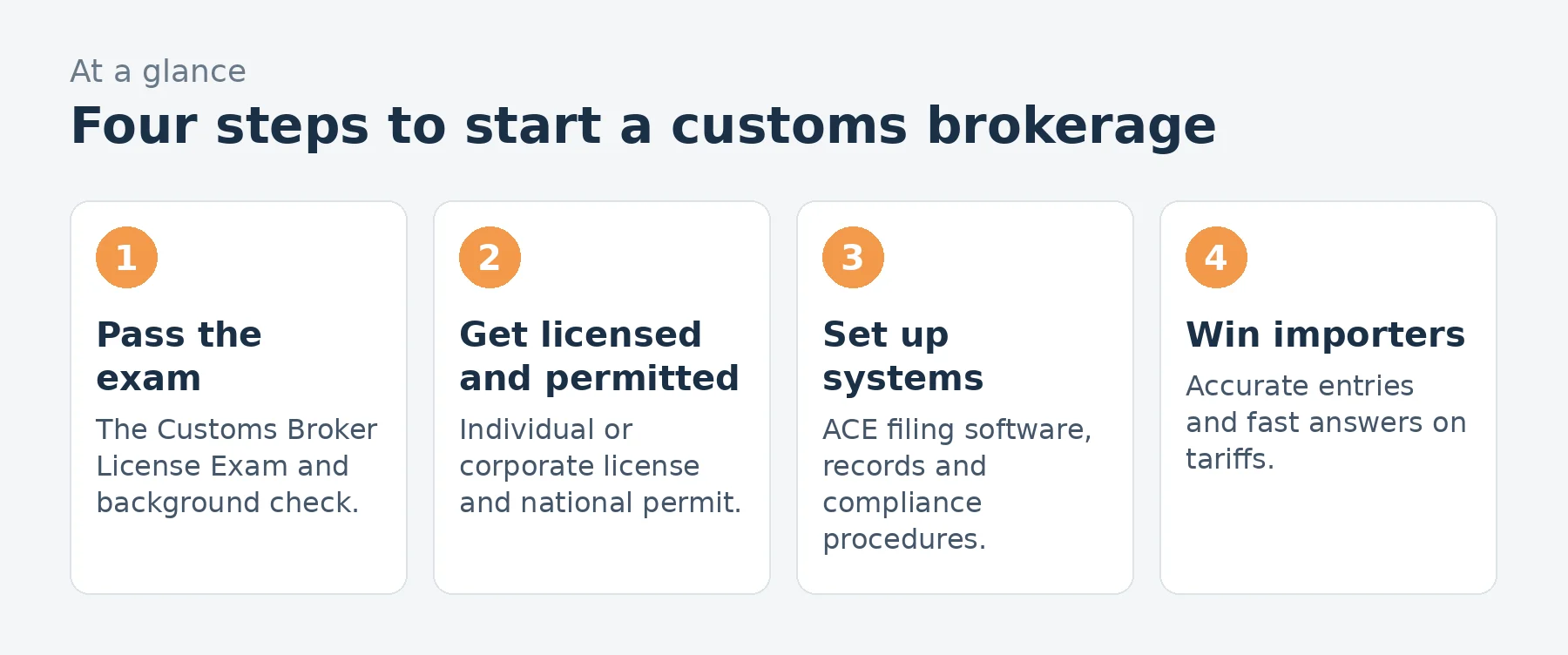
Becoming a broker requires passing the challenging Customs Broker License Exam and a CBP background investigation. Brokers must then obtain a national permit, exercise responsible supervision and control over their business, verify client identities, keep records and complete continuing education. Frequent tariff changes in 2025 and 2026 have made skilled brokers more valuable than ever. The Bureau of Labor Statistics reports a median pay of $80,880 for logisticians (May 2024), with employment projected to grow about 19% over the decade, much faster than average, reflecting demand for supply chain and trade skills. This guide covers licensing, permits, duties, operations, pricing, a worked example and a 90-day plan.
A customs brokerage business at a glance
Table of Contents
| Topic | What to expect |
|---|---|
| Startup cost | Moderate: exam preparation, licensing, ACE filing software, errors and omissions insurance, staff and office |
| Licensing | Pass the Customs Broker License Exam, complete CBP’s background investigation and get a license; corporations need a licensed broker officer |
| Permits | A national permit allows brokers to conduct customs business nationwide |
| Ongoing duties | Responsible supervision and control, client verification, recordkeeping and continuing education |
| Best for | Detail-oriented trade professionals who enjoy regulations and problem-solving |
Who customs brokerage suits
It suits detail-oriented people who enjoy regulations, research and helping businesses solve problems. Many brokers worked in brokerages, freight forwarding or importers’ compliance departments before getting licensed.
The broker license exam
CBP offers the Customs Broker License Exam twice a year. It is an open-book exam covering customs regulations, the Harmonized Tariff Schedule, valuation, entry procedures and more, with a relatively low pass rate. Candidates must be U.S. citizens, at least 21 years old and not federal employees, and after passing they undergo a background investigation before CBP issues a license.
Licenses and national permits
Individuals receive a broker license; a corporation, partnership or association can obtain its own license if at least one officer or member is a licensed broker. Under CBP’s modernized rules, brokers conduct business under a national permit, replacing the older district permit system, and must maintain responsible supervision and control over employees and operations.
Ongoing broker obligations
- Responsible supervision and control of customs business and employees.
- Client identity verification and screening before acting on behalf of importers.
- Written powers of attorney from clients.
- Recordkeeping of customs transactions for required periods.
- Continuing education: licensed brokers must complete continuing education hours in each reporting period and file status reports with CBP.
- Confidentiality of client information.
These requirements are set out in 19 CFR Part 111.
Services to offer
- Entry filing and release.
- Importer Security Filing for ocean shipments.
- Tariff classification and valuation advice.
- Partner government agency filings (FDA, USDA, EPA and others).
- Duty drawback and refund claims.
- Compliance reviews and responses to CBP requests.
- Advice on new and changing tariffs.
Bonds, software and insurance
Brokers file electronically through ACE using approved software. Help clients obtain customs bonds, and carry errors and omissions insurance, since classification or filing mistakes can cost clients penalties and duties.
Startup costs to plan for
| Item | What to budget for |
|---|---|
| Exam and licensing | Prep courses, exam fee, license and permit fees |
| Filing software | ACE ABI software and data subscriptions |
| Insurance | Errors and omissions, general liability |
| Office and IT | Secure systems for client data |
| Staff | Entry writers and support as volume grows |
| Marketing | Industry associations, freight forwarder partnerships |
Use our startup cost calculator for your total.
Pricing
Brokers typically charge a fee per entry, with additional fees for extra lines, partner government agency filings, ISF and bond arrangements, plus hourly or project fees for consulting, classification and drawback. Use our pricing calculator.
A worked example: a small brokerage
These are illustrative assumptions for a small brokerage with two staff, not predictions.
| Assumption | Monthly | |
|---|---|---|
| Entry filing fees | 280 entries at $110 average | $30,800 |
| ISF filing fees | 120 filings at $35 | $4,200 |
| Consulting and classification services | $3,500 | |
| Revenue | $38,500 | |
| Staff wages | Entry writer and assistant, with payroll costs | $(12,000) |
| ACE filing software and data services | $(1,800) | |
| Errors and omissions insurance and bond | Averaged monthly | $(600) |
| Office and technology | $(2,500) | |
| Continuing education and memberships | Averaged monthly | $(150) |
| Marketing | $(800) | |
| Profit before owner pay and taxes | $20,650 |
That leaves about $20,650 a month before the broker’s pay and taxes, on about $38,500 of revenue. Consulting on classification and tariff changes adds higher-value work alongside routine entries.
Loading the calculator…
Tariff changes and client advice
Tariffs have changed often in 2025 and 2026, including broad new duties on many countries and products and legal challenges to some of them, and the United States suspended duty-free de minimis treatment for low-value shipments in August 2025. Always check the current Harmonized Tariff Schedule, CBP guidance and any additional duties before pricing products, and build tariff risk into contracts.
Importers rely on brokers to explain how changes affect their products, documents and costs. Keeping clients informed is a strong reason they stay with a broker.
Finding clients
- Importers of all sizes, especially small businesses new to importing.
- Freight forwarders that need broker partners.
- E-commerce sellers affected by the end of de minimis.
- Industry associations and trade events.
- Referrals from logistics providers.
Classification and rulings
Classification drives duty rates, and disputes can be costly. Brokers research the tariff schedule, CBP rulings and notes, and can help clients request binding rulings from CBP for products with unclear classification.
Partner government agency filings
Many imports need filings or approvals from other agencies, such as FDA for food and medical products, USDA for plants and animal products, EPA for certain chemicals and engines and the Consumer Product Safety Commission. Knowing these requirements is a valuable specialty.
Duty drawback
Drawback refunds certain duties when imported goods, or products made from them, are exported or destroyed. Drawback claims require careful documentation, and with higher tariffs, drawback services have become more valuable to importers that export.
Growing a brokerage
Growth usually means hiring entry writers, adding licensed brokers, specializing in industries such as food, apparel or automotive parts and building partnerships with freight forwarders and logistics companies.
Technology and data security
Brokers handle sensitive client information, including financial details and supplier data. Use secure filing software, protect access to ACE accounts, train staff on phishing and follow recordkeeping rules for retaining customs records.
Serving e-commerce importers
With de minimis duty-free treatment suspended, many e-commerce sellers now need formal or informal entries for shipments that once entered duty-free. Brokers who offer efficient, affordable services for small importers have a growing market.
Client education
Many small importers do not understand their responsibilities. Explain classification, valuation, recordkeeping, bonds and the importer’s liability, and provide checklists for documents. Educated clients make fewer errors and trust their broker more.
Common mistakes to avoid
- Conducting customs business without a license.
- Weak supervision of employees.
- Skipping client identity verification.
- Falling behind on continuing education.
- No errors and omissions insurance.
Your first 90 days
- Days 1-30: if licensed, set up your business entity, national permit and filing software; if not, prepare for the exam.
- Days 31-60: write compliance procedures, buy insurance and set pricing.
- Days 61-90: partner with freight forwarders and pitch small importers.
Frequently asked questions
How do I become a licensed customs broker?
Pass the Customs Broker License Exam, complete CBP’s background investigation and receive a license.
How often is the customs broker exam offered?
CBP offers the exam twice a year.
What is a national permit?
A CBP permit allowing licensed brokers to conduct customs business nationwide.
Do customs brokers need continuing education?
Yes. CBP requires continuing education for licensed brokers, reported periodically.
How do customs brokers charge?
Usually per entry, with additional fees for extra services and consulting.
Can a company be a customs broker?
Yes, if at least one officer or member holds a broker license.
Can I work as a customs broker remotely?
The national permit framework allows brokers to serve clients nationwide, with responsible supervision and control over operations.
Is the customs broker exam hard?
Yes. It is an open-book exam with a historically low pass rate, so many candidates take prep courses.
What software do customs brokers use?
ACE-certified filing software for entries, ISF and agency filings, plus tariff and ruling research tools.
How long does it take to become a customs broker?
It depends on exam timing and the background investigation; candidates often study for months before passing.
Do customs brokers need insurance?
Errors and omissions insurance is strongly recommended because filing mistakes can be costly.
What does a customs broker do?
Files import entries and other data with CBP, classifies goods, calculates duties and advises importers on compliance.
Can customs brokers help with tariff changes?
Yes. Brokers explain how new duties apply to products and help importers plan and comply.
Keep learning
- Import and export industry data
- How to start an import business
- How to start a sourcing agent business
- Pricing calculator
Sources
- CBP, Becoming a customs broker and the Customs Broker License Exam
- 19 CFR Part 111, Customs brokers (licensing, permits and continuing education)
- CBP, Customs bonds
- U.S. International Trade Commission, Harmonized Tariff Schedule
- CBP, Changes to de minimis duty-free treatment (2025)
- US Bureau of Labor Statistics, Logisticians
Last reviewed November 3, 2026. Startup costs are estimates; check local prices, licensing and tax rules before you commit money.

