
A bootcamp fitness business leads high-energy group workouts that mix strength, cardio and conditioning, often outdoors in parks or at beaches, or indoors in small studios. Bootcamps attract people who want motivation, community and results at lower cost than personal training.
Starting outdoors keeps costs low, but many cities and counties require park permits for commercial fitness classes. Coaches should hold accredited certifications, plan for heat and weather safety and scale workouts for all levels. Music in classes needs licensing, and memberships follow auto-renewal rules. The Bureau of Labor Statistics reports a median pay of $46,180 for fitness trainers and instructors (May 2024). Owners earn the profit after rent, equipment, instructors and marketing. This guide covers formats, permits, safety, programming, pricing, a worked example and a 90-day plan.
A bootcamp fitness business at a glance
Table of Contents
| Topic | What to expect |
|---|---|
| Startup cost | Low for outdoor bootcamps (equipment, permits, insurance, marketing); moderate for an indoor studio |
| Permits | Many parks require permits or fees for commercial fitness classes; studios need business licenses and zoning |
| Credentials | NCCA-accredited group fitness or personal training certification, CPR and AED |
| Key rules | Music licensing for classes, automatic renewal laws for memberships and waivers |
| Best for | Motivating coaches who love group energy and community |
Who bootcamps suit
They suit energetic, motivating coaches who can manage groups, adapt workouts on the fly and build community. Early mornings and weather are part of outdoor bootcamps.
Formats
- Outdoor bootcamps in parks, beaches and school fields.
- Indoor studio bootcamps with equipment.
- Corporate bootcamps at workplaces.
- Specialty bootcamps for brides, new moms or beginners.
- Six-week challenges with progress tracking.
Park permits
Many cities and counties require permits or fees for commercial fitness classes in parks, sometimes limiting group size, locations and times or requiring insurance. Federal lands such as national parks require special use permits for commercial activities. Check before advertising a park location.
Certification and safety
Hold an accredited group fitness or personal training certification and keep CPR and AED certification current. Screen new members, demonstrate proper form, offer modifications and progressions and watch for warning signs. Plan for heat and weather: schedule early or late in hot weather, provide water and shade breaks, know heat illness signs and cancel in lightning or extreme conditions. Use participation agreements and liability waivers, though enforceability varies by state, especially for minors. Carry general and professional liability insurance, keep first aid kits and AEDs available and train staff in CPR.
Programming
Design workouts that combine strength, cardio and mobility, scale for beginners through advanced members and progress over weeks. Variety keeps members engaged, while consistent structure helps them see progress.
Music and memberships
Playing music in classes is a public performance that generally requires licenses from performing rights organizations such as ASCAP, BMI, SESAC and GMR, or use of licensed fitness music services. Personal streaming accounts usually do not cover commercial use.
Membership contracts are regulated in many states: health club or health studio laws (for example, in New York and California) set rules on contract terms, cancellation rights, contract length and sometimes bonding, and automatic renewal laws require clear disclosure, consent and easy cancellation for recurring billing. Write clear contracts and make cancellation straightforward.
Startup costs for a bootcamp fitness business
| Item | What to budget for |
|---|---|
| Certification | Accredited certification, CPR/AED |
| Equipment | Kettlebells, bands, cones, mats, sandbags |
| Permits | Park permits or space rental |
| Software | Booking, memberships, payments |
| Speaker and music | Portable speaker, licensed music |
| Insurance and marketing | Liability coverage, website, social media |
Use our startup cost calculator for your total.
Pricing
Offer monthly memberships, class packs and drop-ins, plus challenges and corporate packages. Price below personal training but high enough to support quality coaching and small group sizes. Use our pricing calculator.
A worked example: an outdoor bootcamp
These are illustrative assumptions for an outdoor bootcamp with a small indoor space for winter, not predictions.
| Assumption | Monthly | |
|---|---|---|
| Memberships | 90 members averaging $119 a month | $10,710 |
| Class packs and drop-ins | $1,200 | |
| Corporate bootcamps | $1,500 | |
| Revenue | $13,410 | |
| Assistant coach pay | $(1,800) | |
| Park permits and indoor space rental | $(1,200) | |
| Equipment and maintenance | $(200) | |
| Software, payments and music licensing | $(500) | |
| Insurance | $(150) | |
| Marketing | $(800) | |
| Profit before owner pay and taxes | $8,760 |
That leaves about $8,760 a month before the owner’s pay and taxes, on about $13,410 of revenue. Low overhead is the bootcamp advantage, while retention and community keep income steady.
Loading the calculator…
Building community
Bootcamps thrive on community: learn names, celebrate milestones, run challenges, host social events and create member groups. Accountability keeps members coming back.
Weather and winter plans
Outdoor bootcamps need backup plans: indoor space rentals, covered areas or online sessions during bad weather and winter. Communicate cancellations clearly and early.
Moving indoors
Many bootcamps eventually lease a small studio for year-round classes, storage and stronger community. Model rent against expected memberships before signing, and keep outdoor classes as a low-cost draw in good weather.
Nutrition guidance
Members often ask about nutrition. Share general healthy-eating guidance, recipes and habits, and refer members to registered dietitians for individualized plans, since some states restrict individualized nutrition counseling.
Challenges and progress tracking
Six-week challenges with assessments, such as push-ups, timed runs or measurements, motivate members and attract new ones. Avoid misleading before-and-after claims; follow FTC rules on testimonials and typical results.
Corporate wellness
Companies hire bootcamp coaches for on-site or nearby classes as an employee benefit. Corporate programs bring steady contracts during weekday lunch and before or after work.
Hiring coaches
As you add classes, hire certified coaches who share your style, train them on your programming and safety standards and keep class quality consistent. Pay fairly and classify workers correctly.
Equipment and setup
Choose portable, durable equipment that sets up and packs quickly, such as kettlebells, dumbbells, bands, cones, agility ladders and mats. Store and transport equipment safely, and inspect it regularly for wear.
Member onboarding
Welcome new members with an intake form, health screening, a brief assessment and an orientation explaining modifications and class structure. Good onboarding prevents injuries and early dropouts.
Retention
Track attendance, reach out to members who miss sessions, celebrate milestones and create buddy systems. Members who feel known and supported stay longer.
Weather communication
Set clear rules for cancellations due to heat, storms, smoke or snow, and communicate them by text or app early. Offer indoor or virtual alternatives so members do not lose sessions.
Marketing with results
Share member stories (with permission), class highlights and coaching tips. Honest results and community photos attract people who want the same experience.
Programming software
Booking apps handle schedules, memberships, waivers and payments, while workout tracking tools help members log progress. Choose tools that make signing up and showing up easy.
Common mistakes to avoid when starting a bootcamp fitness business
- Using parks without required permits.
- Workouts that are too intense for beginners.
- Ignoring heat and weather risks.
- Music without licenses.
- Hard-to-cancel memberships.
Your first 90 days as a bootcamp fitness business owner
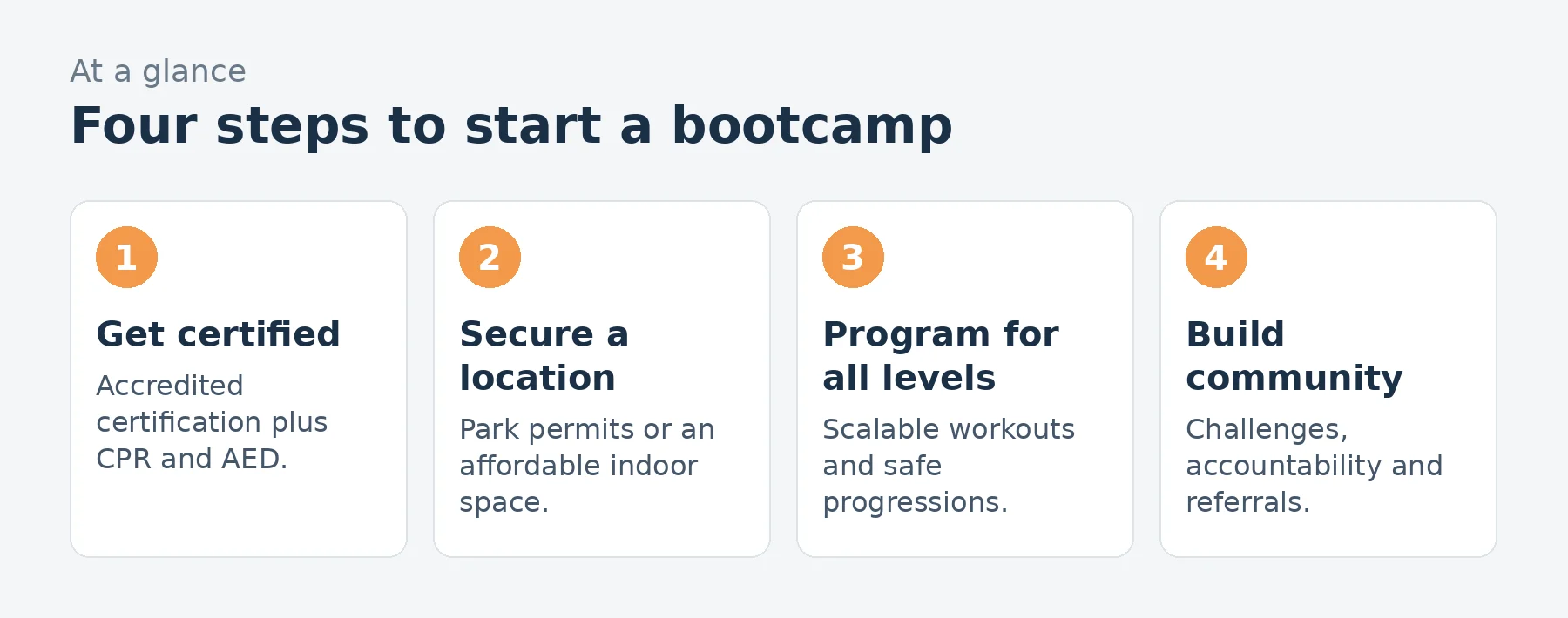
- Days 1-30: get certified, check park permit rules and buy insurance and equipment.
- Days 31-60: secure a location, set up booking and run free launch classes.
- Days 61-90: convert attendees to memberships, launch a challenge and pitch corporate bootcamps.
Frequently asked questions about starting a bootcamp fitness business
Do I need a permit to run a bootcamp in a park?
Many cities and counties require permits or fees for commercial fitness classes in parks.
What certification do bootcamp coaches need?
An accredited group fitness or personal training certification plus CPR and AED.
How much do bootcamps charge?
Monthly memberships, class packs and drop-ins, usually less than personal training.
Can I play music during outdoor bootcamps?
Commercial classes generally need licensed music or public performance licenses.
How do I keep bootcamp members safe?
Screen members, scale workouts, watch for warning signs and plan for heat and weather.
What equipment does a bootcamp need?
Portable gear such as kettlebells, dumbbells, bands, cones, mats and sandbags.
How many people should be in a bootcamp class?
It depends on space and coaching; many keep classes small enough for coaches to watch form.
Can I run a bootcamp part-time?
Yes, many coaches start with early morning and weekend classes.
Do bootcamp clients sign waivers?
Most bootcamps require participation agreements and waivers, though enforceability varies by state.
Is a bootcamp business profitable?
It can be, with low overhead and strong memberships, especially outdoors.
Do I need my own facility?
No. Many bootcamps operate in parks with permits or rent space by the hour.
What should a bootcamp class include?
A warm-up, strength and conditioning circuits with modifications and a cool-down.
How do I choose a park location?
Pick a safe, accessible park with parking, restrooms, shade and permitted use for commercial fitness.
How do I price a bootcamp?
Offer memberships, class packs and drop-ins priced below personal training but enough to support quality coaching.
Do bootcamp coaches need insurance?
Yes, professional and general liability, often required by parks and venues.
What makes bootcamps successful?
Motivating coaching, community, consistent schedules and workouts that work for all fitness levels.
Keep learning
- Fitness industry data
- How to start an online fitness coaching business
- How to start an indoor cycling studio
- Pricing calculator
Sources
- Institute for Credentialing Excellence, NCCA-accredited certifications
- National Park Service, Special use permits (commercial activities)
- OSHA, Heat illness prevention
- ASCAP, Music licensing for fitness businesses
- FTC, Negative option and automatic renewal guidance
- US Bureau of Labor Statistics, Fitness trainers and instructors
Last reviewed November 4, 2026. Startup costs are estimates; check local prices, licensing and tax rules before you commit money.

