
An alarm and camera installation business designs, installs and services security systems: intrusion alarms, video surveillance, access control, smart home security and, with the right licensing, fire alarms. Customers include homeowners, small businesses, property managers, schools and industrial sites, and many become long-term monitoring and service clients.
Security systems are regulated: many states require alarm company and technician licenses, fire alarm work follows strict codes and certifications, many cities require alarm permits and fine false alarms and cameras raise privacy and recording law issues. The Bureau of Labor Statistics reports a median pay of $60,960 for security and fire alarm systems installers (May 2024), with employment projected to grow about 10%. This guide covers licensing, products, legal issues, monitoring, pricing, a worked example and a 90-day plan.
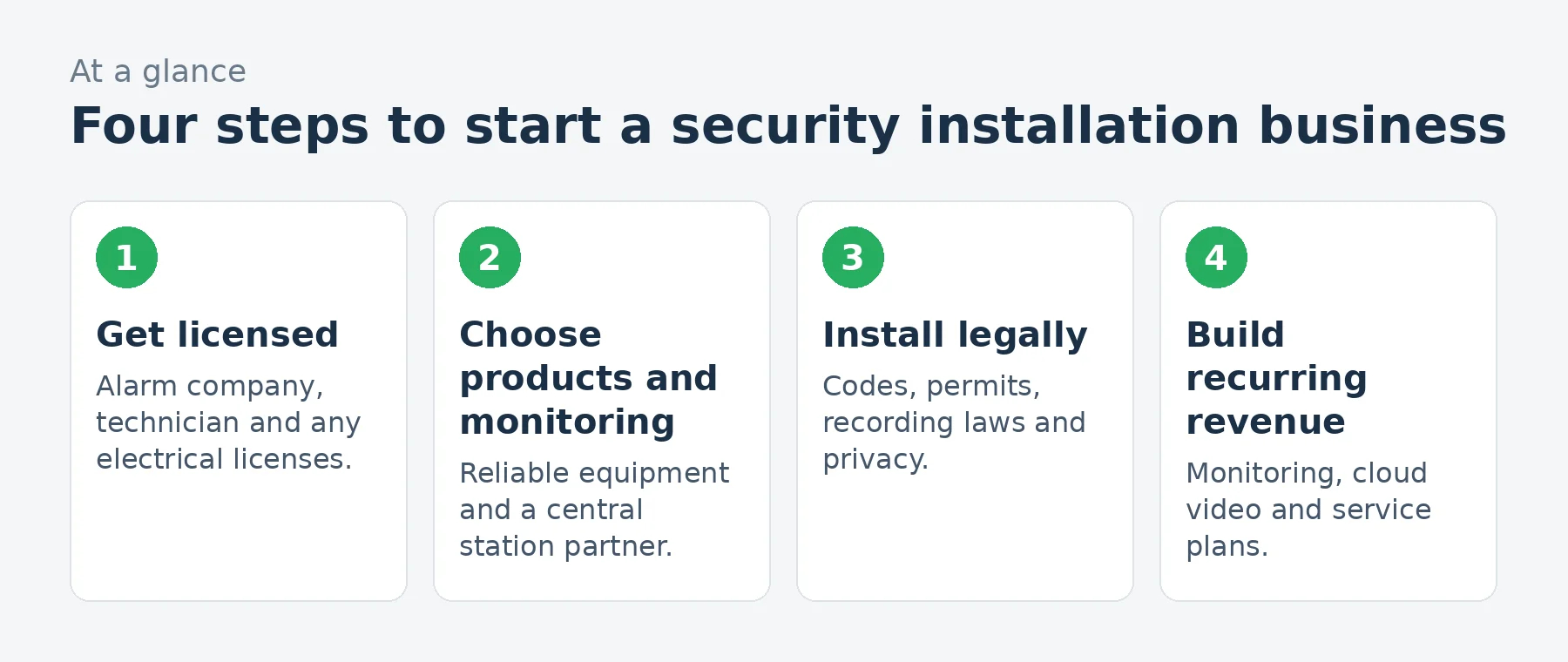
An alarm and camera installation business at a glance
Table of Contents
| Topic | What to expect |
|---|---|
| Startup cost | Moderate: licensing and training, tools, a vehicle, test equipment, product inventory, software and insurance |
| Licensing | State alarm company and technician licenses in many states, plus low-voltage or electrical licenses and fire alarm certifications |
| Key rules | Fire alarm codes (NFPA 72), local alarm permits, audio recording consent laws, privacy in camera placement and FCC equipment bans |
| How you earn | Installation projects plus recurring monitoring, cloud video and service contracts |
| Best for | Technical, detail-oriented installers who enjoy problem-solving and customer service |
Who security installation suits
It suits technical people comfortable with low-voltage wiring, networking and electronics who enjoy solving problems and explaining systems to customers. Technicians must be trustworthy, since they work in homes and businesses and handle security information.
Services to offer
- Intrusion alarms: sensors, panels and keypads.
- Video surveillance: cameras, recorders and cloud video.
- Access control: card readers, keypads and door hardware integration.
- Smart home security: smart locks, doorbells and automation.
- Fire alarms, with the required licenses and certifications.
- Monitoring and maintenance plans.
Licensing
Many states license alarm companies and technicians. California licenses alarm company operators through the Bureau of Security and Investigative Services, Texas licenses alarm companies and installers through the DPS Private Security Program and Florida regulates alarm work through electrical contractor licenses (including specialty alarm licenses). Some states require low-voltage or electrical licenses for any wiring. Fire alarm work often requires additional licensing and NICET certification. Check state and local requirements before installing anything.
Fire alarm codes
Fire alarm systems must follow NFPA 72 and locally adopted codes, usually with plans, permits and inspections by fire officials. Fire work carries life safety responsibility, so many new companies focus on intrusion and video first, adding fire alarms when they have certified technicians and proper licenses.
Monitoring and false alarms
Most small installers partner with a wholesale central station (ideally UL-listed) that monitors alarms 24/7 and dispatches responders, while you own the customer relationship. Many cities require alarm permits and charge fines for repeated false alarms; some require verified alarms before police respond. Train customers, use reliable sensors and offer video verification to reduce false alarms.
Cameras, privacy and recording laws
Federal law and many states allow audio recording with one party’s consent, but about a dozen states, including California, Florida, Illinois, Maryland, Massachusetts, Pennsylvania and Washington, generally require all parties’ consent to record private conversations. Many installers disable audio by default or advise clients to post notices. Never place cameras where people expect privacy, such as bathrooms or changing areas, and follow workplace and landlord-tenant rules for camera use.
Equipment restrictions and cybersecurity
The FCC has prohibited new equipment authorizations for video surveillance equipment from certain companies on its Covered List for national security reasons, and federal contractors face restrictions on using such equipment. Choose reputable brands, change default passwords, update firmware, secure customer networks and protect access to video and alarm accounts.
Startup costs to plan for
| Item | What to budget for |
|---|---|
| Licensing and training | State licenses, manufacturer training, certifications |
| Tools and test equipment | Drills, fish tapes, testers, ladders |
| Vehicle | Work van with storage |
| Inventory | Panels, sensors, cameras, cabling |
| Software | Quotes, scheduling, monitoring platform access |
| Insurance | Liability, errors and omissions, auto, workers’ compensation |
Use our startup cost calculator for your total.
Pricing
Price installations by project (equipment, labor, programming and permits), and sell monitoring, cloud video and service plans monthly. Many companies offer lower installation prices with monitoring contracts, but contracts must clearly disclose terms, length and cancellation. Use our pricing calculator.
A worked example: a small installer
These are illustrative assumptions for a small installer with two technicians, not predictions.
| Assumption | Monthly | |
|---|---|---|
| Installation projects | Residential and small commercial | $26,000 |
| Recurring monitoring and cloud video | 350 accounts averaging $35 | $12,250 |
| Service calls and maintenance plans | $2,500 | |
| Revenue | $40,750 | |
| Equipment and materials | About 40% of installation revenue | $(10,400) |
| Technician wages | Two technicians, with payroll costs | $(11,500) |
| Central station monitoring costs | Wholesale monitoring fees | $(2,800) |
| Vehicles, tools and fuel | $(1,800) | |
| Insurance, licenses and software | $(1,500) | |
| Marketing and sales | $(2,000) | |
| Profit before owner pay and taxes | $10,750 |
That leaves about $10,750 a month before the owner’s pay and taxes, on about $40,750 of revenue. Recurring monthly revenue builds with every installation and is what gives security businesses lasting value.
Loading the calculator…
Sales practices
Door-to-door alarm sales have drawn consumer complaints and enforcement over misleading claims and high-pressure tactics. Be honest about who you are, explain contract terms clearly, follow state door-to-door sales cancellation rules and never claim to represent another company.
Finding customers
- Homeowners through referrals, home builders and real estate agents.
- Small businesses such as retail stores, offices and restaurants.
- Property managers for apartments and commercial buildings.
- Contractors and electricians who need low-voltage partners.
- Local search and reviews.
Access control systems
Businesses increasingly use card, fob or mobile credential access control. Installing readers, door hardware and management software requires coordination with door hardware specialists and fire and life safety codes, since doors must still allow safe exit.
Video analytics and remote monitoring
Modern cameras offer analytics such as person and vehicle detection, and remote video monitoring services can watch sites live and respond to intrusions. These services suit construction sites, car lots and businesses after hours, and add recurring revenue.
Service and maintenance plans
Systems need battery replacements, firmware updates, camera cleaning and testing. Annual maintenance plans keep systems reliable, reduce false alarms and create steady service revenue.
Commercial bids
Commercial projects often come through bids from general contractors and property owners. Read specifications carefully, include programming, testing and training in bids and confirm licensing requirements for commercial and fire work.
Monitoring contracts done right
Monitoring agreements should state the monthly price, term, automatic renewal terms, cancellation process, equipment ownership and responsibilities for false alarm fees. Follow state automatic renewal and door-to-door sales cancellation rules, and give customers copies of everything they sign.
Training customers
Many false alarms come from user error. Walk customers through arming, disarming, canceling false alarms and using the app, and provide written instructions. Well-trained customers have fewer false alarms and fewer service calls.
Smart home and integration
Customers increasingly want security integrated with smart locks, lighting, thermostats and video doorbells. Offering integrated smart home packages raises project value, but secure setup and customer training are essential to prevent unauthorized access.
Common mistakes to avoid
- Installing without required state licenses.
- Doing fire alarm work without proper licensing and certification.
- Recording audio where all-party consent is required.
- Weak passwords and outdated firmware.
- Unclear monitoring contract terms.
Your first 90 days
- Days 1-30: confirm state and local licensing, apply for licenses and complete manufacturer training.
- Days 31-60: choose equipment lines and a central station partner, buy insurance and set pricing.
- Days 61-90: install first systems, register alarm permits as required and build referral partnerships.
Frequently asked questions
Do I need a license to install security cameras and alarms?
Many states require alarm company and technician licenses, and some require low-voltage or electrical licenses.
Can security cameras record audio?
It depends on state law; about a dozen states generally require all parties’ consent to record conversations.
Do I need special certification for fire alarms?
Fire alarm work usually requires additional licensing and often NICET certification, following NFPA 72.
How do alarm companies make recurring revenue?
Through monthly monitoring, cloud video and service plans.
Do customers need alarm permits?
Many cities require alarm permits and fine repeated false alarms.
Are some camera brands restricted?
Yes. The FCC has barred new authorizations for equipment from certain companies on its Covered List.
Should I offer DIY system support?
Some installers help customers set up and monitor DIY systems for a fee, which can lead to professional upgrades.
Is the security installation business growing?
BLS projects employment of security and fire alarm installers to grow about 10% over the decade.
Who owns the security equipment?
It depends on the contract; some customers buy equipment outright, while others lease it with monitoring contracts.
What certifications help alarm technicians?
Manufacturer certifications, state technician licenses and NICET certification for fire alarm work.
Should I buy monitoring accounts?
Some companies grow by acquiring monitoring accounts; review contracts, attrition and equipment carefully before buying.
Keep learning
- Security services industry data
- How to start a locksmith business
- How to start a security guard company
- Pricing calculator
Sources
- US Bureau of Labor Statistics, Security and fire alarm systems installers
- California Bureau of Security and Investigative Services (guards and alarm companies)
- Texas Department of Public Safety, Private Security Program
- NFPA 72, National Fire Alarm and Signaling Code
- NICET, Fire alarm systems certification
- FCC, Covered List of equipment that poses national security risks
- Justia, Recording phone calls and conversations: 50-state survey
- Electronic Security Association (ESA)
Last reviewed November 3, 2026. Startup costs are estimates; check local prices, licensing and tax rules before you commit money.

