
A sports coaching business provides private and small group training for athletes: skills lessons in baseball, basketball, soccer, tennis, volleyball and other sports, speed and agility training, position-specific coaching, camps, clinics and team training. Many clients are young athletes and their parents seeking extra development.
Coaching minors requires careful safety practices: background checks, policies that avoid one-on-one situations out of view, concussion and heat safety and clear communication with parents. Certifications and a track record build trust. The Bureau of Labor Statistics tracks coaches and scouts, an occupation projected to grow as youth and amateur sports participation continues. This guide covers services, safety, insurance, facilities, pricing, a worked example and a 90-day plan.
A sports coaching business at a glance
Table of Contents
| Topic | What to expect |
|---|---|
| Startup cost | Low: equipment, insurance, certifications, background check, booking software and facility rental |
| Key safety practices | Background checks, SafeSport-style policies with minors, concussion and heat safety and emergency plans |
| Services | Private lessons, small group training, camps, clinics and team sessions |
| How you charge | Per session, packages, monthly memberships and camp fees |
| Best for | Experienced players and coaches who teach well and build trust with families |
Who coaching suits
It suits experienced athletes and coaches who can break skills into steps, motivate young athletes and communicate well with parents. Reliability and professionalism build the referrals that drive this business.
Services to offer
- Private lessons for focused skill development.
- Small group training for friends or teammates at lower per-athlete prices.
- Camps and clinics during school breaks and weekends.
- Team training for clubs and school teams.
- Speed, agility and strength training for athletes, with appropriate qualifications.
- Video analysis of technique.
Credentials
Certifications from your sport’s national governing body or coaching associations, plus first aid and CPR, show professionalism. Free courses such as the NFHS Learn courses on concussion, heat illness and sudden cardiac arrest cover essential safety topics. Strength and conditioning work for athletes benefits from recognized strength coaching certifications.
Safety with young athletes
Working with young athletes brings serious responsibilities. The federal SafeSport Authorization Act requires many amateur sports organizations to report suspected child abuse, train adults who work with minors and limit one-on-one interactions; organizations affiliated with national governing bodies follow U.S. Center for SafeSport policies. State laws also make many adults mandatory reporters of suspected abuse. Run background checks on every coach, staff member and volunteer, follow two-adult rules and give parents clear policies.
As a private coach, train in visible locations, keep parents informed, avoid private messaging with minors outside agreed channels and include parents in communications.
Concussion, heat and emergencies
Every state has a youth sports concussion law, typically requiring education for coaches, parents and athletes, removal from play when a concussion is suspected and written clearance from a health care provider before returning. The CDC’s free HEADS UP training and NFHS courses on concussion, heat illness and sudden cardiac arrest are widely used. Keep an emergency action plan, first aid supplies and, ideally, an AED at practices and games.
Waivers and insurance
Carry general liability insurance for coaching and camps, and professional liability if offered for coaches. Use registration forms with medical information, emergency contacts and waivers, keeping in mind that waivers signed by parents for minors are not enforceable in every state. Facilities often require proof of insurance.
Startup costs to plan for
| Item | What to budget for |
|---|---|
| Equipment | Balls, cones, nets, training aids |
| Certifications | Sport, first aid, CPR and safety courses |
| Background check | Required by many facilities and parents |
| Insurance | General liability for coaching and camps |
| Facility rental | Fields, gyms, cages or courts |
| Booking software | Scheduling, payments and waivers |
Use our startup cost calculator for your total.
Training space
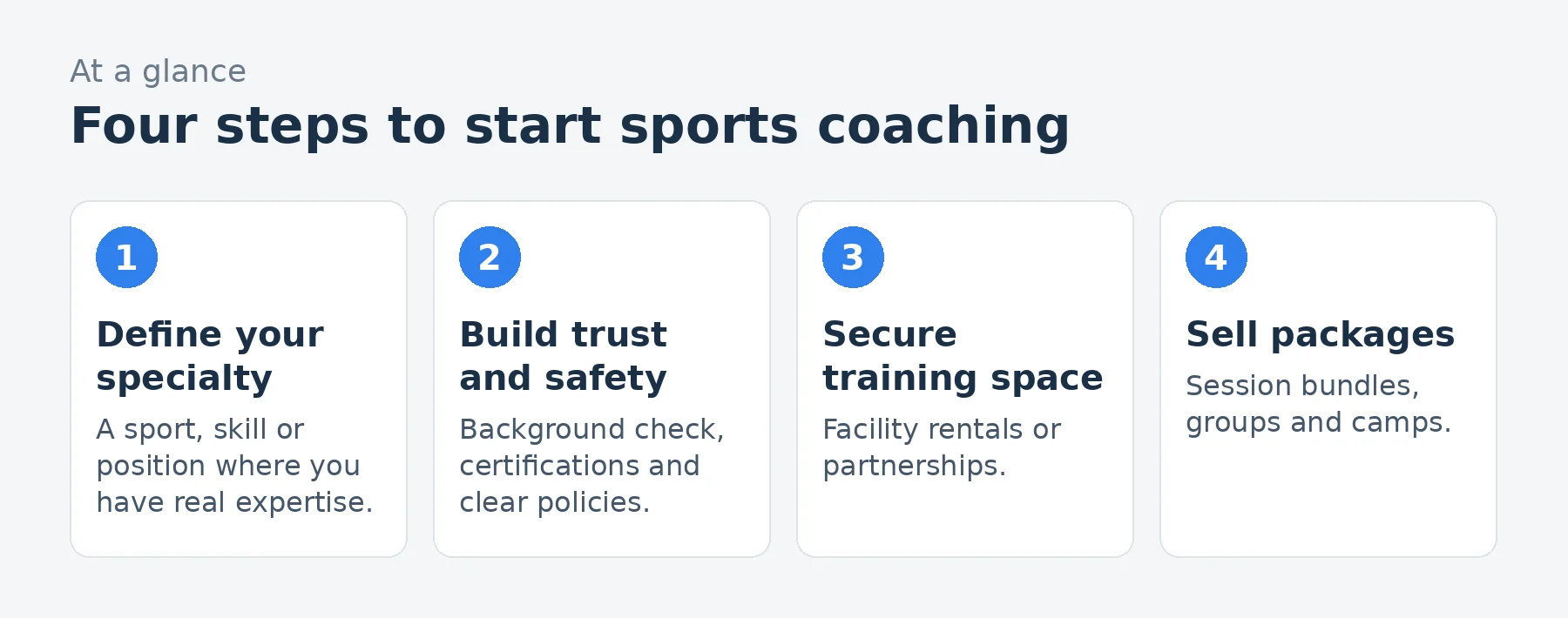
Rent fields, courts, gyms or batting cages by the hour, partner with training facilities on revenue shares or use public parks where permits allow commercial instruction. Check local rules; many parks require permits for paid lessons.
A worked example: a solo coach
These are illustrative assumptions for an established solo coach, not predictions.
| Assumption | Monthly | |
|---|---|---|
| Private lessons | 50 sessions at $70 | $3,500 |
| Small group training | 40 athlete-sessions at $30 | $1,200 |
| Clinic or camp | 1 weekend clinic, 24 athletes at $120 | $2,880 |
| Revenue | $7,580 | |
| Facility rental | Gym, field or cage time | $(1,400) |
| Assistant coach for camps | $(500) | |
| Insurance and booking software | $(150) | |
| Equipment and marketing | $(300) | |
| Profit before owner pay and taxes | $5,230 |
That leaves about $5,230 a month before the coach’s pay and taxes, on about $7,580 of revenue. Camps and small groups raise earnings per hour compared with private lessons alone.
Loading the calculator…
Pricing
Price private lessons per session with discounted packages, small groups per athlete and camps per participant. Monthly memberships for regular training provide steady income. Research local rates and price for your experience. Use our pricing calculator.
Building a client base
- Local clubs and school teams: coaches refer athletes needing extra work.
- Parent networks and youth league partnerships.
- Social media showing drills and athlete progress (with parent permission).
- Free clinics to introduce your coaching.
- Referrals from satisfied families.
Tracking athlete progress
Set goals with athletes and parents, track measurable progress (speed, accuracy, technique) and share updates. Visible progress keeps families committed and generates referrals.
Strength and conditioning for youth
Age-appropriate strength and conditioning improves performance and reduces injury risk when supervised by qualified coaches. Focus on technique, bodyweight movements and gradual progression for younger athletes, and avoid adult programs that are not suitable for growing bodies.
Video analysis
Recording technique and reviewing it with athletes speeds learning. Get parents’ permission before recording minors, store videos securely and share them only with the athlete’s family unless permission is given for marketing.
Communicating with parents
Share session goals, progress updates and practice plans with parents. Set expectations on attendance, cancellations and payments, and keep communications professional and in group channels that include parents.
Honest recruiting guidance
Many families hope for college opportunities. Give honest feedback about level and options, encourage academic focus and avoid promising outcomes. Know the basic recruiting rules for your sport so you can point families to official resources.
School-break camps
Holiday, spring break and summer camps are high-demand products. Plan curriculum, staffing ratios, safety policies and registration well in advance, and limit group sizes so instruction stays personal.
Working with clubs and schools
Clubs and school teams may hire coaches for position training, preseason clinics or skills sessions. Formal agreements should cover fees, schedules, facility use, insurance and safety policies, and the club’s own SafeSport or background check requirements.
Adult athletes
Adults also pay for coaching: tennis, golf, running, swimming and recreational league players. Adult programs fill daytime and evening hours and involve fewer youth-specific requirements, though safety and insurance still apply.
Booking and payments
Use booking software that handles scheduling, packages, payments, waivers and reminders. Set a clear cancellation policy, such as 24 hours’ notice, and require prepayment for packages so income is predictable.
Common mistakes to avoid
- Coaching minors without background checks and clear safety policies.
- Ignoring concussion signs or heat risks.
- No insurance or permits for public spaces.
- Underpricing by charging only per session.
- Overpromising scholarships or college recruitment.
Your first 90 days
- Days 1-30: complete safety courses and a background check, buy insurance and set packages.
- Days 31-60: secure training space, set up booking and run a free clinic.
- Days 61-90: partner with local clubs, launch small groups and plan a school-break camp.
Frequently asked questions
Do I need certification to be a sports coach?
Not legally for private coaching, but sport certifications, first aid, CPR and safety courses build trust and may be required by facilities.
How much do private sports coaches charge?
It varies by sport, location and experience; many sell session packages and lower-priced small group training.
Do private coaches need background checks?
It is strongly recommended, and many facilities, clubs and parents require it.
Are liability waivers enforceable for minors?
It depends on the state; insurance and safety practices remain essential.
Can I coach in public parks?
Often only with a permit for commercial instruction; check local rules.
Should I promise college scholarships?
No. Focus on development and honest guidance; recruiting outcomes depend on many factors.
Can I run sports camps on my own?
Yes, with insurance, appropriate staffing ratios, safety training, facility permits and clear registration policies.
How many athletes should be in a small group?
Small enough for individual attention, often three to six athletes depending on the sport and skill level.
What sports are best for private coaching?
Sports with high skill demands and strong youth participation, such as baseball, softball, basketball, soccer, tennis and volleyball.
Can I coach athletes online?
Video analysis and remote coaching work for some skills, often combined with in-person sessions.
How do I get my first coaching clients?
Run a free or low-cost clinic, connect with local clubs and school coaches and ask early families for referrals and reviews.
Should I form an LLC for coaching?
Many coaches do, to separate finances and liability, alongside insurance; an accountant can advise on structure.
Keep learning
- Sports and recreation industry data
- How to start a youth sports league
- Startup cost calculator
- Pricing calculator
Sources
- US Bureau of Labor Statistics, Coaches and scouts
- U.S. Center for SafeSport, Protecting athletes and the SafeSport Authorization Act
- CDC, HEADS UP concussion training for youth sports
- NFHS Learn, Free coaching courses (concussion, heat illness, sudden cardiac arrest)
- US Small Business Administration, Apply for licenses and permits
Last reviewed November 3, 2026. Startup costs are estimates; check local prices, licensing and tax rules before you commit money.

