
A sign shop designs, prints and installs signs for businesses, events and homes: banners, yard signs, window and wall graphics, vehicle lettering, trade show displays, ADA room signs, monument signs and illuminated storefront signs. Nearly every business needs signs, and many reorder regularly.
Start-up options range from a small shop with a wide-format printer and vinyl cutter to a full fabrication shop building illuminated signs. Some sign work comes with rules: permanent room signs must meet ADA accessibility standards, electric signs need listings and permits, and most exterior signs need local permits. The Bureau of Labor Statistics reports a median pay of $61,300 for graphic designers (May 2024), a benchmark for the design work behind printed products. Shop owners earn the profit after materials, equipment and labor. This guide covers products, equipment, rules, installation, pricing, a worked example and a 90-day plan.
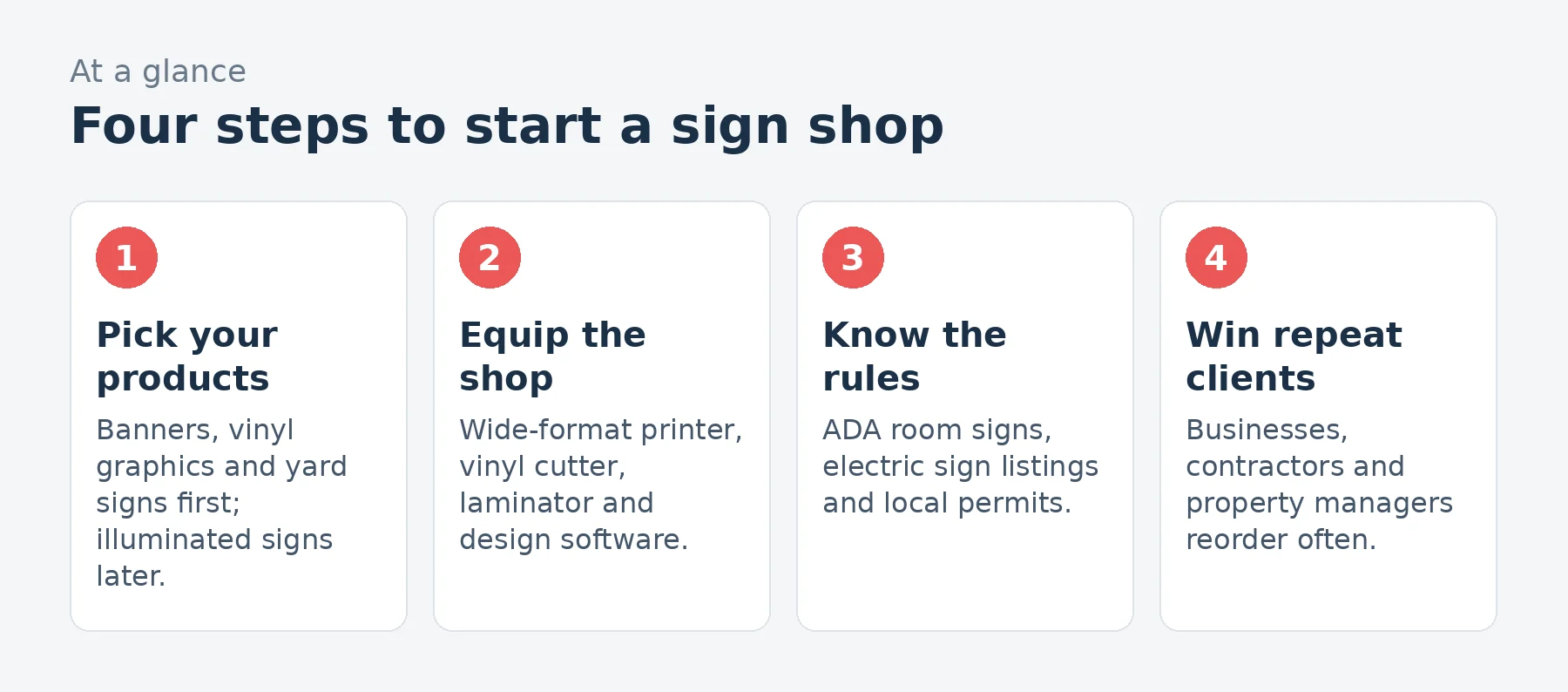
A sign shop at a glance
Table of Contents
| Topic | What to expect |
|---|---|
| Startup cost | Moderate: wide-format printer, vinyl cutter, laminator, design software, materials and a work space |
| Key rules | ADA Standards for permanent room signs; UL-listed electric signs and electrical permits; local sign permits for exterior signs |
| Customers | Local businesses, contractors, real estate agents, schools, churches, events and property managers |
| How you charge | By product or square foot, plus design, installation and rush fees |
| Best for | Practical, design-minded people who like production work and local business relationships |
Who a sign shop suits
It suits practical people who enjoy design, hands-on production and working with local businesses. Installations involve ladders, lifts and tools, so comfort with physical work and safety practices helps.
Products and customers
- Banners and yard signs: events, real estate, political campaigns and contractors.
- Vinyl graphics: window lettering, wall graphics, floor decals and storefront hours.
- Vehicle lettering and graphics: company names, phone numbers and logos (full wraps are a specialty of their own).
- Interior and ADA signs: room numbers, restrooms, wayfinding and directories.
- Trade show and retail displays: retractable banners, backdrops and point-of-sale signs.
- Dimensional and illuminated signs: channel letters, lightboxes and monument signs, usually later as the shop grows.
Equipment
- Wide-format printer (eco-solvent, latex or UV) for banners and graphics.
- Vinyl cutter (plotter) for lettering and decals.
- Laminator to protect printed graphics.
- Cutting tables, trimmers and grommet tools.
- Design software and a color-calibrated monitor.
- Installation tools and a vehicle, plus ladders or access to lifts.
- Optional: flatbed printer, CNC router for dimensional signs and engraving equipment for ADA signs.
ADA sign requirements
Permanent signs that identify rooms and spaces, such as restrooms, room numbers and exits, must meet the ADA Standards for Accessible Design (section 703): requirements cover raised characters, Grade 2 braille, character size, contrast, non-glare finishes and mounting height and location. Directional and informational signs have their own visual requirements. Learn the standards, or partner with a supplier that makes compliant tactile signs.
Electric signs and permits
Illuminated signs are electrical equipment: they should be listed to the safety standard for electric signs (UL 48) and installed with electrical permits, often by or with a licensed electrician. Most cities also require sign permits for exterior signs, with rules on size, height, lighting and placement. Help customers through permits or include permitting in your service.
Installation and safety
Installation is part of the product. Measure carefully, check surfaces, follow ladder and lift safety, use the right adhesives and anchors and protect customers’ property. Carry general liability insurance (many commercial clients require certificates), commercial auto and workers’ compensation for employees.
Startup costs to plan for
| Item | What to budget for |
|---|---|
| Printing and cutting | Wide-format printer, vinyl cutter, laminator |
| Finishing tools | Tables, trimmers, grommets, hems |
| Software and computer | Design and print-management software |
| Materials | Vinyl, banner material, substrates, ink |
| Space | Shop with room for large materials and production |
| Vehicle and insurance | Installation vehicle, liability, auto |
Use our startup cost calculator for your total.
Pricing
Price common products by size or square foot, with minimums for small orders, and add design fees, installation, permits handling and rush charges. Calculate material cost per square foot, ink, labor time and equipment wear, then add margin. Publish simple prices for banners and yard signs, and quote custom work. Use our pricing calculator.
A worked example: a small sign shop
These are illustrative assumptions for a small print-and-install sign shop, not predictions.
| Assumption | Monthly | |
|---|---|---|
| Banners, yard signs and decals | $9,500 | |
| Window, wall and vehicle graphics | $6,000 | |
| ADA and interior signs | $2,500 | |
| Installation fees | $2,000 | |
| Revenue | $20,000 | |
| Materials | Vinyl, substrates, ink, laminate, about 25% of product sales | $(4,500) |
| Staff wages | Production and installation help | $(4,800) |
| Rent and utilities | Small industrial unit | $(2,400) |
| Equipment payments and maintenance | $(1,100) | |
| Vehicle, insurance and software | $(1,300) | |
| Marketing | $(500) | |
| Profit before owner pay and taxes | $5,400 |
That leaves about $5,400 a month before the owner’s pay and taxes, on about $20,000 of revenue. Fast turnaround and reliable installation earn repeat customers, who are the core of a sign business.
Loading the calculator…
Design and proofs
Many customers need design help. Offer design services, send a digital proof showing size, colors and placement, and require approval before production. Keep files on hand for reorders, and confirm the customer has rights to any logos or images they provide.
Winning repeat customers
- Contractors and real estate agents: yard signs and vehicle lettering.
- Property managers: ADA signs, directories and suite signs.
- Retailers and restaurants: window graphics, menus and promotions.
- Schools, churches and event organizers: banners and wayfinding.
- Sign brokers and agencies: production work for their clients.
Turnaround and workflow
Speed wins sign orders. Standardize common products, keep popular materials in stock, batch print jobs and set clear turnaround times with rush options. A simple job tracker keeps proofs, production and installation on schedule.
Growing into illuminated signs
Channel letters and lightboxes bring larger projects, but require fabrication skills, electrical work and permits. Many shops start by subcontracting fabrication to wholesale sign manufacturers, then bring work in-house as volume grows.
Real estate and event signs
Real estate agents, builders and event organizers order yard signs, riders, directional signs and banners in steady volume. Offer fast turnaround, standard sizes and storage of their designs for quick reorders. Some shops also offer sign post installation and removal for agents.
Trade show and retail displays
Retractable banners, table covers, backdrops and point-of-sale displays are popular with businesses that attend events. Keep templates for common sizes, and remind clients before their busy trade show seasons.
Pricing installation
Installation often takes longer than production. Price it by time and difficulty: surface prep, height, access equipment, travel and removal of old signs. Visit complex sites before quoting.
Helping customers with permits
Many customers do not know that exterior signs need permits. Offering to prepare drawings and submit permit applications (for a fee) makes you more valuable and avoids signs being ordered that cannot be installed. Keep notes on each city’s sign rules in your area.
Choosing materials
Match materials to use: banner vinyl and mesh for outdoor banners, corrugated plastic for yard signs, aluminum composite for long-lasting exterior signs, foam board for indoor displays and cast vinyl for long-term graphics. Using the right material prevents early failures and complaints.
Common mistakes to avoid
- Making ADA signs that do not meet the standards.
- Installing illuminated signs without listings or permits.
- Underpricing installation time.
- Printing before proofs are approved.
- Buying fabrication equipment before demand exists.
Your first 90 days
- Days 1-30: choose products, buy a printer, cutter and laminator and learn the ADA sign standards.
- Days 31-60: set prices, build a sample board and portfolio and set up quoting and proofs.
- Days 61-90: visit 30 local businesses, contractors and property managers and deliver first jobs fast.
Frequently asked questions
What equipment do I need to start a sign shop?
A wide-format printer, vinyl cutter, laminator, finishing tools and design software cover most starter products.
Do ADA signs have special requirements?
Yes. Permanent room signs must meet ADA Standards for raised characters, braille, contrast and mounting.
Do I need a license to install signs?
It varies. Exterior signs usually need permits, and electric signs need electrical permits and often a licensed electrician.
How do sign shops price signs?
By size or square foot with minimums, plus design, installation and rush fees.
Can I start a sign shop from home?
Small banner and vinyl work can start at home where zoning allows; larger work needs shop space.
What are the most profitable sign products?
Repeat business products such as vehicle lettering, window graphics and ADA signs often earn well, along with installation services.
Do sign shops need insurance?
Yes. General liability is essential, especially for installations, and commercial clients often require certificates.
Can I make channel letter signs?
Yes, but they require fabrication skills, UL-listed components and electrical permits. Many shops subcontract them at first.
How long do vinyl signs last outdoors?
It depends on the vinyl, laminate and exposure; quality cast vinyl with laminate lasts much longer than economy materials.
Keep learning
- Printing and signs industry data
- How to start a vehicle wrap business
- How to start a screen printing business
- Pricing calculator
Sources
- U.S. Access Board, ADA Standards: signs (Chapter 7, section 703)
- UL Standards, UL 48 Standard for electric signs
- US Bureau of Labor Statistics, Graphic designers
- US Small Business Administration, Apply for licenses and permits
Last reviewed November 3, 2026. Startup costs are estimates; check local prices, licensing and tax rules before you commit money.

