
Burst pipes, storms, sewer backups and fires damage thousands of homes and businesses every week, and owners need help immediately. Restoration companies extract water, dry structures, remove damaged materials, clean smoke and soot, and often rebuild afterward. The work draws on several occupations: the Bureau of Labor Statistics counted about 1.65 million construction laborers and helpers in 2024 (median $46,050, 7% projected growth) and about 51,300 hazardous materials removal workers (median $48,490).
Most restoration revenue is paid through property insurance claims, which shapes everything from documentation to cash flow. Fast response wins jobs; careful documentation gets them paid.
The workforce
| Occupation | Jobs (2024) | Median pay (May 2024) | Projected growth, 2024 to 2034 |
|---|---|---|---|
| Construction laborers and helpers | about 1.6 million | $46,050 | +7% |
| Hazardous materials removal workers | 51,300 | $48,490 | +1% |
Source: U.S. Bureau of Labor Statistics, Occupational Outlook Handbook and Occupational Employment and Wage Statistics.
Business models compared
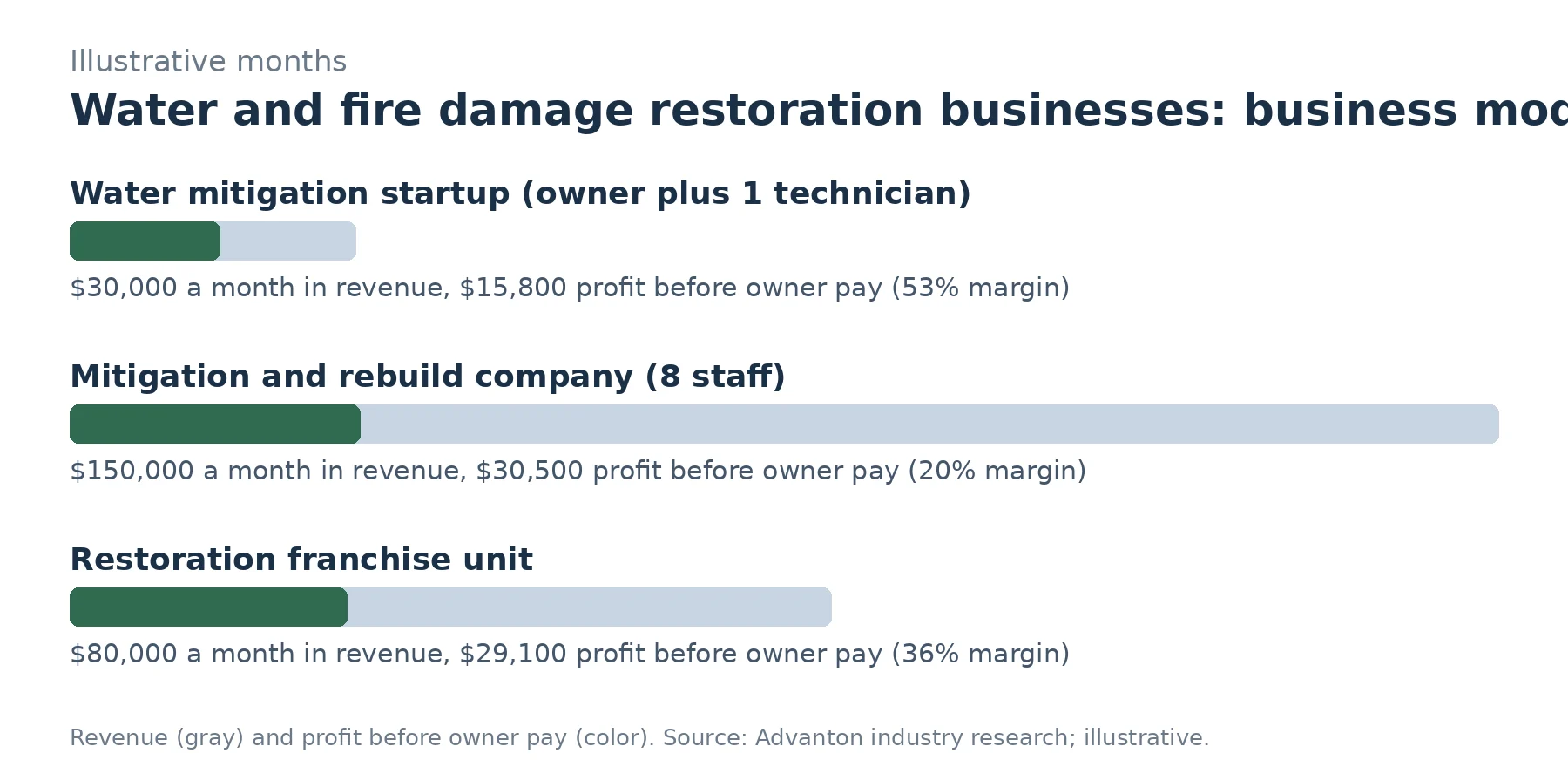
The figures below are illustrative months from our research, not industry averages. They show how revenue and costs typically fit together; your market, prices and costs will differ.
| Business model | Startup costs | Example monthly revenue | Costs | Profit before owner pay | Margin |
|---|---|---|---|---|---|
| Water mitigation startup (owner plus 1 technician) | Moderate: dehumidifiers, air movers, extractors, van, certification | $30,000 | $14,200 | $15,800 | 53% |
| Mitigation and rebuild company (8 staff) | High: equipment fleet, vans, project managers, contractor license | $150,000 | $119,500 | $30,500 | 20% |
| Restoration franchise unit | High: franchise fee, equipment package, royalties | $80,000 | $50,900 | $29,100 | 36% |
Fixed and variable costs
For projections, the most useful split is between variable costs, which rise and fall with sales (materials, supplies, hourly labor, fees), and fixed costs, which you pay every month regardless (rent, salaried staff, insurance, loan payments).
| Business model | Variable costs (% of revenue) | Fixed costs per month | What it means |
|---|---|---|---|
| Water mitigation startup (owner plus 1 technician) | 21.0% | $7,900 | Mostly fixed: needs steady volume to cover overhead |
| Mitigation and rebuild company (8 staff) | 54.0% | $38,500 | Mostly variable: profitable early, but watch cash flow |
| Restoration franchise unit | 41.9% | $17,400 | Balanced: margins improve as volume grows |
What the numbers say
Mitigation earns strong margins because equipment is billed by the day and response is urgent, but equipment payments and insurance waits strain early cash flow.
Rebuild work adds revenue at lower margins, since materials and subcontractors pass through, but it keeps the whole job with one company.
Receivables are the real risk. Insurance payments can take weeks or months, so restoration companies need more working capital than their profit suggests.
The three models in brief
Water mitigation startup. Extraction, drying and demolition of damaged materials, with rebuilds referred to partners.
Mitigation and rebuild company. Handles the full job from emergency response to finished repairs, with project managers and estimators.
Restoration franchise unit. Brand, training and national insurance relationships in exchange for fees and royalties. See franchises.
Cost structure: mitigation and rebuild company (8 staff)
Each cost as a share of the example month’s revenue ($150,000):
| Cost | Monthly amount | Share of revenue | Type |
|---|---|---|---|
| Rebuild materials and subcontractors | $45,000 | 30.0% | Variable |
| Field crew wages | $30,000 | 20.0% | Variable |
| Project manager and estimator | $14,000 | 9.3% | Fixed |
| Equipment and vehicle payments | $9,000 | 6.0% | Fixed |
| Office and admin | $6,500 | 4.3% | Fixed |
| Consumables and disposal | $6,000 | 4.0% | Variable |
| Marketing | $6,000 | 4.0% | Fixed |
| Insurance | $3,000 | 2.0% | Fixed |
| Profit before owner pay | $30,500 | 20% |
A first-year projection: mitigation and rebuild company (8 staff)
New businesses rarely start at full speed. This projection assumes revenue ramps from 35% of the example month in month 1 to 100% by month 12, variable costs move with revenue, and fixed costs stay the same every month. It’s a planning illustration, not a forecast.
| Month | Revenue | Variable costs | Fixed costs | Profit | Cumulative |
|---|---|---|---|---|---|
| 1 | $52,500 | $28,350 | $38,500 | -$14,350 | -$14,350 |
| 2 | $67,500 | $36,450 | $38,500 | -$7,450 | -$21,800 |
| 3 | $82,500 | $44,550 | $38,500 | -$550 | -$22,350 |
| 4 | $93,000 | $50,220 | $38,500 | $4,280 | -$18,070 |
| 5 | $105,000 | $56,700 | $38,500 | $9,800 | -$8,270 |
| 6 | $114,000 | $61,560 | $38,500 | $13,940 | $5,670 |
| 7 | $123,000 | $66,420 | $38,500 | $18,080 | $23,750 |
| 8 | $130,500 | $70,470 | $38,500 | $21,530 | $45,280 |
| 9 | $136,500 | $73,710 | $38,500 | $24,290 | $69,570 |
| 10 | $142,500 | $76,950 | $38,500 | $27,050 | $96,620 |
| 11 | $147,000 | $79,380 | $38,500 | $29,120 | $125,740 |
| 12 | $150,000 | $81,000 | $38,500 | $30,500 | $156,240 |
Year one: revenue $1,344,000, profit before owner pay $156,240. The first profitable month is month 4. Cumulative results bottom out at -$22,350, which is the minimum cash cushion this plan would need, before any startup costs.
Crews, equipment payments and project managers start before referral relationships mature, so this company illustration turns profitable in month 4, with a cumulative low of about $22,400. Slow insurance payments can push the real cash need higher still.
How restoration jobs are paid
- Insurance claims: most residential jobs, priced with industry estimating software and approved by adjusters.
- Direct pay for smaller jobs and uninsured losses.
- Commercial and property manager accounts with negotiated rates.
- Third-party administrator programs that send jobs from insurers in exchange for pricing and service standards.
Documentation decides payment
Moisture readings, photos, drying logs, equipment counts and scope notes support every invoice. Daily drying records and before-and-after photos speed approvals and protect you in disputes. Train every technician to document as carefully as they dry.
A startup checklist
- Earn IICRC certifications such as water damage restoration and applied structural drying.
- Check state mold licensing and contractor licensing for rebuilds.
- Buy or finance a drying fleet: dehumidifiers, air movers, extractors and moisture meters.
- Set up estimating software used by insurers.
- Arrange working capital for slow insurance payments.
Respond in minutes, not hours
Water damage spreads quickly, and customers often call several companies. A 24/7 answering process, on-call rotation and a promise to arrive within an hour or two win jobs and referrals. See speed to lead.
Where the opportunities are
- Property managers and HOAs with many units.
- Plumbers who discover leaks and need a mitigation partner.
- Commercial buildings with large-loss potential.
- Mold remediation following water damage.
- Contents cleaning and pack-outs.
Ethics and the rules
Homeowners are stressed and vulnerable after a loss. Explain the process, don’t negotiate claims you aren’t licensed to handle, and never waive deductibles where state law prohibits it. Several states have also restricted assignment of insurance benefits to contractors. Honest companies earn referrals from agents and adjusters for years.
Key terms
| Term | Meaning |
|---|---|
| Mitigation | Stopping damage from getting worse: extraction, drying, removal |
| Category and class | Industry terms for water contamination level and extent of wetness |
| TPA | Third-party administrator that assigns jobs for insurers |
| Pack-out | Removing and storing contents for cleaning and protection |
Equipment fleet and capacity
Your drying fleet sets your capacity: each active water job may need several dehumidifiers and air movers for three to five days. Track equipment utilization, add units as demand grows, and keep a plan for storm surges, such as rental partners or financing lines, so you never turn away a large loss for lack of equipment.
Key numbers to track
Watch response time, jobs per month by referral source, average invoice, days to payment, equipment utilization and the share of mitigation jobs that convert to rebuilds. Days to payment often tells you more about cash needs than profit does.
Hiring and training
Technicians need training in drying science, safety, customer communication and documentation. Certification courses, ride-alongs and clear checklists keep quality consistent. Night and weekend calls make fair on-call pay and rotation essential for retention.
Common mistakes
- Underestimating working capital for slow insurance payments.
- Weak documentation that leads to reduced payments.
- Overbuying equipment before demand is proven.
- High-pressure tactics that damage reputation.
- Ignoring rebuild licensing requirements.
Marketing a restoration business
Plumbers, insurance agents, property managers and adjusters send much of the work; Google, Local Services Ads and reviews bring emergency calls. See insurance restoration work and mold and asbestos remediation data.
Test these numbers with your own plan
Open this industry in our free Business Idea Reality Check to start from any model above, change prices, costs, startup budget and your own pay, and see your break-even month, the cash you’d need, three scenarios and how new businesses in this sector survive in your state.
- Start with the closest model and its cost structure.
- Replace every price and cost with local quotes.
- Estimate your ramp: how fast customers will realistically come in year one.
- Map cash month by month with the free Cash & Payroll Planner.
- Build the full plan in the free Business Planner.
About this data
Workforce figures come from the U.S. Bureau of Labor Statistics (Occupational Outlook Handbook and Occupational Employment and Wage Statistics, May 2024 wages and the 2024 to 2034 projections, unless noted). Market figures cite their sources above. Business model figures are illustrative months built from typical prices and costs to show how revenue, fixed costs and variable costs fit together; they are not industry averages or guarantees. We review these profiles when new government data is released, at least once a year, and the same figures power the Business Idea Reality Check.
Licensing and rules
Certification from the IICRC (Institute of Inspection, Cleaning and Restoration Certification) is the industry standard for water, fire and mold work and is often expected by insurers; some states license mold assessment and remediation; rebuilding usually requires a contractor license and permits; asbestos and lead rules apply in older buildings; many states restrict contractors from negotiating insurance claims on a homeowner’s behalf unless licensed as public adjusters. Requirements change; confirm with your state and local agencies before you start.
Frequently asked questions
What certification do restoration companies need?
IICRC certification is the industry standard; some states also license mold work, and rebuilds need contractor licenses.
How do restoration companies get paid?
Mostly through insurance claims, plus direct-pay customers and commercial accounts.
Why do restoration businesses need so much cash?
Equipment costs come first and insurance payments can take weeks or months.
Do restoration companies need to offer rebuilds?
Not necessarily; many start with mitigation and refer rebuilds, then add them once licensed and staffed.
Is a franchise a good way to start?
It can provide training and insurer relationships, at the cost of fees and royalties.
How can I test these numbers?
Open damage restoration in the Business Idea Reality Check and enter your own prices and costs.
Keep learning
- Insurance restoration work for contractors
- Mold and asbestos remediation data
- Storm work for contractors
- Business Idea Reality Check
Sources
- U.S. Bureau of Labor Statistics, Construction laborers and helpers
- U.S. Bureau of Labor Statistics, Hazardous materials removal workers
Last reviewed November 1, 2026. Startup costs are estimates; check local prices, licensing and tax rules before you commit money.

