
Most contractor leads still arrive by phone. If you’re spending money on ads, postcards, yard signs or lead platforms, you need to know which ones make the phone ring, and which calls become booked jobs. Call tracking answers that question by assigning different phone numbers to different marketing channels and recording which number each caller dialed.
This guide explains how call tracking works, how to use it without damaging your local listings, the legal points to watch, and simpler alternatives for small businesses.
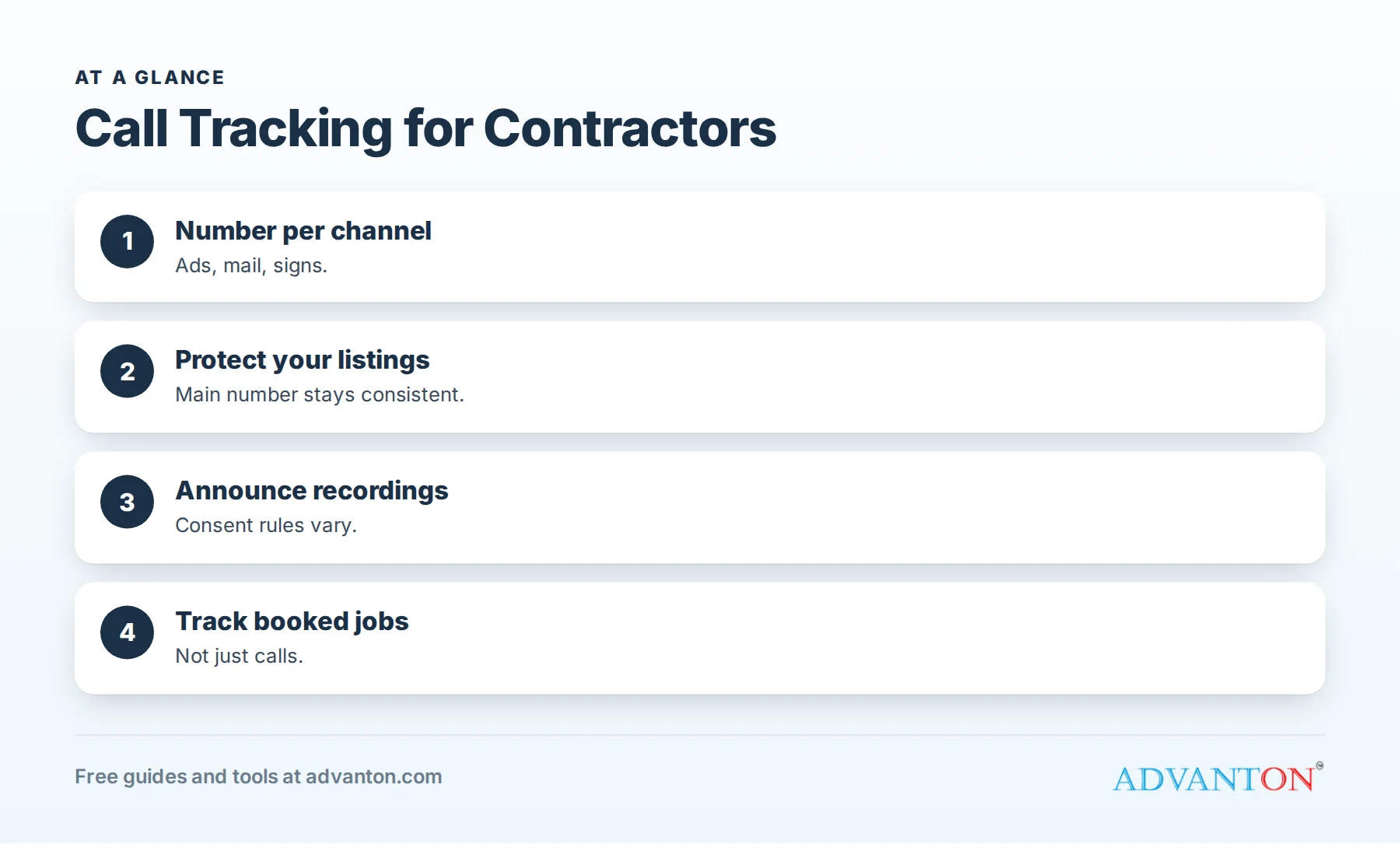
How call tracking works
Table of Contents
| Piece | What it does |
|---|---|
| Tracking numbers | Unique numbers for each channel (postcards, ads, yard signs) that forward to your main line |
| Website number swapping | Shows different numbers to website visitors depending on how they arrived |
| Call logs | Records time, length, caller number and source for every call |
| Recording (optional) | Records calls for training and quality, with proper consent |
| Reports | Calls and booked jobs by channel |
What to track
- Paid ads: search ads, social ads and display ads.
- Print: postcards, door hangers, yard signs and vehicle wraps.
- Lead platforms: where they allow your own numbers.
- Website: organic visitors vs ad visitors.
- Partners: real estate agents, suppliers or home shows.
Start with the channels where you spend the most money.
Protect your local listings
Your Google Business Profile and directory listings depend on consistent business details. Changing your main number to many different tracking numbers can create confusion and inconsistency. A safer approach:
- Keep your main local number as the number customers know.
- On Google Business Profile, you can use a tracking number as the primary number and keep your main number as an additional phone number, so your main number still appears in your business information.
- Use tracking numbers mainly for ads, print and campaigns rather than every directory listing.
See NAP consistency.
Call recording and consent
Recording calls can help with training and resolving disputes, but laws differ by state. Some states require the consent of everyone on the call (California is one example), while others require only one party’s consent. The safest practice is to announce that calls may be recorded at the start of every call. Check the rules for the states where you and your callers are located.
Metrics that matter
| Metric | Why it matters |
|---|---|
| Calls by channel | Shows what makes the phone ring |
| First-time callers | Separates new leads from existing customers |
| Answered vs missed calls | Missed calls are lost money |
| Booked jobs by channel | The number that really counts |
| Cost per booked job | Marketing spend divided by booked jobs |
Connect calls to booked jobs
Calls are only the start. Mark each call as booked or not in your call tracking tool or job management software, or match them in a simple spreadsheet. Then compare cost per booked job across channels and move your budget toward what works. Our free lead source tracker helps.
Use recordings for training
With proper consent, listening to a handful of calls each week shows how your team answers, what questions customers ask, and why some callers don’t book. Short coaching sessions based on real calls can improve booking rates quickly. See speed to lead.
Missed call alerts
Many call tracking tools alert you to missed calls and can send automatic text replies. Missed calls during business hours are among the most expensive problems a contractor can have; fix them first.
Simple alternatives for small businesses
If dedicated software isn’t in your budget yet:
- Ask every caller "How did you hear about us?" and log the answer.
- Use separate web pages or QR codes for each campaign.
- Use a separate phone number for one major campaign (such as postcards) to test it.
- Review your phone app’s call log for missed calls.
Choosing a call tracking tool
Compare tools on:
- Price per number and per minute.
- Website number swapping.
- Integration with your scheduling or CRM software.
- Recording and consent features.
- Missed call text-back.
- Ease of use for your team.
Set up call tracking step by step
- List your marketing channels and monthly spend for each.
- Choose the three biggest to track first.
- Get a tracking number for each, forwarding to your main line or team.
- Add the numbers to the right ads, mailers and pages.
- Add a recording notice if you record calls.
- Mark each call’s outcome (booked, not booked, existing customer, spam).
- Review results monthly and adjust spending.
Track offline campaigns
Print and vehicle marketing are hard to measure without call tracking. A unique number on postcards, door hangers or truck wraps shows exactly how many calls each brings. Combine with dedicated QR code pages for people who prefer to visit your website.
Track text messages too
Many customers text instead of calling. Choose tracking numbers and tools that support text messages, and log texts the same way as calls.
Multiple locations or service areas
If you have several locations or teams, route each tracking number to the right team, and compare channels by location. A campaign that works well in one area may not in another.
Review call outcomes weekly
Once a week, review missed calls, short calls that didn’t book and calls from your most expensive channels. Patterns (such as many calls asking about a service you don’t offer) show where to adjust ads and pages.
Privacy and data retention
Call logs and recordings contain customer information. Limit access to people who need it, store recordings securely and delete them according to a set schedule and your privacy policy.
Answering and booking are part of tracking
Call tracking often reveals that the biggest problem isn’t marketing, but answering. If many calls go unanswered at lunchtime, after 4 p.m. or on Saturdays, adjust staffing, add an answering service or use missed-call text-back before spending more on ads. Every unanswered call is a lead you already paid for.
Compare channels fairly
Some channels bring fewer calls but larger jobs; others bring many small jobs. Compare channels by booked revenue and profit, not just by call count. A postcard campaign that brings ten calls and four replacement jobs may be worth more than an ad that brings forty calls for small repairs.
Share results with your team
Show your team which channels bring the best customers and how quickly calls are answered. When technicians and office staff understand how marketing dollars turn into jobs, they treat every call as the valuable opportunity it is.
Spot spam and wrong-number calls
Tracking numbers sometimes attract robocalls and solicitations. Mark these as spam in your reports so they don’t inflate channel results, and use your tool’s spam filtering where available. Clean data leads to better decisions.
Common mistakes
- Replacing your main number everywhere with tracking numbers.
- Recording calls without consent notices.
- Tracking calls but not booked jobs.
- Ignoring missed calls.
- Too many numbers to manage.
A worked example
A plumbing company adds tracking numbers to its search ads, postcards and truck wraps, keeps its main number on its listings, and marks booked jobs in its software. After three months, it discovers postcards bring fewer calls than expected but more booked water heater jobs, while one search ad campaign brings many calls that rarely book. It shifts budget accordingly. This example is illustrative.
Frequently asked questions
What is call tracking?
Using different phone numbers for different marketing channels to see which ones generate calls.
Will tracking numbers hurt my local SEO?
They can create inconsistency if used carelessly. Keep your main number consistent, and on Google Business Profile keep your main number as an additional phone if you use a tracking number as primary.
Is it legal to record calls?
It depends on the state; some require everyone’s consent. Announce that calls may be recorded.
What should I measure?
Calls, answered and missed calls, and above all booked jobs and cost per booked job by channel.
Do small contractors need call tracking software?
Not always. Asking callers and using separate numbers for major campaigns is a good start.
How many tracking numbers do I need?
One for each channel you want to measure separately, starting with your three biggest marketing expenses.
Can call tracking help with Google Ads?
Yes. Tracking calls from ads, and marking which become booked jobs, shows which campaigns and keywords are profitable.
Should I put tracking numbers on my trucks?
A dedicated number on vehicles can show how many calls they bring; keep your main number on listings.
Do customers mind tracking numbers?
Usually not; tracking numbers forward to your business like any other number. Keep your main number visible on your listings and website.
How Advanton helps
Advanton is a free resource for small businesses. Track leads and booked jobs by channel with our free lead source tracker, and create campaign QR codes with the QR code generator. You can also add your business to the Advanton directory for free. Advanton earns money when you buy a domain or hosting through our store, which helps keep everything else free.
Keep learning
Last reviewed October 30, 2026. Startup costs are estimates; check local prices, licensing and tax rules before you commit money.


Leave a Reply