
Direct mail still works for contractors because it reaches homeowners where they live, in the neighborhoods you already serve. A well-timed postcard about roof inspections after a storm season, AC tune-ups before summer or gutter cleaning before fall can fill a schedule, especially when it’s repeated, targeted and tracked.
This guide covers how to choose your audience, design postcards that get calls, decide how often to mail, and measure results. For step-by-step instructions on the U.S. Postal Service’s neighborhood mailing program, see our guide to Every Door Direct Mail.
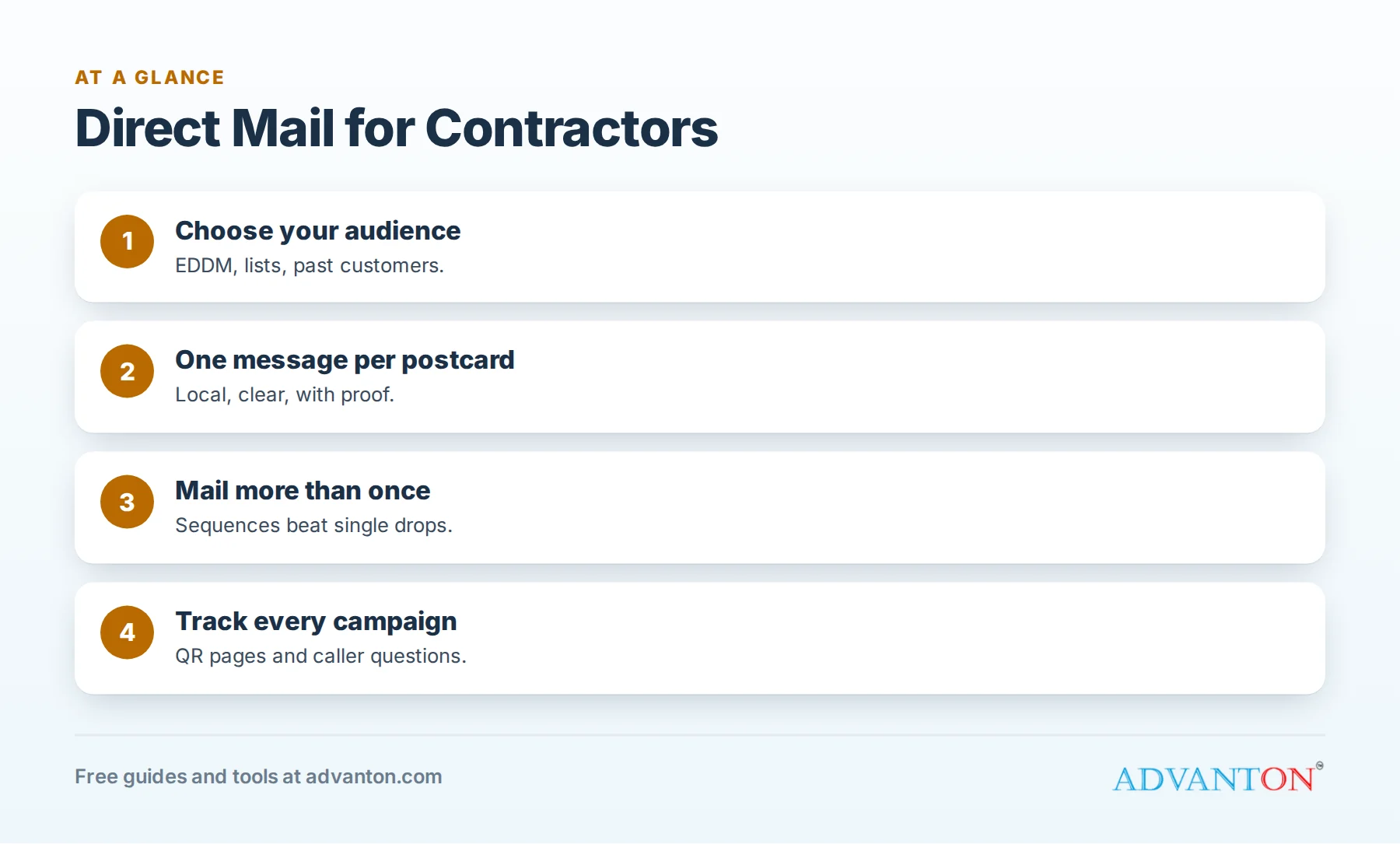
Two ways to reach homeowners by mail
Table of Contents
| Approach | How it works | Best for |
|---|---|---|
| Every Door Direct Mail (EDDM) | Mail to every address on chosen postal carrier routes, without names | Saturating neighborhoods around your jobs and routes |
| Targeted mailing lists | Mail to specific addresses by criteria such as home age, value or recent purchase | Reaching likely buyers, such as new homeowners or older homes |
| Your customer list | Mail to past customers | Repeat work, maintenance and referrals |
Many contractors combine all three: EDDM for neighborhoods, targeted lists for high-value trades, and customer mailings for repeat business.
Targeting ideas by trade
| Trade | Targeting idea |
|---|---|
| Roofing, siding, windows | Neighborhoods with homes of a similar age to your recent jobs |
| HVAC | Older homes likely to have aging systems; past customers for tune-ups |
| Remodeling | Higher-value neighborhoods; homes of a certain age |
| Landscaping, pest control | Dense neighborhoods near existing routes |
| Handyman, painting | New homeowners, who often have project lists |
| All trades | Past customers, for maintenance reminders and referrals |
Design postcards that get calls
- One clear message: a single service and offer.
- A local headline: "Serving [Neighborhood] homeowners since 2012."
- A strong photo of real work.
- Proof: reviews, years in business, licensed and insured.
- A clear offer with an end date.
- A big phone number and a QR code to a dedicated page.
- Both sides used well: headline and offer on one side, details and proof on the other.
Design postcards free with our EDDM postcard maker.
Offers that work
- Free inspections or estimates.
- Seasonal tune-ups or cleanings at a set price.
- Neighborhood specials while you’re working nearby.
- Maintenance plan sign-up bonuses.
Keep offers honest and simple; complicated fine print reduces response.
Mail more than once
A single mailing rarely gets a big response. Homeowners need to see your name several times before they remember it when a need arises. Plan a sequence (for example, three mailings a few weeks apart to the same neighborhoods) rather than one large drop.
Time it to the season
| Season | Mailing ideas |
|---|---|
| Late winter | Spring projects: roofing, painting, landscaping, fencing |
| Spring | AC tune-ups, lawn programs, gutter repairs |
| Summer | Exterior projects, decks, pressure washing |
| Fall | Furnace checkups, gutter cleaning, winter prep |
| Year-round | Past customer reminders and referral thank-yous |
Track every mailing
- Use a dedicated QR code page or tracking link for each campaign.
- Consider a dedicated phone number for mail campaigns.
- Ask every caller how they heard about you.
- Record the campaign, neighborhood and outcome.
Our free lead source tracker helps you calculate cost per booked job by campaign.
Calculate cost per booked job
Add printing, postage and design costs, then divide by the jobs booked from the campaign. Remember that some calls arrive weeks after a mailing, so track results for at least a month or two after each drop.
Pair mail with other neighborhood marketing
Mail works best alongside yard signs, door hangers and an active online presence. A homeowner who receives your postcard, sees your sign down the street and finds strong reviews when they search your name is far more likely to call. See neighborhood marketing for contractors.
Mail to past customers
Your past customers are your most responsive audience. Send seasonal maintenance reminders, thank-you cards with referral offers and updates about new services. These mailings often bring the lowest cost per booked job of any campaign.
A 90-day campaign plan
| Weeks | Actions |
|---|---|
| 1 to 2 | Choose neighborhoods and lists; design postcard and landing page |
| 3 | First mailing |
| 6 | Second mailing to the same addresses |
| 9 | Third mailing; mail past customers with a referral offer |
| 10 to 13 | Track calls and bookings; calculate cost per booked job |
Postcard copy examples by trade
| Trade | Headline | Offer |
|---|---|---|
| HVAC | "Beat the summer rush: AC tune-ups for [Neighborhood]" | Set-price tune-up, book by a date |
| Roofing | "Roofs in [Neighborhood] are reaching 20 years" | Free photo inspection |
| Landscaping | "Your neighbors already trust us with their lawns" | First visit discount with a season plan |
| Remodeling | "See the kitchen we just finished on [Street]" | Free design consultation |
| Pest control | "Spring pests are coming to [Neighborhood]" | Free inspection |
New homeowner mailings
New homeowners often have project lists and haven’t chosen local contractors yet. Mailing lists of recent home buyers (available from list providers) let handymen, painters, HVAC contractors, landscapers and security installers reach them early. A friendly "welcome to the neighborhood" postcard with a modest offer works well.
Mailing lists and privacy
Buy lists from reputable providers, ask how the data was collected and how often it’s updated, and follow any usage restrictions. Remove addresses of people who ask not to be contacted. For your own customer list, mail only to customers who would reasonably expect to hear from you.
Postcards or letters?
Postcards are cheaper and seen instantly, without opening an envelope. Letters can feel more personal and work well for past customers, high-value services and detailed offers. Many contractors use postcards for neighborhoods and letters for customer reminders.
A worked example
An HVAC company mails 3,000 postcards to older neighborhoods near its routes, three times over spring. Across the three drops, the campaign brings 54 calls and 31 booked tune-ups, nine of which become maintenance plan members and two replacements later in the year. Measured that way, the campaign’s value goes far beyond the first tune-ups. These numbers are illustrative; track your own.
Budget for a full sequence
Set your budget for the whole sequence of mailings, not just the first drop. A smaller area mailed three times usually outperforms a larger area mailed once.
Answer calls well
Mail campaigns create bursts of calls. Make sure someone answers, knows the offer and books appointments on the first call. See speed to lead.
Landing pages for mail campaigns
Send QR code scans and website visits to a page built for the campaign, not your homepage. Repeat the postcard’s headline and offer, add photos and reviews from the same area, and include a short form and click-to-call button. A matching page makes it easy for interested homeowners to act, and it lets you measure exactly how many responded.
Test one change at a time
Improve results by testing a single change per campaign: a different headline, offer, photo or neighborhood. Keep everything else the same, compare response and booked jobs, and keep the winner. Over a year, small improvements add up to much cheaper jobs.
Use mail to support your reputation
Homeowners who receive your postcard often look you up before calling. Make sure your Google Business Profile, reviews and website are strong and current before a campaign goes out; a polished postcard that leads to an outdated profile wastes the impression. Include a line such as "See our reviews from your neighbors" with a QR code to your review page or Business Profile.
Common mistakes
- One-time mailings that are never repeated.
- Too many services on one postcard.
- No tracking.
- Mailing far from your routes.
- Ignoring past customers.
Frequently asked questions
Does direct mail work for contractors?
Yes, especially when targeted to neighborhoods you serve, repeated several times and tracked.
What’s the difference between EDDM and targeted mail?
EDDM reaches every address on chosen postal routes without names; targeted lists reach specific addresses by criteria such as home age or recent purchase.
How often should contractors send mail?
Plan sequences of several mailings a few weeks apart rather than single drops.
What should a contractor postcard include?
One service, a local headline, a real photo, proof, a clear offer and a big phone number with a QR code.
How do I track postcard results?
Use a dedicated QR code page or phone number, and ask every caller how they heard about you.
Is EDDM cheaper than targeted mail?
EDDM often costs less per piece because you don’t buy names, but targeted lists can reach likelier buyers. Compare cost per booked job.
How long should I wait to judge a mailing?
Track results for at least four to eight weeks after each drop; many homeowners keep postcards and call later.
Should I put prices on postcards?
A clear set price works well for simple services like tune-ups; for larger projects, offer a free estimate instead.
How Advanton helps
Advanton is a free resource for small businesses. Design postcards in our free EDDM postcard maker, make door hangers and signs in the yard sign maker, and track results with the lead source tracker. You can also add your business to the Advanton directory for free. Advanton earns money when you buy a domain or hosting through our store, which helps keep everything else free.
Keep learning
Last reviewed October 30, 2026. Startup costs are estimates; check local prices, licensing and tax rules before you commit money.


Leave a Reply