
Life coaches help people clarify goals, make decisions and follow through: changing careers, building confidence, improving habits, navigating transitions or leading teams. Coaching can be done in person, by phone or online, which makes it one of the most flexible businesses to start, with almost no startup costs.
That flexibility is also the challenge: anyone can call themselves a coach, so success depends on a clear niche, real skill, trust and consistent marketing.
Life coaching at a glance
Table of Contents
| Services | One-to-one coaching, group programs, workshops, corporate coaching |
| Licensing | Generally unregulated; training and credentials are voluntary |
| Startup costs | Very low: video tools, scheduling, website, training |
| Pricing | Packages and monthly programs rather than single sessions |
| Key to success | A specific niche and clear results for clients |
Choose a niche
"Life coach" is broad; specific niches attract clients faster:
- Career transitions and job search confidence.
- New managers and leadership.
- Entrepreneurs building a business.
- Life transitions: empty nesters, retirement, relocation.
- Habits and productivity.
- Relationships and communication (within coaching scope).
Pick a group you understand, ideally from your own experience or career.
Training and credentials
Coaching is generally unregulated, but training improves your skills and credibility. Professional coaching organizations offer accredited training programs and voluntary credentials based on training hours and coaching experience. Many clients, and especially companies hiring coaches, look for recognized credentials.
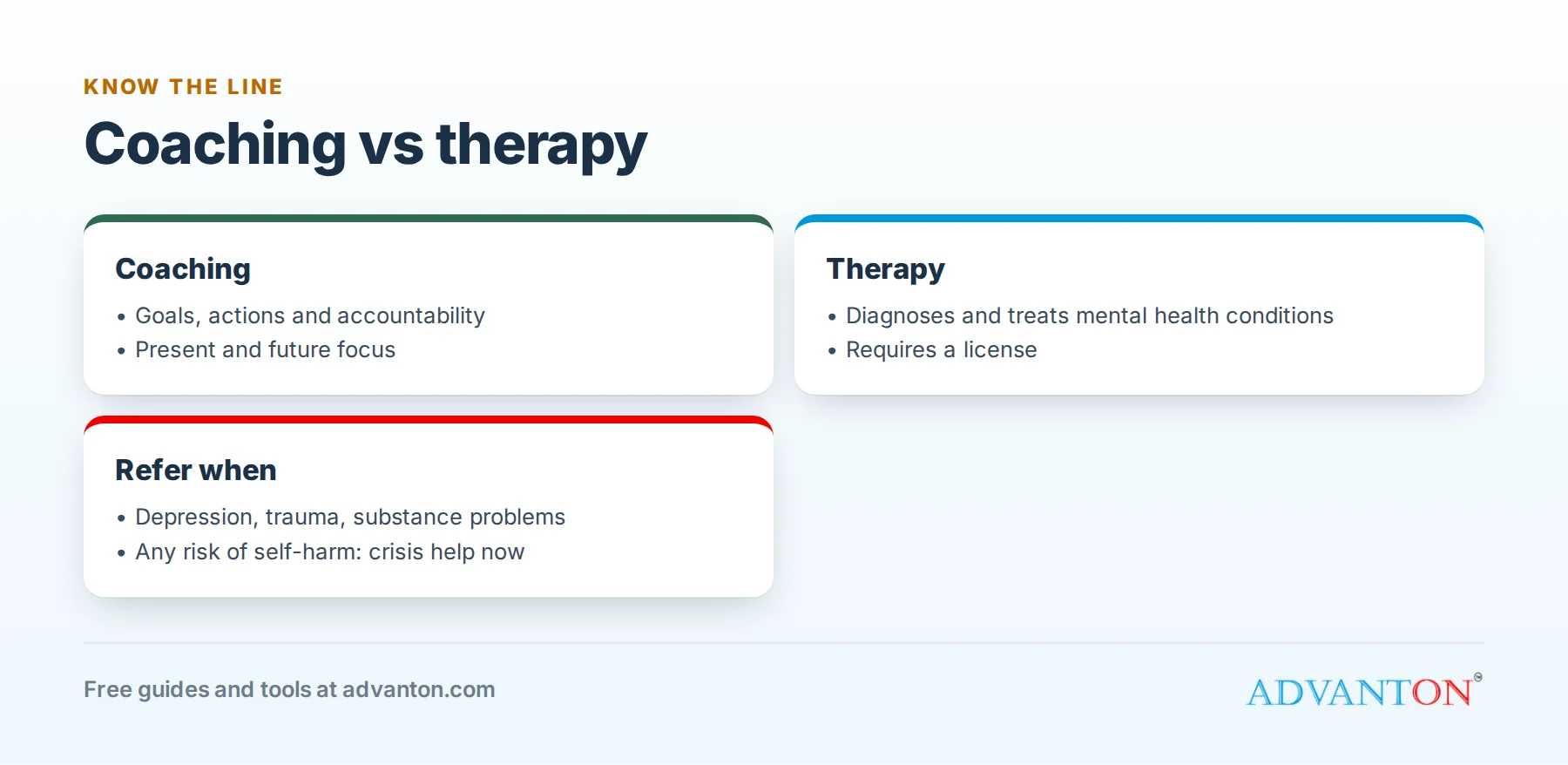
Coaching is not therapy
Coaching focuses on present and future goals and actions; therapy diagnoses and treats mental health conditions. Coaches should not diagnose, treat or claim to treat mental health conditions. Know the signs that a client needs professional help, such as severe depression, anxiety, trauma, substance problems or thoughts of self-harm, and refer them to a licensed mental health professional. In a crisis, direct them to emergency services or a crisis line. Put this boundary in your coaching agreement and on your website.
What to say when a client needs more
If a client’s needs go beyond coaching, be kind and direct: "What you’re describing sounds really hard, and I think you deserve support from someone trained in this. I’d like to help you find a counselor or therapist. We can pause our coaching or continue alongside that support, whichever feels right." Have a list of local and online resources ready, and in an emergency, direct them to emergency services or a crisis line right away.
Your coaching agreement
A written agreement should cover:
- What coaching is and isn’t, including the referral policy.
- Session schedule, length and format.
- Fees, payment terms and refunds.
- Cancellation and rescheduling.
- Confidentiality and its limits.
- Client responsibility for decisions and results.
Packages and pricing
Single sessions rarely produce results; packages do. Common structures:
- Three-month programs with weekly or biweekly sessions.
- Monthly coaching with two to four sessions and support between sessions.
- Intensive days for focused planning.
- Group programs at a lower price per person.
Prices vary widely by niche, experience and results. Use our pricing calculator to set rates that cover your time, admin, marketing and taxes.
A sample 12-week program
| Weeks | Focus |
|---|---|
| 1 to 2 | Clarify goals, values and what success looks like |
| 3 to 4 | Identify obstacles, strengths and resources |
| 5 to 8 | Action steps, habits and accountability |
| 9 to 10 | Review progress and adjust the plan |
| 11 to 12 | Build lasting routines and plan the next stage |
A session structure
- Check in: wins and challenges since the last session.
- Focus: the client chooses the most important topic.
- Explore: questions that help the client think clearly.
- Commit: specific actions before the next session.
- Wrap up: summarize commitments in writing.
An example package list
| Package | Includes | Example price |
|---|---|---|
| Focus session | One 90-minute planning session | $250 |
| Three-month program | Biweekly sessions plus messaging support | $1,200 |
| Monthly coaching | Two sessions a month | $400 a month |
| Group program | Six weekly group sessions | $350 per person |
These prices are illustrative.
A worked example: a solo coach
These figures are illustrative.
| Income | Amount |
|---|---|
| 12 clients × $400 a month | $4,800 |
| One workshop | $1,200 |
| Total income | $6,000 |
| Costs | Amount |
|---|---|
| Software and video tools | $100 |
| Marketing | $400 |
| Training and supervision | $150 |
| Insurance | $40 |
| Payment processing | $180 |
| Total costs | $870 |
Profit before taxes: $5,130. Remember to set money aside for self-employment and income taxes, and to count marketing and admin time when judging your hourly earnings.
Discovery calls
A free, short discovery call lets potential clients understand how you work and whether you’re a good fit. Ask about their goals and obstacles, explain your process and packages, and invite them to start, without pressure. Not every caller is a fit, and referring someone elsewhere builds trust.
Group programs and workshops
Group coaching (six to twelve people working toward similar goals) reaches more people at lower prices and earns more per hour. Workshops for companies, associations and community groups also build your reputation and bring in one-to-one clients.
Finding clients
- Your network: former colleagues and contacts in your niche.
- Helpful content: articles, short videos or a newsletter answering your niche’s questions.
- Speaking: local groups, professional associations, libraries and online events.
- Partnerships with HR professionals, career counselors and business advisers.
- Testimonials and referrals from happy clients.
- A simple website with your niche, process, packages and a booking link; our website builder is free.
Honest marketing
Avoid promising specific results ("double your income in 90 days") that you can’t guarantee. Share real, permission-based testimonials and describe your process clearly. Honest marketing attracts clients who are ready to do the work.
Tools you’ll need
- Video calls and a quiet, professional space.
- Scheduling and payments with reminders.
- Simple notes and goal tracking.
- Contracts and e-signatures; see our free e-signature tools roundup.
Insurance
Professional liability insurance protects you if a client claims your coaching caused them harm or loss. Also consider general liability if you meet clients in person or run events. See how to get business insurance.
Track progress
Agree on measurable goals at the start, such as applications sent, a promotion conversation held, or a new routine kept for a month. Review them regularly, celebrate progress, and use clients’ results (with permission) to improve your programs and marketing.
Corporate coaching
Companies hire coaches for new managers, leadership development and teams. Corporate work often requires credentials, clear proposals, confidentiality agreements and progress reporting that respects coaching confidentiality. One corporate contract can provide several clients at once.
Build a referral network
Get to know local therapists, counselors, career counselors and financial planners. You’ll have trusted professionals to refer clients to when needs go beyond coaching, and they may refer clients who want goal-focused coaching to you.
Set healthy boundaries
Decide when you’re available, how clients can contact you between sessions, and how quickly you’ll reply. Put it in your agreement. Clear boundaries protect your energy and make your support feel reliable rather than unlimited and unpredictable.
Price by value, not just time
Clients pay for outcomes, such as a new job, a promotion, a confident decision or a healthier routine, rather than for hours. Price programs on the value of the change and the structure you provide, while making sure your rates cover the time you actually spend.
Keep developing
Strong coaches keep learning: continuing education, working with a mentor coach, peer supervision groups and getting coached themselves. Your growth shows up in your clients’ results.
Handle sensitive information carefully
Clients share personal details about work, relationships and health. Keep notes brief and secure, share nothing without permission, and explain confidentiality and its limits at the start.
Common mistakes to avoid
- No clear niche.
- Selling single sessions instead of programs.
- Crossing into therapy.
- Overpromising results.
- Inconsistent marketing.
Your first 90 days
- Days 1 to 30: choose your niche, complete or plan training, and write your agreement and referral policy.
- Days 31 to 60: design packages, launch your website and start sharing helpful content.
- Days 61 to 90: hold discovery calls, sign your first clients, and gather testimonials.
Frequently asked questions
Do I need a license to be a life coach?
Generally, no. Coaching is mostly unregulated, but you must not provide services that require a license, such as therapy.
Is certification worth it?
Accredited training improves skills and credibility, especially for corporate clients.
How many clients do I need?
It depends on your prices and income goals; many coaches aim for 10 to 20 regular clients.
Can I coach online?
Yes. Most coaching works well by video or phone.
Should I coach friends and family?
It’s usually better not to. Personal relationships make honest coaching difficult; refer them to a colleague instead.
When can I leave my job to coach full-time?
When steady coaching income covers your living costs for several months. See how to start a business while working full time.
How do I get my first clients?
Start with your network and niche: offer a few discounted founding-client spots in exchange for feedback and testimonials, then raise prices as your results, skills, confidence and reviews grow over your first year.
Keep learning
- How to start a nutrition coaching business
- How to start a business while working full time
- Pricing calculator
Last reviewed October 28, 2026. Startup costs are estimates; check local prices, licensing and tax rules before you commit money.


Leave a Reply