
Music lessons are one of the most rewarding small businesses: students often stay for years, families recommend teachers to friends, and recitals turn your studio into a community. Whether you teach piano from home, guitar in students’ homes, or run a studio with several teachers, a music lessons business can grow steadily with modest startup costs.
Music lessons at a glance
Table of Contents
| Instruments | Piano, guitar, voice, strings, drums, woodwinds and more |
| Formats | Private lessons, group classes, online lessons |
| Locations | Your home, students’ homes, a studio, or online |
| Startup costs | Low to moderate: instruments, studio space, software, insurance |
| Revenue | Monthly tuition, registration fees, recitals, workshops and camps |
Choose your format and location
| Location | Pros | Cons |
|---|---|---|
| Your home | Low cost, your instruments | Zoning, parking, privacy |
| Students’ homes | Convenient for families | Travel time limits lessons per day |
| A rented studio | Professional, room to grow | Rent and commitment |
| Online | Wide reach, flexible | Audio delays, harder for young beginners |
Many teachers start at home or online, then move to a studio as they add teachers.
Licensing, zoning and insurance
- Business registration and a local business license.
- Home occupation rules: check zoning if students come to your home, including parking and signs.
- Insurance: general liability (especially for visitors to your home or studio), professional liability, and coverage for instruments and equipment.
- Rental studios may require proof of insurance.
See business licenses and permits explained.
Safety with young students
- Background checks for you and any teachers.
- Open-door or visible lessons, with parents welcome to sit in or wait nearby.
- Professional communication through parents.
- Appropriate physical guidance: explain and ask before adjusting a student’s posture or hand position.
Put your safety practices in your studio policy and on your website.
Studio setup
- Instruments in good condition, tuned regularly.
- Music stands, a metronome and tuner, plus a small library of method books.
- Seating for waiting parents, if space allows.
- Recording tools to send students practice recordings.
- Scheduling and billing software with automatic payments.
Total your list with our startup cost calculator.
Pricing and tuition
Many studios charge monthly tuition rather than per lesson, based on lesson length (30, 45 or 60 minutes) and the number of lessons in a term. Monthly tuition gives predictable income and reduces missed lessons. Common additions:
- Registration fee each year.
- Recital fee to cover venue and costs.
- Sibling discounts.
- Group classes at a lower price per student.
Research local teachers and studios, and use our pricing calculator.
Group classes and early childhood music
Group classes for young children (singing, rhythm and simple instruments) introduce music early and feed future private students. Group piano, guitar or ukulele classes for older beginners cost families less and earn you more per hour. Keep groups small and age-appropriate, and use them as a path into private lessons.
Adult learners
Adults are a growing, loyal market: beginners fulfilling a lifelong goal, returning players and retirees. They often prefer daytime lessons, flexible scheduling and music they love. Offer adult beginner packages, adult group classes and informal performance evenings without the pressure of a formal recital.
Studio policies that protect you
| Policy | Example |
|---|---|
| Payment | Tuition due on the 1st, paid automatically |
| Missed lessons | Tuition reserves a weekly time; limited make-ups with notice |
| Teacher cancellations | Always made up or credited |
| Holidays and breaks | Published calendar for the year |
| Withdrawal | 30 days’ notice |
Send the policy at enrollment and ask families to sign it.
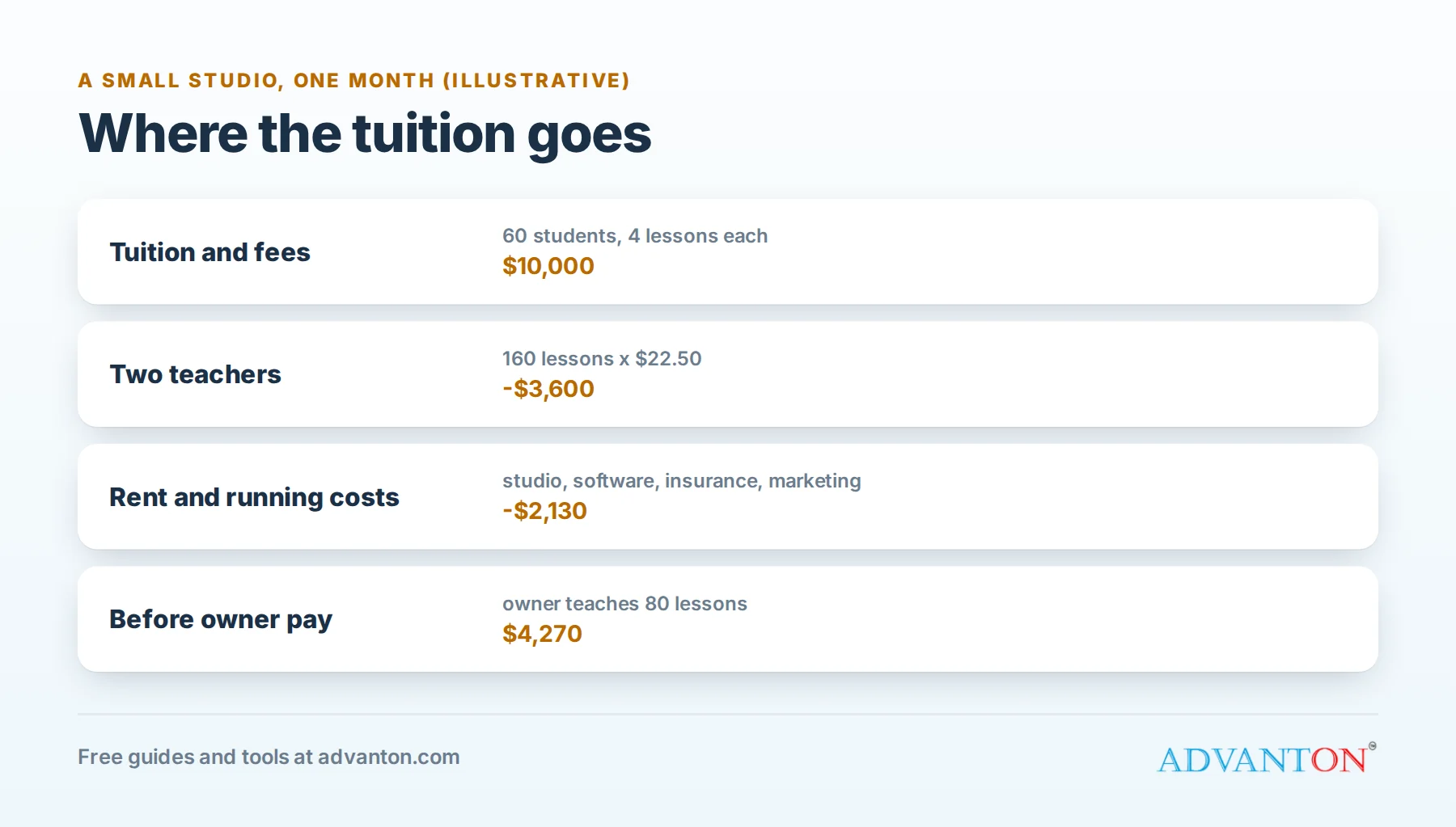
A worked example: a small studio with two teachers
These figures are illustrative.
| Revenue | Amount |
|---|---|
| 60 students × 4 lessons × $40 (30-minute lessons) | $9,600 |
| Recital and registration fees | $400 |
| Total revenue | $10,000 |
| Costs | Amount |
|---|---|
| Two teachers: 160 lessons × $22.50 | $3,600 |
| Studio rent | $1,500 |
| Instrument upkeep | $150 |
| Studio software | $80 |
| Insurance | $100 |
| Marketing | $300 |
| Total costs | $5,730 |
Profit before owner’s pay and taxes: $4,270, with the owner teaching the remaining 80 lessons a month and managing the studio. Summer often brings fewer lessons; summer camps and workshops help.
Supporting practice at home
Progress depends on practice between lessons. Give each student a short, specific practice plan, send recordings of tricky passages, and encourage parents to create a regular practice time. Practice charts and small rewards motivate younger students; adults benefit from realistic goals that fit busy schedules.
Online lesson tips
For online lessons, use an external microphone, turn on any "original sound" or music mode in your video software to reduce audio filtering, and position cameras so you can see hands and posture. Playing together in real time is difficult online because of delays, so use recordings and take turns instead.
Recitals build community
Recitals give students goals, show families progress, and attract new students through word of mouth. Hold them once or twice a year in a community hall, church or library. If you hold public performances, ask the venue about music licensing for copyrighted works. Celebrate every student, keep the program short, and take photos (with permission) for your website and social media.
Instrument rental partnerships
Families of beginners often don’t want to buy an instrument right away. Partner with a local music store that offers rental programs, keep a list of recommended starter instruments, and help families avoid poor-quality instruments that make learning frustrating. Some stores pay referral fees or offer discounts to your students.
Graded music exams
Many students enjoy working toward graded exams from established music examination boards, which provide structure, goals and certificates. Offer exam preparation as an option for students who want it, and keep it optional for those who simply want to play for enjoyment.
Studio software
Look for software that handles scheduling, automatic tuition billing, make-up lesson tracking, attendance, practice logs and family communication in one place. It saves hours of admin each month.
Hiring teachers
Look for strong musicianship, teaching experience and a warm manner with children. Observe a sample lesson, check references and run background checks. Agree on curriculum, policies, pay and scheduling in writing, and check worker classification rules (contractor or employee) with a professional.
Finding students
- Google Business Profile and reviews.
- Schools and music teachers, who often recommend private teachers.
- Music stores, which may offer lesson rooms or referrals.
- Community events, free trial lessons and "instrument petting zoos" for kids.
- Referral rewards for families.
- A website with instruments, teachers, prices and a booking form; our website builder is free.
Keeping students for years
- Help students choose music they love, alongside technical work.
- Set goals each term, such as a recital piece, an exam or a band audition.
- Celebrate progress with certificates or a practice rewards program; our free rewards program prints stamp cards.
- Communicate with parents about progress and practice.
Summer camps and workshops
Summer often brings vacations and fewer lessons. Fill the gap with short camps (beginner band, songwriting, rock band or musical theater), intensive workshops for exam preparation, and flexible summer lesson packages. Camps also introduce new families to your studio.
Track the health of your studio
Watch active students, retention from term to term, waitlist length, average tuition per student and where new families come from. A growing waitlist is a clear signal to add a teacher or open more lesson times; falling retention is a signal to check in with families and your teachers. Review these numbers each term.
Common mistakes to avoid
- Per-lesson billing that leads to constant cancellations.
- No written policies.
- Overbooking without breaks.
- Ignoring zoning for home studios.
- Neglecting adult learners, a growing and loyal market.
Your first 90 days
- Days 1 to 30: choose your location, check zoning, register your business, and write your policies.
- Days 31 to 60: set tuition, launch your website and Google Business Profile, and offer trial lessons.
- Days 61 to 90: enroll your first students, plan your first recital, and gather reviews.
Frequently asked questions
Do I need a music degree to teach lessons?
No, though training and performance experience build credibility. Strong teaching skills matter most.
Should I teach online?
Online lessons work well for many intermediate and adult students; young beginners often do better in person. See how to start an online tutoring business.
What age should students start?
It depends on the instrument and child; many teachers start piano around ages 5 to 7.
How do I handle missed lessons?
Monthly tuition with a clear make-up policy works best for most studios.
How long should lessons be?
Many young beginners start with 30-minute lessons; older and more advanced students often move to 45 or 60 minutes.
Can I teach several instruments?
Yes, if you can teach each one well. Many teachers start with their main instrument and add others, or hire specialist teachers, as the studio grows. Families appreciate a studio where siblings can learn different instruments at the same time, often in back-to-back slots on the same afternoon. That convenience is a strong reason families choose one studio over several separate teachers. Studios that offer flexible family scheduling often keep those families, and the friends they refer, for many happy years of weekly lessons.
Keep learning
Last reviewed October 28, 2026. Startup costs are estimates; check local prices, licensing and tax rules before you commit money.


Leave a Reply