
Mobile car detailing brings a deep clean, inside and out, to the customer’s driveway or office parking lot. It’s popular with busy professionals, families and car enthusiasts, and it’s one of the more affordable automotive businesses to start: no shop, a modest equipment list, and skills you can learn and perfect quickly.
The best detailing businesses don’t rely on one-off washes. They build recurring maintenance customers and sell high-value services like paint correction and ceramic coatings, which turns a weekend side hustle into a steady business.
Mobile detailing at a glance
Table of Contents
| Core services | Interior and exterior details, maintenance washes |
| High-value add-ons | Paint correction, ceramic coatings, headlight restoration, odor removal |
| Licensing | Business license; local rules on water runoff and working on private property |
| Startup costs | Low to moderate: vehicle, water tank, pressure washer, vacuums, products |
| Recurring revenue | Weekly, biweekly or monthly maintenance plans |
Services and packages
| Package | Typical contents |
|---|---|
| Maintenance wash | Exterior wash, wheels, quick interior vacuum and wipe-down |
| Full detail | Deep interior clean, shampoo, exterior wash, decontamination, wax or sealant |
| Interior only | Vacuum, shampoo, leather care, odor treatment |
| Paint correction | Machine polishing to remove swirls and scratches |
| Ceramic coating | Long-lasting protective coating, usually after correction |
Packages make choosing easy for customers and raise your average ticket.
A starter product list
- pH-neutral car shampoo and a rinseless wash product.
- Wheel and tire cleaner, plus tire dressing.
- All-purpose interior cleaner, fabric and carpet shampoo, and leather cleaner and conditioner.
- Glass cleaner safe for tinted windows.
- Clay bar or decontamination spray.
- Wax or spray sealant for protection.
- Plenty of microfiber towels, color-coded so wheel towels never touch paint.
Start with versatile products, then add specialty items as you learn what your customers’ cars need.
Pet hair and odors
Pet hair and odors are among the most common requests, and they take extra time. Use rubber brushes and pet hair tools, charge a clear add-on fee, and treat odors at the source (cleaning and extraction) rather than covering them with fragrance. Mention these add-ons when customers book, so there are no surprises.
Equipment and setup
- A vehicle: a van, truck or trailer with secure storage.
- Water supply: a water tank and pump, or waterless and rinseless products that use far less water.
- Power: a quiet generator or battery power if you can’t use the customer’s outlets.
- Pressure washer, foam cannon and buckets with grit guards.
- Vacuums, extractors and steamers for interiors.
- Polishers for paint correction (once trained).
- Quality towels and products, organized for quick setup.
Use our startup cost calculator to list everything before you buy.
Water runoff rules
Wash water carries soap, oil, brake dust and grime. In many places it’s illegal to let it run into storm drains, which flow to streams and lakes without treatment. Before you start, check your city’s stormwater rules and consider:
- Water containment mats that capture runoff for proper disposal.
- Rinseless and waterless washes, which avoid runoff almost entirely.
- Biodegradable products and careful chemical storage.
- Working on grass or gravel only where local rules allow.
Following runoff rules protects you from fines and makes a strong selling point for environmentally conscious customers.
Licensing and permission
- A business license where you operate, and any city permits for mobile services.
- Permission from property owners for offices, apartment complexes and HOAs.
- Sales tax where your state taxes detailing services.
See business licenses and permits explained.
Insurance
Detailers need general liability, garagekeepers coverage for damage to customers’ vehicles in your care, commercial auto for your work vehicle and tools and equipment coverage. Add workers’ comp when you hire. See how to get business insurance.
A full detail, step by step
- Walk around the car with the customer, noting scratches, stains and problem areas, and take before photos.
- Interior first: remove floor mats and trash, vacuum, then shampoo carpets and seats as needed.
- Clean hard surfaces, vents, door jambs and glass.
- Wheels and tires with dedicated brushes and products.
- Exterior wash with a pre-rinse or foam, then a careful hand wash.
- Decontaminate paint with a clay bar or chemical decontamination if included.
- Protect with wax, sealant or coating.
- Final inspection with the customer, and after photos for your portfolio.
A consistent process keeps quality high and helps you train helpers later.
An example price list
| Service | Sedan | SUV | Truck or van |
|---|---|---|---|
| Maintenance wash | $75 | $85 | $95 |
| Full detail | $200 | $225 | $250 |
| Interior only | $130 | $150 | $170 |
These are illustrative prices; research your local market and adjust for condition.
Pricing your services
- Price by vehicle size: sedans, SUVs and trucks or vans.
- Price by condition: pet hair, heavy stains and neglected paint take longer.
- Membership pricing: a discount for recurring maintenance washes keeps your calendar full.
- Premium services like correction and coatings priced by time and product cost.
Use our pricing calculator to make sure prices cover products, travel and your time.
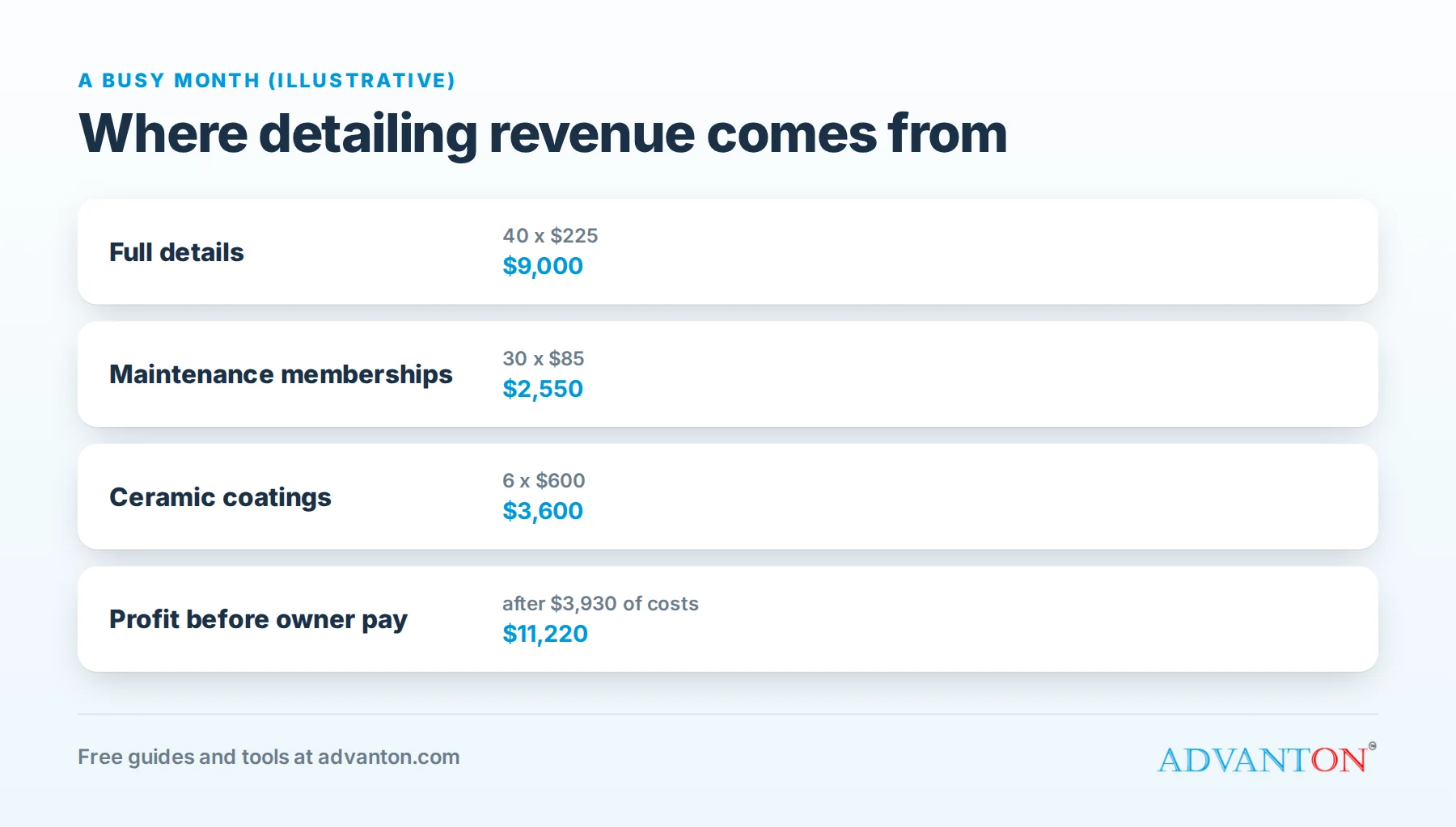
A worked example: a busy month
These figures are illustrative.
| Revenue | Amount |
|---|---|
| 40 full details × $225 | $9,000 |
| 30 maintenance washes × $85 | $2,550 |
| 6 ceramic coatings × $600 | $3,600 |
| Total revenue | $15,150 |
| Costs | Amount |
|---|---|
| Products and supplies | $1,100 |
| Fuel and vehicle costs | $700 |
| Water and generator costs | $200 |
| Insurance | $180 |
| Software and marketing | $450 |
| Helper, 60 hours × $20 plus payroll costs | $1,300 |
| Total costs | $3,930 |
Profit before owner’s pay and taxes: $11,220. Full details take several hours each, so watch your hours: the high-value coatings and steady memberships do the most to raise your earnings per hour.
Build recurring revenue
- Offer memberships: weekly, biweekly or monthly washes at a set price, billed automatically.
- Book the next visit before you leave.
- Reward loyalty: our free rewards program prints stamp cards (for example, a free interior after nine washes).
- Target offices and apartment complexes, where you can wash several cars in one stop.
Ceramic coatings: train first
Ceramic coatings are among the most profitable services, but mistakes are expensive: poor paint preparation or uneven application can leave visible defects. Take a hands-on training course, practice on your own or friends’ cars, and learn each product’s curing time and care instructions. Explain to customers what a coating does and doesn’t do, and give written care instructions.
Weather and scheduling
Rain, wind and direct sun affect detailing: products can dry too fast in heat, and exterior work is difficult in the rain. Carry a canopy for shade, schedule exterior-heavy jobs for mild parts of the day, offer interior-only work on rainy days, and tell customers your weather rescheduling policy when they book.
Finding customers
- Google Business Profile and reviews, with before-and-after photos.
- Before-and-after videos on social media; see our video editing tools roundup.
- Partnerships with car dealers, real estate agents (detailing before showings) and local businesses.
- Fleet and rental cars, such as company vehicles and short-term rental hosts’ cars.
- Gift certificates for holidays; our Brand & Print Studio makes them.
Growing your detailing business
As demand grows, hire and train a helper using your step-by-step process, add a second vehicle, and pursue fleet and dealership contracts for steady weekday volume. Memberships make growth predictable, because you know how many washes are booked each month before you hire.
Protect yourself with before photos
Take clear photos of every car before you start, especially existing scratches, dents and stains, and point them out to the customer. If a question comes up later about damage, your photos show what was already there. Store them in the customer’s folder with your notes and the after photos.
Keep your setup organized
Organize your vehicle so every product and tool has a fixed place, restock at the end of each day, and clean and wash your towels after every job. A tidy, well-stocked setup makes jobs faster and looks professional to customers watching you work.
Common mistakes to avoid
- Ignoring runoff rules.
- Underpricing large or very dirty vehicles.
- Selling coatings without proper training and paint preparation.
- No memberships, leaving income unpredictable.
- Scratching paint with dirty towels or poor technique, which costs more than any job pays.
Your first 90 days
- Days 1 to 30: check local runoff rules, register your business, get insured and buy core equipment.
- Days 31 to 60: practice on friends’ cars, build a portfolio of before-and-after photos, set packages and launch your Google Business Profile.
- Days 61 to 90: start booking paid work, offer memberships, and ask every customer for a review.
Frequently asked questions
Do I need a water tank?
Not always. Rinseless and waterless methods work for many maintenance washes, but a tank helps for heavily soiled cars where rules allow.
How long does a full detail take?
Often several hours, depending on vehicle size and condition.
Are ceramic coatings worth offering?
Yes, once you’re trained, because they’re high-value, but they require careful paint preparation.
How many cars can I detail in a day?
Usually two or three full details, or more maintenance washes, depending on vehicle size, condition and travel time.
Can I start part-time?
Yes. Many detailers start on evenings and weekends, building memberships and reviews before going full time.
Keep learning
Last reviewed October 28, 2026. Startup costs are estimates; check local prices, licensing and tax rules before you commit money.


Leave a Reply