
Busy families want a nanny they can trust, and finding one on their own takes time, judgment and a lot of interviews. A nanny agency solves that: it recruits and screens caregivers, matches them with families, and supports both sides after placement. Done well, it’s a relationship business built on trust, with relatively low startup costs and strong word of mouth.
It’s also a serious responsibility. You’re helping families choose someone to care for their children, so thorough screening, honest communication and clear contracts are the foundation of the business.
Nanny agency at a glance
Table of Contents
| What you do | Recruit, screen and match nannies with families; support placements |
| Business models | Placement (families employ the nanny) or employer of record (the agency employs the nanny) |
| Licensing | Some states and cities license employment or placement agencies |
| Startup costs | Low to moderate: screening, software, insurance, marketing |
| Revenue | Placement fees, temporary care commissions, add-on services |
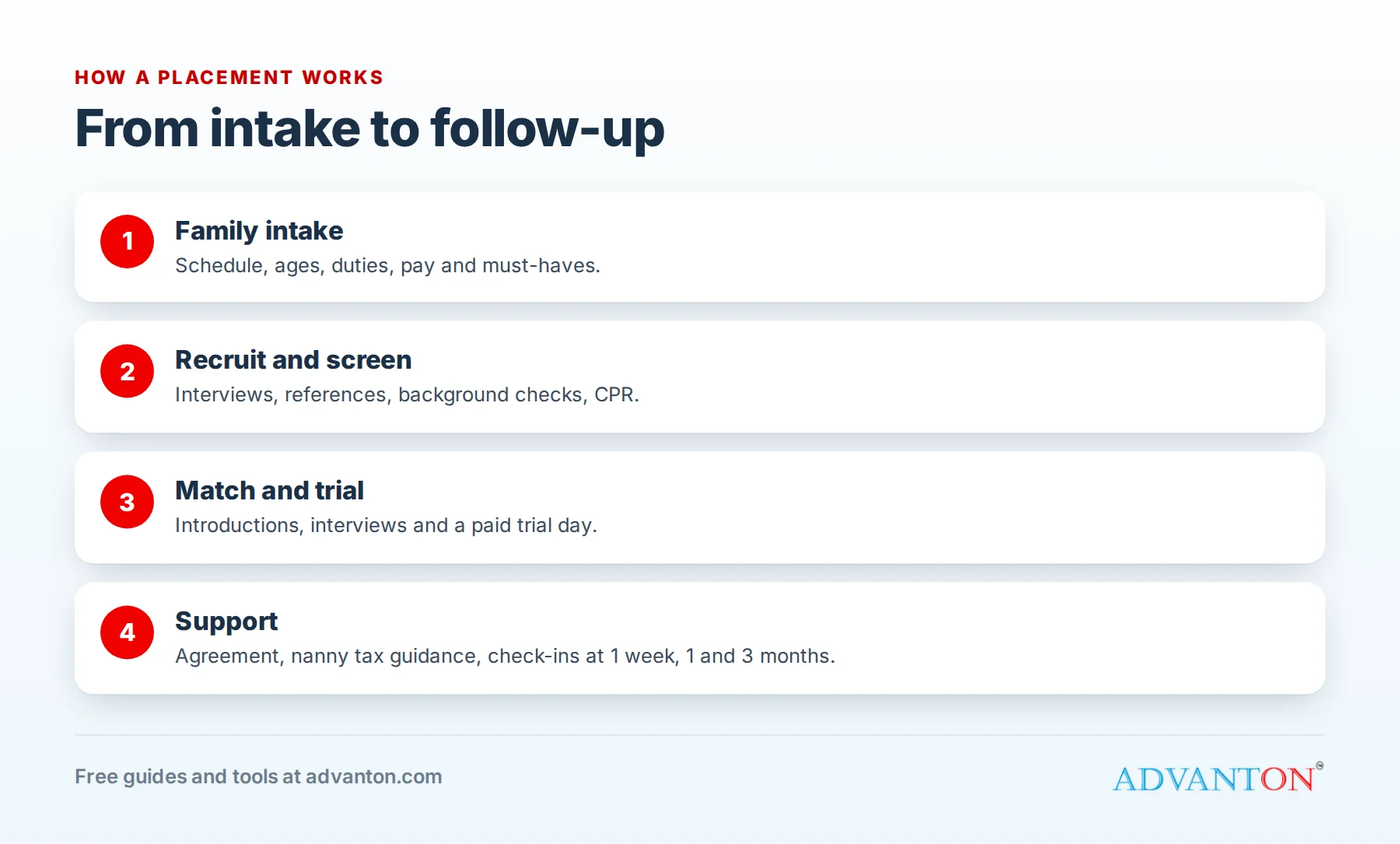
Choose your business model
1. Placement agency (most common). You find and screen candidates, introduce them to families, and charge a fee when a family hires. The family becomes the employer, responsible for wages, taxes and following employment laws. Your role ends with the placement, apart from support and any replacement guarantee.
2. Employer of record. The agency employs the nannies, handles payroll, taxes and insurance, and bills families for care. It’s more complex and capital-intensive, but it creates ongoing revenue and removes the paperwork for families.
3. Temporary and backup care. Short-term, date-night and backup nannies, often billed hourly with an agency commission. Many agencies combine this with full-time placement.
Start with the model you can run well; many agencies begin with placement and add temporary care later.
Licensing and legal basics
- Employment agency licensing: some states and cities require placement or employment agencies to be licensed or registered, sometimes with fee limits, bonds or required contract terms. Check your state labor department and your city.
- Business registration and a local business license.
- Background check rules: follow federal and state laws on consumer reports, including candidates’ written consent and the required notices if you take action based on a report.
- Fair hiring laws: treat candidates fairly and consistently, and follow anti-discrimination rules.
- Contracts: clear written agreements with families and candidates.
An employment attorney can review your agreements and confirm local requirements, which is money well spent before your first placement.
Screening: the heart of your business
A thorough, consistent screening process is what families pay for:
- Application and interview, including experience with different ages and situations.
- Reference checks, speaking directly to previous families.
- Background checks with written consent: criminal history, sex offender registries and driving records for nannies who drive.
- Identity and work eligibility verification.
- Certifications: CPR and first aid, ideally infant and child specific.
- Trial days with the family before a final decision, often paid.
Document every step. If something goes wrong later, your records show what you checked.
Nanny taxes: what families need to know
Families who hire a nanny through a placement agency usually become household employers. For 2026, if a family pays a household employee $3,000 or more in cash wages during the year (up from $2,800 in 2025), they owe Social Security and Medicare taxes, split between employer and employee. Federal unemployment tax applies when a family pays $1,000 or more in a calendar quarter, and state taxes and workers’ comp rules may apply too.
Agencies that explain these rules, and recommend a household payroll service, help families stay legal and protect nannies’ benefits. Many agencies make this part of their service.
Pricing your services
- Placement fee: often a flat fee or a percentage of the nanny’s expected first-year pay, charged when a family hires. Research local agencies to set a competitive fee.
- Registration or search fee: some agencies charge families a smaller up-front fee, credited toward the placement fee.
- Replacement guarantee: a free replacement if a placement ends within an agreed period; it’s a strong selling point.
- Temporary care: an hourly rate to the family, with a share kept by the agency.
A worked example: a small agency’s month
These figures are illustrative.
| Revenue | Amount |
|---|---|
| 3 full-time placements × $4,000 fee | $12,000 |
| Temporary and date-night care (agency share) | $1,800 |
| Total revenue | $13,800 |
| Costs | Amount |
|---|---|
| Background checks and screening (12 candidates × $90) | $1,080 |
| Marketing and job ads | $1,200 |
| Software and phone | $250 |
| Insurance | $300 |
| Part-time assistant | $1,800 |
| Total costs | $4,630 |
Profit before owner’s pay and taxes: $9,170. Placements vary from month to month, so plan with a cash flow forecast and build a steady base of temporary care.
How temporary care pricing works
For temporary and date-night care, many agencies charge families an hourly rate and pay the caregiver most of it, keeping the difference to cover screening, booking and support. For example, if a family pays $32 an hour and the caregiver receives $25, the agency keeps $7 for each hour booked. A steady stream of bookings smooths out months with few full-time placements.
Software that keeps you organized
An applicant tracking or agency management system keeps candidate files, screening results, family profiles and placements in one place, with reminders for follow-ups and certification renewals. A secure, organized record of every screening step also protects you if a placement is ever questioned.
Insurance to consider
- General liability.
- Professional liability (errors and omissions) for claims about your matching and screening.
- Abuse and molestation coverage, often essential for childcare-related businesses.
- Workers’ compensation and employment practices liability if you employ nannies or staff.
Ask an agent who works with staffing or childcare businesses. See how to get business insurance.
Recruiting great nannies
- Pay attention to candidate experience: respond quickly and treat candidates as clients too.
- Recruit from early childhood education programs, childcare centers and nanny communities.
- Offer ongoing value: training, certifications and help negotiating fair pay and written agreements.
- Ask your best nannies for referrals.
Winning families
- A professional website that explains your screening process in detail. Families want to know exactly how candidates are vetted.
- Google Business Profile and reviews from placed families.
- Partnerships with pediatricians, obstetricians, parenting groups, schools and relocation companies.
- Clear pricing and a simple intake process.
Support after placement
- Check in after the first week, the first month and the third month.
- Help resolve problems early, before they end placements.
- Provide templates for a written family-nanny agreement covering hours, pay, duties, time off and expectations.
A family-nanny agreement checklist
Encourage every family and nanny to sign a written agreement covering:
| Topic | What to agree |
|---|---|
| Schedule | Regular hours, overtime and how changes are handled |
| Pay | Hourly rate or salary, overtime, pay dates, raises and legal payroll |
| Duties | Childcare, driving, meals, light housework, homework help |
| Time off | Paid holidays, vacation, sick days and notice periods |
| House rules | Screen time, food, discipline approach, visitors, phone use |
| Driving | Whose car, insurance, mileage reimbursement |
| Ending the arrangement | Notice period and severance, if any |
Clear agreements prevent most of the disputes that end placements early.
Growing into specialized placements
As your agency builds a reputation, consider adding specialized roles that families pay more for: newborn care specialists, nannies experienced with twins or children with additional needs, bilingual nannies, household managers and family assistants. Each needs its own screening criteria, but they deepen relationships with families and raise your average fee.
Common mistakes to avoid
- Cutting corners on screening.
- Unclear contracts about fees, guarantees and responsibilities.
- Ignoring licensing rules for employment agencies.
- Not explaining nanny taxes, leaving families and nannies exposed.
- Treating nannies as a commodity rather than partners.
Your first 90 days
- Days 1 to 30: confirm licensing, register your business, get insured, and have an attorney review your contracts.
- Days 31 to 60: build your screening process and candidate pool, and launch a website with our free website builder.
- Days 61 to 90: make your first placements, collect reviews and build referral partnerships.
Frequently asked questions
Do I need childcare experience to start a nanny agency?
It helps enormously. Families trust owners who understand children and caregiving, and experience improves your matching.
Who employs the nanny?
In a placement agency, the family. In an employer-of-record agency, the agency.
How long does a placement take?
Often a few weeks, depending on the family’s needs, the local market and how many candidates you already have.
Can I run a nanny agency from home?
Yes, many do, meeting candidates and families virtually or in public spaces, provided local rules allow it.
What if a placement doesn’t work out?
Most agencies offer a replacement guarantee for a set period. Define it clearly in your contract, including what happens if the family or nanny ends the arrangement early.
How do I compete with online babysitting platforms?
Platforms list caregivers; agencies vet and match them. Emphasize your in-depth screening, personal matching, replacement guarantee and ongoing support, which busy families value for long-term care. Your reviews, referrals and website should all tell that story clearly and consistently, in families’ own words.
Keep learning
Sources
- GTM Payroll Services, 2026 nanny tax threshold
- Mondaq, Hiring household employees: practical steps for families (2026)
Last reviewed October 28, 2026. Startup costs are estimates; check local prices, licensing and tax rules before you commit money.


Leave a Reply